Import Duties From China to the USA: Who Pays Customs Fees Before Cargo Ships?
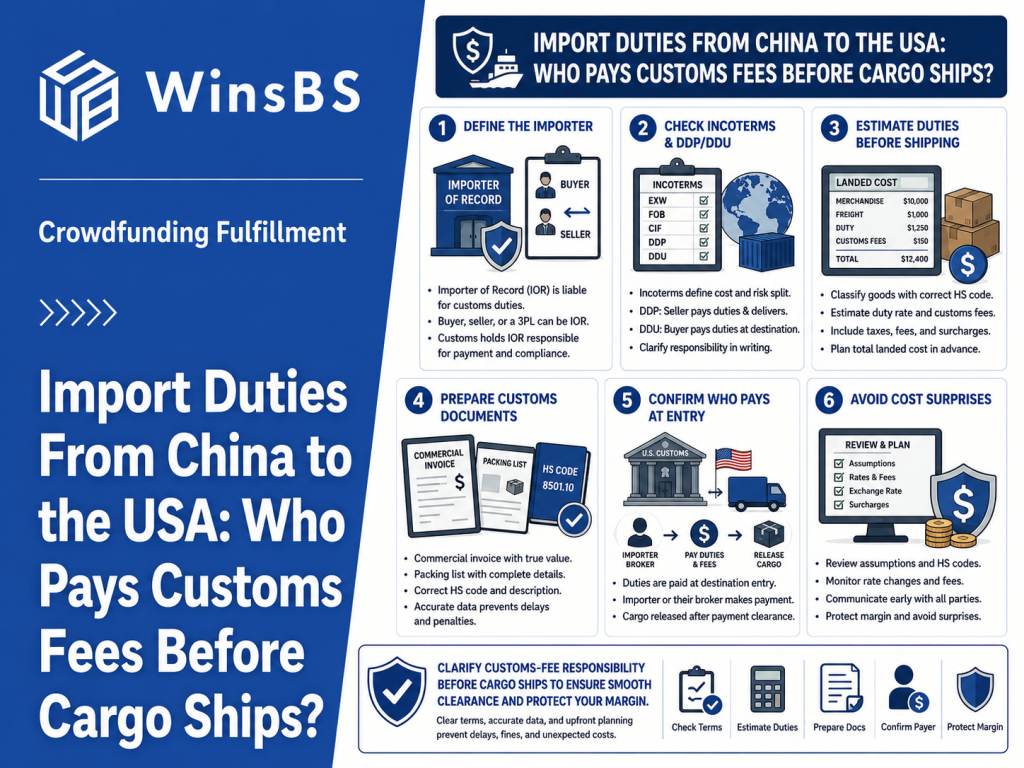
WinsBS / Import costs from China to the U.S. Import Duties From China to the USA: Who Pays Customs Fees, and When Should That Be Clear? For China-to-U.S. shipments, the first question is not whether a warehouse can receive the cargo. It is who will clear the goods into the U.S. and who gets the bill if customs stops the shipment. When that part is still fuzzy, the problem stops looking like paperwork. It turns into extra duty, exam fees, daily demurrage, launch delays, and angry customer messages asking where the inventory went. Where the U.S. import problem starts The warehouse usually sees the cargo after customs release. It is not where this problem begins. China pickup and export docs The invoice, packing list, and product details have to be right before the cargo moves. Ocean booking and filing Carrier filings and pre-arrival data have to match the real shipment. IOR, broker, and bond Someone on the U.S. side has to be named to clear the goods and work with the broker. HTS, value, origin, and duty bill The product code, declared value, and origin decide how much the import bill will be. Arrival, exam, and release risk If customs or the port stops the cargo here, the bill can snowball before the warehouse ever sees it. Release, drayage, and warehouse receipt Only after release can the cargo move to the warehouse the way the original plan expected. If these answers are still loose, the first damage shows up as extra bills and delay long before the warehouse can help. The cheapest time to fix this is before the cargo leaves China. If a quote says DDP but nobody can explain who clears customs and who pays surprise port bills, the risky part of the shipment is still open. Quick Answer Before cargo leaves China, someone has to own the U.S. customs job and someone has to own the bills if that job goes wrong. If that is still fuzzy at departure, the bill can jump fast: a single exam event can add roughly $500 to $2,000+, and demurrage can climb to about $150 to $400+ per container, per day, once free time expires. That means naming the Importer of Record, the broker, the bond or filing authority, the HTS code, the declared value, the country of origin, and who pays duty, Section 301, MPF, HMF, exam bills, demurrage, storage, and drayage if they show up. A DDP quote may sound reassuring, but it still does not prove the customs side is ready. The warehouse usually gets the cargo after release. It is not the automatic backup payer when the customs side was never settled. Start With Customs, Not The Warehouse If the first serious question in your shipment plan is still “Can the warehouse receive this?”, you are looking too late in the process. The real question is who will clear the goods into the U.S. and who will answer when customs asks for more money or more documents. The warehouse cannot solve that part for you. If the importer, broker, or paperwork is wrong, the cargo can still stop at the port even when the warehouse is fully ready to receive it. That is why WinsBS starts from the China side. We check the invoice, material list, HTS assumptions, and labels at the factory floor in China, because it is far cheaper to catch a mistake there than after the ship arrives and the port clock starts running. The warehouse enters the story later, after release. It does not magically become the importer or the duty payer just because it is waiting for the truck. Where This Problem Usually Hits In A China-To-U.S. Ocean Shipment On a real ocean shipment, the import-cost problem shows up in the middle of the U.S. release process, not at the very end. China pickup and export documentation Ocean booking and carrier filing Pre-arrival filing and ISF readiness U.S. arrival, entry, and entry-summary work Duty, MPF, HMF, and additional-duty calculation Exam, hold, demurrage, detention, or storage if triggered Release, drayage, and inland transfer Warehouse receipt after cargo is cleared If duty, broker, and port costs are still unclear here, the warehouse cannot clean that up later. By then the shipment is already in the expensive part of the route. Debunking The Search Terms: Import Duties vs. Import Tax vs. Customs Fees People search these three phrases as if they mean the same thing. On a real U.S. shipment, they do not. Search phrase What the term usually points to Where the bill usually lands Import duties Usually customs duty under the HTS classification, and sometimes additional duties such as Section 301. Usually on the U.S. import side, often through the Importer of Record, unless the seller is clearly absorbing that bill under a DDP structure. Import tax Many U.S. buyers use this loosely when they mean duty or other government entry charges. It is search language, not a precise U.S. import term like VAT. The bill still has to sit with either the U.S. importer or the seller under the agreed trade term. A warehouse does not become the payer just because it receives the goods. Customs fees This is the most misleading phrase because it may refer to MPF or HMF, broker fees, exam costs, demurrage, detention, storage, or other extra charges, even though those are not all the same kind of bill. The payer depends on the exact charge. Government fees, broker service fees, carrier or terminal charges, and warehouse charges need to be separated before anyone says a quote “includes customs fees.” In plain English: the Importer of Record is the name tied to the customs entry. The broker files it. The forwarder moves the freight and may re-bill charges. The warehouse usually sees the cargo only after customs release. One caution: the final payer still depends on the country rules, the contract, and the names actually used on the shipment. When Someone Says “Customs Fees,” Ask Which Bill