
Region-Friendly Shipping for Kickstarter Board Games in 2026: When DDP Beats Surprise Duties
A core strategy guide for tabletop creators deciding when DDP, surcharge timing, and landed-cost control protect backer trust better than pushing duty friction downstream.
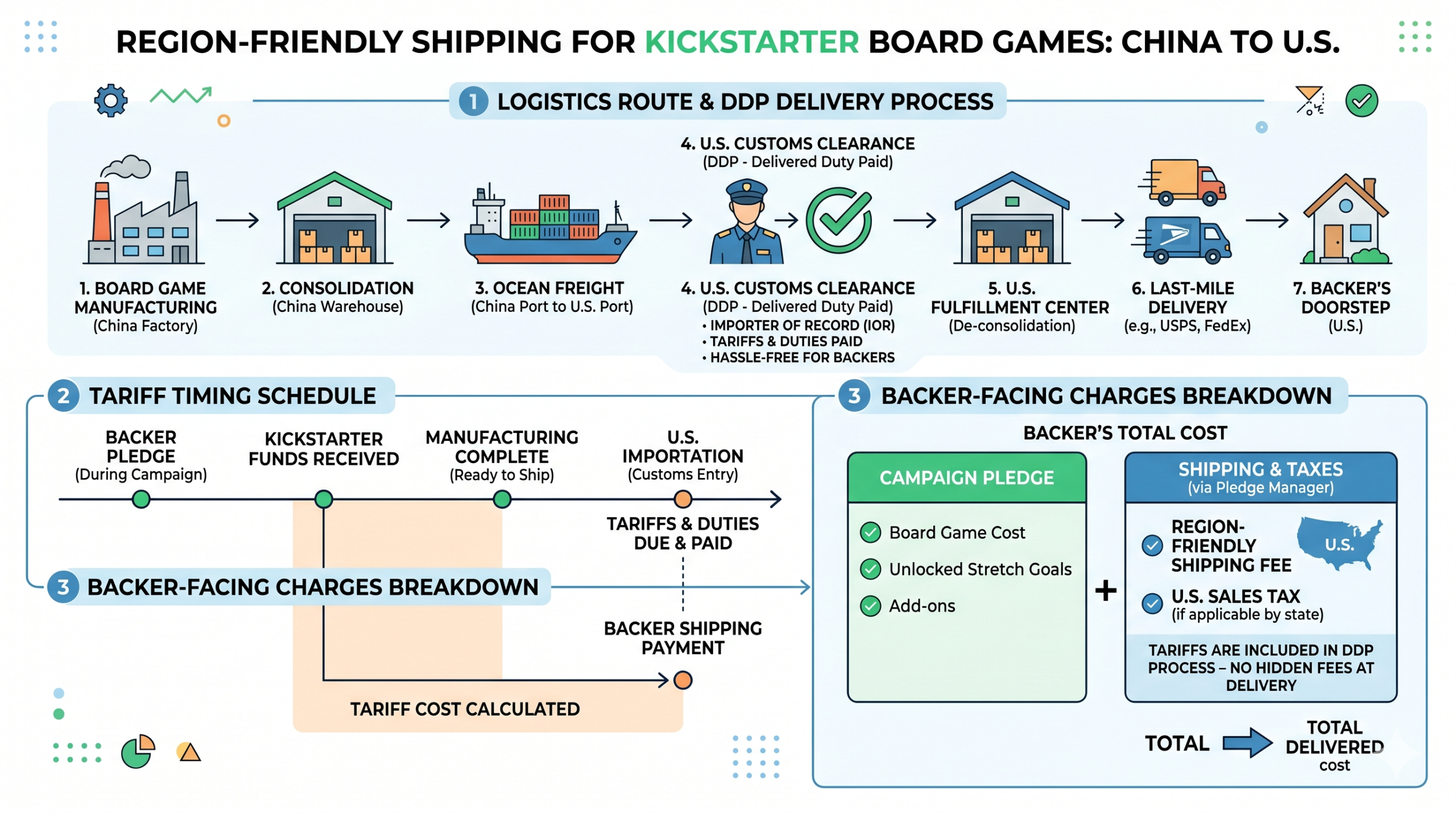
Region-friendly shipping makes sense when backer trust matters more than the apparent savings from pushing duties and surprise charges downstream. If your board game is made in China and shipping into the U.S., the decision comes down to a few practical questions. Can DDP (Delivered Duty Paid) work for this shipment? Are tariff exposure, carton weight, and import timing stable enough to price cleanly? Can you tell backers the final number before frustration starts? If those answers are still moving, a region-friendly promise usually turns into a support problem instead of a fulfillment advantage.
The Bottom Line
The bottom line: Region-friendly shipping is not just a delivery slogan. It is a decision about who deals with duty friction first: your campaign team or your backers.
Why This Issue Changes the Fulfillment Decision
Region-friendly shipping changes the fulfillment decision because it is really about buyer experience, not parcel delivery. You are not only deciding how the game arrives. You are deciding where duties, tariff friction, and landed-cost uncertainty show up. They can stay inside your operating model, or they can show up in front of the backer at checkout or delivery. In practice, that means building a complete China-to-U.S. Kickstarter shipping cost model before you promise a cleaner, more local-feeling delivery experience.
For tabletop campaigns, that matters more than many teams expect. Backers do not experience tariff strategy as a spreadsheet choice. They feel it when the project suddenly looks less predictable, when support messages spike after import, or when the original shipping promise no longer feels fully honest.
Key takeaway: Region-friendly shipping is valuable when it removes buyer-side friction earlier than a support team can realistically clean it up later.
Why China-US Execution Makes This Harder
This issue gets harder under China-to-U.S. fulfillment because the backer-facing promise depends on choices that may still be moving before import. Carton weights can change. Freight timing can move. DDP can look workable at first, then stop working once Section 301 exposure, HTS codes, HS classification, or the need for a U.S. Importer of Record (IOR) changes the landed-cost math. A surcharge can also look safer on paper, then become a trust problem when the extra payment request lands too late.
The technical details matter more than they look. Merchandise Processing Fee (MPF), duty-inclusive parcel assumptions, importer responsibility, and classification accuracy all affect whether a region-friendly promise is truly fundable. If those details are treated like customs fine print, the campaign is not really managing landed cost. It is pushing the problem downstream and hoping the backer will absorb it.
A U.S. warehouse can move parcels quickly after receipt, but it cannot fix a broken import model. If the landed-cost logic is wrong, faster shipping just delivers the wrong buyer experience more efficiently. That is why WinsBS treats region-friendly shipping as an execution decision tied to China-origin prep, import timing, and landed-cost review before the promise is made.
Key takeaway: If tariff and duty logic is still unstable before import, a region-friendly promise is still an execution risk, not a marketing advantage.
Core Decision Variables
The right region-friendly model depends on whether landed-cost uncertainty can be absorbed before the backer sees it. That depends on a handful of variables that should be locked before the campaign hardens its shipping promise.
| Variable | What Creators Often Assume | What Actually Changes The Outcome | What WinsBS Needs To Lock |
|---|---|---|---|
| DDP feasibility | DDP is simply the cleaner option | Import timing, tariff exposure, classification, and landed-cost confidence | Whether duty-inclusive delivery can be supported without margin drift |
| Tariff exposure | A surcharge can always be passed through later | Backer tolerance, U.S.-address limits, checkout friction, and campaign timing | Whether surcharge logic protects or damages trust |
| Carton weight | Duties are mostly a customs issue | Weight, dimensional changes, and landed-cost sensitivity across the shipment | Final carton truth before import math hardens |
| Backer communication timing | The message can be fixed later | When the fee is shown, how much explanation is needed, and whether the project already promised a cleaner experience | When the campaign should ask for money and how much confidence is behind the ask |
| Warehouse placement | The U.S. warehouse only affects speed | Import handoff, duty model, domestic parcel experience, and exception handling | Where inventory lands after import and what the warehouse is expected to solve |
Decision Snapshot
For the broader cost picture behind this decision, start with the full China-to-U.S. Kickstarter shipping cost model before choosing DDP, surcharge timing, or a region-friendly promise.
The Multi-Hub Myth vs. China-Origin DDP Planning
Many creators assume region-friendly shipping means sending inventory to separate 3PLs in the U.S., EU, and Australia. Sometimes that works. Often it creates a second problem: duplicate inventory buffers, more handoff points, and multiple LCL or inbound minimums before the first backer order even ships.
For many mid-sized tabletop campaigns, China-origin DDP planning is cleaner. If HTS classification, Importer of Record responsibility, Section 301 exposure, and landed-cost math are locked before import, WinsBS can help create a more local-feeling delivery experience without forcing the project to stage inventory across several continents just to sound region-friendly.
Common Misreads
Misread 1: Region-Friendly Means Cheap
Region-friendly shipping is not valuable because it is always cheaper. It is valuable when a cleaner landed-cost experience is worth more than asking the backer to deal with duty friction later.
Misread 2: DDP Is Always Safer
DDP is safer only when landed-cost assumptions are stable enough to support a duty-inclusive promise. If import timing, tariff exposure, or carton truth are still moving, DDP can create its own margin problem.
Misread 3: Tariff Surcharges Are Just A Checkout Detail
A surcharge is part of the trust model. If the campaign asks for extra money too late or without enough clarity, most backers experience that as fulfillment failure, not policy complexity.
Misread 4: A U.S. Warehouse Can Fix It Later
A U.S. warehouse can ship parcels after import, but it cannot cheaply repair a weak region-friendly promise once the duty model, timing, and backer expectations are already misaligned.
Misread 5: Small Campaigns Need A Full Multi-Continent Network
Smaller campaigns do not always need a sprawling warehouse map to create a cleaner buyer experience. Some simply need earlier DDP review, cleaner China-origin prep, and a more disciplined import model.
Bottom line: Region-friendly shipping fails when the promise is made like a marketing claim but funded like an unresolved landed-cost question.
Recommendation
Use region-friendly shipping when the campaign needs to protect backer trust from duty surprise and can actually support that promise with real landed-cost control. In practice, that usually means China-origin carton truth, import timing, DDP or surcharge logic, and U.S. warehouse placement have already been reviewed together before backers are asked to rely on the message.
Use surcharge collection more cautiously when the project still has unstable weights, tariff exposure, or import timing and needs one last round of clarity before the final ask. Even then, the plan should protect trust first. It should not depend on the backer quietly absorbing uncertainty later.
What WinsBS Actually Locks Before A Region-Friendly Promise Is Made
- China-origin carton truth: final weights, packaging assumptions, and add-on impact are checked before landed-cost math hardens.
- Tariff and DDP logic: import exposure, DDP feasibility, and surcharge timing are reviewed before the message reaches the backer.
- Freight timing: route timing and import schedule are aligned with the promised buyer experience.
- Warehouse handoff: the U.S. warehouse receives inventory for clean domestic execution, not tariff confusion that should have been solved earlier.
- Backer communication timing: the project decides when the final number becomes trustworthy enough to show.
- Smaller-campaign fit: the team can evaluate whether a cleaner duty experience is possible without overbuilding a multi-region network.
Where WinsBS fits: A generic warehouse starts after import. WinsBS starts earlier, while the campaign can still decide whether the backer experience will feel region-friendly or tariff-friction-heavy.
For the operational choice itself, the next step is to compare BackerKit shipping fees against DDP for China-made board games before the campaign locks its final import and fee logic.
FAQ
What does region-friendly shipping mean for a Kickstarter board game?
Region-friendly shipping means the backer gets a cleaner delivery experience with less duty surprise and less cross-border friction. In practice, that usually requires earlier landed-cost control, not just faster parcel delivery.
When is DDP better than charging a tariff surcharge later?
DDP is better when landed-cost assumptions are stable enough to support a duty-inclusive promise and the campaign wants to reduce buyer friction. A tariff surcharge is safer when import exposure is still moving and the creator needs one last round of clarity closer to import.
Can a smaller Kickstarter campaign still offer a cleaner duty experience?
Yes, if the campaign reviews DDP feasibility, China-origin prep, landed-cost sensitivity, and import timing early enough. A smaller project does not always need a multi-continent inventory network to feel more region-friendly.
What should be final before a region-friendly promise is made?
Before making the promise, creators should have final carton weights, tariff or DDP logic, freight timing, warehouse placement, and backer-facing charge timing reviewed together. If those inputs are still unstable, the promise is still risky.
Does a U.S. warehouse solve duty confusion after import?
No. A U.S. warehouse can execute domestic parcel fulfillment after import, but it cannot cheaply repair a weak landed-cost promise once the backer already expects a cleaner experience.
Methodology
This article was built from Stonemaier Games' shipping and fulfillment hub, BackerKit tariff manager guidance, Kickstarter tariff surcharge guidance, and WinsBS operational judgment around China-origin prep, import timing, DDP review, surcharge timing, and U.S. warehouse handoff. It does not claim that DDP is always better or that a region-friendly promise can be made without landed-cost discipline.
What To Do Next
Before you promise region-friendly shipping, test whether the landed-cost model is stable enough to protect the buyer experience. This is not about whether the phrase sounds better on the campaign page. It is about whether the import model, tariff logic, and backer-facing charge timing will still hold up once the real shipment starts moving.
Review the decision in this order:
- Final carton weight and dimensional sensitivity
- Tariff exposure and DDP feasibility
- Freight route and import timing
- Backer-facing charge timing
- U.S. warehouse handoff after import
- Whether the campaign needs a cleaner duty experience or just a later surcharge
If those inputs are still moving, go back to the full Kickstarter shipping cost model for heavy board games first, then compare DDP against backer-facing tariff surcharges before the campaign locks its promise.