
BackerKit Shipping Fees vs DDP For China-Made Board Games in 2026: Which Model Protects Margin and Backer Trust?
A comparison for tabletop creators deciding whether shipping and tariff uncertainty should stay flexible inside the pledge manager or be locked earlier in the China-to-U.S. landed-cost model.
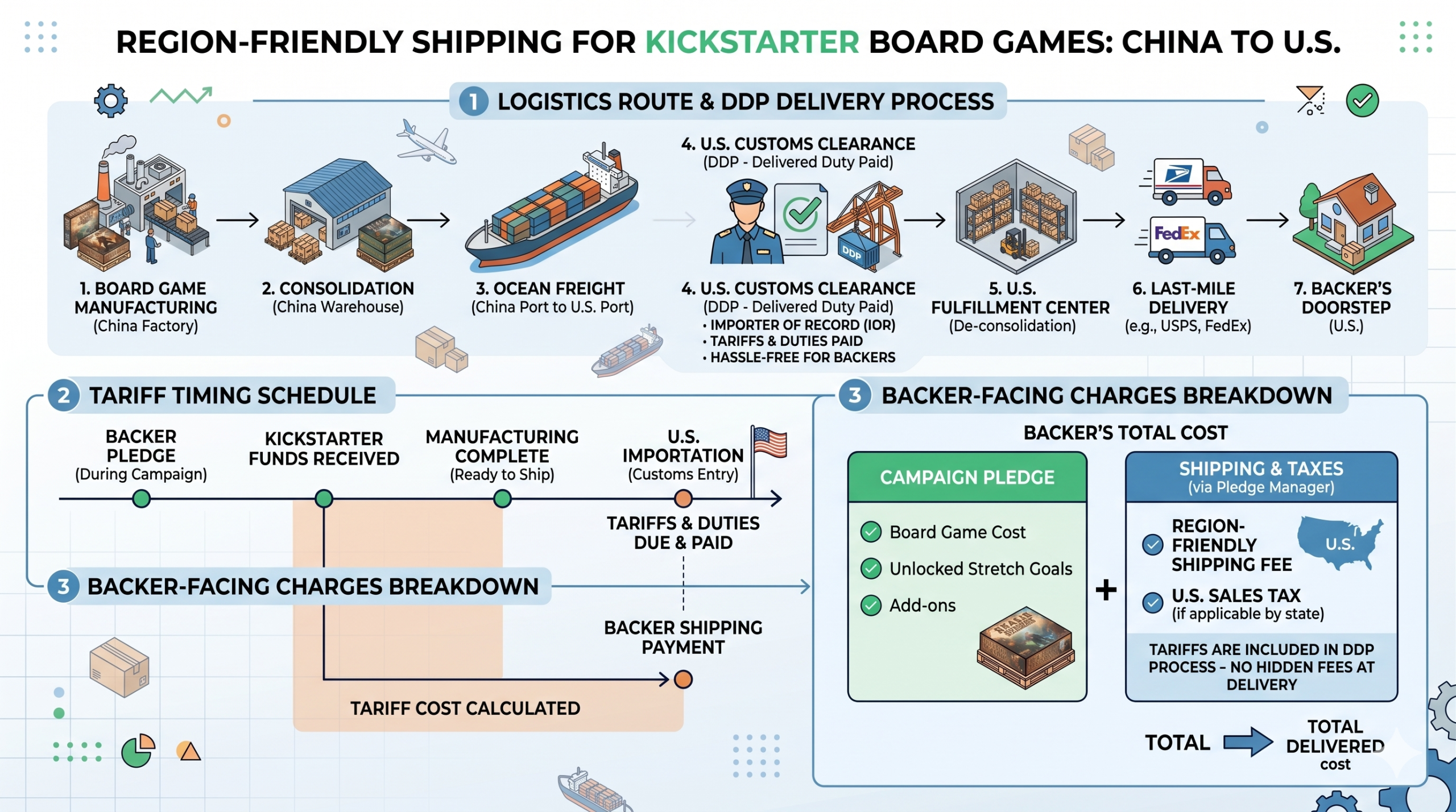
Use BackerKit shipping fees when your campaign still needs flexibility around weights, add-ons, shipping zones, or tariff recovery. Use DDP (Delivered Duty Paid) when you want a cleaner backer experience and your landed-cost assumptions are stable enough to price with confidence before import. For China-made board games shipping to the U.S., the wrong choice usually shows up as either margin drift on your side or payment friction for your backers.
Why This Decision Gets Hard
Many creators treat this as a billing choice. It is bigger than that. It decides where uncertainty gets handled inside a China-to-U.S. fulfillment model that may still be moving after the campaign looks funded.
BackerKit shipping fees give you more room when weights, add-ons, or tariff recovery are still being cleaned up. DDP gives the backer a cleaner experience, but only if the landed-cost model is already strong enough to survive real import conditions. Here, the goal is to connect that choice back to the broader China-to-U.S. Kickstarter shipping cost model and to the bigger question of where fulfillment risk gets absorbed before U.S. receipt.
The bottom line: BackerKit protects flexibility while the physical shipment is still moving. DDP protects trust once the landed-cost model is stable enough to price before import.
Executive Summary
For most China-made tabletop campaigns: BackerKit is safer earlier in the workflow. DDP becomes safer later, once carton truth, tariff exposure, and import timing finally describe the same shipment.
Core Comparison
| Decision Point | BackerKit Shipping Fees | DDP Shipping |
|---|---|---|
| Best timing | Lets the campaign keep pricing flexible inside the pledge manager while the physical file is still settling. | Asks the team to lock landed-cost assumptions earlier, before import begins. |
| Best fit | Unstable weights, moving add-ons, changing shipping zones, or tariff recovery that still needs clarification. | Cleaner U.S. backer experience, stable carton truth, clearer tariff math, and stronger confidence before shipment release. |
| Main risk | Backer payment friction if the final ask arrives late, feels confusing, or looks higher than expected. | Margin drift if the campaign prices duty-inclusive delivery before the import model is truly stable. |
| Tariff handling | Can recover part of the change later through tariff-related fee collection, but that turns trust into a timing problem. | Absorbs duty friction earlier, but only works if tariff exposure and classification are reliable enough before import. |
| Add-on complexity | Usually stronger when add-ons, deluxe tiers, or split waves still change the order profile. | Usually weaker if the campaign still cannot describe the final shipped order clearly enough to price upfront. |
| Warehouse consequence | The warehouse may receive inventory tied to a cleaner fee model but still inherit uncertainty around landed cost and backer messaging. | The warehouse receives a cleaner domestic execution plan if the China-origin and import assumptions were locked correctly. |
Industry Benchmark: BackerKit And Kickstarter Treat Final Fees As Timing Decisions
BenchmarkBackerKit's shipping options documentation explains that whole-order shipping logic depends on accurate item and packaging weights. Kickstarter's pledge-manager guidance also supports charging shipping closer to fulfillment when pricing is clearer.
What This MeansThat means the pledge manager is useful when the physical shipment still needs cleanup. It does not mean the campaign can leave the physical assumptions unstable forever.
WinsBS RecommendationWinsBS uses that flexibility as a temporary control valve, not as a substitute for China-origin carton truth, tariff review, or import planning.
Industry Benchmark: Region-Friendly Delivery Depends On Earlier Cost Control
BenchmarkStonemaier Games' shipping and fulfillment guidance treats region-friendly delivery as part of the trust model for serious tabletop campaigns. BackerKit's tariff manager guidance also recommends charging additional tariff fees as close as possible to import timing.
What This MeansBacker-facing friction usually appears when the campaign promises a cleaner delivery experience before it really knows whether duty and tariff assumptions will hold.
WinsBS RecommendationWinsBS treats DDP as the safer model only after carton, tariff, and import assumptions describe the same shipment. Before that point, BackerKit fee collection is usually the more honest tool.
Special Scenarios
Heavy Deluxe Edition With Late Add-Ons
BackerKit is usually safer when deluxe boxes, neoprene mats, sleeves, upgraded inserts, or stretch-goal add-ons are still changing order weight. The campaign needs time to clean up the physical file before the final charge hardens. When carton protection and replacement assumptions are still moving too, review the board game packaging standards guide for China-to-U.S. fulfillment before you decide how early the fee model can harden.
In that case: charging later is not the risk. Charging from unstable carton data is the risk.
Mostly U.S. Backers And A Strong Need For A Cleaner Experience
DDP becomes more attractive when the campaign wants fewer duty surprises, fewer support emails, and fewer checkout shocks for U.S. backers. But that only holds if the landed-cost model is already reliable enough to price early.
In that case: DDP is protecting trust, not just changing where the fee appears.
Smaller Campaign Without A Big Operations Team
Many smaller creators think DDP sounds simpler because it hides more of the friction from the backer. Sometimes that is true. Sometimes it just hides uncertainty inside the margin. If the campaign still needs cost discovery, BackerKit may be the safer tool for one more round of decision-making.
In that case: simplicity matters, but false simplicity is expensive.
Anonymized Campaign Example
In one anonymized China-to-U.S. tabletop campaign, the team originally wanted DDP because it sounded cleaner for backers. That changed once late add-ons and final carton weights pushed the landed-cost model back into motion. The safer move was to keep fee flexibility longer, then harden the import math before the final charge.
What this shows: DDP was not the wrong model forever. It was simply too early for the shipment the team actually had.
Campaign Already Too Late In The Workflow
If freight is already moving and tariff or carton assumptions are still unclear, DDP is often too late to fix cheaply. That does not make BackerKit ideal. It means the campaign is now choosing the least-damaging way to communicate the gap.
In that case: the real mistake happened before the fee model was chosen.
Final Decision
BackerKit shipping fees are usually the safer choice when the campaign still needs flexibility. That includes unstable weights, changing add-ons, uncertain shipping zones, or tariff recovery that still depends on late import clarity.
DDP is usually the safer choice when the campaign wants a cleaner backer experience and the landed-cost model is already strong enough to support it. At that point, the project has moved past rough estimates and can price from stable carton, tariff, and import assumptions.
What WinsBS Needs Locked Before Choosing
- China-origin carton truth: real finished weights, packaging assumptions, and add-on impact.
- Tariff and classification review: enough confidence in duty exposure to know whether DDP is fundable.
- Import timing: a realistic window for when the shipment lands and when fees should become final.
- Backer experience goal: whether the campaign is prioritizing flexibility, a cleaner checkout experience, or both.
- Warehouse handoff: a plan that gives the U.S. warehouse inventory to ship, not uncertainty to diagnose.
- Communication timing: when the campaign can ask for money without turning the request into a trust problem.
Where WinsBS fits: a generic warehouse starts after import. WinsBS steps in earlier, while the campaign can still decide whether uncertainty should be absorbed in China-origin prep, inside BackerKit, or before the backer ever sees it.
FAQ
Is BackerKit shipping fee collection the same as DDP?
No. BackerKit is a fee-collection workflow. DDP is a landed-cost and import model. You can use BackerKit to collect more accurate fees later, while DDP decides whether duty friction is absorbed earlier before delivery.
When should creators avoid DDP?
Creators should be cautious with DDP when carton weights, add-ons, tariff exposure, or import timing are still unstable. In that situation, DDP can hide uncertainty inside the margin instead of removing it.
Can a campaign use BackerKit and still aim for a cleaner duty experience?
Yes. BackerKit can buy time while the cost model stabilizes. The real question is whether that extra time is used to lock carton truth, tariff review, and import timing, or whether the campaign is simply delaying the same uncertainty.
Which model is better for heavy add-ons and deluxe tiers?
BackerKit is usually safer when heavy add-ons still change the order profile. DDP becomes safer only after those add-ons stop changing the landed-cost model in meaningful ways.
What if tariff exposure changes late?
If tariff exposure changes late, the campaign may need BackerKit-level fee flexibility or a clearer surcharge communication plan. The real lesson is that DDP became too early, not that landed cost stopped mattering.
Methodology
This comparison uses public workflow guidance from BackerKit shipping options, BackerKit tariff manager, Kickstarter pledge-manager shipping guidance, Kickstarter tariff surcharge guidance, and tabletop fulfillment framing from Stonemaier Games. The recommendation layer comes from WinsBS experience with China-origin carton readiness, tariff timing, import handoff, and U.S. warehouse execution. It does not claim that one model is universally better in every campaign.
What To Do Next
Before you choose BackerKit fees or DDP, review the decision in this order:
- Final carton weights and packaging assumptions
- Add-on and deluxe-tier stability
- Tariff and landed-cost confidence before import
- When the campaign can ask for money without surprising backers
- Whether the U.S. warehouse will receive inventory or inherited correction work
If those answers are still moving, go back to the full Kickstarter shipping cost model first. If you are trying to promise a cleaner buyer experience, read this comparison alongside the article on region-friendly shipping before the fee model hardens.