
Kickstarter Shipping Costs for Heavy Board Games in 2026: The China-to-U.S. Cost Model Creators Need Before Freight Moves
A benchmark playbook for tabletop creators pricing freight, cartons, tariffs, DDP, BackerKit shipping fees, warehouse receiving, and replacement risk before the campaign becomes underpriced.
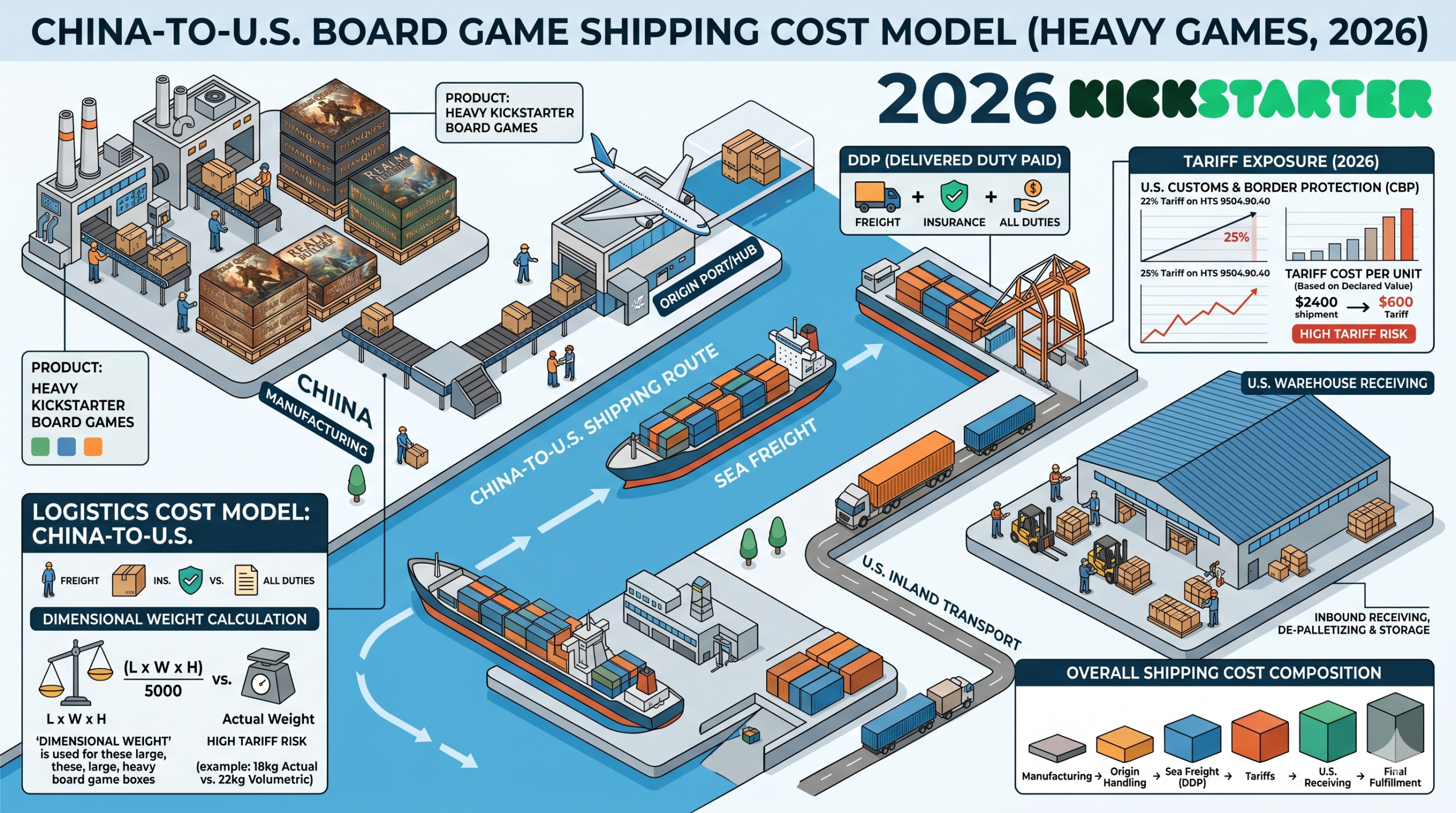
The dangerous number in Kickstarter board game shipping is not the parcel quote alone. For heavy board games made in China, the real cost model combines carton weight, dimensional weight, freight volatility, tariff or DDP exposure, pledge-manager fee timing, warehouse receiving quality, and replacement risk. If those variables are not locked together before freight moves, a campaign can look funded and still be operationally underpriced.
Quick Scan Summary
Heavy board game shipping gets mispriced when creators treat fulfillment as a postage problem instead of a China-to-U.S. cost system. The first quote is rarely the final cost. The final cost is shaped by what the factory releases, what freight lane is used, what the pledge manager charges, what customs and tariff exposure remains, and what the U.S. warehouse has to fix after receipt.
Cost Model Snapshot
The bottom line: A Kickstarter campaign can look funded and still be operationally underpriced if freight, carton reality, tariff exposure, and shipping-fee timing are not locked together before inventory leaves China.
Why This Benchmark Matters
Shipping cost is where tabletop campaigns often discover that the campaign math was built on estimates, not execution data. A creator can calculate pledge revenue, manufacturing cost, and a rough postage estimate, then lose margin because the final carton is heavier, add-ons changed the order profile, freight moved, tariff exposure shifted, or the warehouse received inventory that needed correction.
This is harder under China-to-U.S. fulfillment conditions because the cost is not created in one place. The factory controls carton reality. The freight lane controls timing and ocean cost. Customs and DDP decisions control landed-cost exposure. The pledge manager controls when backers see the number. The U.S. warehouse controls whether inventory ships cleanly or turns into receiving-side rework.
That is why the benchmark cannot be "What is the cheapest way to ship a board game?" The better question is: "Which cost assumptions are still unstable before freight moves?"
Key takeaway: The hidden cost in heavy board game fulfillment is often not the freight bill itself, but the gap between the cost model and the physical shipment that finally leaves China.
The China-to-U.S. Cost Model
The right cost model starts with carton truth, not the pledge tier. A heavy game can look simple as a reward level and still become expensive when add-ons, deluxe components, master cartons, cushioning, tariff treatment, and receiving instructions are added.
| Cost Variable | What Creators Often Price | What Changes The Final Number | Where To Lock It |
|---|---|---|---|
| Carton weight | The estimated game weight from the campaign plan | Final components, inserts, rulebooks, add-ons, cushioning, and master-carton layout | At China-origin carton review before freight release |
| Dimensional weight | The product box dimensions | Retail box protection, void fill, outer carton size, and parcel carrier billing rules | During packaging and carton test review |
| Freight | A single ocean or forwarder quote | China/East Asia to North America lane movement, port choice, timing, and consolidation logic | Before final shipping fees are shown to backers |
| Tariff / DDP exposure | A rough duty or surcharge estimate | Classification, import timing, tariff policy, DDP feasibility, and backer-facing surcharge rules | Before import and before final pledge-manager charge timing |
| Warehouse receiving | Pick, pack, and ship fees | Receiving errors, relabeling, inspection, bundle clarification, damaged cartons, and rework labor | Before the U.S. warehouse appointment is set |
| Replacements | An exception budget | Collector-box damage, missing components, split inserts, crushed corners, and support workload | During packaging standard and replacement-part planning |
WinsBS treats this as a linked cost system. A carton-weight change can affect freight, BackerKit shipping rules, DDP math, U.S. receiving, and replacement planning at the same time. When those variables are managed separately, the campaign does not see the real cost until it is too late to communicate cleanly with backers.
Key takeaway: Heavy board game shipping cost is not one number. It is the combined behavior of carton reality, freight timing, landed-cost exposure, and warehouse execution.
Variables That Change The Number
1. Carton Weight And Dimensional Weight
The first cost break usually appears when the finished carton no longer matches the campaign estimate. Extra cards, trays, upgraded inserts, thicker rulebooks, minis, playmats, or deluxe packaging can change the parcel and freight profile without looking like a major product change to backers.
BackerKit's shipping documentation is useful here because it explains weight-based whole-order shipping logic and the need to account for item and packaging weight. The commercial lesson is simple: a pledge-manager shipping rule is only as good as the weight and packaging assumptions behind it.
Key takeaway: If the carton is still changing, the shipping table is not final. It is a placeholder with margin risk.
2. Freight Volatility
Heavy tabletop products are dense paper-based freight. A campaign does not need to speculate on every freight index move, but it does need to understand that transpacific movement can change the real cost model before final import.
The Freightos Baltic Index guide identifies China/East Asia to North America West Coast and East Coast container lanes. That makes FBX useful as a warning system: if the lane environment moves, creators should revisit route timing, DDP math, surcharge timing, and warehouse placement before backer-facing charges harden.
Key takeaway: Freight is not locked when the quote is received. It is locked when route timing, landed-cost exposure, backer-facing charge timing, and U.S. warehouse receipt still fit the same plan.
3. Tariff, DDP, And Surcharge Timing
Tariff exposure can turn into a margin problem or a backer-trust problem depending on when it is discovered and how it is communicated. DDP can create a cleaner experience when the landed cost is knowable. A surcharge can make sense when the campaign needs to recover a changing cost closer to import. Neither choice works if the campaign waits until the goods are already moving.
BackerKit's tariff manager guidance and Kickstarter's tariff surcharge guidance both show that backer-facing fee collection can happen close to fulfillment. The operational point is that fee timing must follow import reality, not campaign optimism.
Key takeaway: DDP and tariff surcharges are not pricing decorations. They are ways of deciding who absorbs landed-cost uncertainty and when.
4. Add-Ons, Split Waves, And Pledge-Manager Timing
Heavy add-ons create cost distortion because the order profile can change after the campaign looks funded. A base game may fit one model. A base game plus expansion, neoprene mat, metal coins, sleeves, and collector box may need different carton logic, different shipping rules, and sometimes different wave planning.
Kickstarter's pledge-manager shipping guidance supports charging final shipping closer to fulfillment when final order counts and provider costs are clearer. For tabletop campaigns, that flexibility is valuable only if the physical file is being cleaned at the same time: SKU data, add-on combinations, carton weights, and route assumptions have to converge before final charges are set.
Key takeaway: A pledge manager can delay the final charge, but it cannot turn unstable carton data into a stable shipping model.
5. Packaging Failure And Replacement Cost
Packaging cost is part of shipping cost for tabletop campaigns. Thin outer cartons, weak corner protection, poor void-fill logic, and moving components can turn a small factory-side saving into a larger U.S.-side replacement and support cost.
Stonemaier Games' fulfillment writing is useful because it treats packaging quality, communication, speed, customer service, and problem-solving as fulfillment-center evaluation criteria. WinsBS extends that logic upstream: if the game is made in China, the board game packaging standard should be checked before the freight handoff, not after damaged boxes appear at the U.S. warehouse. For a practical review of cartons, corner protection, and replacement planning before release, use the board game packaging standards guide for China-to-U.S. fulfillment.
Key takeaway: For collector-grade tabletop products, replacement cost starts as a packaging decision before it becomes a support ticket.
Where Campaigns Get Underpriced
The most dangerous shipping mistakes do not always look like mistakes during the campaign. They look like clean estimates, neat pledge tiers, and a shipping table that appears finished. The problem appears later, when physical reality catches up.
The Underpricing Map
- Freight quoted too early: the lane, port, timing, or consolidation model changes before import.
- Packaging assumed too lightly: the final carton needs more protection than the cost model allowed.
- DDP or tariff handled too late: landed-cost exposure becomes a backer-facing surcharge or margin hit.
- Pledge-manager shipping fixed too early: the rule is set before final carton weight and add-on logic are stable.
- Warehouse rework not modeled: receiving, relabeling, inspection, or bundle clarification becomes hidden labor.
- Replacements treated as exceptions: damage-sensitive products create a predictable cost pattern, not a random event.
At WinsBS, the cost review starts before these issues separate into different spreadsheets. The workflow connects China-origin carton checks, freight route review, tariff or DDP exposure, pledge-manager timing, and U.S. receiving instructions so the creator is not pricing one shipment while physically moving another.
Bottom line: A campaign is underpriced when the backer-facing shipping number describes the estimate, but the warehouse receives the truth.
What WinsBS Actually Locks Before Shipping Fees Are Final
WinsBS does not treat shipping cost as a quote-comparison exercise. For China-made tabletop campaigns, the cost-control work is to make the physical shipment, landed-cost logic, pledge-manager fee timing, and U.S. warehouse receipt describe the same operational plan before backers see a final number.
The WinsBS Cost-Control System
- Final carton truth: retail box, outer carton, master carton, component weight, add-ons, and packaging protection are checked before freight release.
- Dimensional weight exposure: carton size, cushioning, void fill, and parcel billing risk are reviewed before the pledge-manager table hardens.
- Freight timing: China-to-U.S. route, port choice, consolidation logic, and warehouse appointment window are tied to the shipping-fee decision.
- Tariff and DDP stack: import exposure, surcharge timing, DDP feasibility, and backer communication are reviewed as one landed-cost problem.
- Origin pre-kitting burden: SKU separation, bundle logic, add-on combinations, and replacement parts are cleaned before the U.S. warehouse receives inventory.
- Receiving and rework risk: labels, carton counts, pallet or carton expectations, exception rules, and inspection needs are locked before the warehouse appointment.
- Replacement-cost exposure: collector-box damage, crushed corners, missing components, and support workload are treated as cost variables, not random exceptions.
Where WinsBS fits: A generic warehouse prices the work after inventory arrives. WinsBS protects the shipping model earlier, while the creator can still change cartons, fees, routes, and handoff rules before cost mistakes become backer-facing.
Industry Benchmarks And WinsBS Commentary
Industry Benchmark: Stonemaier Treats Fulfillment Quality As Cost Control
BenchmarkStonemaier Games' shipping and fulfillment resources frame tabletop fulfillment as a full workflow involving freight, regional staging, packaging quality, fulfillment-center performance, communication, and backer experience.
Commercial CommentaryFor heavy board games, quality is not separate from cost. Corner damage, weak cushioning, poor receiving data, and slow issue resolution can turn a cheap quote into a more expensive campaign.
WinsBS RecommendationWinsBS moves cost control earlier by reviewing China-origin carton readiness, packaging protection, freight handoff data, DDP or tariff exposure, and U.S. receiving quality before the warehouse starts absorbing mistakes.
Industry Benchmark: BackerKit And Kickstarter Make Fee Timing Flexible
BenchmarkBackerKit and Kickstarter both support pledge-manager workflows where final shipping or tariff-related charges can be handled closer to fulfillment, when weights, add-ons, address data, and provider pricing may be clearer.
Commercial CommentaryThat flexibility protects creators only when the physical model is being cleaned at the same time. Delaying the charge does not fix wrong carton weights, unstable add-ons, or late tariff assumptions.
WinsBS RecommendationWinsBS connects fee timing to execution readiness: SKU files, carton weights, route options, DDP math, and U.S. warehouse receiving data should be reviewed before final charges harden.
Industry Benchmark: FBX Is A Freight Warning System, Not A Campaign Quote
BenchmarkThe Freightos Baltic Index provides benchmark logic for China/East Asia to North America freight lanes, including West Coast and East Coast trade routes.
Commercial CommentaryCreators should not use FBX as a project quote, but they should use freight movement as a warning that final shipping math can change before import.
WinsBS RecommendationWinsBS uses freight signals to revisit route timing, warehouse placement, DDP feasibility, and backer-facing shipping communication before the cost model becomes stale.
Common Operator Mistakes
Mistake 1: Pricing Shipping Before Carton Reality
The campaign estimates product weight, but the final carton carries the real cost. Heavy rulebooks, upgraded inserts, add-ons, and protective packaging can change both parcel and freight math.
Mistake 2: Treating DDP As A Yes-Or-No Label
DDP is not a magic setting. It only protects backer experience when classification, landed cost, import timing, and fee collection are reviewed together.
Mistake 3: Ignoring Warehouse Receiving Cost
Pick-and-pack is not the whole warehouse cost. Receiving errors, relabeling, bundle confusion, damaged cartons, and inspection can become the labor that was missing from the budget.
Mistake 4: Treating Replacements As Random
For collector-grade board games, replacements are often a predictable consequence of packaging choices, long transit, and component movement. They should be modeled before freight leaves China.
Bottom line: The cheapest shipping plan is not the one with the lowest visible quote. It is the one with the fewest unpriced corrections after the campaign is already committed.
FAQ
What is the biggest hidden cost in Kickstarter board game shipping?
The biggest hidden cost is usually correction work after the physical shipment no longer matches the cost model. That can include carton-weight drift, tariff exposure, warehouse rework, damaged boxes, and replacement parts.
When should Kickstarter creators lock shipping costs?
Creators should lock final shipping costs only after carton weight, packaging size, add-on logic, freight route, tariff exposure, and warehouse receiving data are reliable. Locking earlier can make the campaign look cleaner while hiding margin risk.
Is BackerKit shipping fee collection enough to solve cost risk?
BackerKit shipping fee collection helps, but it does not solve cost risk by itself. The shipping table still depends on accurate weights, packaging assumptions, add-on combinations, tariff logic, and route timing.
Is DDP better for heavy board games made in China?
DDP is better when landed cost can be modeled clearly and the creator wants to reduce surprise duty friction. If weights, add-ons, tariffs, or destination mix are still moving, charging closer to fulfillment may be safer.
Why do heavy add-ons distort shipping costs?
Heavy add-ons distort shipping costs because they change order weight, carton size, packaging protection, and sometimes shipping wave logic. A base-game shipping rule can fail once expansions, mats, sleeves, coins, or deluxe components are added.
How does packaging affect the final shipping budget?
Packaging affects the final budget through dimensional weight, carton protection, damage rate, replacement parts, and support labor. For tabletop campaigns, weak packaging is often a future shipping cost, not a factory saving.
What should be checked before board game freight leaves China?
Before freight leaves China, creators should check SKU files, final carton weight, carton dimensions, packaging protection, add-on combinations, tariff or DDP exposure, freight route, receiving instructions, and backer-facing shipping communication.
Methodology
This cost guide was built from public tabletop fulfillment guidance from Stonemaier Games, pledge-manager shipping and tariff guidance from BackerKit and Kickstarter, Freightos Baltic Index lane documentation, and WinsBS operational judgment around China-origin carton readiness, freight routing, landed-cost review, packaging control, and U.S. warehouse handoff. It does not use unverified backer refusal percentages, current live FBX rates, or unsupported WinsBS transit-time claims.
What To Do Next
Before finalizing shipping fees, test whether the cost model still depends on assumptions that are not locked. The goal is not to find one cheaper quote. The goal is to make the backer-facing number match the shipment that will actually leave China.
Map the cost model in this order:
- Final SKU and add-on combinations
- Retail box, outer carton, and master-carton dimensions
- Final carton weight and dimensional weight exposure
- Packaging protection and replacement-part assumptions
- Freight lane, port choice, and timing
- Tariff, surcharge, or DDP exposure
- BackerKit or Kickstarter shipping fee timing
- U.S. warehouse receiving and rework risk
If any of these inputs are still moving, review the China-to-U.S. cost model before freight moves and before final shipping charges harden.