
Board Game Packaging Standards for China-US Fulfillment: Cartons, Corners, and Damage Control Before U.S. Receipt
For Kickstarter and Gamefound teams trying to avoid corner damage, warehouse holds, and replacement headaches after China-to-U.S. freight, this guide shows what needs to be locked before the cartons leave the factory.
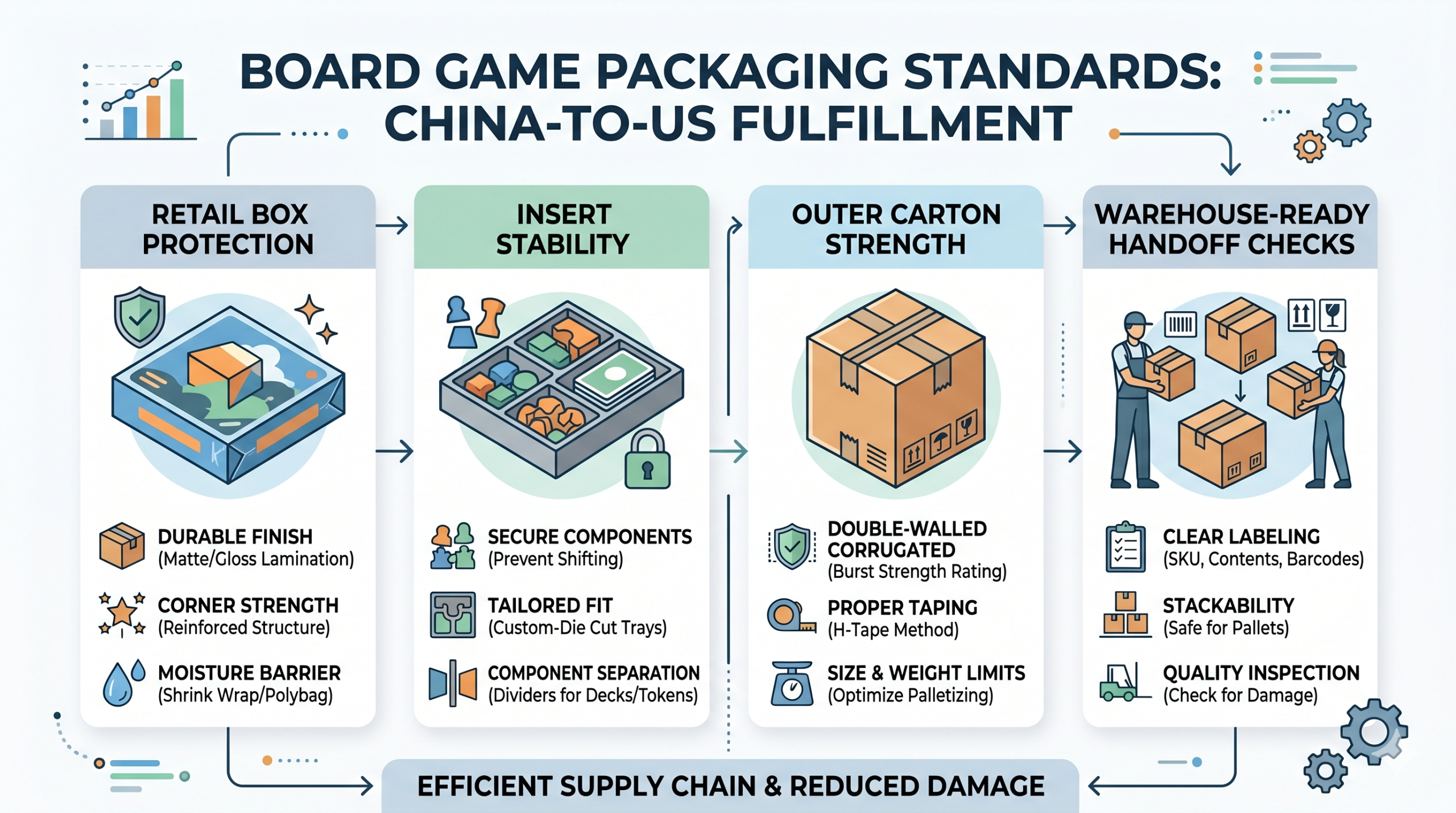
If you are about to approve a board game packout in China, do not sign off just because the retail box looks good on the table. For China-made board games, the packaging standard has to be locked before freight leaves the factory. Otherwise the bill usually arrives later as corner damage, warehouse inspection holds, replacement pressure, and unhappy backers who waited months for a premium box to show up looking rough.
Quick Scan Summary
If you are searching for board game packaging requirements, shipping damage prevention, or the right carton spec for heavy board games, the practical answer is this: packaging for tabletop crowdfunding is not just a print-quality decision. It decides whether the game reaches the U.S. warehouse ready to ship or arrives as a release problem the warehouse has to clean up.
A heavy game with weak corner protection, drifting insert fit, or soft master cartons can survive manufacturing approval and still fail during China-to-U.S. transit. That is why packaging decisions belong in the same conversation as freight timing, shipping charges, replacements, and backer experience.
Packaging Control Snapshot
If This Feels Familiar, You Are Probably Dealing With The Right Problem
- Freight is getting booked: but carton truth still depends on late insert tweaks, heavier add-ons, or a last-minute packout change.
- The U.S. warehouse is expected to move fast: but nobody has written down what should be released, quarantined, or inspected if box condition comes in uneven.
- You want a premium backer experience: but the current packaging review still stops at factory appearance instead of transit reality.
- Shipping fees are getting locked: but carton weight, protective material, or dimensional exposure may still change before export.
The bottom line: For board games, packaging is not separate from fulfillment quality. It is the first physical test of whether the China-to-U.S. execution model is ready to protect the box the backer actually sees.
Why This Benchmark Matters
Board-game packaging gets judged differently from ordinary parcel packaging because the box is part of the reward. A dented apparel shipper may be forgettable. A crushed collector box, split lid, or tray that shifted inside the retail box is often the first thing the backer notices and remembers.
That pain usually shows up late.
The campaign looks funded. Production looks done. Freight is moving. Then the warehouse sees inventory that is technically present but not confidently releasable.
Now the team is paying for inspection, arguing about acceptable box condition, and trying to protect the backer experience with fewer cheap options left.
This gets harder under China-US fulfillment conditions because the cheapest correction point disappears early.
Once inventory leaves China, weak edge protection, moving components, poor carton strength, or unclear replacement logic stop being packaging choices and start becoming freight damage, warehouse inspection labor, customer-support load, and replacement work.
Stonemaier Games' current worldwide fulfillment update is useful here because it treats packaging quality, communication, speed, and problem solving as fulfillment quality standards. ISTA's transit-testing guidance adds another layer: test design should reflect supply-chain hazards, be documented clearly, and be repeated when the product or package changes. For creators, the commercial lesson is simple: the real benchmark is not whether the box passed factory sign-off. The real benchmark is whether it still arrives in saleable condition after the full China-to-U.S. workflow.
Key takeaway: If packaging standards are decided too late, the campaign does not just absorb damage. It absorbs avoidable rework at the most expensive stage.
A Familiar Project Manager Moment
You are close to freight booking. Manufacturing says the game is ready. The fulfillment partner wants receiving details. The campaign team wants to lock shipping charges and move on.
Then one small change lands late: thicker inserts, extra promo content, another protective layer, a revised carton count, or a question about whether visibly soft corners should still ship. None of those changes feels huge on its own. Together, they decide whether the warehouse receives clean inventory or a release problem.
An Anonymized Recurring Pattern
One recurring tabletop pattern is sealed inventory that arrives with counts intact but box condition too inconsistent to release cleanly. The warehouse can see that the campaign technically received stock, yet still has to sort visibly crushed units, quarantine some cartons, and decide whether replacement handling should start before outbound even begins.
That is the moment when packaging stops being a factory discussion and becomes a warehouse-cost and backer-experience problem.
A Second Recurring Pattern: Insert Failure Without Obvious Carton Damage
Another recurring pattern is inventory that reaches the warehouse with cartons that look acceptable from the outside, but the internal fit is no longer stable enough for a clean release. Trays have shifted, cards have broken loose, or heavy components have started marking the inside of the retail box even though the shipment still looks presentable on the pallet.
That forces a harder decision: ship a product that may create missing-part or damaged-component complaints, or open units and convert a packaging problem into inspection labor and replacement handling.
The Packaging Benchmark Matrix
The right standard is layered.
Retail-box approval is not enough if the insert allows components to move, the outer carton collapses under load, or the master carton creates avoidable crush risk during long transit.
| Packaging Layer | What The Standard Should Protect | Common Failure Signal | Where To Lock It |
|---|---|---|---|
| Retail box | Corners, lid fit, surface scuff resistance, and visible premium-box integrity for shelf and backer presentation. | Crushed corners, split edges, bowed lids, or abrasion visible before the order is even opened. | During pre-freight packaging review at China origin, not after U.S. receipt photos start showing damage. |
| Insert and component stability | Movement control for trays, minis, cards, tokens, and heavy add-ons inside the retail box. | Loose components, tray shift, split inserts, or internal friction that makes the product feel used or broken. | Before cartonization, while insert fit and replacement-part planning can still be adjusted cheaply. |
| Outer carton | Compression resistance, edge protection, void-fill behavior, and stable parcel handling through warehouse touchpoints. | Corner collapse, carton seam stress, or visible crush once the retail units are unpacked. | At China-origin carton spec review, together with weight, dimensions, and handling assumptions. |
| Master carton and pallet logic | Stacking load, warehouse receiving stability, and long-transit handling for dense game boxes. | Bottom-layer compression, burst cartons, mixed-SKU confusion, or receiving damage before pick-and-pack begins. | Before freight booking, when palletization, counts, and warehouse receiving rules still match the shipment plan. |
| Replacement and exception plan | The campaign's ability to solve damage or missing-part issues without breaking sealed-unit economics. | The warehouse has to open saleable units for parts, or replacement decisions are improvised after complaints arrive. | Before export, while spare parts, damaged-unit segregation, and receiving instructions can still be designed on purpose. |
Retail Box
Protect: Corners, lid fit, finish, and shelf-level presentation.
Watch for: Crushed corners, split edges, bowed lids, abrasion.
Lock it: During China-origin review before freight release.
Insert And Components
Protect: Trays, cards, minis, tokens, and heavier add-ons from internal movement.
Watch for: Tray shift, loose parts, split inserts, internal scuffing.
Lock it: Before cartonization and replacement planning are frozen.
Outer Carton
Protect: Compression resistance, edge protection, and handling stability.
Watch for: Corner collapse, seam stress, visible crush on unpack.
Lock it: At carton-spec review with final weight and dimensions.
Master Carton And Pallet
Protect: Stacking load, receiving stability, and long-transit handling.
Watch for: Bottom-layer compression, burst cartons, mixed counts.
Lock it: Before freight booking and warehouse receiving setup.
Replacement Plan
Protect: Clean handling of damaged units and missing-part issues.
Watch for: Opening saleable units for parts or improvising replacements after complaints.
Lock it: Before export while spare logic and exception rules can still be designed.
Key takeaway: A packaging standard is only real when every layer, from insert fit to master-carton behavior, supports the same China-to-U.S. handoff plan.
Variables That Change The Answer
1. Corner Protection And Edge Compression
Heavy board games fail at the corners first because the box is rigid, dense, and easy for backers to inspect. That matters even more for collector editions, foil boxes, slipcases, or oversized formats where visible corner damage can make an otherwise complete reward feel unsellable.
The right standard should account for transit reality, not only factory appearance. If the retail box leaves China looking sharp but reaches the U.S. warehouse with corner crush after linehaul and warehouse handling, the standard was not strong enough.
Key takeaway: For tabletop campaigns, corner protection is part of product quality, not an afterthought.
2. Component Movement And Insert Fit
Loose cards, shifted trays, and heavy components moving inside the box can damage the product even when the outer carton looks acceptable. This is one reason packaging review has to cover more than carton strength. The internal package has to survive real motion, not just shelf display.
That matters operationally because component movement turns into missing-part claims, opened-unit inspection, and replacement labor after receipt. Those are packaging costs that show up later under a different label.
Key takeaway: A stable insert is part of fulfillment control because it reduces exception handling before backers ever see the product.
3. Master-Carton Strength And Stacking Load
Dense game boxes create load problems quickly. A carton that works for a lighter product can underperform once books, boards, inserts, sleeves, minis, or heavy add-ons shift the compression profile. That is why board-game carton logic should be judged under long-transit and warehouse-stacking conditions, not only by whether the factory can seal the box. The Fibre Box Association's handbook resources are useful here because they frame corrugated performance as a system that includes pallet patterns, unitization, storage, and handling, not just box selection in isolation.
In practice, that means a carton review should be reopened when the load plan changes. If the pallet pattern changes, the number of retail units per master carton changes, or storage and handling assumptions change after the first packaging sign-off, the outer-carton choice may no longer be strong enough for the actual trip.
WinsBS treats this as a receiving issue as well as a packaging issue. When master cartons collapse, the U.S. warehouse does not just see damage. It sees mixed counts, unstable pallets, slower receiving, and more uncertainty before outbound fulfillment starts.
Key takeaway: If the master carton is underbuilt, the warehouse inherits a packaging decision it did not make.
4. Packaging Truth Changes Cost And Promise Accuracy
Packaging standards affect more than damage rate.
They change carton weight, dimensional exposure, replacement pressure, and what creators can honestly promise about shipping costs. That is why this packaging discussion belongs next to the article on Kickstarter shipping costs and the BackerKit vs DDP comparison.
BackerKit's shipping options documentation is useful here because it explains that whole-order shipping depends on accurate item and packaging weight.
If the packaging standard keeps moving, the shipping rule is not really final either.
Key takeaway: Packaging truth is part of pricing truth. If the box changes, the shipping promise may change with it.
5. Replacement Logic Before U.S. Receipt
Weak packaging becomes more expensive when the replacement workflow is undefined. If the warehouse has to decide on the fly whether to ship dented units, open good units for parts, or quarantine cartons without clear instructions, the campaign pays in delay and inconsistency.
For creators trying to offer a cleaner buyer experience through region-friendly shipping, packaging quality matters even more. A clean landed-cost promise does not feel clean if the box arrives visibly damaged.
Key takeaway: Packaging standards should be tied to exception handling before freight leaves China, not after the first complaints arrive.
When A Board Game Packaging Standard Is Actually Ready
A board game packaging standard is ready only when retail-box integrity, internal component stability, master-carton performance, and replacement logic all match the same China-to-U.S. handoff plan.
The Four-Part Readiness Check
- Retail-box integrity: corners, lid fit, and visible finish can survive the real transit and handling path.
- Internal component stability: trays, inserts, cards, and heavier parts stay controlled even when the carton still looks acceptable outside.
- Master-carton performance: carton strength, pallet pattern, stacking load, and warehouse handling assumptions still describe the same load.
- Replacement logic: the team knows what happens if units arrive damaged, shifted, or not clean enough to release.
Bottom line: If one of these four is still vague, the packaging standard is not really locked yet.
Where This Packaging Logic Fits And Where It Does Not
This packaging decision matters most when the game is made in China, moving into U.S. fulfillment, and likely to create visible box-condition pressure or replacement pressure after receipt. That usually means heavier games, collector editions, add-on-heavy campaigns, projects with multiple waves, or any campaign where backers treat the box as part of the product.
Best Fit For This Packaging Standard Logic
Use this framework when the shipment still depends on China-origin packout decisions, the warehouse will be expected to release inventory quickly after receipt, and box condition is commercially visible enough that damage turns into support work instead of a minor cosmetic issue.
Less Critical Or Lower-Fit Scenarios
This matters less when the SKU is already packed out and stable inside the U.S., the product is light and damage-insensitive, or the commercial model can tolerate minor box wear without triggering replacement pressure. It also matters less for routine domestic replenishment where the packout system is already proven and the warehouse is not being asked to absorb China-origin variation.
Boundary: This is not a generic rule saying every carton needs the same protection standard. It is a decision framework for shipments where weak packaging can still change the cost model, release quality, or backer experience after China-to-U.S. handoff.
What That Does Not Mean
It does not mean every heavy game automatically needs the highest carton spec, or that adding more material is always the better decision. Stronger protection can also add weight, dimensional exposure, and cost pressure. The real job is to choose the lightest packaging system that still protects the product and keeps the shipping promise honest.
Overpacking can be as misleading as underpacking if the added protection changes carton truth after the shipping model was already priced or communicated.
What WinsBS Locks Before Freight
WinsBS does not treat packaging review as a cosmetic sign-off. For China-made tabletop campaigns, the real job is to make the retail box, outer carton, freight plan, warehouse handoff, and replacement logic describe the same shipment before the first pallet departs.
The WinsBS Packaging-Control System
- Retail-box readiness: corner sensitivity, lid fit, surface vulnerability, and collector-box handling expectations are reviewed before freight release.
- Insert and component stability: trays, loose parts, heavy components, and movement risk are checked before transit turns them into support issues.
- Outer-carton and master-carton logic: compression exposure, carton strength, counts, pallet stability, and warehouse receiving assumptions are aligned.
- Packaging-linked cost control: carton weight, dimensional exposure, and replacement risk are reviewed alongside the shipping cost model.
- Region-friendly and DDP fit: packaging truth is checked before promising a cleaner backer experience that the physical shipment cannot support.
- Replacement workflow before receipt: spare-part handling, damaged-unit segregation, and warehouse exception rules are set before the U.S. warehouse has to improvise.
What WinsBS Actually Checks At China-Origin Handoff
- Retail-unit condition risk: which edge, lid, finish, or collector-box surfaces are most likely to show transit damage first, and which visible flaw would make a unit commercially unsafe to release.
- Insert and component change risk: whether trays, heavier parts, promos, or add-ons changed the internal stability enough to justify a fresh review even if the outer carton still looks unchanged.
- Carton and load reality: final units per carton, carton material, pallet pattern, stacking logic, and whether that load still matches the receiving plan instead of the first packaging draft.
- Release decision rules: what the warehouse should release, quarantine, inspect, or route to replacement handling if inventory arrives present but not clean enough to ship, so receiving does not have to invent the rule under pressure.
Changes That Should Reopen Packaging Review Before Release
- Packout changes: promos, heavier add-ons, revised inserts, or new closure method that alter internal pressure or movement behavior.
- Load changes: different units per carton, revised pallet pattern, new stacking assumptions, or longer storage window before final release.
- Cost-model changes: added protective material, changed cushioning, or carton growth that shifts weight and dimensional exposure after shipping logic was already built.
- Warehouse-blame changes: any scenario where counts may still be correct but release quality is unclear, which is how the U.S. warehouse ends up absorbing a China-origin packaging decision.
Where WinsBS fits: A domestic warehouse receives the result of these packaging choices. WinsBS steps in while the choices can still be corrected at China origin, which is why this guidance belongs inside the broader China-to-U.S. fulfillment decision model.
Industry Benchmarks And WinsBS Commentary
Industry Benchmark: Tabletop Fulfillment Quality Includes Packaging Quality
BenchmarkStonemaier's shipping and fulfillment hub and its 2026 fulfillment commentary frame tabletop fulfillment as a full workflow, not just parcel delivery. Packaging quality sits alongside communication, speed, and problem solving as part of that benchmark.
Commercial CommentaryFor creators, that means a cheap warehouse quote is not the real standard if weak packaging pushes damage, replacements, or support work downstream.
WinsBS RecommendationWinsBS moves that judgment earlier by treating packaging standards as part of the China-origin handoff instead of a problem that only appears after U.S. receipt.
Industry Benchmark: Packaging Weight Affects Shipping Rules
BenchmarkBackerKit's shipping documentation makes it clear that item and packaging weight both affect whole-order shipping logic.
Commercial CommentaryThat means packaging is not just a damage-prevention issue. It also shapes whether a shipping table, surcharge plan, or DDP promise is built on stable physical assumptions.
WinsBS RecommendationWinsBS uses packaging review to tighten the connection between carton truth, shipping cost, and backer-facing fee logic before those numbers harden.
Industry Benchmark: Packaging Standards Should Be Tested And Rechecked When The Pack Changes
BenchmarkISTA frames transit-tested packaging around documented pre-shipment evaluation, correct test sequence, and retesting when the product, package, or process changes.
Commercial CommentaryFor tabletop campaigns, that means upgraded inserts, heavier add-ons, new closure methods, changed carton materials, or different packout sequence should not be treated as harmless tweaks. Each of those changes is a practical trigger to reopen packaging review before release, because the package is no longer the same system that was first approved.
WinsBS RecommendationWinsBS treats late packaging changes as a signal to recheck the full China-origin handoff, not just update one packaging note and hope the freight outcome stays the same.
Industry Benchmark: Corrugated Performance Depends On The Full Load System
BenchmarkFibre Box Association resources group corrugated guidance with pallet patterns, unitization, storage, and handling instead of treating the carton as a standalone choice.
Commercial CommentaryFor board games, that means the carton spec should be rechecked when the load changes. If carton count, pallet pattern, stacking assumptions, storage window, or handling route move, the original carton decision may no longer fit the trip or the warehouse handoff even if the box material itself did not change.
WinsBS RecommendationWinsBS reviews carton strength together with pallet logic, receiving conditions, and release timing so the outer-carton decision still matches the real load, not just the first draft of it.
Common Operator Mistakes
Mistake 1: Approving The Retail Box But Not The Transit System
A game can look premium on the production table and still fail in freight because the review stopped at print finish instead of testing the full packaging stack.
Mistake 2: Treating Corner Damage As Random
For heavy board games, repeated corner damage usually points to a weak packaging standard, not bad luck. If the same failure keeps appearing, the model is underbuilt.
Mistake 3: Letting Packaging Drift After Shipping Rules Are Set
Once cushioning, carton weight, insert format, or add-on packing changes, the cost model and shipping promise may need to change too. Campaigns get into trouble when they update the box but not the assumptions built on the box.
Mistake 4: Asking The U.S. Warehouse To Diagnose Factory Packaging Problems
The warehouse can catch damage, but by then the cheapest correction point is gone. Receiving teams should not be the first serious packaging reviewers in the workflow.
Mistake 5: Assuming More Protection Automatically Means Better Packaging
Extra material can reduce damage risk, but it can also raise carton weight, dimensional exposure, and shipping-fee distortion. If the added protection is not reviewed against the cost model, the campaign may solve one packaging risk while quietly creating a pricing and communication problem.
Bottom line: Packaging problems look smaller before freight and larger after receipt. That is why the standard has to be built upstream.
FAQ
What packaging standard matters most for heavy board games?
The most important standard is the one that protects visible box quality and internal stability through the full China-to-U.S. workflow. For heavy board games, corner protection, carton strength, insert fit, and replacement planning usually matter more than cosmetic factory approval alone.
When is double-wall carton protection worth reviewing?
It is worth reviewing when the game is dense, collector-grade, add-on heavy, or likely to face stacking and compression pressure in long transit. Not every project needs the same carton spec, but heavy tabletop campaigns should make that decision deliberately before freight release.
What is the best carton spec for heavy board games?
The best carton spec is the one that still works after final weight, pallet pattern, stacking load, and handling assumptions are known. Heavy board games often need a stronger spec than the first factory draft, but the right answer depends on the actual load, not a generic rule copied from another product.
How does packaging affect shipping cost?
Packaging affects cost through carton weight, dimensional exposure, damage rate, replacement pressure, and warehouse rework. For tabletop campaigns, weak packaging is often a future shipping cost, not a factory saving.
Can a U.S. warehouse fix weak board-game packaging?
A U.S. warehouse can catch or repair some issues, but usually after the mistake has become expensive. Inspection, repacking, relabeling, and replacement handling are all costlier after the shipment reaches the U.S. than before it leaves China.
What should creators check before freight leaves China?
Creators should check retail-box vulnerability, insert stability, outer-carton strength, master-carton counts, carton weight, replacement logic, receiving instructions, and whether the shipping-cost model still matches the physical packaging reality.
How do I prevent corner damage during China-to-U.S. shipping?
Start by reviewing the retail-box edge sensitivity, cushioning approach, outer-carton protection, pallet pattern, and compression exposure together. Corner damage usually comes from a weak packaging system, not one isolated mistake, so the fix has to cover the full handoff from China packout to U.S. receipt.
Do packaging decisions affect DDP or region-friendly shipping promises?
Yes. Packaging decisions affect weight, carton count, replacement pressure, and the overall quality of the backer experience. A cleaner landed-cost promise still fails if the product arrives visibly damaged.
Why does packaging need to be reviewed before U.S. receipt?
Because that is when the cheapest correction point still exists. Before U.S. receipt, creators can still change the packaging standard, receiving assumptions, and replacement plan without turning the warehouse into a damage-control operation.
Methodology
This packaging review was built from Stonemaier Games' public tabletop fulfillment guidance, BackerKit shipping-rule guidance, ISTA transit-testing guidance, Fibre Box Association corrugated resources, and WinsBS operational judgment around China-origin carton review, packaging integrity, warehouse handoff, and replacement control. The operating layer reflects recurring WinsBS planning patterns around damage-sensitive shipments where release quality, receiving rules, and replacement handling need to be decided before U.S. receipt. It links to the confirmed live articles that readers would logically check next. FAQ schema is kept for machine readability and page structure, not because Google regularly shows FAQ rich results for ordinary commercial sites.
Board Game Packaging Review Checklist Before Freight Leaves China
Before freight leaves China, test whether the packaging standard is detailed enough to survive the rest of the fulfillment model. The goal is not just to approve the box. The goal is to make sure the U.S. warehouse receives inventory it can ship cleanly.
Use this review order:
- Retail-box corner and surface vulnerability
- Insert fit and component movement risk
- Outer-carton protection and master-carton load
- Carton weight, dimensions, and shipping-cost impact
- Replacement-part and damaged-unit handling
- Warehouse receiving instructions before appointment booking
- Whether region-friendly, DDP, or pledge-manager promises still match packaging reality
Do not sign off until you can answer four questions clearly: which packaging layer is most likely to fail, what the warehouse should do if it does fail, whether shipping-fee logic still matches the final carton truth, and whether the backer promise still fits the physical packout.
If those inputs are still moving, review them alongside the articles on China-to-U.S. board game crowdfunding fulfillment, Kickstarter shipping costs, region-friendly shipping, and the BackerKit vs DDP comparison.