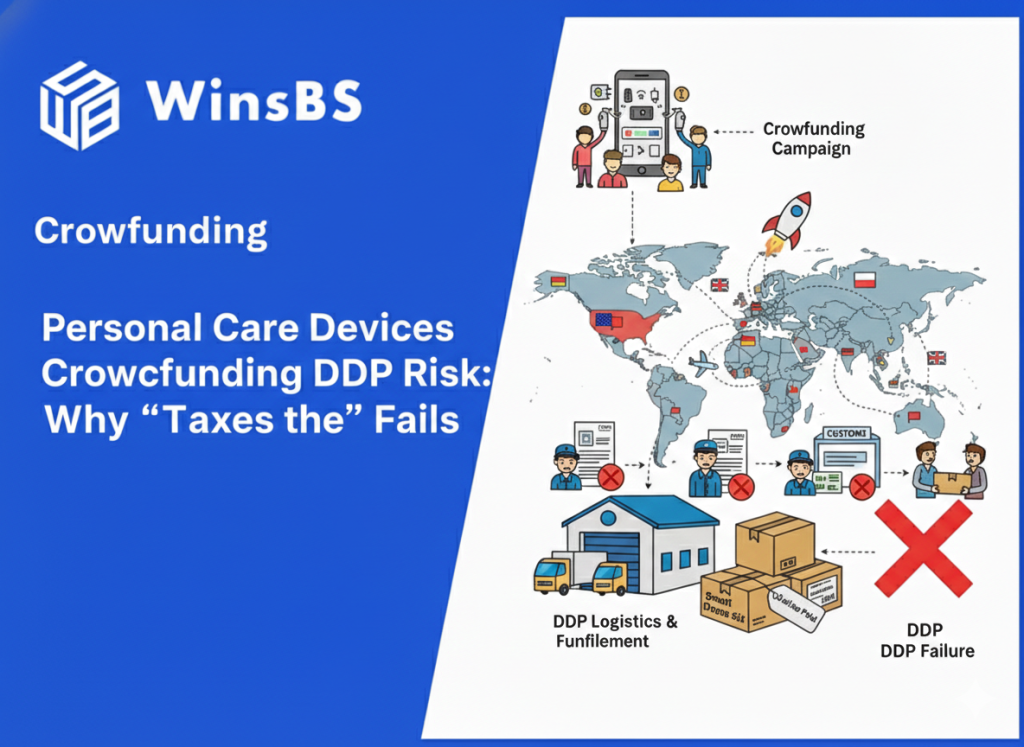
Personal Care Devices Crowdfunding DDP Risk: Why “Taxes Included” Fails
Personal Care Devices Crowdfunding DDP Risk Why Beauty Devices, Massagers, EMS/TENS Patches & LED Tools Break After “Taxes Included” — Not Because of Shipping, but Because of Physical Threshold Checks WinsBS Fulfillment — Maxwell Anderson Updated February 2026 Table of Contents TL;DR 1. Why Personal Care Devices Are Misjudged in Crowdfunding 2. The Intuitions That Feel Safe — and Consistently Break 3. How Entry Systems Actually Define a Personal Care Device 4. Why DDP Turns Entry Holds Into Locked Liability 5. Country Differences Are Entry Questions, Not Strictness 6. Why Responsibility Cannot Be Reassigned Once It Breaks 7. When DDP Can Work — and Why It’s Rare 8. Why Crowdfunding Timelines Collide With Entry Logic 9. What “Taxes Included” Really Means for This Category TL;DR In crowdfunding, personal care devices (beauty tools, massagers, EMS/TENS patches, LED masks, RF/ultrasound skincare devices) repeatedly fail under Delivered Duty Paid (DDP) shipping not because transit breaks, and not because customs suddenly becomes “stricter.” They fail because entry systems repeatedly ignore the sales channel and marketing tone and instead lock identity through physical threshold checks — current, temperature, wavelength, energy density, vibration frequency, RF output, exposure time, and use context. Once those checks pull the product into a medical-device-adjacent identity path, missing preconditions cannot be created after arrival. DDP does not reduce the blast radius. It concentrates delay, cost, and liability on the campaign. 1. Why Personal Care Devices Are Misjudged in Crowdfunding In commerce, personal care devices are packaged and sold like cosmetics. A red-light mask is photographed next to skincare. A microcurrent tool is marketed as “beauty tech.” A recovery patch is framed as lifestyle, not clinical. In crowdfunding, that commercial proximity turns into a planning assumption: these are treated as low-risk physical rewards — ship the batch, use DDP to remove doorstep fees, and keep the backer experience clean. The recurring failure begins when the shipment hits entry. Entry systems do not care whether the device was sold on Kickstarter, Shopify, or through influencer content. They care whether the product acts on the human body in measurable ways. In the field, the repeated pattern is simple: even when creators avoid medical language, devices that output measurable current, heat, light energy, vibration, RF, ultrasound, or prolonged exposure trigger identity questions that bypass marketing entirely. 2. The Intuitions That Feel Safe — and Consistently Break The breakpoints in this category usually come from “reasonable” crowdfunding instincts — instincts that work in commerce, but do not map to entry-system logic. “We avoided medical claims, so it won’t be treated as medical-device-adjacent.” Example: an LED mask removes words like “treat,” “therapy,” and “heal,” and positions itself as cosmetic glow support. The device still declares wavelength ranges and session instructions. At entry, the device is not evaluated as “beauty.” It is evaluated as “a device delivering energy to the body,” and the identity question becomes physical: what wavelength, what irradiance/energy, what use duration, what exposure area (eyes/face), and what implied effect. What changes in reality is not the marketing line — it is the threshold the system is forced to examine. Once that identity question is opened, the shipment no longer behaves like consumer accessories. “It’s non-invasive, so it should import like a normal consumer product.” Example: a heated eye mask or neck wrap is sold as comfort and relaxation. It is still a device that reaches and sustains a surface temperature against skin for defined durations. The entry question does not start with invasiveness. It starts with what physical output is being applied and how long it is applied. Once a thermal output profile is in scope, admissibility becomes identity-gated, not shipping-gated. “We’ll finalize specs after the campaign — that’s normal iteration.” Example: a microcurrent tool changes peak output, adds new modes, or revises electrode contact area late in production. Packaging and declarations remain aligned to an earlier build. At entry, the question is not “why did you iterate.” It is “what arrived,” and whether the documentation matches the as-shipped configuration. When it does not match, the failure is not delay — it is a stop. 3. How Entry Systems Actually Define a Personal Care Device In this category, identity is repeatedly derived from measurable outputs and exposure context. That is why “grey-zone” devices behave differently from cosmetics at the border: the system has physical indicators it can interrogate. The table below is not a compliance checklist. It is a map of the physical indicators that repeatedly show up in real entry questions and inspections for personal care devices shipped as crowdfunding rewards. Physical indicator that gets checked How it shows up in real products What the system is really asking Observed identity path that gets triggered Observed failure presentation to backers Output current (mA / μA) Microcurrent facial tool; EMS toner; TENS/EMS patch kit Is the device applying electrical stimulation to the body? Medical-device-adjacent review queue (identity must be resolved before release) Tracking stalls at entry hub; “clearance delay / hold” with no reliable ETA Peak vs continuous current “Pulse modes” added after campaign; intensity sliders What is the maximum delivered stimulation profile? Mismatch between declared identity and as-shipped behavior becomes the issue Partial releases fail; shipment held pending identity evidence Waveform type (pulse / continuous) EMS/TENS units; “program modes” with different patterns Is this structured therapeutic stimulation (not generic vibration)? Functional-device identity locks; normal consumer-goods lane closes Support escalations; “it cleared duties but didn’t move” becomes the narrative Electrode contact area & placement Patch kits with multiple electrode sizes; facial/neck electrode pads What body area is targeted and how is contact controlled? Use-context becomes part of identity, not a marketing detail Backers see weeks of silence; creator forced into refund pressure Surface temperature (°C) Heated eye mask; neck wrap; warming facial tool Is sustained heat being applied to skin for defined durations? Thermal-therapy-adjacent identity questions (exposure and safety gating) “Held for review” at entry; delivery promise collapses at the last mile stage Temperature rise rate Fast-heating devices; “quick warm-up” feature How quickly does