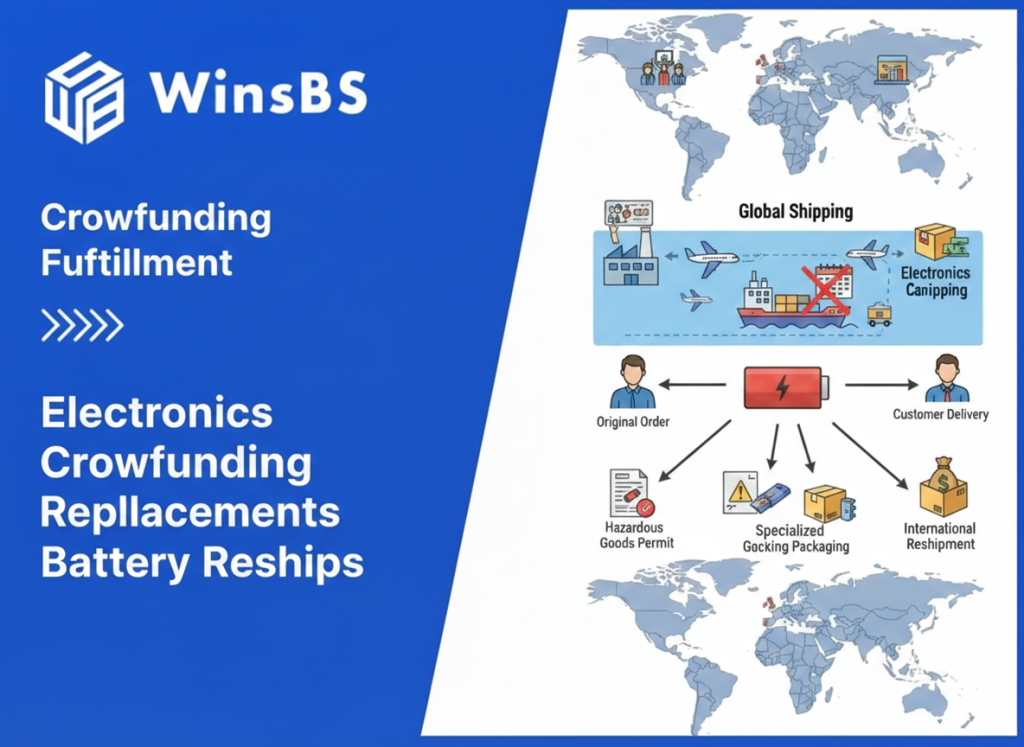
Electronics Crowdfunding Replacements 2026: Battery Reships
Electronics Crowdfunding Replacements in 2026 Why battery devices and partial defects turn reships into full-unit replacements WinsBS Fulfillment — Maxwell Anderson Updated February 2026 · Electronics & Gadgets · Crowdfunding Fulfillment · Reship & Replacement TL;DR: In electronics crowdfunding, replacements rarely stay “small.” A cracked casing, firmware issue, or unstable battery often results in full-unit reship. Once lithium batteries enter the equation, cross-border replacements behave very differently from the main wave. On this page You Shipped the Devices — Then a Few Batteries Start Failing The Variable: Battery Classification and Partial Defects Why Electronics Replacements Default to Full Units Route Differences: Lithium Reships vs Main Wave Freight Buffer Risk: When Spare Units Disappear Faster Than Expected Cost Reality: Testing, Rework, and Compliance Friction The Structural Reality of Hardware Replacement Cycles Methodology & Sources You Shipped the Devices — Then a Few Batteries Start Failing The containers arrive. Devices are picked, packed, and shipped. Tracking updates roll in. Backers post unboxing photos. For a hardware campaign, that moment feels bigger than most. Months of prototyping, tooling, certification, firmware updates — finally out in the real world. Then the first message lands. “My unit won’t power on.” “The battery drains in two hours.” “It overheats while charging.” “It arrived, but something feels off.” At first, it feels isolated. One case. Then two. Then five. The issue rate may still be small — 1% or less. But in electronics, even a small percentage carries weight. In hardware, a defect isn’t just cosmetic. It often raises safety and reliability questions. A cracked plastic casing in a board game is annoying. A lithium battery behaving unpredictably is different. And that difference changes how replacements behave. If you shipped 4,000 units, even a conservative 1% issue rate means 40 backers need resolution. In electronics, the resolution is rarely “send a small missing piece.” There usually isn’t one. You’re dealing with sealed devices, integrated components, and safety considerations. A firmware glitch might be fixable remotely. A battery stability issue usually isn’t. The main wave ships devices. The replacement wave reopens liability. That’s when the second cycle begins — not because volume failed, but because hardware behaves differently once it leaves controlled testing environments. For U.S.-based creators with international backers, this moment carries another layer: lithium batteries change how parcels move. The same route that handled bulk freight smoothly may not behave the same way for individual reships. What looked like a clean finish to fulfillment quietly becomes a new operational phase — one device at a time. The Variable: Battery Classification and Partial Defects Electronics campaigns don’t usually struggle because of SKU count. They struggle because of classification. The moment a device contains a lithium battery, it enters a different shipping category. A device with a battery is not just “a gadget.” It’s regulated cargo. During the main wave, that classification is managed at scale. Freight is prepared correctly. Documentation is aligned. Carriers are pre-selected. Volume smooths complexity. In the replacement phase, volume disappears. Now you are shipping single parcels — often to individual addresses in different countries — each one containing a battery. Carriers treat that differently than a palletized main shipment. Transit options may narrow. Air lanes may be limited. Certain services may no longer be available at small scale. The main wave benefits from freight planning. The replacement wave faces parcel-level rules. Then there’s the defect type itself. In electronics, issues rarely isolate cleanly. A casing crack might expose internal components. A charging issue might indicate battery instability. A firmware glitch might require hardware inspection to confirm. Even if only one component is faulty, the practical resolution is often full-unit replacement. Hardware problems don’t fragment well. They default to whole-device decisions. That default matters. In tabletop, you can sometimes send a single expansion. In electronics, you’re usually sending another complete device — battery included. Which means: Another unit leaves inventory Another battery crosses a border Another compliance-sensitive parcel enters transit The issue percentage may still look small. The structural weight per case is not. Why Electronics Replacements Default to Full Units In theory, a hardware defect sounds specific. “The battery won’t hold charge.” “The screen flickers.” “The button feels loose.” In practice, resolving that defect rarely means mailing one small part. Consumer electronics are integrated systems. When one part fails, the safest fix is often replacing the whole device. Most crowdfunding hardware is not designed for field repair. Devices are sealed. Batteries are internal. Casings are glued or ultrasonically welded. Opening the unit voids warranties and creates new risks. So when a backer reports a problem, you’re usually deciding between: Troubleshooting remotely and hoping firmware solves it Requesting return for inspection (slow and costly) Shipping a full replacement unit immediately Most creators choose the third option. It’s faster. It protects reputation. It avoids prolonged back-and-forth. But operationally, that choice changes the math. A “minor defect” becomes a full-unit inventory decision. If you shipped 3,500 devices and held 5% buffer, that leaves 175 spare units. At a 1% issue rate, 35 units are consumed quickly. If defects cluster early, buffer can thin before you realize it. And unlike tabletop components, you cannot rebalance parts. A spare casing without a battery is not a replacement device. A spare PCB without enclosure is not shippable inventory. Electronics buffer is binary: you either have a complete, compliant unit — or you don’t. The main wave consumes production volume. The replacement wave consumes finished goods. That’s why electronics replacements feel heavier per case. The issue percentage may match other categories. The unit impact rarely does. Bulk freight vs lithium parcel replacement workflow Comparison between main wave freight fulfillment and individual lithium battery replacement parcels, highlighting differences in cost structure, compliance handling, and operational workflow. Main Wave (Freight) Replacement (Parcel) Bulk Pallets / Sea Freight Scale Efficiency Individual Units / Air Parcel Premium Unit Cost UN38.3 Master Manifest Consolidated Compliance Individual Hazmat Labeling Parcel-Level Friction Automated Pick & Pack Linear Workflow Testing + Serial Tracking Multi-Touch Rework Fig 1: