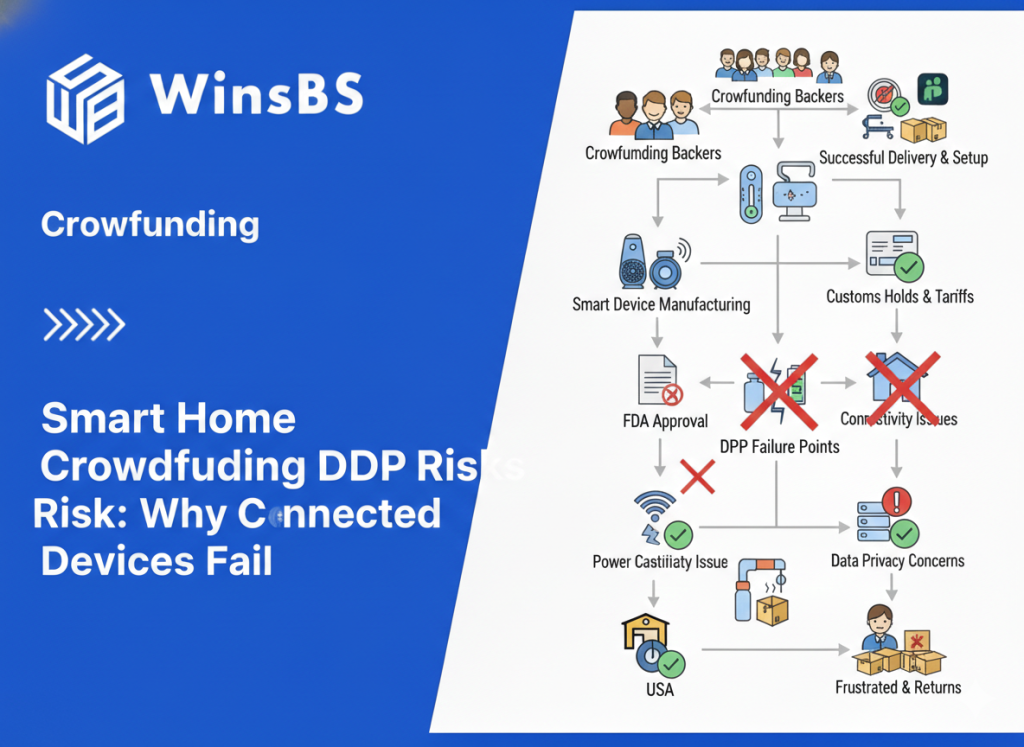
Smart Home Crowdfunding DDP Risk: Why Connected Devices Fail
Smart Home Crowdfunding DDP Risk Why Connected Devices Break After “Taxes Included” — Not Because of Shipping, but Because of Identity WinsBS Fulfillment — Maxwell Anderson Updated February 2026 Table of Contents TL;DR 1. Why Smart Home Products Are Misjudged in Crowdfunding 2. The Intuitions That Feel Right — and Always Fail 3. How Systems Actually Define a Smart Home Device 4. Why DDP Turns Identity Risk Into Locked Liability 5. Country Differences Are Entry Questions, Not Strictness 6. Why Responsibility Cannot Be Transferred Once It Breaks 7. When DDP Can Work — and Why It Rarely Does 8. The Structural Conflict With the Crowdfunding Timeline 9. What “Taxes Included” Really Means TL;DR In crowdfunding, Smart Home and connected devices repeatedly fail under Delivered Duty Paid (DDP) shipping not because customs suddenly becomes “stricter,” and not because teams ignored wireless rules. They fail because these products are redefined by entry systems as network-connected terminal devices, not ordinary consumer goods, after delivery promises, tax payments, and responsibility have already been locked. Once that identity shift occurs, missing or unfrozen variables cannot be corrected. DDP does not reduce the risk. It concentrates cost, delay, and liability on the campaign. 1. Why Smart Home Products Are Misjudged in Crowdfunding Smart Home campaigns usually begin with confidence. A smart lock still looks like a lock. A connected light still looks like a lamp. A hub looks like a simple piece of plastic. From the campaign’s point of view, these are tangible, familiar objects. Risk discussions naturally revolve around tooling, yields, packaging, and whether shipping can be advertised as “taxes included.” The system does not see them that way. At the moment of entry, Smart Home devices are not evaluated by how ordinary they appear, but by what they do: emit radio signals, connect to networks, update behavior remotely, and interact with infrastructure beyond the physical unit. This is where the first misalignment forms. The commercial world treats these products as hardware. Entry systems treat them as connected endpoints. That gap does not surface during prototyping or early testing. It surfaces only when the product meets the border — after commitments are already made. 2. The Intuitions That Feel Right — and Always Fail Failures in this category rarely come from ignorance. They come from intuitions that work perfectly well in business, but collapse under system judgment. “It’s not cellular, so it’s not a communication device.” Commercially, Wi-Fi and Bluetooth feel incidental. They are framed as features rather than identities. Systemically, the moment a device actively emits radio signals, it enters a wireless equipment evaluation path. The question shifts from “what is this product” to “what does it transmit, and under whose responsibility.” “We sell hardware, not software or services.” Backers receive a physical object. The reward is tangible. Entry systems ask whether the device depends on firmware, applications, or cloud services to function as promised. If it does, the product is no longer treated as static hardware, but as a device with ongoing behavioral control. “We can finalize everything after the campaign.” Crowdfunding assumes iteration. Prototypes evolve, features shift, and details are refined late. Entry systems do not operate on future intent. Device identity is assessed once, at entry, and “it will be finalized later” is not an acceptable state. 3. How Systems Actually Define a Smart Home Device Systems do not read marketing pages. They do not care how the product was framed on a campaign page. Identity is derived from observable variables. Identity Variable System Question Observed Failure Outcome Wireless emission Does the device transmit radio signals? Wireless equipment path triggered Protocol type Wi-Fi, BLE, Zigbee, Thread, Sub-GHz? Country-specific entry logic applied Transmission behavior Continuous or event-based? Escalated technical review Firmware control Can behavior change post-sale? Lifecycle responsibility questioned OTA capability Who controls updates? Manufacturer accountability locked Cloud dependency Is remote service required? Service-linked identity applied App requirement Is the device usable offline? Not treated as standalone hardware Data capture Does it sense or record? Privacy or security review triggered Battery type Is there an internal lithium cell? Hazmat overlay added Product role Endpoint or system gateway? Infrastructure classification risk Bundle context Sold alone or as a kit? Reclassification as a system Responsible entity Who legally owns device behavior? Responsibility locked at entry Observed Scenario: A Small Change That Triggers a System Failure A campaign ships a Smart Home sensor originally designed for local Bluetooth control. Late in production, firmware is updated to allow optional cloud connectivity. The hardware is unchanged. The packaging is unchanged. The declaration still reflects the original design. At entry, the device is evaluated as a remotely controlled, network-connected endpoint. Documentation tied to the earlier configuration no longer maps cleanly. The shipment is held. No post-entry correction is accepted. 4. Why DDP Turns Identity Risk Into Locked Liability Delivered Duty Paid shipping is often chosen to remove friction for backers. Taxes are prepaid. The experience appears clean. In Smart Home categories, this creates a dangerous illusion. Payment of duties does not determine whether a device is admissible. Once device identity is questioned, responsibility concentrates immediately. Duties are sunk. Storage costs accrue. Options narrow to return, destruction, or indefinite delay. DDP does not mitigate uncertainty here. It converts uncertainty into irreversible liability. 5. Country Differences Are Entry Questions, Not Strictness Countries do not differ because one is “harder” than another. They differ because each system asks a different first question. United States. Entry systems first determine what kind of device this is. If it is treated as a connected endpoint, identity and responsibility are resolved before release. European Union. Evaluation begins with whether the device fits a defined equipment category. Unclear identity variables halt the process early. United Kingdom. Post-EU divergence changes sequencing, but identity determination remains front-loaded. Canada. Wireless behavior frequently becomes the earliest trigger, before logistics considerations are addressed. Australia and Japan. Device role and ongoing control are assessed early, leaving little room for correction once flagged. 6. Why Responsibility Cannot Be Transferred Once It Breaks