







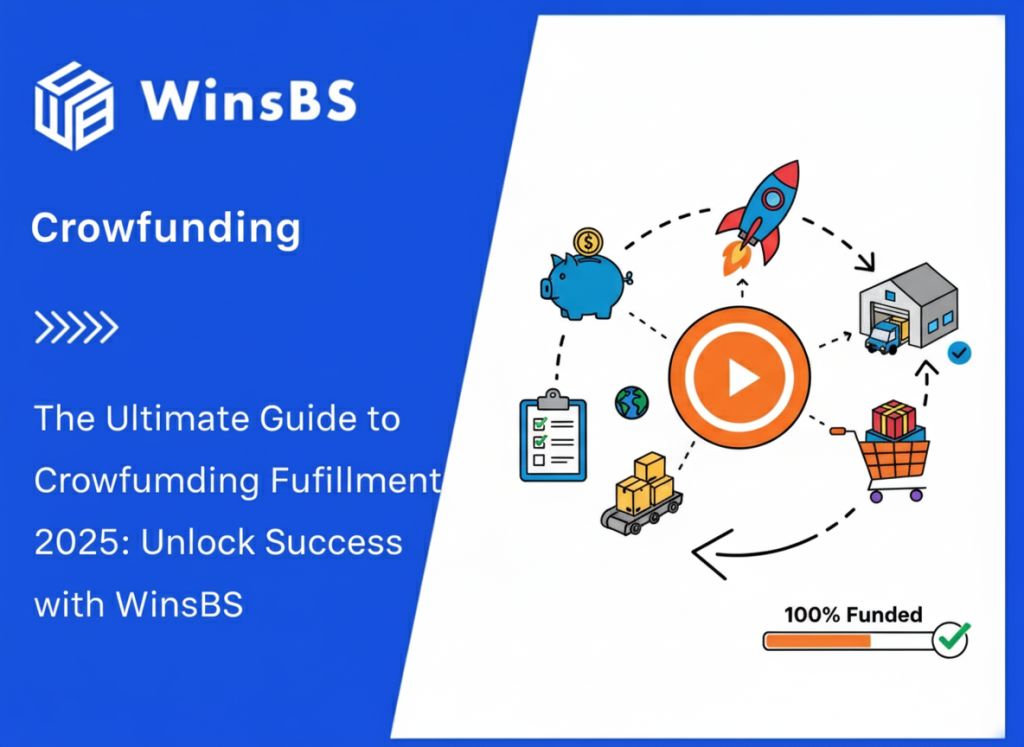
The Ultimate Guide to Crowdfunding Fulfillment in 2025
The Ultimate Guide to Crowdfunding Fulfillment in 2025 How Kickstarter, Indiegogo & Gamefound Creators Prevent Delays, Cost Overruns, and Backer Complaints WinsBS Fulfillment – Maxwell Anderson Updated December 2025 TL;DR Crowdfunding fulfillment is the end-to-end operational process of turning pledge data into delivered rewards: inventory receiving, tier-to-SKU mapping, pick and pack, shipping labels, customs and duties decisions, tracking, replacements, and returns. In 2025, most crowdfunding fulfillment failures are not “carrier delays” — they are compounding execution breakdowns: bad tier data, weak address control, incomplete compliance files (especially for batteries), slow inbound-to-shelf receiving, and exception chaos that corrupts the main shipping wave. The highest-ROI path is not “spend more everywhere.” It is building a campaign-specific crowdfunding order fulfillment system: data-lock rules, wave planning, packaging standards, cross-border duty clarity, and a 3PL execution layer that isolates exceptions early. If you need a campaign-ready plan for crowdfunding fulfillment services (Kickstarter, Indiegogo, or Gamefound), get a free crowdfunding fulfillment plan from WinsBS. Contents What Is Crowdfunding Fulfillment? Why Crowdfunding Fulfillment Fails in 2025 Two Critical Updates (2025) Crowdfunding Fulfillment in the United States: What Actually Matters Kickstarter vs Indiegogo vs Gamefound Fulfillment Crowdfunding Fulfillment vs Ecommerce Fulfillment vs Freight Forwarders What a Crowdfunding-Specific 3PL Actually Looks Like How to Choose the Right Crowdfunding Fulfillment Partner Crowdfunding Fulfillment Pricing: Cost Structure & Total Cost Campaign Fulfillment Timeline (From Factory to Backer) Crowdfunding Fulfillment FAQs (2025) Outlook: 2026 Trends Creators Should Plan For Final Recommendation WHAT IS CROWDFUNDING FULFILLMENT? Crowdfunding fulfillment is the operational workflow that converts pledges (tiers, add-ons, shipping regions, and backer addresses) into accurate, compliant, and trackable deliveries. In practice, crowdfunding order fulfillment is not just “shipping rewards.” It is the coordination of inventory, data, packaging, customs decisions, warehouse execution, and exceptions — under a public timeline. A reliable definition that creators can use: crowdfunding fulfillment services include inbound receiving, quality control, SKU labeling, tier mapping, pick and pack, label creation, last-mile carrier handoff, tracking, replacements, returns processing, and post-shipment support. Crowdfunding Fulfillment vs Ecommerce Fulfillment (Practical Difference) Ecommerce fulfillment assumes steady daily orders with predictable SKU behavior. Crowdfunding fulfillment assumes burst volume, time-boxed shipping waves, tier complexity, and public backer scrutiny. A normal ecommerce workflow can ship fast and still fail crowdfunding if tier accuracy, add-ons, address changes, and replacement logic are not engineered from the start. WHY CROWDFUNDING FULFILLMENT FAILS IN 2025 Most delayed crowdfunding projects do not fail because a truck ran late. They fail because small “data and execution” issues compound into a visible collapse: wrong packs, wrong addresses, inventory mismatches, customs holds, and a flood of exceptions that destroys throughput. If you want a campaign that backers praise instead of complain about, treat crowdfunding fulfillment as a designed system. Four failure categories appear repeatedly in Kickstarter fulfillment and Indiegogo fulfillment: Planning failures: vague tier mapping, no wave plan, no packaging standards, and no “definition of done.” Compliance and paperwork gaps: weak commercial invoices, incomplete product descriptions, missing battery documentation where required. Backer data errors: address changes, undeliverable formats, late survey edits, duplicate orders, and unsupported regions. Warehouse execution bottlenecks: slow receiving, inaccurate inventory counts, missed cutoffs, and exceptions mixed into the main wave. The Most Expensive Pattern: Exceptions Poison the Main Wave In crowdfunding fulfillment, one error type can spread: an address format problem becomes label rework, rework becomes missed cutoffs, missed cutoffs become backer complaints, complaints become support overload, overload reduces operational focus, and the error rate increases again. The fix is not “more people.” The fix is isolating exceptions early so the main wave stays clean. TWO CRITICAL UPDATES (2025) Correction Update #1: “Fast Shipping” Is Not the Same as “Successful Crowdfunding Fulfillment” Many creators choose a provider based on promises like “2-day shipping.” In crowdfunding fulfillment, success is defined first by tier accuracy, exception control, and predictable wave execution. Fast shipping can still fail if tier bundles, add-ons, replacements, and address changes are handled manually or inconsistently. A practical creator metric: if your provider cannot clearly describe how they handle tier mapping, re-ship rules, and exception queues, you are not buying crowdfunding fulfillment services — you are buying labels. Correction Update #2: “One-Stop Logistics” Claims Often Hide Responsibility Gaps In 2025, many suppliers and forwarders market “one-stop” services. The problem is accountability. If inbound receiving is slow, inventory is inaccurate, or backer data is not validated, a “one-stop” claim does not protect your campaign. Crowdfunding fulfillment requires clear ownership of each stage: data import, inventory truth, pick and pack accuracy, cutoff engineering, and replacements/returns handling. A simple rule: for campaign fulfillment, every milestone must have an owner and a measurable output — “received,” “available-to-ship,” “picked,” “packed,” “shipped,” and “exception-resolved.” CROWDFUNDING FULFILLMENT IN THE UNITED STATES: WHAT ACTUALLY MATTERS Creators frequently ask if they need a large warehouse network for crowdfunding fulfillment USA. The answer is: you need the right coverage for your backer distribution and your cost model — plus fast inbound-to-shelf receiving. In the United States, the biggest performance gap is rarely “how many warehouses exist.” It is whether your US crowdfunding fulfillment operation can convert arrivals into ship-ready inventory quickly and ship waves predictably. For most Kickstarter fulfillment and Indiegogo fulfillment campaigns shipping across the United States: Inventory truth beats inventory spread: two locations with accurate counts often outperform many locations with drift. Inbound-to-shelf speed is a hidden driver: “delivered to warehouse” is not “available to ship.” Zone strategy matters: the best network is one that matches your order map and shipping cutoff plan. Ground reliability beats expensive upgrades: predictable 2–5 day ground shipping is often the best cost-to-experience trade. China → United States Replenishment: The Real Risk Is Not Transit Time Many campaigns source from China. The recurring delay driver is not only transit time — it is uncertainty: unclear lane milestones, missing documents, rework at arrival, and slow receiving. The best crowdfunding fulfillment strategy is to plan replenishment with auditable milestones and protect your campaign timeline with buffers and pre-defined exception rules. If your campaign includes batteries or regulated components,