Free 1 Month of Warehousing for New Clients Start with lower storage cost from day one.

FREE QUOTE

Michael

Since 2013, Michael has been neck-deep in the world of order fulfillment—digging into every nook and cranny of warehousing, logistics, and the full supply chain. What started with mastering 3PL operations quickly expanded into a holistic grasp of how every piece connects: from the moment an order hits the system to the second it lands on a customer’s doorstep, he’s lived and breathed the nitty-gritty.​
Years of rolling up his sleeves in the field have turned him into a go-to for insights that matter—whether it’s streamlining warehouse workflows, troubleshooting last-mile snags, or untangling the complexities of end-to-end supply chain management. For Michael, it’s not just about the processes; it’s about sharing the hard-earned lessons that help businesses run smoother, faster, and smarter.​
Here, he breaks down the chaos of logistics into actionable wisdom—because when it comes to getting things from point A to point B (and every point in between), experience isn’t just valuable. It’s everything.​

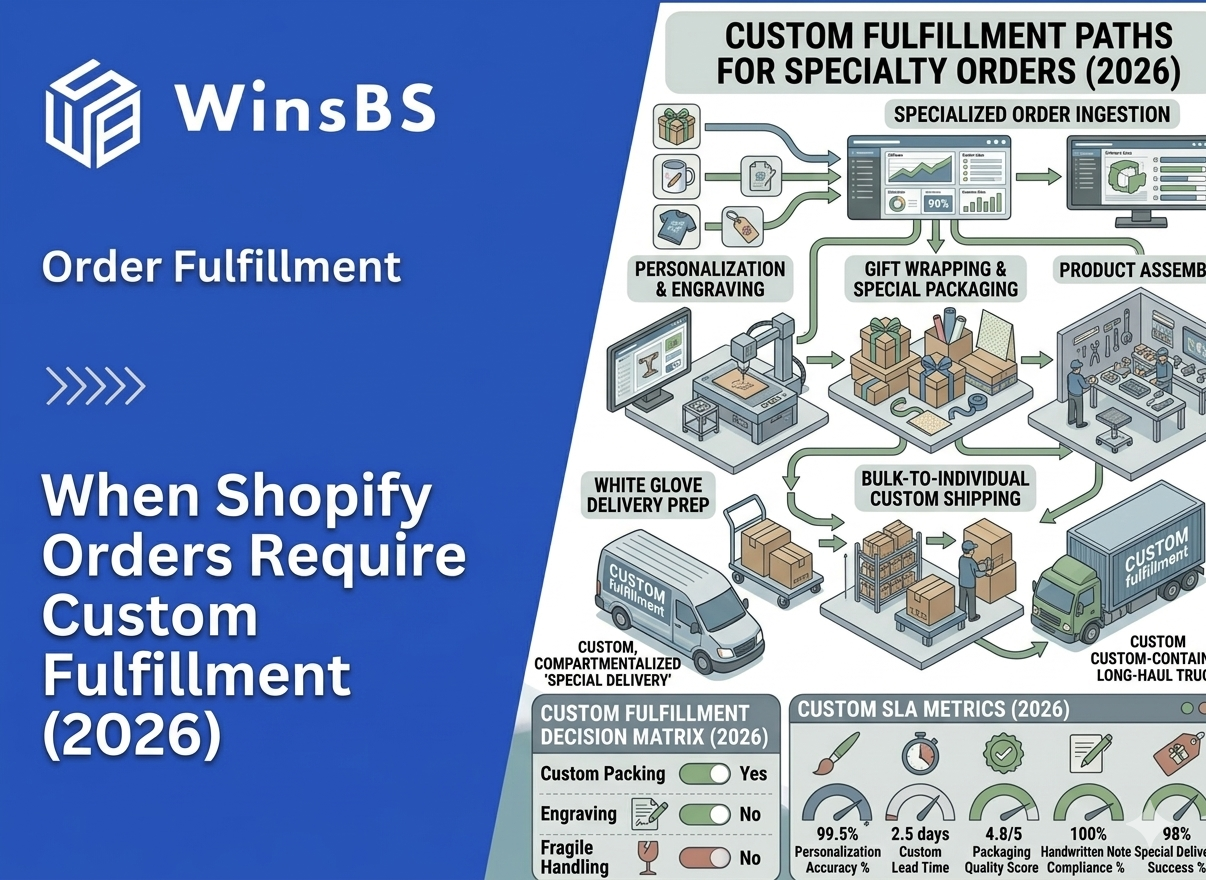
WinsBS infographic “When Shopify Orders Require Custom Fulfillment (2026).” Isometric workflow showing custom order intake, personalization, gift packaging, white-glove prep, dedicated logistics, and SLA metrics.
Ecommerce, Order Fulfillment, Shipping & Logistics, Warehousing, Winsbs

Custom Order Fulfillment for Shopify in 2026: When Standard 3PL Workflows Stop Fitting the Order

Custom Order Fulfillment for Shopify in 2026 When standard 3PL workflows stop fitting the order and the work has to be defined differently Michael Director | WINSBS April 2026 In Brief Most Shopify teams are already doing custom fulfillment before they call it that. The sign is simple: the orders still look manageable in Shopify, but the warehouse is now relying on extra notes, bundle logic, insert changes, or product-specific handling to get them out correctly. Once that starts happening regularly, the issue is no longer whether Shopify can pass the order through. It is whether the work has been defined clearly enough to run without memory, side channels, and rework becoming the real workflow. The moment this usually becomes visible A campaign goes live, the insert changes midweek, one bundle variant is short, customer service still promises the original ship window, and the warehouse is now working from a mix of order tags, account notes, and human memory. That is usually when a merchant realizes the orders may still look normal in Shopify, but the fulfillment model underneath them no longer is. Use this page for the narrower problem If you are still deciding whether the business even needs a 3PL, start with Best 3PL for Shopify in 2026. If you still need the broader provider map, use Shopify Fulfillment Companies in 2026. This page is for the next stage: when the order itself has changed enough that standard pick-pack-ship no longer describes the work cleanly. Table of Contents What Merchants Usually Mean When Standard Fulfillment Stops Fitting Shopify’s Native Mechanism Where It Breaks First What Must Be Defined Which Brands Cross Earlier Boundary Table Where WinsBS Fits Official References Frequently Asked Questions Keep Reading Most Merchants Search This Phrase Only After Standard Fulfillment Has Already Started Slipping If you are not at the workflow-definition stage yet and still need the broader selection framework, go back to best 3pl for shopify. If you need the wider market landscape before narrowing to one operating model, use shopify fulfillment companies. Most merchants do not use this phrase because they are interested in a technical setting. They use it because something about the order has changed and the current fulfillment flow no longer feels clean. Sometimes the change is obvious. A bundle has to be assembled. A note has to be inserted. The outer carton has to reflect a campaign. A battery product needs extra handling. A wholesale order and a DTC order are now entering the same operation but cannot be treated the same way. Sometimes the change is quieter. The order still looks simple in Shopify, but the real instruction lives outside the order in a spreadsheet, a tag, a Slack message, or a weekly email to the warehouse. That is usually the moment the business has already crossed into custom fulfillment, even if nobody has named it yet. The practical definition Custom order fulfillment starts when the order can no longer move through one repeatable warehouse path without interpretation, assembly, or exception handling. The Real Threshold Is When Standard Pick-Pack-Ship Stops Describing the Work A standard 3PL workflow assumes the warehouse can pick known items, pack them to a stable rule, and move them out with limited interpretation. Once the order needs more than that, the work changes. Bundles and kits change the order from selection to assembly A multi-SKU bundle is not just a longer pick list. It often has its own logic, sequence, packaging requirement, and quality risk. If the warehouse is still treating it like ordinary outbound, packout accuracy starts depending on tribal knowledge instead of process. Inserts and campaign packouts turn every order into a moving target One insert campaign is manageable. Weekly insert changes across several campaigns are different. Once packout rules change faster than the warehouse workflow itself, custom is no longer a marketing flourish. It is a control problem. Personalization creates order-level exceptions The moment an order needs a name, a note, a chosen configuration, or any buyer-specific handling, the warehouse can no longer treat all otherwise similar orders as interchangeable. That introduces verification work, failure risk, and return complexity. Special-handling products break the fantasy of a universal workflow Fragile items, liquids, batteries, compliance-sensitive goods, gift sets, and premium unboxing programs all pull the order away from plain parcel logic. The shipping label may still be standard. The work behind it is not. Mixed channels create conflicting instructions from the same stock A merchant may think they need custom order fulfillment because orders are more complicated. In reality, they sometimes need it because several channels are asking the same inventory to behave differently. Shopify, Amazon, wholesale, influencer seeding, and campaign orders can all pass through one building while demanding different rule sets. Shopify’s Native Custom Fulfillment Service Explains the Hand-Off, Not the Warehouse Reality Shopify uses the phrase “custom fulfillment service” in a specific platform sense. Its documentation explains how a merchant can add a custom fulfillment service and route order information through that mechanism. That is useful platform behavior to understand. But merchants often search this phrase while meaning something else entirely. They are not asking whether Shopify can email order details or route a status update. They are asking whether the warehouse-side workflow can support orders that no longer fit a standard path. Those are related questions, but they are not the same question. Why the distinction matters Shopify’s custom fulfillment mechanism explains how the platform can hand work off. Custom order fulfillment in practice explains whether the warehouse can actually execute that work accurately, repeatedly, and transparently. This is where many merchants get stuck. The integration exists, the order tags exist, the workflow technically connects, but the actual work still depends on interpretation, side instructions, and manual correction. That is not a software problem anymore. It is an operating-model problem. Custom Shopify Orders Usually Break First Where the Rule Is Least Visible Custom order fulfillment rarely fails first at carrier speed. It usually fails where the custom instruction

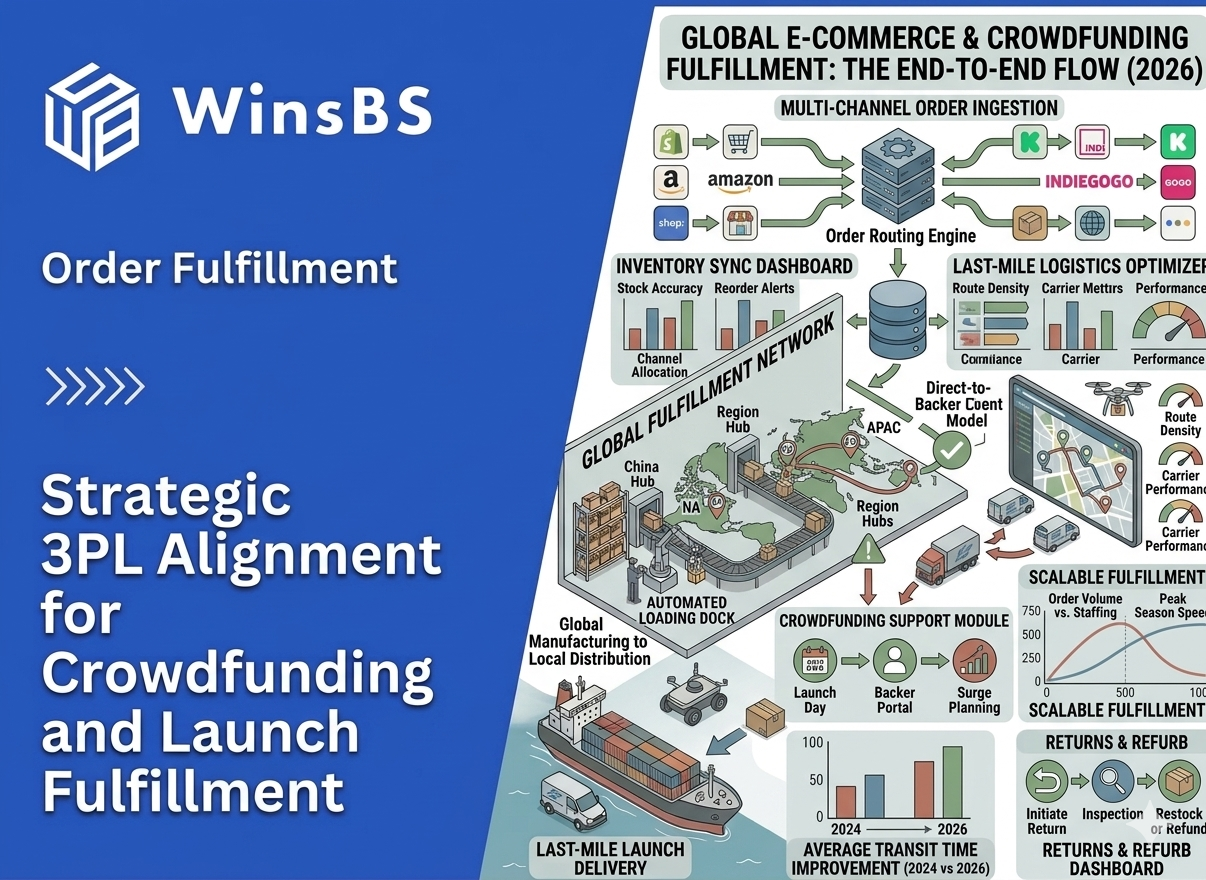
Isometric infographic showing global eCommerce and crowdfunding order fulfillment beside WinsBS logo and title, featuring multi-channel integrations, inventory sync, and 3PL fulfillment network.
Ecommerce, Order Fulfillment, Shipping & Logistics, Warehousing, Winsbs

Strategic 3PL Alignment for Crowdfunding and Launch Fulfillment

Why Crowdfunding and Complex Launch Fulfillment Depend More on Strategic 3PL Alignment Why multi-wave inventory flow, release timing drift, and customer-promise pressure expose weak fulfillment structures faster WinsBS Research INDEPENDENT FULFILLMENT RESEARCH · COMPLEX LAUNCH OPERATIONS March 2026 Quick Read Complex launch fulfillment usually becomes fragile when inventory timing, release sequencing, support communication, and customer promises stop moving together. In that environment, a 3PL relationship cannot be judged on warehouse execution alone. The stronger relationship is usually the one with enough structure to absorb staged arrivals, changing release logic, and rising support pressure without forcing every exception back onto the operator. Why This Matters Crowdfunding and complex launch programs are often evaluated as if the main question were whether a warehouse can ship on time. That is too narrow. The harder problem usually appears when inventory lands unevenly, release conditions shift, and customer-facing timing becomes more exposed. This article focuses on the relationship structure required to keep launch fulfillment usable under those conditions. Table of Contents Why Standard Models Break Faster What the 2026 Study Suggests Why Launch Fulfillment Needs More Multi-Wave Risk and Coordination What Strategic Alignment Looks Like What to Clarify Before Launch Frequently Asked Questions Decision Closure Source Traceability Why Standard 3PL Models Break Faster in Crowdfunding Fulfillment Crowdfunding and complex launch fulfillment put more pressure on a 3PL relationship because inventory, customer expectation, and release timing are rarely stable enough for a narrow transactional model. In a standard replenishment environment, the relationship is often judged on whether orders move efficiently through a relatively predictable flow. In a launch environment, the operating picture is less stable from the beginning, and the cost of misalignment becomes visible much faster. The issue is not simply whether a 3PL can store inventory and ship orders. The issue is whether the relationship can absorb uneven demand, staged inventory arrivals, shifting release conditions, and rising customer-facing pressure without forcing the operator to manually coordinate every new exception. Once a campaign goes live, those pressures usually arrive together rather than one at a time. That difference matters because launch fulfillment is rarely protected by the same buffers that make standard ecommerce execution look stable. Customer expectations are more exposed, timing assumptions are more visible, and operational drift becomes harder to hide once backers or launch customers are already waiting on a specific wave, bundle, or promised ship window. Under those conditions, a 3PL model that works well in normal flow can start breaking faster than the operator expects. What Makes This Fulfillment Model Different Demand arrives unevenly: the order stream does not always behave like a stable replenishment pattern. Inventory often lands in stages: what can ship and when it can ship may keep changing after launch. Release timing is harder to stabilize: the launch model may need to adjust while customers are already watching progress. Customer promises are more exposed: timing drift becomes visible faster and is harder to absorb quietly. The real question is whether the 3PL relationship is actually structured to absorb that pressure. Strategic alignment matters more here than it does in a calmer fulfillment model. What the 2026 3PL Study Suggests About Strategic Alignment The 2026 Third-Party Logistics Study is useful here because it shows that many shipper-3PL relationships are described as strategic, but not all of them appear to be structured strongly enough to absorb execution pressure when conditions become unstable. That distinction matters in complex launch fulfillment because strategic language is easy to claim in a stable operating environment. It becomes more meaningful only when the relationship is tested by changing release conditions, uneven inventory flow, and rising customer-pressure exposure. The study matters beyond general relationship sentiment. High confidence in the relationship is useful, but it does not automatically prove that the underlying operating structure is strong enough for launch fulfillment. In a crowdfunding or multi-wave environment, the more important question is whether the relationship includes enough review discipline, shared visibility, and escalation clarity to absorb change without forcing the operator to manage every exception from outside the warehouse. Strategic Language Is Common, but Structure Is Not Always Deep One of the useful readings of the study is that shipper-3PL relationships are often described in strategic terms, yet the mechanisms that support real operational alignment are less evenly established. That gap may not become obvious when the fulfillment model is stable. It becomes much more visible when execution conditions change quickly and both sides need to respond through a shared structure rather than through ad hoc communication. In launch fulfillment, that difference matters immediately. A relationship can sound collaborative at a high level and still be structurally weak once release sequencing, staged arrivals, or support-pressure changes begin forcing decisions across multiple teams at once. Stable Environments Hide Weak Alignment More Easily The study also matters because it helps explain why some 3PL relationships appear stronger than they really are until operating pressure increases. In a stable replenishment model, weak escalation discipline or shallow review structure may not create obvious problems right away. Orders continue moving, inventory assumptions remain relatively stable, and the relationship appears functional. A launch environment is much less forgiving. Once wave timing shifts or inventory lands unevenly, weak structure is exposed faster. What looked like a strategic relationship in a calmer setting may turn out to be a transactional relationship with better language around it. Strategic Alignment Is More Than Relationship Sentiment The study is most useful when strategic alignment is read as an operating condition rather than a relationship label. For a launch operator, the important issue is not whether the provider sounds responsive or cooperative. It is whether the relationship includes shared review, clear ownership, consistent escalation, and enough visibility into the launch model to keep changes from becoming unmanaged execution risk. In that sense, the study supports a practical conclusion. Strategic alignment matters more in launch fulfillment because the environment exposes weak structure faster. Once the launch begins shipping under changing conditions, the relationship is no longer being tested

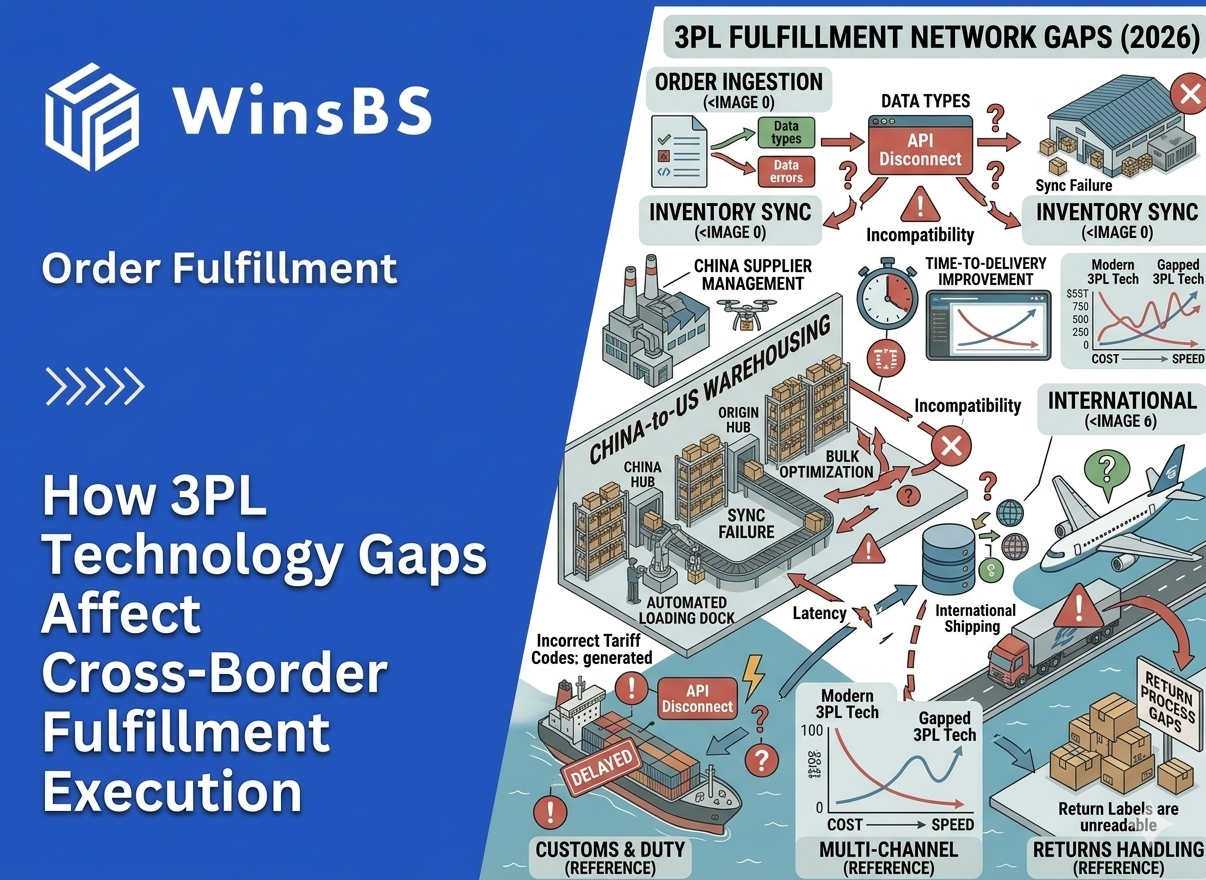
Isometric logistics infographic showing cross-border order fulfillment from China to the U.S. with warehouse sync failures, API disconnects, and data issues beside WinsBS logo and title, highlighting 3PL fulfillment technology gaps and their impact on order fulfillment performance.
Ecommerce, Order Fulfillment, Shipping & Logistics, Warehousing, Winsbs

How 3PL Technology Gaps Affect Cross-Border Fulfillment Execution

How 3PL Technology Gaps Affect Cross-Border Fulfillment Execution Why better systems improve data and coordination, but still cannot override physical execution reality WinsBS Research INDEPENDENT FULFILLMENT RESEARCH · CROSS-BORDER OPERATIONS March 2026 Quick Read The real 3PL technology gap in cross-border fulfillment is not whether software exists. It is whether the system improves data accuracy, visibility, exception handling, and coordination across origin, transit, customs, warehouse intake, and downstream delivery without overstating what technology can actually control. Better platforms can reduce preventable mistakes and shorten reaction time, but they cannot eliminate customs holds, carrier delay, warehouse bottlenecks, or policy volatility. Why This Topic Matters Technology claims are easy to overread in logistics. In cross-border fulfillment, however, the execution chain still depends on multiple physical handoffs, multiple operating teams, and multiple events that sit outside the platform layer. This article focuses on the useful boundary: what 3PL technology can genuinely improve, where it still falls short, and how operators should evaluate those limits in practice. Table of Contents Why the Debate Is Framed Wrong What the 2026 Study Reveals What Technology Can Improve What Technology Cannot Fix Why Execution Still Fails What Operators Should Ask Frequently Asked Questions Why the 3PL Technology Debate Is Often Framed Wrong The 3PL technology debate is often framed too loosely. Technology is still discussed as if software can solve execution problems that are actually physical, regulatory, or network-driven. That framing is especially misleading in cross-border fulfillment, where movement depends on more than one system and more than one controlled environment. A provider may have a modern interface, stronger dashboards, or more automation language, yet still operate inside a chain shaped by carrier dependency, customs intervention, warehouse limits, and policy volatility that software cannot remove. That is why this should not be treated as a simple question of whether a 3PL is technologically advanced. The more useful question is whether its technology improves decision quality inside a chain that remains operationally complex. In cross-border fulfillment, execution does not happen inside the platform alone. It happens across origin handling, transport movement, customs review, warehouse intake, and downstream delivery commitments that have to stay aligned in real time. This distinction matters because technology is often marketed as if visibility creates control by itself. In reality, visibility only becomes valuable when it helps operators respond earlier, coordinate better, and avoid preventable mistakes. It does not change the fact that a late carrier handoff is still late, a customs hold is still a customs hold, and a warehouse capacity ceiling is still a physical limit. Once that boundary is clear, the technology discussion becomes more useful. The real issue is not whether systems look modern. It is what they actually improve, where they still fall short, and how those limits affect fulfillment execution under pressure. What This Article Is Actually About Not software marketing: this is not a review of dashboards, AI labels, or interface quality. Not warehouse systems alone: fulfillment execution depends on carriers, customs, warehouse intake, and downstream coordination across the full chain. Not technology hype: stronger systems can improve response speed and information quality, but they do not override physical or regulatory reality. But operating control: the real question is whether a 3PL’s technology helps teams act better inside a cross-border network that remains inherently complex. The 2026 Third-Party Logistics Study is useful here because it helps separate adoption from operating usefulness. The strongest signal is not adoption in the abstract. It is that expectation for usable technology still appears to run ahead of what many operators believe current 3PL systems actually deliver. What the 2026 3PL Study Actually Reveals About the Gap The most important technology signal in the 2026 Third-Party Logistics Study is not simply that digital adoption is rising. It is that expectation still runs ahead of practical usefulness. Shippers increasingly say technology capability matters when selecting a 3PL, yet satisfaction with actual 3PL technology performance remains meaningfully lower. That gap matters more than the adoption headline because it points directly to an execution problem rather than a branding problem. This distinction matters in cross-border fulfillment because technology is easy to overread at a distance. A provider may report analytics usage, AI activity, optimization tools, or platform investment and still leave the operator with limited control over route variability, exception handling, or inventory timing. The more useful reading is that technology importance is already widely accepted. The real issue is whether the technology being deployed is actually helping operators run a more stable network. Technology Importance Is No Longer in Doubt One of the clearest signals in the study is that shippers now treat technology capability as an important part of 3PL selection. That matters because it confirms a broader shift in how 3PL value is judged. Providers are no longer being evaluated only on transportation reach, warehouse footprint, or labor execution. They are increasingly being judged on whether their systems improve visibility, coordination, and operating control across the fulfillment chain. In cross-border terms, that change is significant. Once inventory is moving across origin, transit, customs, warehouse intake, and downstream delivery, system quality becomes part of the execution model rather than a secondary support layer. Adoption Does Not Equal Operating Usefulness The study also shows that advanced analytics and AI-related tools are already active in a meaningful share of the market. On the surface, that can sound like technology maturity. The more useful reading is different. Usage alone does not tell an operator whether the system actually improves decision quality at the points where fulfillment breaks down. In practice, a 3PL may be able to claim analytics, AI, automation, or optimization while still giving the shipper delayed status, weak exception ownership, or shallow visibility at the moments that matter most. That is why the adoption story is not enough. The operating question is whether those tools improve execution, not whether they exist. The Satisfaction Gap Is the Real Operating Signal The strongest signal in the study is the spread between expectation and satisfaction. That

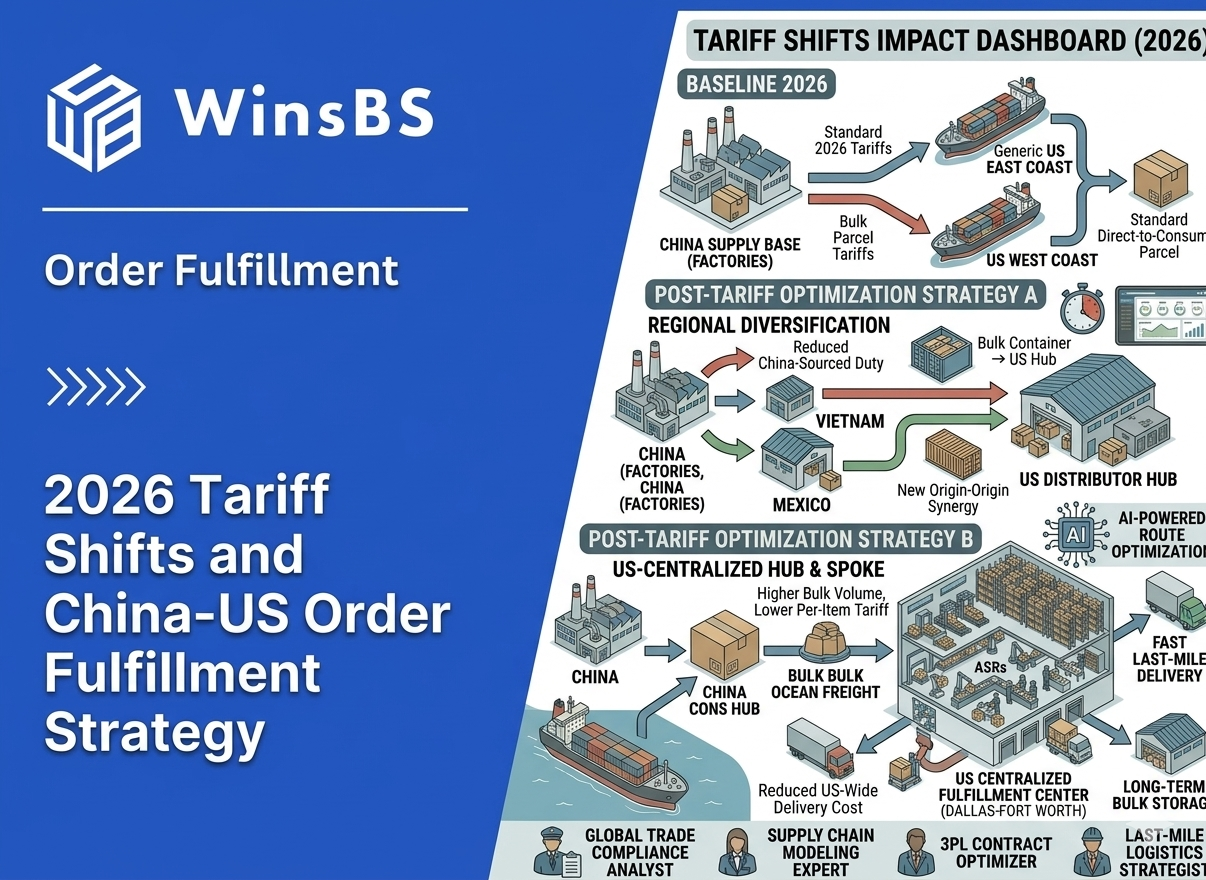
Infographic showing 2026 tariff changes and China–US order fulfillment strategy beside WinsBS logo and title, illustrating diversified sourcing, centralized U.S. fulfillment hubs, and optimized 3PL order fulfillment operations.
Ecommerce, Order Fulfillment, Shipping & Logistics, Warehousing, Winsbs

2026 Tariff Shifts and China-US Order Fulfillment Strategy

2026 Tariff Shifts and China-US Order Fulfillment Strategy WinsBS Research INDEPENDENT FULFILLMENT RESEARCH · CHINA-US OPERATIONS March 2026 Quick Read The 2026 tariff shift is not just a duty issue. For China-US fulfillment teams, it changes planning windows, customs exposure, route defensibility, and inventory timing at the same time. The practical question is no longer whether tariffs are higher or lower in isolation. It is which route model still works under the current policy window, the current enforcement climate, and the current level of verification risk. Table of Contents Why This Is a Fulfillment Decision Problem What Changed in February 2026 Enforcement Playbook Route Decision Matrix Scenario Split by Operator Type 30 / 60 / 90-Day Action Plan Why 2026 Tariff Shifts Are a Fulfillment Decision Problem In 2026, China-US order fulfillment is no longer driven by tariff rates alone. It is being shaped by a moving combination of temporary policy windows, enforcement pressure, and route-level execution risk. For operators, that changes the question. The issue is no longer whether tariffs have gone up or down in the abstract. The issue is whether the current fulfillment model can still hold under the conditions now attached to moving goods into the United States. That is why this is a fulfillment decision problem rather than a trade-policy article. Tariff shifts now affect more than landed cost. They affect booking timing, customs exposure, inventory staging, route design, documentation discipline, and the stability of the customer-facing delivery model. A route that once looked efficient can become much weaker if the new tariff structure, the enforcement environment, and the business’s current operating assumptions stop fitting together. The practical framework for 2026 is straightforward. First, there is a temporary policy window that changes what is possible in the near term. Second, there is an enforcement layer that can still delay, detain, or weaken a shipment even if the tariff headline looks manageable. Third, there is the route decision itself, which now has to balance cost, timing, verification exposure, and continuity. Those three variables have to be evaluated together. Who Needs to Act Now on China-US Fulfillment Importers with active Q2-Q3 volume: because the current tariff structure creates a temporary planning window rather than a stable long-term base. 3PL and fulfillment operators: because route design and customs performance now matter more than transportation execution alone. Supply chain and procurement leads: because tariff timing, documentation quality, and route stability now affect the same decision set. Brands comparing China-direct, China+1, and US staging: because 2026 conditions make route choice a strategic operating decision, not just a sourcing preference. Before deciding how aggressively to move inventory or which route to defend, teams need a clear view of what actually changed in late February 2026 and why that change created a temporary planning window rather than a durable reset. What Changed After February 20 and February 24, 2026 The February 2026 policy shift did not remove tariff risk. It changed the structure of that risk. For China-US fulfillment teams, the practical issue is not whether the environment suddenly became simple. It is that one tariff mechanism ended, a narrower temporary mechanism took its place, and that change created a short planning window rather than a stable long-term settlement. That distinction matters because fulfillment decisions are highly sensitive to timing. If a business treats the current posture as permanent, it may overcommit to a route or inventory model that becomes weaker once the window closes. If it ignores the window entirely, it may miss the opportunity to move inventory, adjust routes, or revise contracts while the current structure is still in place. What Ended On February 20, 2026, the White House ended a set of tariff actions tied to the earlier IEEPA structure. For operators, the significance is straightforward: the broader emergency-tariff framework that had pushed exposure much higher was no longer the current operating baseline. That did not erase all tariff pressure, but it did change the near-term planning environment. What Replaced It Beginning February 24, 2026, the working baseline shifted to a Section 122 temporary import surcharge set at 10%. That matters because Section 122 is narrower and more time-bound than the emergency posture it replaced. It also carries a statutory ceiling of 15%, but that ceiling should not be confused with the current applied rate. For planning purposes, the current working figure remains 10%, not 15%. Why the Current Window Matters For fulfillment operators, the practical value of the Section 122 shift is that it creates a temporary planning window that runs roughly through July 24, 2026. That window is long enough to affect booking decisions, inventory staging, route review, and contract timing. It is short enough that companies cannot treat it as a durable operating base. In practical terms, this means some businesses still have time to accelerate eligible shipments, stage inventory earlier, or test a more stable route before the current structure expires. The point is not to overreact. The point is to recognize that timing itself has become part of the fulfillment decision. Why This Is Not a Stable Long-Term Base The current window should be treated as a temporary operating condition, not as a settled tariff structure. USTR investigations and later tariff actions can still change the planning base after the current Section 122 period ends. For that reason, fulfillment teams should use the current window to improve control, not to assume that volatility has disappeared. Current Planning Window and Monitoring Triggers Current baseline: Section 122 temporary surcharge at 10%, plus any applicable existing Section 301 tariffs. Current planning window: now through around July 24, 2026, subject to route-specific clearance and enforcement risk. Do not assume stability: the current posture is temporary and should not be treated as a long-term tariff settlement. Watch for next-step signals: White House proclamations, USTR Section 301 notices, Federal Register actions, and CBP CSMS alerts. Before deciding how aggressively to move inventory or redesign routes, teams need to factor in one more reality: even a workable tariff window can

Isometric infographic of China–US cross-border logistics flow with transport modes, warehouse network, and decision dashboard beside WinsBS logo and title, symbolizing cross-border 3PL fulfillment and order fulfillment strategy.
Ecommerce, Order Fulfillment, Shipping & Logistics, Warehousing, Winsbs

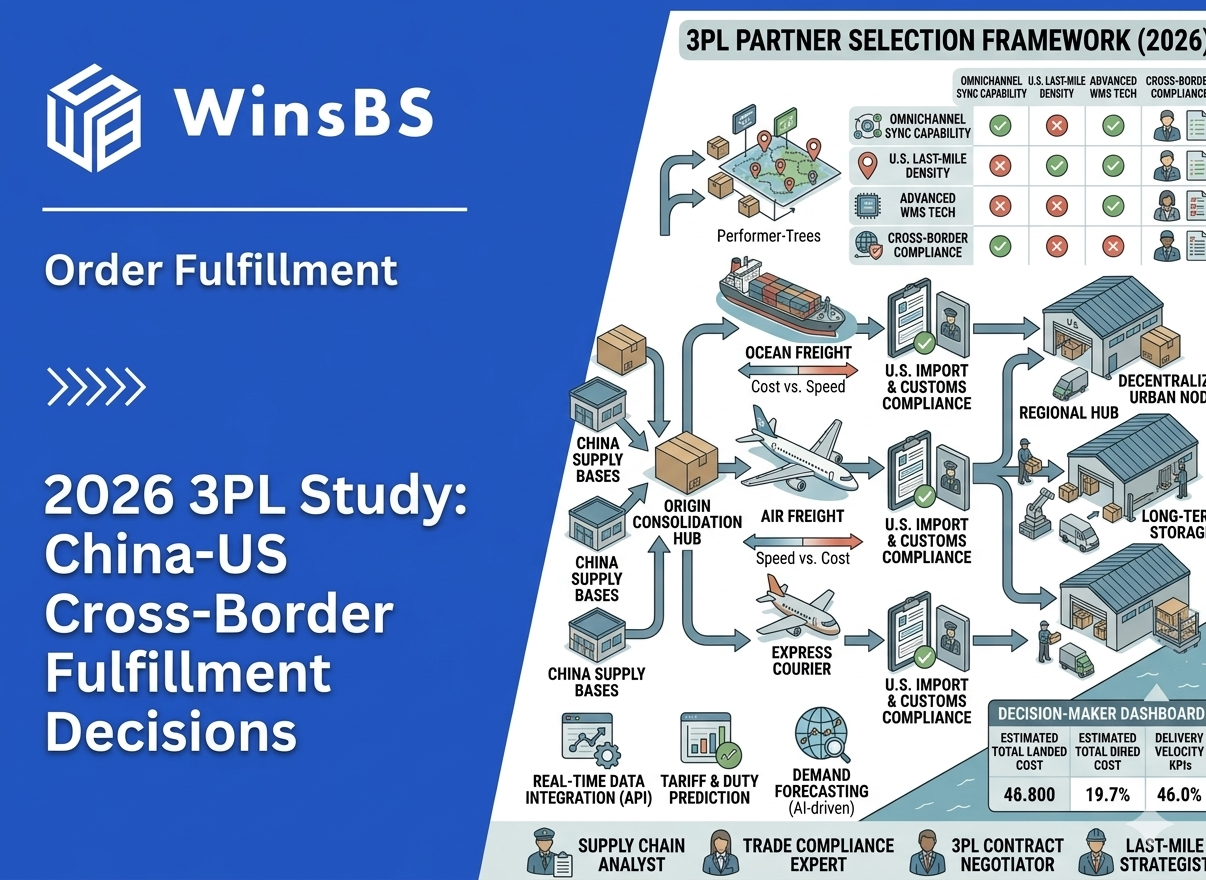
2026 3PL Study: China-US Cross-Border Fulfillment Decisions

2026 Third-Party Logistics Study Decision Implications for China-US Cross-Border Ecommerce Fulfillment Networks WinsBS Research INDEPENDENT FULFILLMENT RESEARCH · CROSS-BORDER OPERATIONS March 2026 Quick Context The 2026 Third-Party Logistics Study is not just another market summary. For brands shipping from China into the United States, it is a decision document. The report shows that 3PL selection now affects more than transportation cost. It shapes tariff exposure, customs variability, inventory positioning, visibility, and the stability of the fulfillment network behind the customer promise. Why This Matters for China-US Fulfillment Decisions Many ecommerce teams still evaluate logistics partners as if domestic parcel execution were the core question. That is too narrow for 2026. A China-US fulfillment network is influenced by tariff pressure, route design, customs release variability, inventory staging, and the quality of coordination between upstream movement and downstream order execution. That is why this page reads the 2026 study through a fulfillment-operations lens. The goal is not to restate the report. It is to clarify what the report means for operators, founders, logistics leads, and supply chain teams making network decisions in a live cross-border environment. Primary Research Source The primary source for this analysis is the 2026 Third-Party Logistics Study PDF . This article uses the report as the main authority for shipper-3PL relationship trends, outsourcing maturity, technology adoption, IT capability gaps, tariff response behavior, and strategic collaboration signals. Copyright and Citation Boundary The PDF linked above is provided as a source document for citation and verification. It is hosted on a WinsBS server for reference convenience, but copyright remains with the original publishers or rights holders. This page is an independent analytical interpretation from an order-fulfillment perspective. It is not a republication of the original report. This article sits inside the broader Cross-Border Fulfillment cluster and connects directly to China-US fulfillment decisions involving DDP routing, customs variability, inventory staging, and US warehouse execution. Table of Contents 2026 Study Highlights Impact on China-US Fulfillment Networks Tariff-Driven Routing Decisions Technology Gaps in Fulfillment Execution Strategic 3PL Partnership Design WinsBS Route Variance Observations Related Topic Cluster Frequently Asked Questions Decision Closure Source Traceability and Data Integrity 2026 Study Highlights Several signals in the 2026 Third-Party Logistics Study stand out immediately for companies managing China-US fulfillment. The first is relationship strength. The second is that outsourcing has not stopped growing, but it is no longer expanding in the same way it did during the earlier post-pandemic adjustment cycle. The third is that technology adoption is moving faster than technology satisfaction. Together, those three points matter more than any single data point in isolation. For cross-border operators, that combination changes the decision frame. The question is no longer whether a 3PL can move product from origin to destination. The real question is whether the provider can absorb variability across tariff exposure, customs movement, inventory staging, and downstream fulfillment execution without weakening service quality or control. Relationship confidence remains high: 88% of shippers said their 3PL relationships have been successful, while 100% of 3PL respondents described those relationships as successful. Outsourcing is still increasing, but at a slower pace: 81% of shippers reported increased use of outsourced logistics, down from 87% a year earlier. 3PLs are now judged on more than execution: 81% of shippers said 3PLs help improve customer service, 75% said they reduce costs, and 69% said they contribute innovation. Advanced analytics is now mainstream: 80% of shippers and 81% of 3PLs reported using advanced analytics. AI and machine learning are already in active use: 67% of shippers and 73% of 3PLs reported using AI or ML solutions. The IT gap is still real: 90% of shippers said technology capability is important when selecting a 3PL, but only 57% said they were satisfied with current 3PL technology capability. Tariff pressure is influencing operating decisions now: 45% of shippers said they are shifting toward alternative sourcing strategies in response to tariff pressure. Read together, these findings point to a more demanding operating environment. A 3PL may still look acceptable on paper if the evaluation stays focused on freight movement or warehouse capacity alone. That is no longer enough. In 2026, the stronger providers are the ones that can connect visibility, coordination, and execution across a more fragile network. The next step is to translate those report-level signals into the actual structure of a China-US fulfillment network. That is where the practical implications become clearer. Impact on China-US Fulfillment Networks The practical value of the 2026 study becomes clearer once its findings are mapped onto the structure of a China-US fulfillment network. In that environment, fulfillment is not one decision. It is a connected system that begins before export, passes through customs and route uncertainty, and ends in local warehouse execution and customer delivery. That matters because the report’s strongest signals do not sit in one part of the chain alone. They affect the system as a whole. On the China side, the pressure begins earlier than many teams assume. Product flow, replenishment timing, and staging decisions now carry more weight because upstream mistakes are harder to correct once tariff exposure, customs friction, and downstream service commitments begin interacting. A network that looks efficient at origin can still become unstable if it reaches the US side without enough flexibility in inventory timing or route control. In transit, the issue is no longer just movement from point A to point B. Tariff conditions, clearance timing, documentation quality, and route-level volatility all influence whether inventory enters the US market in a way that supports reliable fulfillment. This is where a weaker operating model often begins to show strain. Delays at this layer do not stay contained. They move downstream into warehouse pressure, order allocation problems, and wider service inconsistency. On the US side, warehouse execution is still critical, but it is now the receiving end of upstream network design decisions. If inbound timing is unstable, if inventory is staged too narrowly, or if visibility breaks between international movement and domestic fulfillment, the warehouse inherits the consequences. At

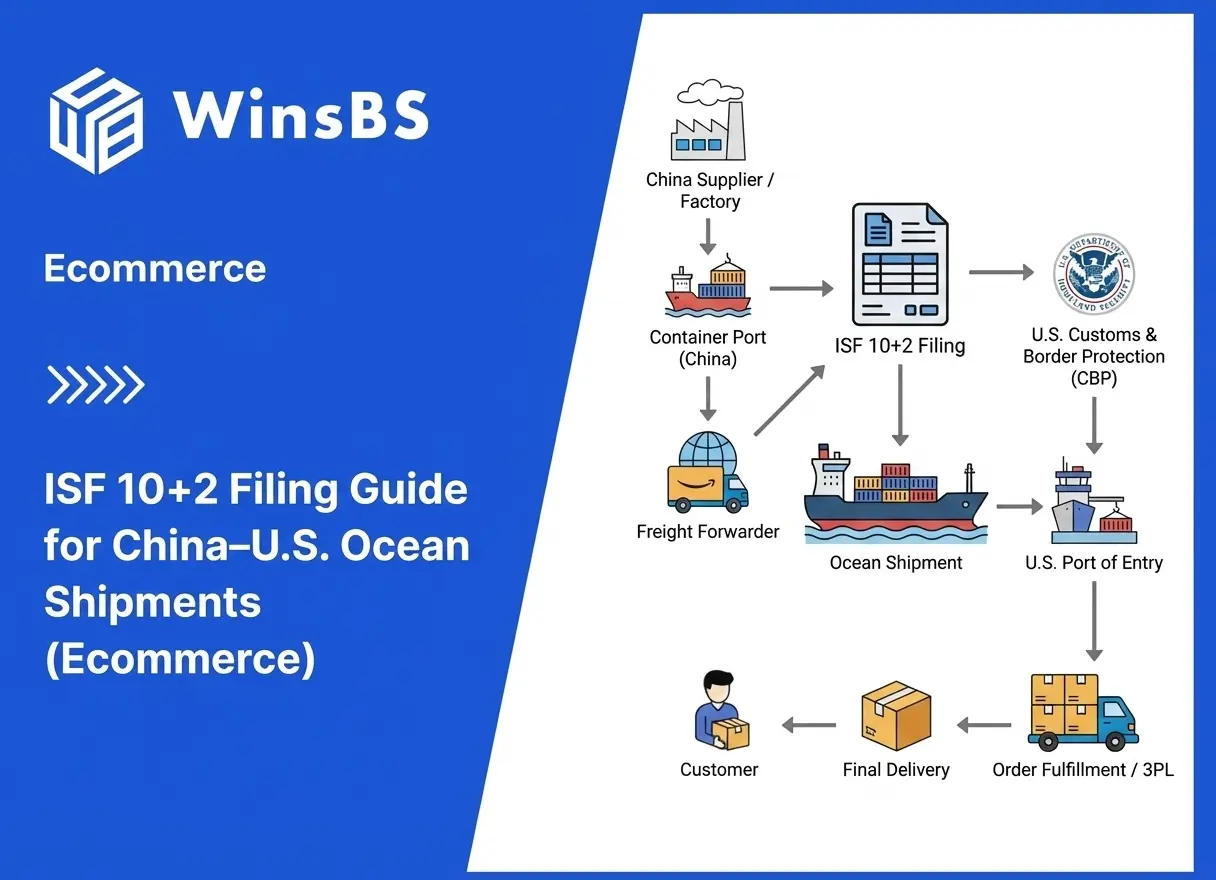
WinsBS branded cover image showing ISF 10+2 filing guide for China–U.S. ocean shipments, featuring container ship, compliance documents, and data flow icons, representing cross-border shipping compliance and order fulfillment logistics.
Ecommerce, Order Fulfillment, Shipping & Logistics

ISF 10+2 Filing Guide for China–U.S. Ocean Shipments (Ecommerce)

ISF 10+2 Filing Guide for China–U.S. Ocean Shipments A Fulfillment-First Playbook for Ecommerce Inventory, FBA Inbound Timing & U.S. Port Hold Avoidance WinsBS Research – Michael Updated December 2025 TL;DR Importer Security Filing (ISF 10+2) is an advance cargo security filing required for U.S.-bound ocean freight. In ecommerce, ISF is not “customs paperwork.” It is a fulfillment gate: if ISF data is late, inconsistent, or amended after vessel loading, inventory may be physically at a U.S. port while still being operationally blocked—causing FBA check-in delays, inventory availability gaps, missed inbound appointments, and lost sales windows. Official CBP overview: Importer Security Filing “10+2”. This article is written for ecommerce operators shipping from China to the United States by ocean freight, including Amazon FBA sellers, direct-to-consumer (DTC) brands, and crowdfunding teams. It explains how ISF interacts with purchase orders, factory data, booking discipline, and warehouse receiving—so your inventory becomes sellable on time, not “arrived but unusable.” If you want an inbound workflow check (data discipline, cross-border readiness, inbound scheduling), Get Started for Free or contact the team: Talk to WinsBS. If your China–U.S. ocean shipment is showing “Arrived” but: Amazon FBA inbound cannot be checked in Inbound appointments keep getting pushed out Your 3PL says the container cannot be released yet then the issue is often not port congestion and not warehouse capacity. In ecommerce fulfillment, the missing control is frequently Importer Security Filing (ISF 10+2)—specifically, whether the inbound data story was stable before vessel loading. Contents Fast Answers: ISF 10+2 for Ecommerce Why Ecommerce Shipments Say “Arrived” but Fulfillment Has Not Started What Is Importer Security Filing (ISF 10+2)? ISF as a Fulfillment Gate (Not a Customs Form) FBA vs DTC vs Crowdfunding: How ISF Failure Breaks Each Model Importer of Record Responsibility in Ecommerce Structures ISF-10 Data Elements Explained with Ecommerce Data Sources The “+2” Carrier Data Elements: What Sellers Must Still Watch ISF Timeline: What “24 Hours Before Loading” Actually Means FCL vs LCL vs Multi-SKU: Where ISF Risk Explodes High-Frequency ISF Failure Modes (Case Cards) ISF Penalties vs Fulfillment Loss: The Real Cost Model ISF vs AMS vs Customs Entry — Fulfillment Control Comparison Fulfillment-First ISF Checklist (Copy/Paste) People Also Ask: Short Answers Final Recommendation: Build ISF Into Inbound Execution FAST ANSWERS: ISF 10+2 FOR ECOMMERCE What is Importer Security Filing (ISF 10+2)? Importer Security Filing (ISF 10+2) is an advance security filing required for U.S.-bound ocean freight. It requires ten importer-provided data elements and two carrier-provided data elements to be submitted to U.S. Customs and Border Protection before vessel loading. Official CBP overview: ISF 10+2. When must ISF be filed? ISF is generally required no later than 24 hours before cargo is loaded on the vessel at the foreign port. Do not interpret this as “24 hours before the ship departs.” CBP help article: When to submit ISF. Why do ecommerce sellers feel ISF problems at FBA check-in or warehouse receiving? Because ISF is a pre-fulfillment gate. If ISF data is late, inconsistent, or amended after vessel loading, the shipment may be flagged for review and operationally delayed at the exact moment you need to schedule drayage, inbound appointments, and inventory availability. Who is responsible for ISF in practice? The Importer of Record (and/or the ISF importer depending on cargo type and filing structure) bears responsibility. A freight forwarder or customs broker may transmit the filing, but responsibility and downstream fulfillment risk do not disappear. Reference: CBP ISF FAQ: ISF 10+2 FAQs Download CBP FAQs PDF. What is the most common ecommerce ISF mistake? Treating ISF as “broker paperwork” instead of inbound execution data—especially inaccurate manufacturer identity, inconsistent ship-to party, and last-minute amendments after vessel loading. WHY ECOMMERCE SHIPMENTS SAY “ARRIVED” BUT FULFILLMENT HAS NOT STARTED China → U.S. ocean freight in ecommerce has a recurring failure pattern: the container is physically present at a U.S. port, but the business experiences the shipment as if it is “missing.” This is not a contradiction. It is a system mismatch. Ecommerce fulfillment does not start when a vessel arrives. Fulfillment starts when inventory becomes operationally usable: when drayage can be scheduled, inbound appointments can be confirmed, receiving can be executed, and the inventory record can be trusted. If any upstream control blocks those actions, you get the most frustrating state in cross-border logistics: arrived but unusable. Many sellers misdiagnose this state as port congestion, warehouse capacity, or “random inspection.” Those can be real contributors, but for ecommerce shipments the decisive root cause is often the same: the inbound data that proves identity, origin, and routing was not stable at the moment ISF needed it. In other words, the problem is not the container. The problem is the inbound proof that the container should be allowed to flow into the fulfillment system. Fulfillment-first framing: ISF 10+2 is not a form that “finishes customs.” It is a control that helps determine whether your shipment can proceed to appointment booking, receiving, and inventory availability without disruption. WHAT IS IMPORTER SECURITY FILING (ISF 10+2)? Importer Security Filing (ISF 10+2) is an advance cargo security filing required for non-bulk cargo shipments arriving in the United States by vessel. It requires the electronic transmission of specific data elements to U.S. Customs and Border Protection (CBP) prior to vessel loading. CBP’s official program page provides the baseline definition and scope: Importer Security Filing “10+2”. From a fulfillment execution perspective, Importer Security Filing (ISF 10+2) functions as a pre-entry control gate rather than a customs form. If the ISF data story is unstable at loading time, downstream inbound execution becomes unpredictable—even when the vessel arrives on schedule. “10+2” means: 10 data elements provided by the importer (or the importer’s nominated agent) that describe the seller-buyer relationship, factory identity, origin, classification, and consolidation details. 2 data elements provided by the ocean carrier: vessel stow plan data and container status messages. ISF applies to U.S.-bound cargo by vessel, including shipments moving to U.S. ports for direct discharge as well as certain transit cargo structures depending on the filing

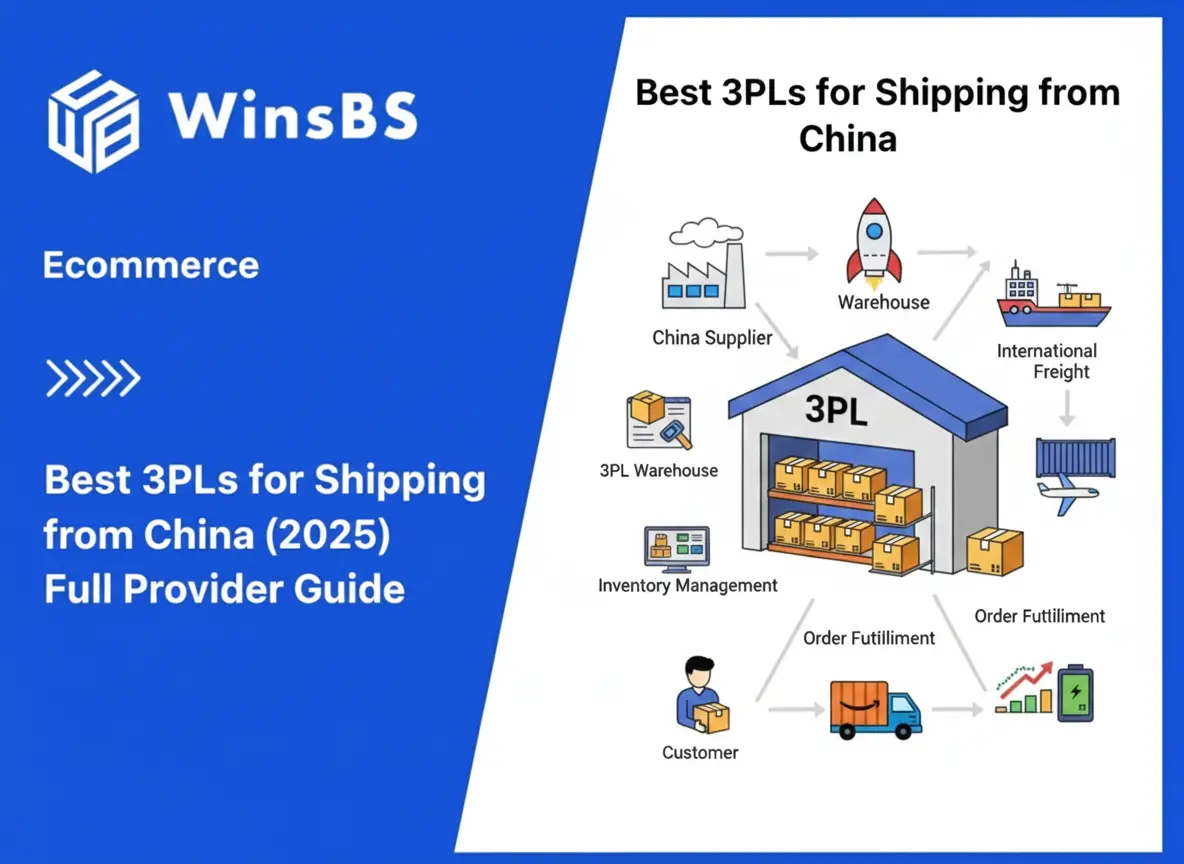
Cross-border eCommerce flowchart showing China suppliers, international freight, 3PL warehouse, inventory management, and order fulfillment leading to the customer, displayed beside the WinsBS logo and blog title, symbolizing 3PL fulfillment and cross-border order fulfillment services.
Ecommerce, Order Fulfillment, Shipping & Logistics

Best 3PLs for Shipping from China (2025) | Full Provider Guide

Best 3PLs for Shipping from China in 2025 Provider Landscapes Backed by the Vertical Fulfillment Performance Model (VFPM-2025) By Michael · Updated 2025 DEC On This Page Executive Summary VFPM Overview Shopify / DTC Amazon FBA Prep Crowdfunding Electronics / Battery Apparel & Fashion Beauty & Personal Care Heavy / Bulky Supplements / Food B2B / Omnichannel Section 321 / IOSS Final Recommendations Methodology EXECUTIVE SUMMARY The search for the “best 3PL in China” is misleading. WinsBS Research’s VFPM-2025 dataset shows that 25–48% of SLA variance and 30–55% of cost-per-order variance comes from vertical differences—not warehouse size, automation level, or geographic footprint. A 3PL that excels in fashion accuracy performs poorly in batteries; a 3PL optimized for crowdfunding waves fails under everyday Shopify volatility. This means that any universal ranking is inherently flawed. Instead, brands need a vertical-specific Provider Landscape. This report introduces 10 vertical landscapes—each with: a vertical profile grounded in VFPM-2025 cost, risk, and volatility models, a curated 6–12 provider evaluation pool (with external links), a Capabilities Matrix (SLA, SKU entropy, compliance readiness, volatility handling), a Why Included justification for every provider, and a vertical-specific RFP checklist. The goal is simple: give decision-makers an actionable, research-backed map of which 3PLs fit which products, channels, and compliance regimes when shipping directly from China. For brands planning China→US/EU expansions, WinsBS offers a free VFPM-aligned assessment: Get Started for Free. VFPM-2025 MODEL OVERVIEW The Vertical Fulfillment Performance Model (VFPM-2025) is WinsBS Research’s analytical framework for understanding why fulfillment performance differs dramatically across product categories—even inside the same warehouse. VFPM-2025 decomposes fulfillment into five structural components: Cost Structure — fixed vs. variable handling, packaging intensity, DIM exposure. SLA Stability — P50/P80/P95 transit distributions and last-mile variance. Labor Intensity — touchpoints, QC minutes, returns friction. Compliance & Risk — battery/DG rules, VAT/IOSS/321 requirements, regulator exposure. Volatility Handling — promo spikes, seasonality, crowdfunding waves. These metrics are normalized using VFPM’s trimmed mean and IQR median methodology to prevent outliers from dominating any vertical. The full methodology is documented in the VFPM-2025 Benchmark Report. This article applies VFPM-2025 to the specific context of shipping from China, where additional factors like customs clearance, long-haul reliability, and tax structuring materially change a 3PL’s suitability for each vertical. SEGMENT 1 — SHOPIFY / DTC BRANDS SHIPPING FROM CHINA Vertical Profile Shopify / DTC brands shipping 1,000–20,000 orders per month from China operate within a mid-volatility, mid-labor cost structure. VFPM-2025 shows that these brands experience predictable order waves around promotions, but relatively stable SKU entropy compared with apparel or beauty. What distinguishes this vertical is the emphasis on: carrier diversification for multi-region lanes, Shopify-native visibility for branded tracking events, tax orchestration (321 / IOSS / DDP) handled upstream, and the ability to maintain 6–12 day CN→US / CN→EU consistency. Provider Landscape (Evaluation Pool) The following 3PLs form the recommended evaluation pool for Shopify / DTC brands shipping directly from China. Providers may appear in multiple verticals when their operating model supports several product classes. NextSmartShip — Website Capabilities: China-based global fulfillment, strong Shopify integrations, branded tracking, EU/UK duty workflows. Best For: 2k–20k orders/month mid-complexity DTC catalogs. Limitations: Not ideal for Class 9 battery products. Why Included: Stable CN→US 6–10 day performance, high SKU accuracy, and strong presence in VFPM DTC lanes. SendFromChina (SFC) — Website Capabilities: Mature China 3PL with marketplace and DTC flows, broad carrier network, multi-region fulfillment. Best For: blended Amazon + Shopify international sellers. Limitations: System UI less modern than Shopify-native 3PLs. Why Included: Long-standing performance in CN→US/EU cross-border lanes and strong operational redundancy. EcommOps — Website Capabilities: DTC-focused China 3PL offering cost modeling, carton optimization, and Shopify-native workflows. Best For: brands needing analytics-driven routing and packaging efficiency. Limitations: Less ideal for very large catalogs (2,000+ SKUs). Why Included: Strong VFPM alignment for cost transparency and SKU stability in mid-volume DTC. ShipBob — Website Capabilities: Global network with CN inventory intake, strong tech stack, fast U.S./EU regional delivery. Best For: brands wanting CN production + U.S./EU distributed nodes. Limitations: Higher pricing for low-AOV DTC brands. Why Included: Shopify-native support and scalable multi-node routing useful for China-origin expansion. FF Logistics — Website Capabilities: China-based fulfillment for beauty/lifestyle DTC, strong QC workflows. Best For: design-led DTC brands needing packaging consistency. Limitations: Limited support for heavy/oversized items. Why Included: High repeatability in QC-heavy verticals, consistent with VFPM labor-intensity models. ShipSmartly.io — Website Capabilities: Shopify automation, CN-origin duty-optimized routing, branded tracking flows. Best For: 1k–8k orders/month stores needing rapid setup. Limitations: Less suitable for large multi-region B2B shipments. Why Included: Lightweight but fast implementation ideal for newer Shopify brands. SHIPHYPE Fulfillment — Website Capabilities: U.S./Canada-based hubs fed by CN production, strong returns handling. Best For: brands selling heavily in North America. Limitations: Higher storage than CN-based facilities. Why Included: Provides hybrid CN→US workflows aligned with VFPM multi-node strategies. Salesupply — Website Capabilities: multi-region EU/U.S. network with CN integration, strong CX focus. Best For: brands scaling into EU markets. Limitations: Not a China warehouse operator—relies on inbound flows. Why Included: Strong EU footprint helps brands mix CN origin with regional warehousing. WAPI — Website Capabilities: distributed EU/UK fulfillment with CN routing and marketplace tools. Best For: multi-marketplace sellers (Amazon + Shopify + eBay). Limitations: Not ideal for custom packaging workflows. Why Included: High fit for brands prioritizing Europe expansion from CN production. J&T Express (Cross-Border Unit) — Website Capabilities: CN-origin parcel network, fast lanes into Southeast Asia and U.S. consolidators. Best For: cost-sensitive high-volume DTC brands. Limitations: Not a full 3PL; limited pick/pack depth. Why Included: Strong for brands prioritizing speed and cost over customization. Capabilities Matrix (DTC Segment) The following matrix summarizes qualitative capabilities relevant to Shopify / DTC brands: SLA Stability: High — NextSmartShip, SFC, ShipBob SKU Complexity Fit: Strong — NextSmartShip, EcommOps Compliance Readiness (IOSS / 321): High — ShipSmartly.io, NextSmartShip Cost Structure Transparency: High — EcommOps, SFC Volatility Handling: Strong — SFC, ShipBob RFP Questions for Shopify / DTC Fulfillment from China Provide P50 / P80 / P95 transit distributions for U.S., EU, UK, AU. Show

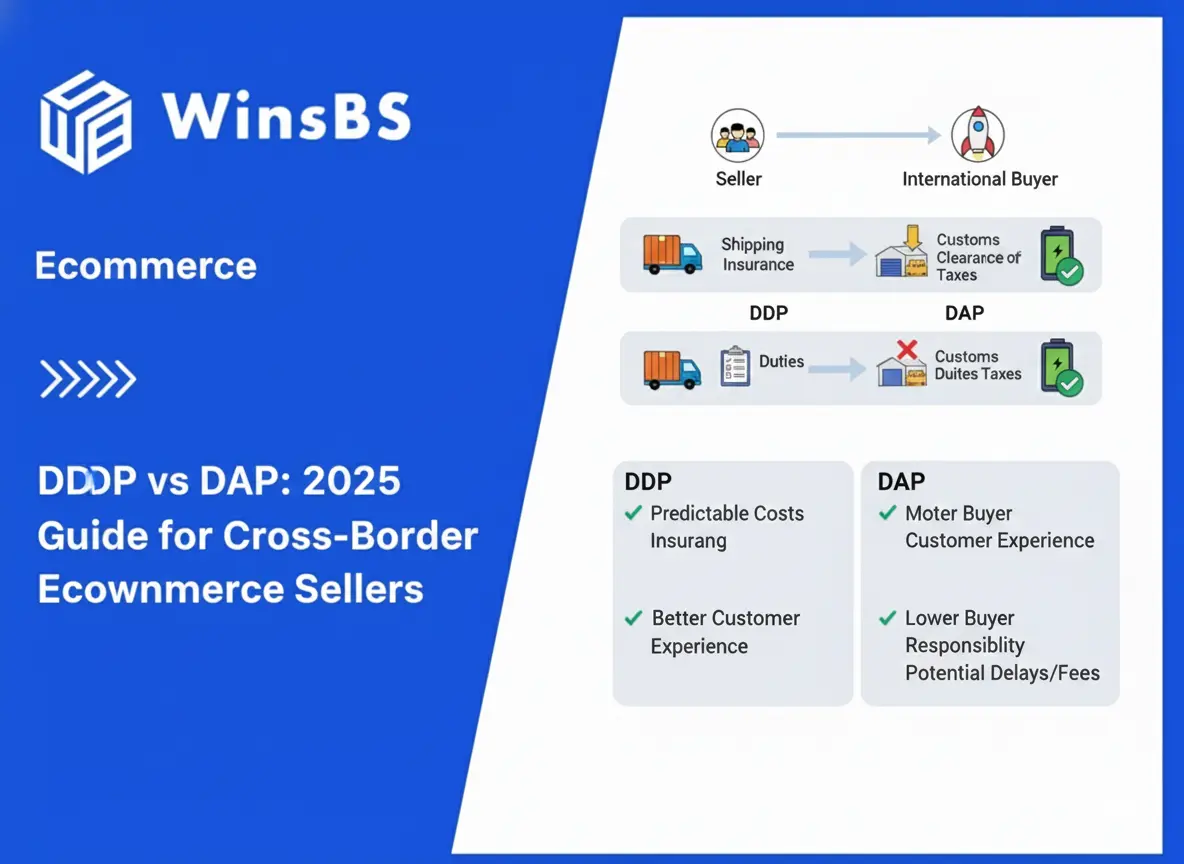
DDP vs DAP cross-border eCommerce illustration beside WinsBS logo and title, showing trade terms, duties, taxes, and shipping responsibilities for 3PL fulfillment and order fulfillment services.
Ecommerce, Order Fulfillment

DDP vs DAP: 2025 Guide for Cross-Border eCommerce Sellers

DDP vs DAP: Incoterms for Cross-Border Parcels Which Incoterm Should eCommerce Sellers Use in 2025? WinsBS Fulfillment Research Team – Michael December 2025 TL;DR DDP (Delivered Duty Paid) gives buyers a seamless, tax-inclusive delivery experience. DAP (Delivered at Place) pushes duties and VAT onto buyers at arrival, often causing refusals, delays, and negative reviews. In 2025, with tighter U.S. Section 321 enforcement, strict EU VAT rules under IOSS, and platform requirements from Shopify and TikTok Shop, DDP has become the de facto standard for cross-border parcels shipping from China to the U.S., EU, and UK. Brands switching from DAP to DDP consistently report: 10–15% higher checkout conversion 20–40% fewer returns and refusals Faster customs clearance and more predictable lead times Better logistics scores and algorithm visibility on major platforms For eCommerce brands shipping globally, DDP is no longer optional. It is the operating baseline for reliable cross-border parcels. For brands that want to move from “surviving” to “scaling,” a well-designed DDP workflow is now a core advantage. Get Started for Free and see how a full-chain DDP setup can work for your store. INCOTERMS FOR ECOMMERCE: A PRACTICAL OVERVIEW Incoterms are standardized trade rules published by the International Chamber of Commerce (ICC). They define who pays for freight, who handles customs, who pays duties and taxes, and where risk transfers from seller to buyer along the route. Traditional freight forwarders work with a longer list of Incoterms, but for cross-border eCommerce parcels, two terms do almost all of the work: DDP — Delivered Duty Paid DAP — Delivered at Place On paper, the difference between DDP and DAP looks like a small shift in who pays for duties and VAT. In practice, they create completely different customer journeys and P&L outcomes. For a Shopify, TikTok Shop, Amazon FBM, or crowdfunding brand, choosing the wrong term can be the difference between profitable scaling and constant firefighting. WHAT IS DDP (DELIVERED DUTY PAID)? Under DDP (Delivered Duty Paid), the seller takes responsibility for the entire cross-border parcel journey. That includes export procedures, international transport, import customs clearance, duties and VAT, and final-mile delivery to the buyer’s door. In a DDP setup, the seller or their logistics partner typically handles: Export clearance from the origin country (for example, China) Line-haul via air freight or express lanes Customs declaration in the destination country Payment of duties, VAT, and any import taxes Handover to last-mile carriers such as USPS, UPS, DHL, DPD, or Royal Mail The buyer receives a parcel that feels almost identical to a domestic purchase: the price shown at checkout is the price paid, with no extra door charges, no customs forms to fill, and no surprise visits from carriers asking for taxes. This is why DDP has become the default for modern cross-border eCommerce. It matches expectations shaped by Amazon Prime and other domestic delivery standards: transparent pricing, predictable timing, and minimal friction. WHAT IS DAP (DELIVERED AT PLACE)? DAP (Delivered at Place) is the mirror image of DDP when it comes to taxes and customs. Under DAP, the seller pays for transportation to the destination country or specified place, but the buyer is responsible for duties, VAT, and any clearance fees when the parcel arrives. In a DAP workflow, the buyer must often: Pay duties and VAT before release Pay carrier handling or brokerage fees Interact with customs or a postal operator Authorize the release of the parcel This may be acceptable for professional importers in a B2B context. For consumer parcels, it is a major break in the customer journey. Most retail buyers are not prepared to handle paperwork, unexpected charges, or customs deadlines. Many will refuse the parcel outright. As regulators, platforms, and buyers have evolved, DAP has shifted from “cost-saving shortcut” to “legacy freight term that does not fit eCommerce.” It still has a place in bulk B2B transactions but is a poor choice for direct-to-consumer shipping. DDP VS DAP: SIDE-BY-SIDE COMPARISON Putting both terms in a side-by-side matrix makes the trade-offs clearer: Aspect DDP (Delivered Duty Paid) DAP (Delivered at Place) Duties & VAT Paid by seller; taxes can be embedded at checkout Paid by buyer at arrival; often a surprise Customs Clearance Handled by seller or logistics partner Requires buyer action and payment Buyer Experience Like domestic delivery; no extra steps “Pay to get your package” experience Refusal Rate Typically under 5% Often 20–40% for retail parcels Delivery Speed Fewer holds and faster customs decisions Delays when buyers do not act quickly Total Cost Lower when returns, holds, and penalties are included Higher long-term due to operational friction Platform Performance Supports strong delivery scores and rankings Increases risk of penalties and demotion Best Use Case Cross-border B2C parcels High-value B2B freight with professional importers For cross-border parcels, this DDP vs DAP Incoterms comparison makes the conclusion straightforward: DDP aligns with how eCommerce actually works; DAP fights both buyer behavior and regulatory direction. DDP, DAP, AND DDU: COMPLETE DEFINITION CLUSTER Search engines and readers both benefit from a clear cluster of key term definitions. In the Incoterms space, three acronyms show up again and again: DDP (Delivered Duty Paid) means the seller assumes all responsibility for delivering the goods to the agreed destination, including paying duties, VAT, and any import-related taxes or fees. The buyer pays nothing at the door and has no customs interaction. DAP (Delivered at Place) means the seller is responsible for delivering the goods to a named place, usually in the destination country, but the buyer must pay duties, VAT, and any customs or carrier fees prior to release or delivery. DDU (Delivered Duty Unpaid) is an older term no longer part of the official Incoterms list and has effectively been replaced by DAP. In practice, DDU and DAP both signal that duties and taxes will be collected from the buyer on arrival. For eCommerce sellers, the practical interpretation is simple: DDP is the modern standard for consumer parcels. DAP is a legacy freight term that fits only B2B use cases.

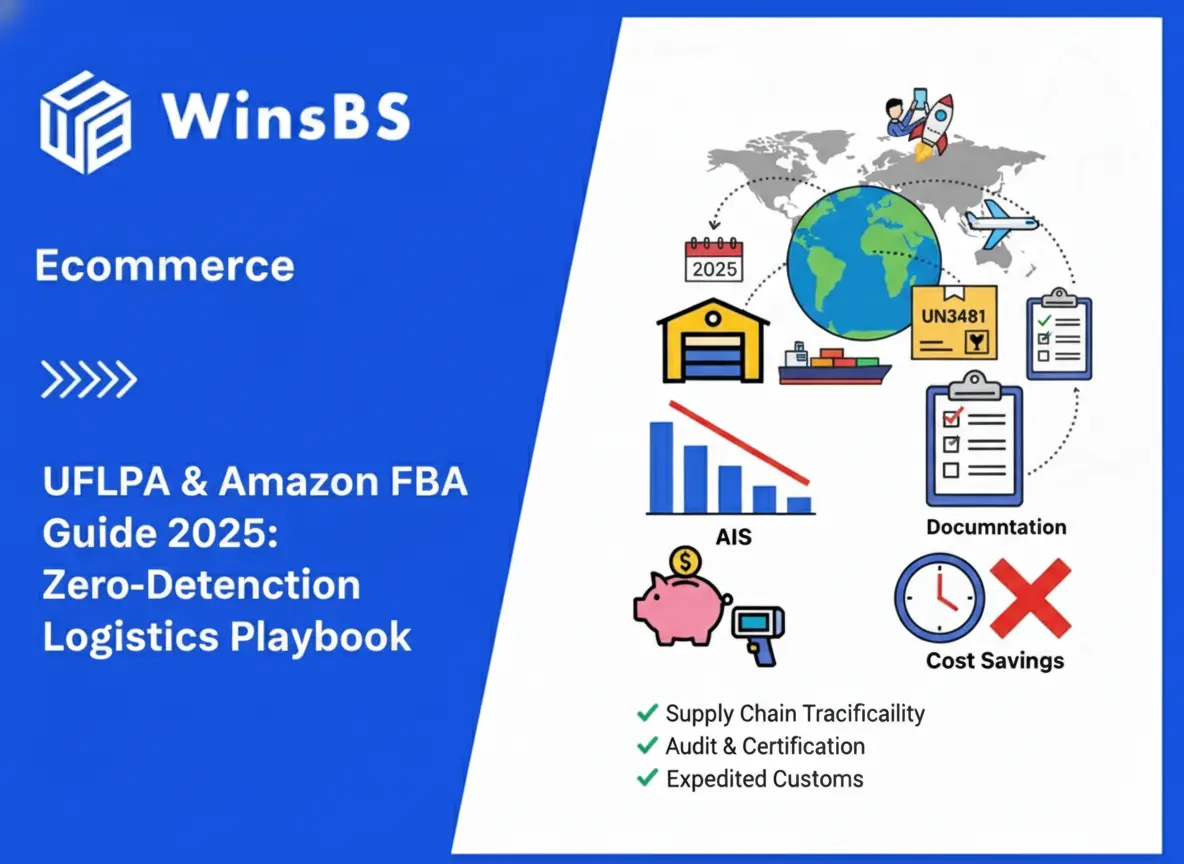
WinsBS logo and blog title "UFLPA & Amazon FBA Guide 2025: Zero-Detention Logistics Playbook" beside an illustration showing compliance documents, global trade routes, and supply chain traceability icons, symbolizing 3PL order fulfillment and efficient FBA logistics under UFLPA regulations.
Ecommerce, Order Fulfillment

UFLPA & Amazon FBA Guide 2025: Zero-Detention Logistics Playbook

UFLPA & Amazon FBA: The 2025 Playbook for Zero-Detention Logistics A 7-Layer Defense Model for Sellers Targeting 0% Detention Rate WinsBS Fulfillment Research Team – Michael November 2025 Executive Summary TL;DR The 2025 enforcement cycle eliminated the Substantial Transformation loophole and shifted Amazon FBA detention risk from apparel to metals and lithium compounds. Vietnam and Thailand are no longer “safe” alternatives; CBP now follows the origin of the raw input, not the country of assembly. This playbook outlines the 7-layer Zero-Detention Framework used by multiple 8-figure Amazon brands maintaining less than 0.5% detention rate in 2025. Since early 2025, CBP and DHS/FLETF have intensified UFLPA enforcement across all FBA-bound supply chains. Over 16,700 shipments have been detained since mid-2022, totaling an estimated 3.7 billion dollars in restricted goods. A record 78 new entities were added to the UFLPA Entity List in the past 18 months, including a large-scale update in January 2025 affecting upstream metals and battery materials. For many sellers, the legacy strategy of shifting final assembly to Vietnam, Thailand, or Malaysia no longer mitigates risk. CBP now evaluates the “economic nationality” of a product based on its mineral or chemical origin — steel billet, copper cathode, lithium hydroxide, aluminum ingot, PVC resin — regardless of where the finishing assembly occurred. The combined tightening of UFLPA audits, Entity List expansion, and risk profiling of transshipment routes has created a new operational baseline for Amazon FBA importers. Traceability must now be batch-level, supplier declarations must be transaction-specific, and freight forwarders must maintain verifiable detention statistics to avoid unnecessary holds during Q4 and Q1 peak seasons. This report provides a structured 7-layer framework to help Amazon sellers, direct-to-consumer brands, and global exporters maintain zero-detention logistics in 2025 and prepare for DHS/FLETF 2026 updates. 2025 Enforcement Reality: What Changed and Why Legacy Playbooks Died By early 2025, CBP fully closed the Substantial Transformation workaround. Sellers relying on “final assembly in Vietnam or Thailand” discovered it no longer protects inbound FBA shipments from UFLPA detention. Origin now follows the mine, not the factory floor — meaning any product containing upstream materials traced to restricted regions remains prohibited regardless of downstream assembly. Enforcement volume has surged across metals, battery materials, and industrial inputs. CBP and DHS/FLETF data show a rapid shift in the profile of detained commodities as upstream minerals became the dominant signal in risk scoring models. 2025 Enforcement Snapshot Over 16,700 shipments detained since June 2022 Total estimated value exceeding 3.7 billion dollars 144 entities on the UFLPA Entity List, including 78 added in the past 18 months A major update in January 2025 added 37 upstream mining and processing entities Top flagged origins in 2025: China (#1), Vietnam (#2), Malaysia (#3), Thailand (#4) Transshipment now increases — not decreases — risk scoring The acceleration of metals enforcement, especially in steel, copper, and lithium compounds, has caught many Amazon sellers unprepared. These products typically pass through multiple tiers of suppliers, most of whom cannot provide raw-material provenance without a structured documentation system. 2025 Risk Velocity: Where Detentions Are Actually Moving Sector 2023–2024 Share 2025 Risk Velocity Why It Matters Cotton & Apparel ~45% Baseline Zero-tolerance is permanent; predictable but still strictly enforced Steel (New Priority) Less than 1% Explosive Growth Shelving, cookware, tools, auto parts — large spike in upstream-material detentions Copper (New Priority) Less than 1% Explosive Growth Wiring harnesses, electronics, plumbing fixtures — materials traced to upstream cathodes Aluminum ~6% High Increase Frames, foils, cookware — new mining entities added to the list Lithium / Batteries ~4% Sharply Targeted Power banks, EV accessories, toys — increased upstream hydroxide tracing PVC & Plastics ~5% Rising Vinyl flooring, shower curtains, packaging — resin tracing required Polysilicon / Solar ~12% Moderate Decline Share shrinking as metals rise — but still heavily policed Red Dates / Agri Negligible Emerging Early-stage enforcement expansion into agriculture Takeaway: Apparel is now “routine enforcement,” while metals and lithium compounds have become the silent drivers of new detentions — primarily because most sellers lack Tier-2 and Tier-3 documentation for these inputs. The 2025 Zero-Detention Framework: The 7 Layers Used by 8-Figure Brands Across Amazon FBA and cross-border ecommerce, the brands consistently maintaining less than 0.5% detention rate in 2025 all follow the same seven-layer system. This framework operationalizes UFLPA compliance into repeatable, shipment-level processes rather than one-time supplier paperwork. 1. Supplier Governance — Contractual Lockdown Every Master Service Agreement and Purchase Order includes a mandatory UFLPA/ESG addendum. Tier-1 suppliers must disclose Tier-2 and Tier-3 sourcing for all high-priority inputs (steel, copper, lithium, PVC, aluminum). Annual CBP-format Supplier Declaration is required, but not accepted as sufficient for shipment clearance. 2. Transaction-Level Traceability — The New Minimum Standard Annual certificates are now rejected by CBP. Each shipment requires a batch-tied packet: Raw-material invoice with batch or lot number Exact origin province or administrative region Third-party due-diligence report addressing forced-labor indicators Batch-linked Certificate of Origin or sworn statement 3. Four-Way Perfect Alignment (Non-Negotiable) These four fields must match exactly across all documents: Physical product label Commercial invoice Packing list Amazon ASIN “Country of Origin” field Province-level detail is now expected (e.g., “Guangdong Province, China”). 4. Freight Forwarder as Insurance Only work with forwarders that publish detention rates by commodity. Less than 1% detention on your category is the benchmark. Forwarders must be able to document routing integrity for Q4 peak season. 5. Document Readiness — Never Pre-Submit to Tier-1 Seller Support Proactive Amazon cases trigger mis-flags in 2025 more than any other behavior. Correct procedure: Prepare one encrypted ZIP (20 MB or less) per shipment. Upload only when the official request is generated — within two hours. 6. Real-Time Early-Warning Stack Top performers use automated signals: Helium 10 and Jungle Scout Sellerboard or API-connected dashboards Slack or Telegram alerts for “Reserved – Compliance Review” events 7. Quarterly Independent Audits — The Actual Competitive Moat Performed by Verité, Elevate, UL Responsible Sourcing, or Arche Advisors. Top sellers audit their 10 most important suppliers every 90 days. Rebuttal success rate rises from 35%

Illustration of safe shipping for electronics and battery products beside WinsBS logo and title, showing packages with lithium battery warning labels, airplane, truck, security scanner, and warehouse, symbolizing compliant 3PL fulfillment and order fulfillment services.
Ecommerce, Order Fulfillment, Shipping & Logistics

Safe Shipping for Electronics & Battery Products (2025)

Safe Shipping for Electronics & Battery Products (2025) Compliance, Cost Mitigation & Fulfillment Risk Control WinsBS Fulfillment Research Team – Michael November 2025 Executive Summary TL;DR Since January 1, 2025, the IATA Dangerous Goods Regulations (DGR), 66th Edition has been fully enforced worldwide, tightening compliance for UN38.3 testing and UN 4G/Class 9 certified packaging of lithium batteries and electronic products. This report reviews the first year of enforcement, analyzes real-world seller data, and provides practical insights for sustained compliance as the industry prepares for the upcoming 67th Edition in 2026. Since its enforcement at the start of 2025, the International Air Transport Association (IATA)’s Dangerous Goods Regulations (DGR) 66th Edition has redefined the operational baseline for shipping electronics and lithium batteries (UN 3481/3091). Carriers and customs agencies have reinforced documentation audits, demanding verified UN38.3 test reports, UN 4G/Class 9 certified outer packaging, and valid Safety Data Sheets (SDS, formerly MSDS) for every declared consignment. Over the first three quarters of 2025, B2B exporters and fulfillment centers reported higher inspection rates but lower rejection ratios—evidence that standardized documentation and packaging are reducing overall risk. However, compliance gaps remain for smaller exporters and crowdfunding projects, especially those lacking familiarity with multi-modal requirements under both air (IATA) and sea (IMDG) frameworks. In parallel, the U.S. Pipeline and Hazardous Materials Safety Administration (PHMSA) has already begun enforcing enhanced battery isolation standards, requiring 5 cm (2 inches) non-conductive spacing or certified fire-resistant partitions for lithium shipments stored or processed domestically. This report, compiled by WinsBS Research using aggregated 2024–2025 operational data, summarizes key compliance outcomes observed during the first implementation year of the IATA DGR 66th Edition. It also highlights emerging regulatory themes—such as digital traceability and the EU’s upcoming Battery Passport requirement under Regulation (EU) 2023/1542 —to help B2B sellers prepare for the transition to the 67th Edition in 2026. Key Regulatory Shifts & Risk Areas in 2025 Electronics Shipping Compliance Throughout 2025, the global compliance landscape for electronics and lithium-battery shipments has evolved significantly. The IATA Dangerous Goods Regulations (DGR), 66th Edition and the U.S. PHMSA battery isolation directive have reshaped how B2B exporters handle documentation, packaging, and transport classification. These updates, now fully enforced, demand operational precision and continuous monitoring to avoid costly detentions and rejected shipments. Below are the most notable regulatory shifts and risk areas identified by WinsBS Research during the first year of enforcement: Mandatory UN38.3 Verification: Airlines and customs authorities now require verified UN38.3 test reports before accepting any lithium battery shipment. Non-certified cells or missing summaries have led to repeated detentions in Hong Kong, Frankfurt, and Los Angeles hubs (2025 Q2 data). UN 4G/Class 9 Certified Packaging: The DGR 66th Edition mandates all packages containing lithium batteries (UN 3481/3091) to use UN 4G/Class 9 outer cartons. Carriers have reported a 15% decrease in damage incidents, but inspection frequency increased by 20%. SDS (Safety Data Sheet) Validation: SDS (formerly MSDS) documents must align with the GHS chemical classification system. Outdated SDS versions have been a primary cause of customs delays across EU ports. PHMSA 2025 Isolation Rule: Since July 2025, U.S. warehouses processing lithium shipments must apply 5 cm (2 inches) spacing or certified fire-resistant dividers to prevent thermal propagation. EU Battery Regulation (EU) 2023/1542: The first enforcement phase introduces the concept of a “Battery Passport” for traceability and recycling compliance. Sellers distributing to EU markets should prepare digital product records by mid-2026. These changes highlight a clear trend: global regulators are prioritizing documentation transparency and packaging integrity over shipment volume. Compliance audits have increased across both air and sea freight, emphasizing preventive validation instead of post-shipment correction. The table below summarizes the most impactful regulatory adjustments observed in 2025: Regulatory Area 2024 Baseline 2025 Enforcement Status Operational Impact for B2B Sellers UN38.3 Testing Accepted manufacturer declaration Mandatory verified test summary per shipment Documentation workload ↑ 30%; detentions ↓ 25% with proper verification UN 4G/Class 9 Packaging Recommended for bulk lithium shipments Now mandatory for all lithium-inclusive devices Packaging cost ↑ 8–12%, but insurance claims ↓ 20% SDS Documentation MSDS accepted under legacy format GHS-aligned SDS required, reviewed at customs Ensure SDS issue date ≤ 12 months to avoid clearance hold PHMSA Isolation Standards Advisory only Mandatory 5 cm (2 in) separation or fire-proof divider Warehouse retrofitting needed; improves safety compliance ratings EU Battery Regulation Not enforced Phase I: traceability & passport framework launched Requires data infrastructure for 2026 digital Battery Passport The 2025 data shows that early adopters of standardized documentation and certified packaging achieved higher on-time delivery rates and lower claim ratios. Sellers who continue using outdated formats face growing risks of refusal or surcharge penalties as regulators move toward the 67th Edition (2026). Practical Compliance Checklist for Electronics & Battery Shipments — Lessons from 2025 Enforcement Before shipping electronics or battery-powered products, a quick compliance check can help you avoid costly rejections or detentions. This 5-minute self-assessment summarizes the most common issues flagged under the IATA Dangerous Goods Regulations (DGR), 66th Edition and U.S. PHMSA 2025 requirements. Use it to confirm that your documentation, packaging, and labeling meet current standards before dispatch. The following questions will help you assess potential compliance risks in your fulfillment workflow: UN38.3 Test Verification: Has every lithium battery (UN 3481/3091) been tested and documented with a valid UN38.3 Test Summary? Missing test proof remains the leading cause of shipment refusals. Packaging Certification: Are you using UN 4G/Class 9 certified outer packaging with clear hazard labels and handling marks? Generic cartons no longer meet IATA 66th-Edition standards. SDS Accuracy: Does your Safety Data Sheet (SDS, formerly MSDS) follow the GHS format and include the most recent issue date? Customs authorities in the EU and U.S. now verify SDS validity upon inspection. Review your shipment against the checklist below to determine risk exposure and recommended next steps: Compliance Check What to Verify Risk Level Recommended Action UN38.3 Test Summary Missing or expired test report for lithium batteries High Obtain a valid test report from a certified lab (e.g., TÜV, SGS) before shipping. Attach the summary to your documentation pack. UN 4G/Class 9 Packaging Outer carton lacks UN marking or Class 9 hazard label High Switch to UN-certified packaging and ensure Lithium Battery Marks (120 × 110 mm) are printed and placed on two opposite sides. Safety Data