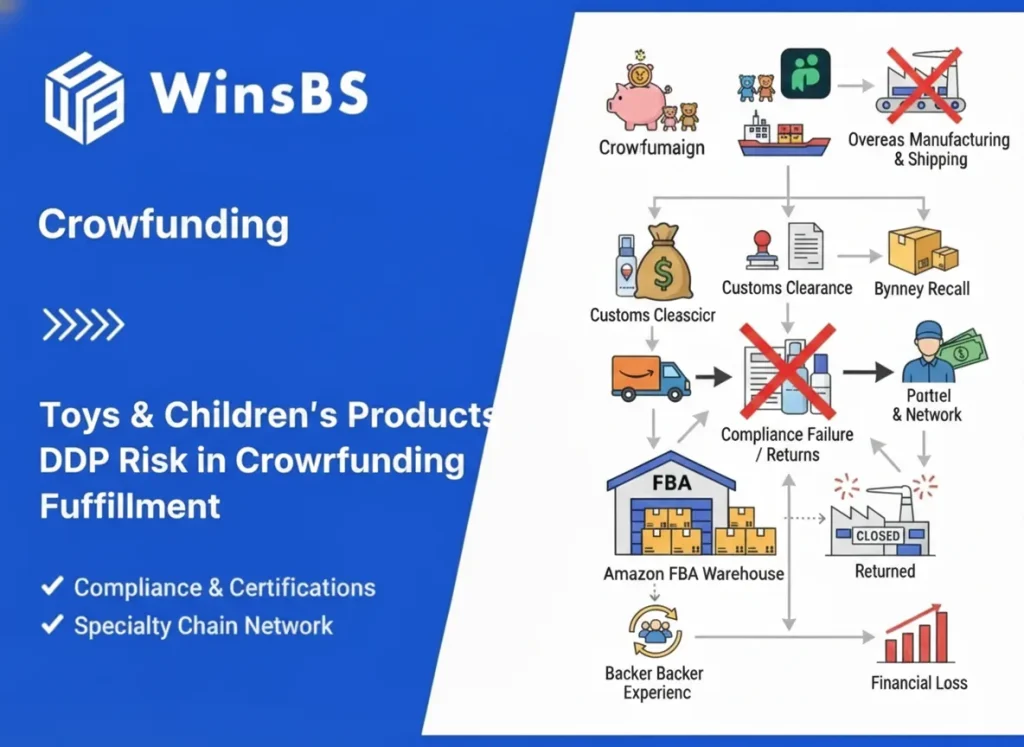










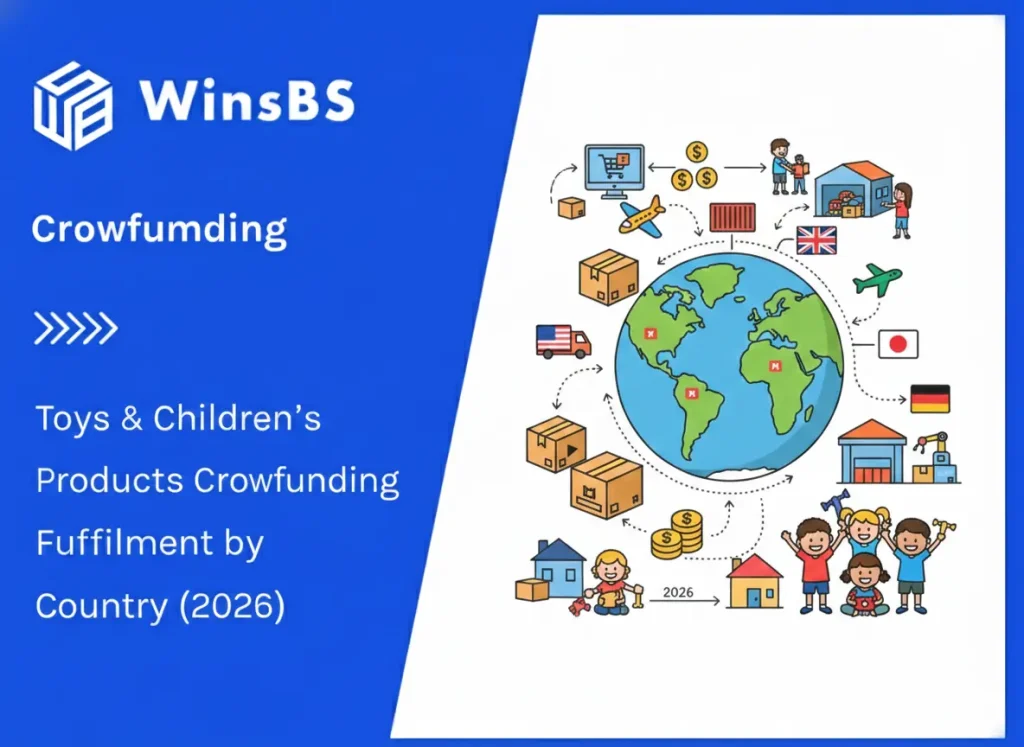
Toys & Children’s Products Crowdfunding Fulfillment by Country (2026)
Toys & Children’s Products Crowdfunding Fulfillment by Country (2026) What DDP Fixes — and What Still Breaks at Safety Proof, Age Grading, and Market Permission WinsBS Fulfillment — Maxwell Anderson Updated February 2026 This page is a country-outcomes expansion of: Toys & Children’s Products DDP Risk in Crowdfunding Fulfillment . Table of Contents The Observable Pattern: Same Toy, Same DDP, Different Outcomes The Mechanism: Why Toys Fail as “Permission” Problems, Not Shipping Problems Where It Breaks in the Execution Flow Fulfillment Reality by Country (US, EU, UK, Canada, Australia) Bundles & Stretch Goals: The Hidden Compliance Multiplier Replacement & Recall: Why Reship Often Recreates the Failure Country Outcome Matrix Operational Implications for 2026 Campaigns Children’s toy crowdfunding fulfillment outcomes differ by country — even under identical DDP terms. In 2026, many creators choose DDP to remove the most visible historical failure: backers being charged at the door. That decision often works. Complaints about surprise VAT and duties drop sharply. But toy campaigns rarely fail at the payment layer anymore. They fail at the safety proof + age grading + accountable operator layer — the layer that decides whether a toy can enter the child-consumer channel in that market. The observable pattern across modern campaigns is consistent: the same toy configuration clears quickly in one country, freezes for weeks in another, and is treated as non-placeable in a third. DDP pays the bill. It cannot prove a toy is safe, correctly age-graded, correctly labeled, and documented in the way that market enforcement expects at the moment of scrutiny. The Mechanism: Why Toys Fail as “Permission” Problems, Not Shipping Problems Toys are not operationally treated as “just another consumer product.” In most developed markets, toys and children’s products sit inside enforcement systems designed to prevent unsafe items from reaching children. That enforcement surface is broad: it can be triggered by age claims, small parts risk, magnets, batteries, coatings, cords, projectiles, or mismatched labeling. In crowdfunding, this becomes structurally fragile for one reason: the “product” is not a single SKU. The product is the pledge bundle as shipped — core toy, stretch goals, add-ons, accessories, and replacement parts. If any component shifts the hazard profile, the shipment becomes a different object from an enforcement perspective. Observed execution reality: When enforcement triggers, the shipment stops behaving like freight and starts behaving like a permission test. That is why DDP predictability can coexist with delivery failure. Where It Breaks in the Execution Flow The fastest way to misread toy fulfillment risk is to assume “customs clearance = success.” For toys, many failure events occur after the moment a shipment enters the domestic network: documentation requests, post-clearance checks, market surveillance actions, or retailer/channel-level gating. Execution Stage What Creators Assume What the System Actually Tests How Failure Presents Pre-ship (final packaging) “Labels are marketing.” Age grading + warnings + traceability consistency Hold triggered by mismatch between claims and physical toy Entry / clearance “DDP means it will clear.” Operator responsibility + required documentation availability Document request; release timeline becomes unpredictable Post-clearance / market surveillance “Tracking moved; it’s fine.” Safety compliance evidence; risk-based checks Tracking freezes; partial-country delays emerge Replacement wave “We’ll just reship.” Same permission checks apply to replacements Reship loop; support meltdown accelerates Fulfillment Reality by Country (US, EU, UK, Canada, Australia) The Country Divergence Pattern One campaign ships a single “global” toy pledge set under DDP. Freight, packaging, and labeling look identical. Yet delivery outcomes diverge by market because each system enforces permission at a different control point: some markets concentrate on post-clearance documentation and certification traceability, others on market placement proof and accountable operators, and others on age grading and specific hazard enforcement (small parts, coatings, batteries). United States — Post-Clearance Proof and Certificate Availability In the U.S., many toy shipments appear to move normally until the moment a request is made for children’s product certification proof. The operational trap is that a campaign can be “shipping-correct” while being “proof-fragile”: when a proof request is triggered, release depends on whether the required certification record exists and is retrievable fast enough to keep the flow intact. In practice, the system does not care whether the team is confident the toy is safe; it cares whether the campaign can produce the required artifact on demand. That artifact is commonly referred to as a CPC, and its function is formalized under the U.S. framework described as the Children’s Product Certificate . When a campaign cannot produce it quickly, the shipping terms (including DDP) do not change the outcome — the flow still freezes. Observed U.S. failure presentation: tracking begins, then stalls; some states/regions deliver while others pause; the support narrative shifts from “shipping” to “why is it held if you already paid?” European Union — Market Placement Permission and CE as a Declaration Chain The EU’s toy failure mode is structurally different: the system is built around market placement permission. The operational question becomes: can this toy be legally placed on the EU market as shipped? That is why a shipment can arrive physically and still be operationally non-shippable inside EU flows. This is not a “link says so” point; it is how the EU’s control surface is designed to work. The EU frames the entry boundary around the concept of market placement, described as placing toys on the EU market . The key execution implication is that CE is treated as the end of a responsibility chain (product identity + documentation + accountable operator), not as a packaging shortcut. If any part of that chain is mismatched, EU inventory becomes “present but non-shippable.” Observed EU failure presentation: “inventory exists but doesn’t ship,” country-specific stalls inside the EU, and long quiet periods followed by sudden movement (or rework). United Kingdom (GB) — Split Regimes, UKCA/CE Boundary, and Market-Specific Gating UK toy fulfillment divergence often appears as an “EU is fine / UK is stuck” pattern. The failure is not that the toy is unshippable in general; it is that the GB market has its own placement