


Online Support
Typically replies within 5 minutes
Hello! How can we assist you today?

Shipping & Logistics

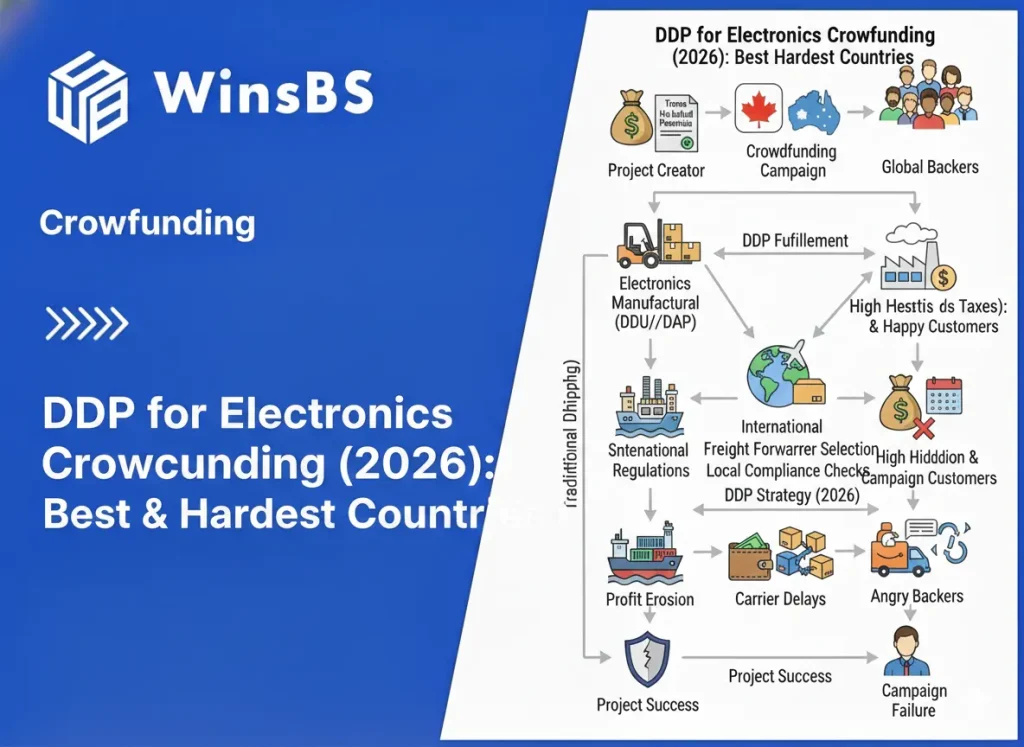
Infographic showing DDP for electronics crowdfunding in 2026 beside WinsBS logo and title, illustrating cross-border order fulfillment, taxes, tariffs, and global logistics routes for successful or failed campaigns.
Crowdfunding Fulfillment, Ecommerce, Order Fulfillment, Shipping & Logistics

DDP for Electronics Crowdfunding (2026): Best & Hardest Countries

DDP for Kickstarter & Indiegogo Electronics 2026: Best & Hardest Countries Guide Tariffs After De Minimis Removal, Battery/Wireless Compliance, Costs & Execution Tips WinsBS Fulfillment – Maxwell Anderson Updated January 20, 2026 Table of Contents TL;DR Why DDP Remains the Default Choice 2025–2026 Changes: De Minimis Gone & Tariff Reality DDP by Country: Easiest vs Hardest in 2026 Why DDP Is Predictable in Some Countries — and Structurally Hard in Others Why Regulatory Responsibility Does Not Transfer Under DDP What Actually Breaks When DDP Fails in Crowdfunding How to Execute DDP Successfully for Electronics Battery, Wireless & Extension Risks When to Avoid DDP (Red Flags & Alternatives) Self-Check: Is DDP Right for Your Campaign? FAQ: Common DDP Questions 2026 TL;DR For most $50–200 consumer electronics campaigns on Kickstarter or Indiegogo in 2026, DDP (Delivered Duty Paid) is still the smartest play to keep backers happy—no surprise fees, fewer chargebacks, better reviews. The big shift? US de minimis ended August 29, 2025—every commercial shipment now hits formal entry + duties (typically 15–30% for electronics). EU kicks in a €3 flat customs fee per item from July 1, 2026 on low-value parcels. Easiest markets: Canada, Singapore, Australia, UK, US (with solid prep). Hardest: India, Brazil, much of LATAM and select Middle East (high tariffs, delays—often better to skip DDP here). The key is locking in battery/wireless specs early and budgeting realistically. Partner with a 3PL that handles IOR, CE/RED, UN38.3—makes all the difference. Why DDP Remains the Default Choice for Electronics Crowdfunding in 2026 Let’s be real: backers on Kickstarter and Indiegogo don’t want to deal with unexpected duty or tax bills when their gadget finally arrives. Those surprise charges often lead to refunds, chargebacks, public complaints in the comments, and lasting damage to your campaign’s rating. That’s exactly why DDP—where you pre-pay duties, taxes, and clearance—continues to be the go-to recommendation from fulfillment partners like LaunchBoom, Fulfillrite, and eFulfillment Service. It delivers the cleanest backer experience, especially for products in the $50–200 range. Yes, costs have gone up significantly since late 2025. But for most campaigns, the math still works: absorbing 15–30% extra in landed costs upfront is usually cheaper than the fallout from unhappy backers. 2025–2026 Changes: De Minimis Gone & Tariff Reality The landscape shifted hard in 2025. The US fully suspended the de minimis exemption ($800 duty-free threshold) on August 29, 2025, via Executive Order. Now every commercial shipment—regardless of value—requires formal entry, broker involvement, and full duties/taxes. For consumer electronics (HS codes in the 85xx chapter), you’re typically looking at 0–5% base duties plus Section 301 add-ons, pushing effective rates to 15–30% in many cases. Broker fees alone can add $20–50 per parcel. Over in the EU, a new €3 flat customs duty per item kicks in July 1, 2026 for parcels valued under €150, on top of VAT (19–27%) and any product-specific duties. The UK remains relatively stable post-Brexit, but VAT enforcement is tight. Campaigns that pretend it’s still 2024 pricing get burned on margins. The ones that model these realities into their pledge tiers and shipping costs? They fulfill smoothly and keep backers smiling. DDP by Country: Easiest vs Hardest in 2026 (Consumer Electronics) Not all markets are created equal when it comes to DDP execution. Here’s a quick-reference table based on current enforcement patterns and real-world data from 3PLs handling electronics campaigns. Country/Region DDP Ease Level 2026 Key Changes Typical Added Cost Tips for Success Biggest Risks United States Medium-Hard De minimis gone Aug 2025; formal entry always 15–30% duty + $20–50 broker/parcel Bulk to US warehouse; accurate HTS code; pre-pay via 3PL Margin erosion from high tariffs Canada Easy-Medium Low threshold; predictable valuation Low duties (often 0–5%) Clear valuation and documentation Minimal European Union (Core Markets) Medium €3 flat fee Jul 2026 + CE/RED/Batteries Reg strict VAT 19–27% + €3 + 0–5% duty IOSS for VAT; early conformity (CE/RED); UN38.3 for batteries Conformity review reopening if wireless changes United Kingdom Easy-Medium Post-Brexit VAT enforcement Similar to EU Use UK VAT scheme for high volume Declarant vs consignee mismatch Australia Medium GST on low value; scope validation 10% GST + duties Pre-pay GST; early product scope check Reassessment delays Japan Medium-Hard Registered importer required Low-moderate duties Use 3PL as IOR; pre-register Importer mismatch blocks release Singapore Easy Efficient customs, low barriers Minimal duties Standard docs; fast clearance Minimal India / Brazil / LATAM / Select Middle East Hard High tariffs + strict inspections + local rules 20–50%+ + delays Avoid DDP; consider local partner or DAP Long holds, rejections, extra fees Pro tip: If your backers are concentrated in the top easy-medium markets (US, Canada, EU core, UK, Australia), DDP scales well. Spreading thin across hard regions? That’s when risk compounds quickly. Why DDP Is Predictable in Some Countries — and Structurally Hard in Others Here’s the thing that trips up a lot of teams: DDP difficulty isn’t about carrier reliability or warehouse speed—it’s about how each country’s customs and regulatory systems sequence their checks. In the US, since the de minimis suspension in August 2025, everything goes formal entry. But the focus stays on classification accuracy, valuation, and entry docs first. Get those right, and prepaid duties under DDP usually clear without drama—even if the bill is higher than before. That’s why so many campaigns describe US DDP as “expensive but predictable.” The rules are clear: importers must exercise reasonable care under 19 U.S.C. §1484. That said, flip to the European Union and the sequence changes. For wireless products, conformity under the Radio Equipment Directive (2014/53/EU) comes before duties are even considered valid. Battery-powered gear falls under the Batteries Regulation (EU) 2023/1542, with similar upfront checks. Prepaying duties doesn’t override those requirements—so if scope or docs get questioned, the shipment sits. This isn’t inconsistency; it’s different enforcement logic. The same gadget might sail through US customs under DDP but stall in the EU until conformity is confirmed. Understanding this upfront lets you plan smarter—early pre-checks in conformity-heavy markets, tighter valuation in tariff-first
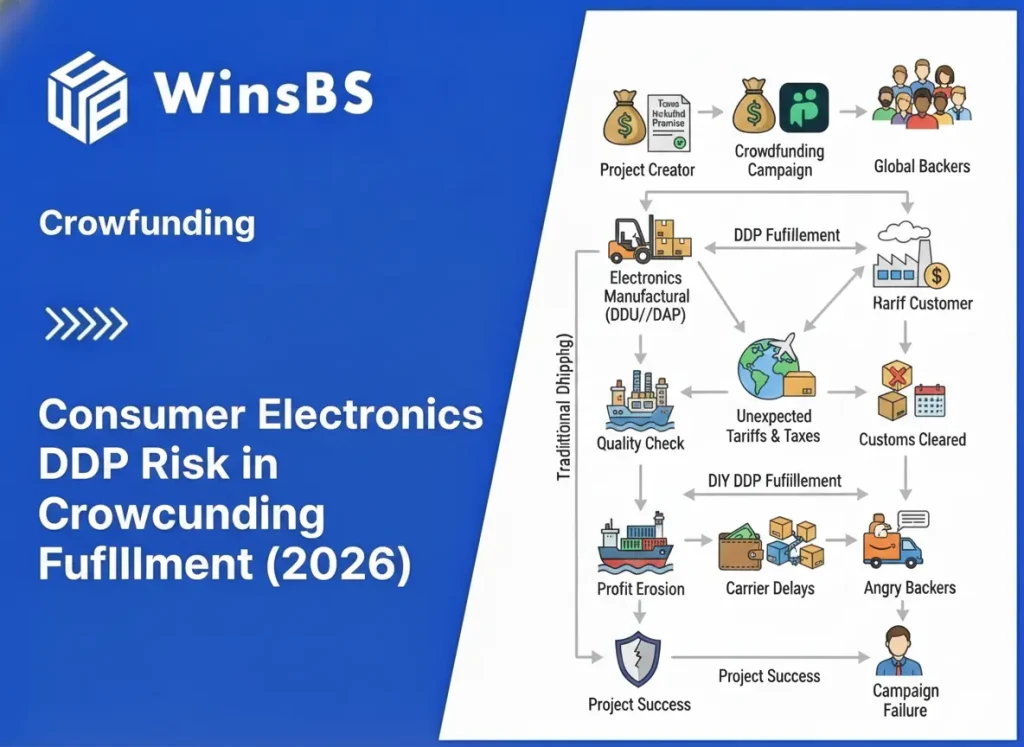
Infographic showing crowdfunding fulfillment risks for consumer electronics under DDP in 2026, with WinsBS branding, a DDP tax trap, logistics flow from creators to backers, and outcomes including cost overruns, reputational damage, and campaign failure.
Crowdfunding Fulfillment, Ecommerce, Order Fulfillment, Shipping & Logistics

Consumer Electronics DDP Risk in Crowdfunding Fulfillment (2026)

Consumer Electronics DDP Risk in Crowdfunding Fulfillment Why “Prepaid Duties” Fails When Product Definition Isn’t Fixed WinsBS Fulfillment – Maxwell Anderson Updated January 2026 Table of Contents TL;DR 1. Why Consumer Electronics Are Most Often Misjudged in Crowdfunding 2. The Three Intuitive Assumptions That Fail Under Regulatory Review 3. How Customs and Regulatory Systems Actually Define Electronic Products 4. Why DDP Becomes Structurally Unstable for Consumer Electronics 5. Country Differences Are Not Policy Variations, but Classification Entry Points 6. Why Responsibility Becomes Non-Transferable Once Problems Appear 7. When DDP Can Work — and Why These Conditions Are Rare 8. Why Crowdfunding Timelines Conflict With Regulatory Timelines 9. What This Means Before You Commit to DDP TL;DR Consumer electronics are misjudged in crowdfunding because they feel familiar, but customs and regulatory systems do not evaluate products by retail category. They evaluate devices by technical and regulatory attributes that can shift with small specification changes. DDP covers duties and taxes, but it does not retroactively validate an incorrect or outdated classification. When product definition is unstable at the time of commitment, DDP becomes structurally unstable. In U.S. law, the importer of record is legally responsible for filing with reasonable care, including declared value, classification, and duty rate. The responsibility concentrates; it does not transfer when a problem appears. In the EU and UK, the same consumer-facing device can trigger different regulatory paths based on technical scope and legal responsibility, which is why “it worked in Country A” does not guarantee it will work elsewhere. 1. Why Consumer Electronics Are Most Often Misjudged in Crowdfunding Consumer electronics feel familiar. Most creators have owned similar products, backed comparable campaigns, or shipped related items before. Compared to categories like food, cosmetics, or medical devices, electronics appear mature, standardized, and globally routine. That familiarity creates confidence. The problem is not that this confidence is irrational. The problem is that commercial product categories are not the way customs systems evaluate goods. In international trade enforcement, products are classified according to technical and regulatory attributes, not retail labels or consumer perception. What creators call “consumer electronics” has no standalone legal meaning in customs law. Product evaluation follows formal customs classification and entry responsibilities that are independent of how an item is marketed or sold. This disconnect between commercial language and regulatory definition is why consumer electronics are repeatedly misjudged at the crowdfunding stage. The failure does not begin at shipping. It begins at definition. 2. The Three Intuitive Assumptions That Fail Under Regulatory Review Most consumer-electronics campaigns do not fail because creators ignore the rules. They fail because decisions are made using intuitions that operate outside the regulatory responsibility framework. The first intuition is: “This product isn’t dangerous.” Regulatory control, however, is not limited to hazardous goods. Electronic products containing batteries or circuits remain subject to formal oversight regardless of perceived danger. International transport and border systems treat lithium-powered devices as regulated articles even when they are consumer-safe. (49 CFR § 173.185 — Lithium cells and batteries) The second intuition is: “Similar products ship successfully every day.” This is true only after product specifications and regulatory classifications have been finalized. In routine trade, electronics are shipped under stable definitions. In crowdfunding, commitments are made before specifications are frozen, reversing the normal compliance sequence. The third intuition is: “DDP solves the problem by paying upfront.” Delivered Duty Paid terms cover customs duties and taxes, but they do not override regulatory admissibility requirements. If a product fails classification or compliance review, payment cannot resolve the hold. These assumptions are common because they work in mature supply chains. They break down when responsibility is assessed before product identity is fixed. 3. How Customs and Regulatory Systems Actually Define Electronic Products Customs systems do not treat consumer electronics as a single category. They evaluate devices through multiple regulatory scopes, each triggered by specific technical attributes rather than end-user function. Electronic products are assessed based on factors such as battery composition, radio or wireless functionality, and applicable safety frameworks. A device marketed under the same name can be routed into a different regulatory pathway if any of these attributes change. This approach is codified in the EU’s regulatory treatment of electronic equipment, where compliance obligations depend on technical scope rather than consumer labeling. (Directive 2014/53/EU; Regulation (EU) 2023/1542) Once a product is declared, legal responsibility for classification accuracy rests with the importer of record, not the logistics provider or payment intermediary. Misclassification is treated as a liability issue, not a billing issue. (19 U.S.C. § 1484(a)(1) — importer responsibility using reasonable care) For crowdfunding campaigns, this creates a structural mismatch. Product specifications frequently evolve after campaigns close. From a regulatory perspective, those changes do not refine the product—they redefine it. At that point, the risk is no longer logistical. It is legal, and it cannot be corrected retroactively. 4. Why DDP Becomes Structurally Unstable for Consumer Electronics Delivered Duty Paid works only when the product being declared is already stable. DDP assumes that the description, classification, and regulatory scope used at the time of declaration will remain valid through clearance. For consumer electronics in crowdfunding, that assumption is rarely true. Customs declarations rely on the accuracy and completeness of declared product information. When specifications change—battery type, wireless capability, internal components—the original declaration no longer reflects the actual product entering the country. At that point, DDP does not “fail” operationally; it fails because it was applied to a product definition that no longer exists. (19 U.S.C. § 1484 — filing documentation, classification, and duty rate using reasonable care) This is why additional payment often cannot resolve a hold. DDP covers duties and taxes, but it does not retroactively validate an incorrect or outdated classification. When a product’s regulatory identity changes after commitment, the issue is not cost—it is admissibility. (19 CFR Part 141 — entry of merchandise requirements) For electronics, where minor specification changes can trigger different regulatory treatment, DDP becomes structurally unstable in crowdfunding timelines. The model presumes certainty at the exact

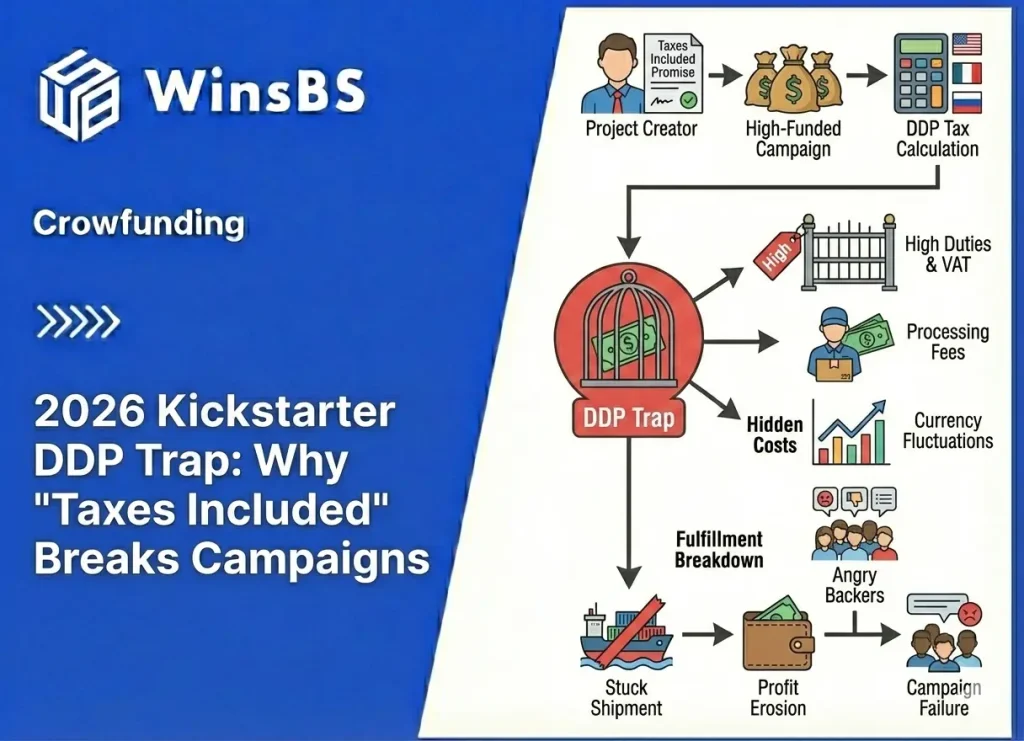
WinsBS logistics infographic showing the 2026 Kickstarter DDP trap, with VAT and tax risks, customs issues, and budget overruns caused by “taxes included” crowdfunding fulfillment promises.
Crowdfunding Fulfillment, Ecommerce, Order Fulfillment, Shipping & Logistics

2026 Kickstarter DDP Trap: Why “Taxes Included” Breaks Campaigns

2026 Kickstarter DDP Trap: Why “Taxes Included” Still Breaks Crowdfunding Campaigns Most international fulfillment failures no longer start in shipping — they start at the commitment stage WinsBS Fulfillment – Maxwell Anderson Updated February 2026 – Series Hub v1.1 In 2026, crowdfunding delivery failures are rarely caused by bad logistics. Warehouses, carriers, and 3PLs are usually doing exactly what they were contracted to do. What fails instead are the promises written on campaign pages — promises that once survived loose enforcement, but now collapse under routine customs scrutiny. “Worldwide shipping,” “taxes included,” and “DDP” are not delivery options. They are commitments about responsibility, cost absorption, and legal exposure. Once those commitments stop aligning with enforcement reality, execution cannot repair the damage. It can only reveal it. Contents Why backer frustration begins before shipping What actually changed in 2025–2026 Why execution is blamed for problems it didn’t create The promises that quietly lock failure in place Why DDP protects backers and concentrates risk on creators Why product category matters more than destination Why this page will continue expanding by category What to verify before the promise is locked WHY BACKER FRUSTRATION BEGINS BEFORE SHIPPING Backers rarely become angry the moment a package is delayed. Most people who support crowdfunding understand uncertainty. They expect production challenges, tooling delays, and imperfect international logistics. Frustration begins later — when a delivery window has already passed, and the next message they receive is not a progress update, but a request for additional payment at the door. Historically, this tension remained muted. Many low-value international parcels cleared customs quietly. Duty collection was inconsistent. Brokerage intervention was sporadic. From the outside, smooth delivery appeared normal. That environment changed decisively in late 2025. When de minimis stopped functioning as an invisible buffer for commercial shipments , costs that creators once treated as edge cases became routine. Import duties, brokerage fees, and documentation checks moved from “sometimes” to “expected.” The practical consequence is simple: campaigns that were funded under one enforcement environment are now being executed under another. The promise did not change. The rules around it did. WHAT ACTUALLY CHANGED IN 2025–2026 It is tempting to describe recent failures as the result of “higher tariffs” or “stricter customs.” That framing misses the real shift. The fundamental change is not that duties exist. Duties always existed. The change is that enforcement moved upstream and became routine for commercial crowdfunding shipments. Tools that estimate tariffs or visualize landed cost respond to this visibility problem. But they do not solve the executability problem. They cannot stabilize product definitions, reconcile classification drift, or override regulatory sequencing. This is why campaigns can be fully aware of “expected duties” and still fail at the border. Awareness does not equal clearance. WHY EXECUTION IS BLAMED FOR PROBLEMS IT DIDN’T CREATE When fulfillment begins to unravel, attention naturally shifts downstream. Warehouses, carriers, customs brokers, and 3PL partners become the visible actors. In most cases, execution is not malfunctioning. It is performing exactly as contracted. If the commitment structure is wrong, changing execution partners rarely changes the outcome. Risk simply reappears in a different form — delay, re-quotation, return-to-sender, or abandoned international parcels. This misattribution shows up repeatedly across categories. In electronics campaigns, execution is often blamed for delays that were triggered upstream by classification drift and importer responsibility, as documented in real consumer electronics campaigns where DDP locked responsibility before product definitions stabilized . THE PROMISES THAT QUIETLY LOCK FAILURE IN PLACE Crowdfunding fulfillment rarely fails because of one bad decision. It fails because several reasonable promises are made simultaneously. “Worldwide shipping” assumes legal importability across all listed destinations. “Taxes included” reallocates duty responsibility away from the backer. Together, they define who absorbs classification disputes, clearance delays, and unexpected administrative costs. At the same time, crowdfunding products evolve after launch. Materials change. Batteries are added. Bundles expand through stretch goals. Each change can alter how customs defines the product, even though the campaign page — and its promises — remain frozen. Once funded, those promises stop being assumptions. They become constraints. WHY DDP PROTECTS BACKERS AND CONCENTRATES RISK ON CREATORS Duty-paid delivery is popular in crowdfunding because it removes friction at the door. Backers receive rewards without surprise charges or paperwork. What changes under DDP is not the shipping route. It is who customs treats as responsible when classification is questioned, documentation is incomplete, or prepayment is rejected. This responsibility concentration appears again in regulated consumables. In supplements and cosmetics, DDP absorbs not just duties but regulatory rejection risk — a pattern examined in food supplement campaigns where taxes were prepaid but market access was denied and later mirrored in cosmetics projects blocked after compliance checks escalated . WHY PRODUCT CATEGORY MATTERS MORE THAN DESTINATION Country rules change frequently. Product characteristics do not. In children’s products, failure is driven by safety documentation and traceability rather than shipping speed, as shown in toys and children’s products where DDP did not override safety enforcement . Apparel campaigns break under origin responsibility, not delivery distance, as analyzed in apparel crowdfunding failures triggered by UFLPA origin enforcement . Even non-regulated products can fail when fulfillment complexity overwhelms execution tolerance, as demonstrated in board game campaigns where SKU coupling and wave sequencing collapsed delivery timelines . Country-level divergence becomes most visible after a failure mechanism is triggered. Identical products, shipped under identical DDP terms, routinely clear in one market and stall in another. This execution spread is mapped explicitly in electronics campaigns compared by destination country , as well as in supplement fulfillment outcomes that diverge after customs review . The same pattern appears in apparel and tabletop fulfillment. Origin-sensitive textiles break differently by market, while board game delays cluster around specific regions depending on wave structure and replacement flow. These differences are analyzed in apparel DDP outcomes by country and board game crowdfunding delays broken down by region . In regulated consumables and children’s products, country divergence is even sharper. Compliance may be sufficient for one market and unacceptable

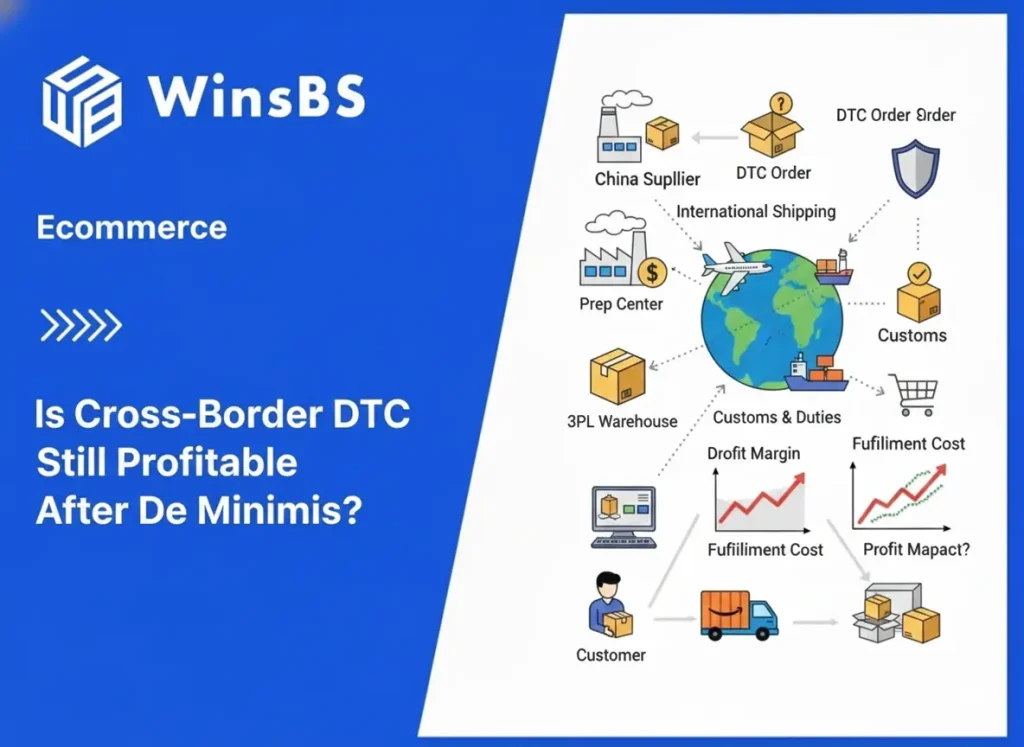
Cross-border eCommerce logistics illustration beside WinsBS logo and blog title, showing international shipping, 3PL warehouses, customs duties, and profit growth, symbolizing cross-border order fulfillment and DTC fulfillment operations.
Ecommerce, Order Fulfillment, Shipping & Logistics

Is Cross-Border DTC Still Profitable After De Minimis?

Is Cross-Border DTC Still Profitable After De Minimis? A 2025 Reality Check and 2026 Survival Guide for DTC and Shopify Brands WinsBS Research – Maxwell Anderson TL;DR — Five structural judgments you must understand: Cross-border DTC is not dead after U.S. de minimis and new tariffs, but the direct-ship-per-order model is no longer economically viable for low-AOV brands. If your average order value remains below $40–$50 in the U.S. or €30–€40 in Europe, fixed per-shipment costs now overwhelm gross margin. The primary profit killer is no longer shipping rates, but per-shipment brokerage and clearance fees, compounded in the EU by item-based customs charges. Brands that do not pre-collect duties at checkout are seeing higher refusal and return rates as customers reject surprise delivery charges. Local or bonded inventory combined with upfront duty collection is no longer an optimization—it is the minimum structural requirement to stabilize unit economics in 2026. Many sellers are misreading what actually changed. They look at collapsing margins and conclude that cross-border DTC demand has weakened, that paid acquisition has become inefficient, or that the market has simply “matured.” This is a misdiagnosis. What has changed is not demand. What has changed is the cost structure that sits underneath each individual order. Post–de minimis enforcement did not raise costs gradually. It introduced fixed, non-negotiable per-shipment charges that scale poorly against low average order values. The result is a profit cliff. Orders that once cleared margin thresholds now fall off abruptly, not because consumers stopped buying, but because fulfillment economics crossed a structural boundary. Read this as a decision guide, not a news recap. The goal is to determine whether your cross-border DTC unit economics still clear the post–de minimis viability boundary—and what minimum changes are required if they do not. Contents Is Cross-Border DTC Dead or Still Survivable? The Profit Cliff: Why AOV Is the First Death Line The U.S. Reality: Fixed Per-Shipment Costs as the Primary Killer The EU Reality: €3 Is Charged Per Item Type, Not Per Parcel Why This Is an Asymmetric Cost Disadvantage Against Local Sellers Operational Fallout: Refusals, Returns, and Rating Damage AOV Break-Even Calculator (Post–De Minimis) The Minimum Survival Architecture for Cross-Border DTC in 2026 Execution Checklist: How to Apply the AOV Boundary in Practice What Does Not Fix the Problem Why This Becomes a Fulfillment Decision, Not a Marketing One Next Steps for Brands Crossing the AOV Boundary When Fulfillment Architecture Becomes the Decision Content Attribution & Editorial Disclosure — WinsBS Research IS CROSS-BORDER DTC DEAD OR STILL SURVIVABLE? The short answer is no—cross-border DTC is not dead. But the model that powered its growth for the last decade no longer survives under post–de minimis enforcement. Cross-border DTC remains viable only when unit economics can absorb fixed per-shipment costs without collapsing margin. That condition is no longer true for the classic low-AOV, direct-ship-per-order model. For years, sellers relied on a structure where shipping, duties, and clearance scaled roughly in proportion to order value. When de minimis thresholds were broadly enforced, low-value orders could cross borders without triggering formal entry, brokerage, or itemized customs handling. That proportionality no longer exists. Post–de minimis enforcement introduces fixed costs that apply regardless of whether the order is worth $20 or $200. Once those fixed costs exceed gross margin, the business does not gradually degrade—it flips into loss. This is why many sellers experience the change as sudden and confusing. Demand often remains stable. Conversion rates may not collapse. But profitability disappears at the order level. In other words, cross-border DTC did not die. A specific economic configuration died. THE PROFIT CLIFF: WHY AOV IS THE FIRST DEATH LINE The most important variable in post–de minimis cross-border DTC is average order value. Not conversion rate. Not shipping speed. Not marketing efficiency. Average order value determines whether fixed per-shipment costs behave like a tolerable tax or a fatal burden. When AOV remains consistently below $40–50 in the United States or €30–40 in Europe, cross-border DTC becomes structurally unprofitable unless major changes are introduced. This is not a pricing opinion. It is a mathematical boundary. Fixed clearance, brokerage, and processing fees do not scale down for small baskets. They apply per shipment, not per dollar of revenue. Below this AOV range, each order must absorb a similar fixed cost while generating less gross profit. Once that fixed cost exceeds contribution margin, bundling, discounts, and shipping optimization can no longer repair the equation. This creates a profit cliff rather than a slope. Orders do not become “less profitable.” They cross into guaranteed loss territory. Many brands continue shipping because top-line revenue still appears healthy. But at the unit level, every fulfilled order accelerates margin erosion. This is why AOV must be evaluated before any discussion of tactics, fulfillment partners, or logistics optimization. If the order value sits below the cliff, no downstream fix can restore profitability. Figure 1: Cross-Border DTC Profit Cliff After De Minimis (2025–2026) High Margin Break-even Loss $20 $30 $40 $50 $60+ Fixed per-shipment costs ($25–$45) Profit Cliff Zone $40–$50 AOV threshold AOV Profit Cliff Visualization Fixed brokerage, clearance, and duty costs create a hard profitability floor. Below approximately $40–$50 average order value, net margin per order remains structurally negative regardless of shipping optimization or gross margin percentage. The curve illustrates how margin only stabilizes once order value clears the fixed-cost boundary. THE U.S. REALITY: FIXED PER-SHIPMENT COSTS AS THE PRIMARY KILLER One of the most common misdiagnoses is blaming shipping rates. Sellers see higher landed costs and assume that parcel carriers or linehaul pricing are the main drivers of margin collapse. In reality, shipping rates are no longer the dominant factor. In the United States, the primary profit killer after de minimis enforcement is fixed per-shipment brokerage and clearance cost. These costs typically range from $20 to $50 per shipment, depending on entry type, carrier handling, and compliance requirements. Crucially, these fees apply regardless of order value. A $22 order and a $220 order incur similar clearance overhead. For low-AOV brands, brokerage alone

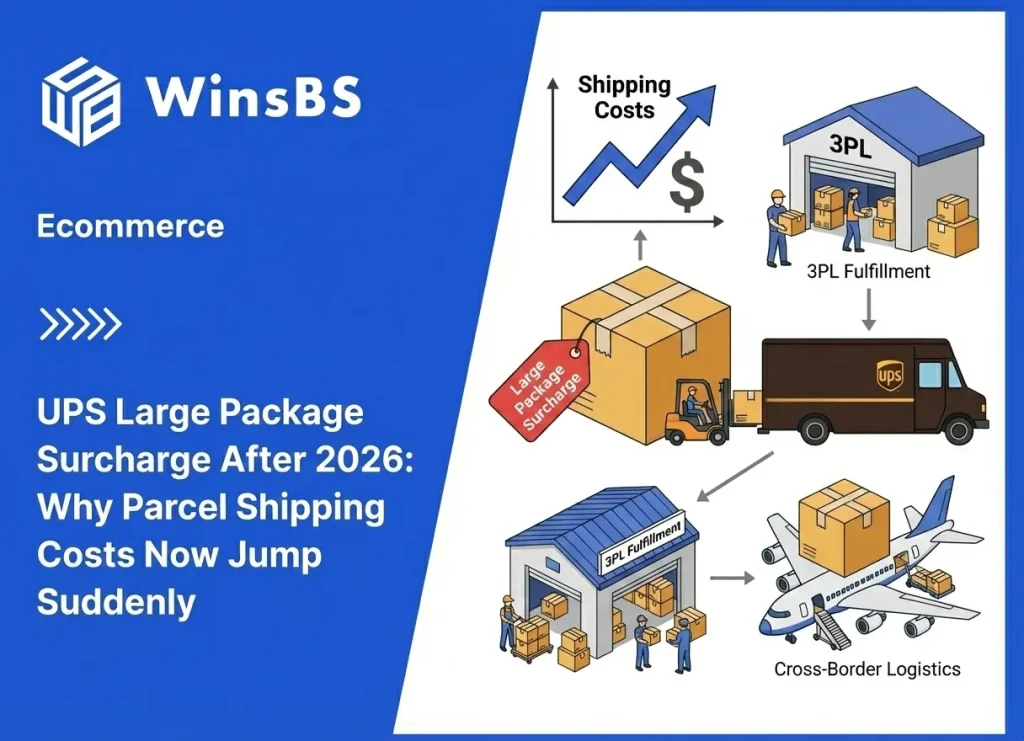
Large package with rising cost symbols beside WinsBS logo and title, illustrating UPS large package surcharge impact on cross-border eCommerce fulfillment and 3PL order fulfillment costs.
Ecommerce, Order Fulfillment, Shipping & Logistics

UPS Large Package Surcharge After 2026: Why Parcel Shipping Costs Now Jump Suddenly

UPS Large Package Surcharge After 2026 How Rule Changes Are Redefining Parcel Shipping Economics WinsBS Research – Maxwell Anderson Updated for 2026 Carrier Rule Changes TL;DR — What changed, why invoices jump, and what it means for shippers: Starting in 2026, UPS Large Package Surcharge stops behaving like a marginal fee and starts behaving like a hard classification boundary. A shipment no longer needs to “look oversized” to qualify. Under the new rules, a package can trigger Large Package classification not only through traditional size limits (longest side over 96 inches, or length plus girth over 130 inches), but also by crossing volume or weight thresholds. Specifically, a carton qualifies if its cubic volume exceeds 17,280 cubic inches (length × width × height), or if its actual weight exceeds 110 pounds, even when all visible dimensions remain within standard parcel ranges. Once any one threshold is crossed, pricing behavior changes immediately. The shipment is reclassified as “Large Package,” a minimum billable weight of 90 lbs is applied, and several hundred dollars in surcharge can appear without any gradual ramp. This is why small packaging decisions—extra padding, a different carton, or consolidating one additional unit—can cause sudden invoice shocks. This is not a UPS-only adjustment. Other major parcel carriers are converging on similar volume- and weight-based logic, which means carrier switching alone does not remove the underlying risk if your shipments sit near the same boundaries. The practical signal is structural. When profitability depends on “staying just under” a threshold, parcel shipping is no longer stable. Cost control has to move upstream into carton design, SKU configuration, consolidation rules, and fulfillment routing decisions rather than being treated as a downstream shipping problem. For many years, parcel shipping followed a predictable cost curve. As packages became larger or heavier, shipping costs increased incrementally. Sellers could plan margins, adjust pricing, and optimize packaging with reasonable confidence. That predictability no longer applies. Beginning in 2026, the Large Package Surcharge enforced by UPS has shifted from a niche penalty into a structural pricing mechanism. What qualifies as a “large” package is no longer limited to obvious oversize items. Instead, classification is now driven by volume and weight thresholds that fundamentally alter how parcel shipping behaves. To understand why shipping costs now jump abruptly—and why this matters beyond UPS itself—it is necessary to move step by step from rules, to impact, to structural consequences. Contents Rules: What UPS Changed in 2026 and Why It Matters Impact: Why Ordinary Packages Are Suddenly at Risk Structural Change: From Linear Pricing to Cost Cliffs Risk Matrix: How Size, Volume, and Weight Translate Into Cost Exposure Calculation Example: How a “Normal” Box Becomes a Large Package Typical “Hidden” Trigger Paths Fees: Why Surcharges Now Dominate the Invoice Decision Boundary: When Parcel Shipping Becomes Structurally Unstable Industry Alignment: Why This Is Not a UPS-Only Shift Future Market Consequences: What the 2026 Rules Set in Motion RULES: WHAT UPS CHANGED IN 2026 AND WHY IT MATTERS Effective January 26, 2026, UPS applies the Large Package Surcharge when any one of the following conditions is met. Traditional triggers remain unchanged. A package qualifies if its longest side exceeds 96 inches, or if the combined length plus girth exceeds 130 inches. Two additional triggers now operate independently of physical shape. A package qualifies if its cubic volume exceeds 17,280 cubic inches, calculated as length × width × height. A package also qualifies if its actual weight exceeds 110 pounds, regardless of dimensions. Once any trigger is met, UPS enforces a minimum billable weight of 90 pounds, even if actual or dimensional weight is lower. These thresholds are binary. Crossing them immediately changes how the shipment is priced. Trigger Type Threshold What It Captures Why Ecommerce Sellers Get Hit Longest side > 96 inches Physically long cartons Classic oversize scenario Length + girth > 130 inches Bulky cartons Classic “big box” profile Cubic volume > 17,280 in³ Compact but high-volume cartons Square/optimized packaging crosses a hard line Actual weight > 110 lbs Dense shipments Heavy items remain small but still qualify Billing behavior Minimum billable weight: 90 lbs Cost cliff compounding Even “light” DIM/actual weight may be priced higher Figure 1. 2026 UPS Large Package classification is binary: any single trigger flips the pricing state. Qualification Triggers (any one triggers LPS) Trigger A — Longest side Length > 96 inches Classic oversize Trigger B — Length + girth Length + (2×Width) + (2×Height) > 130 inches Classic bulky Trigger C — Cubic volume (new) Length × Width × Height > 17,280 in³ A carton can look compact and still cross the threshold. Volume-based Trigger D — Actual weight (new) Actual weight > 110 lbs (dimensions do not matter) Density-based State Large Package Classification flips Billing behavior Minimum billable 90 lbs Result Binary price jump Visual is explanatory. Always validate thresholds and rate application using the carrier’s latest published tariffs and your contract. Caption: The 2026 rule change is not only “new numbers.” It creates a binary qualification state. When any single trigger is met, the shipment is treated as a Large Package and priced under a different billing behavior (including a minimum billable weight of 90 lbs). Figure 2. Binary thresholds create “cost cliffs” (qualification flips instantly, not gradually). Relative pricing behavior (conceptual) Left: below threshold — incremental pricing Right: above threshold — classification-driven pricing Incremental cost curve New classification state (LPS) Threshold boundary (examples): 17,280 in³ or 110 lbs Below threshold Small packaging changes mostly cause small price changes. Above threshold A small packaging change can trigger a large surcharge jump. This figure visualizes the binary behavior described in the Rules section. It is not a rate chart and does not represent exact dollars. Caption: The Rules section describes binary triggers. This chart translates that into behavior: once a shipment crosses a threshold, cost behavior changes from incremental to classification-driven, producing the “cost cliff” effect. IMPACT: WHY ORDINARY PACKAGES ARE SUDDENLY AT RISK Under earlier pricing logic, surcharge risk was easy to identify.

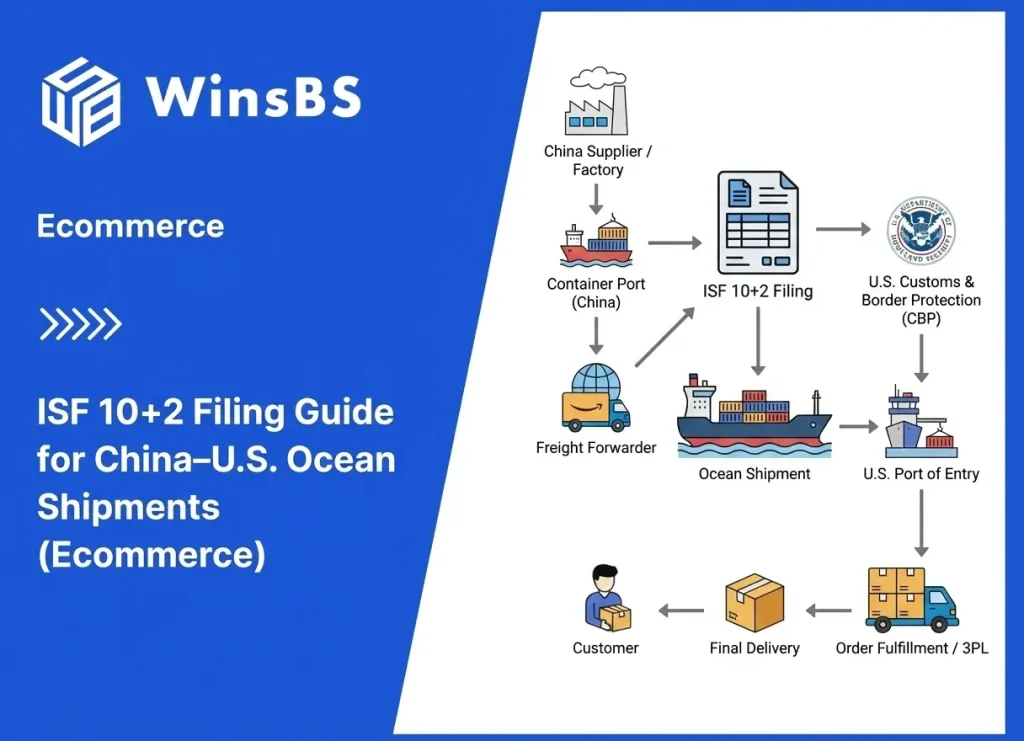
WinsBS branded cover image showing ISF 10+2 filing guide for China–U.S. ocean shipments, featuring container ship, compliance documents, and data flow icons, representing cross-border shipping compliance and order fulfillment logistics.
Ecommerce, Order Fulfillment, Shipping & Logistics

ISF 10+2 Filing Guide for China–U.S. Ocean Shipments (Ecommerce)

ISF 10+2 Filing Guide for China–U.S. Ocean Shipments A Fulfillment-First Playbook for Ecommerce Inventory, FBA Inbound Timing & U.S. Port Hold Avoidance WinsBS Research – Michael Updated December 2025 TL;DR Importer Security Filing (ISF 10+2) is an advance cargo security filing required for U.S.-bound ocean freight. In ecommerce, ISF is not “customs paperwork.” It is a fulfillment gate: if ISF data is late, inconsistent, or amended after vessel loading, inventory may be physically at a U.S. port while still being operationally blocked—causing FBA check-in delays, inventory availability gaps, missed inbound appointments, and lost sales windows. Official CBP overview: Importer Security Filing “10+2”. This article is written for ecommerce operators shipping from China to the United States by ocean freight, including Amazon FBA sellers, direct-to-consumer (DTC) brands, and crowdfunding teams. It explains how ISF interacts with purchase orders, factory data, booking discipline, and warehouse receiving—so your inventory becomes sellable on time, not “arrived but unusable.” If you want an inbound workflow check (data discipline, cross-border readiness, inbound scheduling), Get Started for Free or contact the team: Talk to WinsBS. If your China–U.S. ocean shipment is showing “Arrived” but: Amazon FBA inbound cannot be checked in Inbound appointments keep getting pushed out Your 3PL says the container cannot be released yet then the issue is often not port congestion and not warehouse capacity. In ecommerce fulfillment, the missing control is frequently Importer Security Filing (ISF 10+2)—specifically, whether the inbound data story was stable before vessel loading. Contents Fast Answers: ISF 10+2 for Ecommerce Why Ecommerce Shipments Say “Arrived” but Fulfillment Has Not Started What Is Importer Security Filing (ISF 10+2)? ISF as a Fulfillment Gate (Not a Customs Form) FBA vs DTC vs Crowdfunding: How ISF Failure Breaks Each Model Importer of Record Responsibility in Ecommerce Structures ISF-10 Data Elements Explained with Ecommerce Data Sources The “+2” Carrier Data Elements: What Sellers Must Still Watch ISF Timeline: What “24 Hours Before Loading” Actually Means FCL vs LCL vs Multi-SKU: Where ISF Risk Explodes High-Frequency ISF Failure Modes (Case Cards) ISF Penalties vs Fulfillment Loss: The Real Cost Model ISF vs AMS vs Customs Entry — Fulfillment Control Comparison Fulfillment-First ISF Checklist (Copy/Paste) People Also Ask: Short Answers Final Recommendation: Build ISF Into Inbound Execution FAST ANSWERS: ISF 10+2 FOR ECOMMERCE What is Importer Security Filing (ISF 10+2)? Importer Security Filing (ISF 10+2) is an advance security filing required for U.S.-bound ocean freight. It requires ten importer-provided data elements and two carrier-provided data elements to be submitted to U.S. Customs and Border Protection before vessel loading. Official CBP overview: ISF 10+2. When must ISF be filed? ISF is generally required no later than 24 hours before cargo is loaded on the vessel at the foreign port. Do not interpret this as “24 hours before the ship departs.” CBP help article: When to submit ISF. Why do ecommerce sellers feel ISF problems at FBA check-in or warehouse receiving? Because ISF is a pre-fulfillment gate. If ISF data is late, inconsistent, or amended after vessel loading, the shipment may be flagged for review and operationally delayed at the exact moment you need to schedule drayage, inbound appointments, and inventory availability. Who is responsible for ISF in practice? The Importer of Record (and/or the ISF importer depending on cargo type and filing structure) bears responsibility. A freight forwarder or customs broker may transmit the filing, but responsibility and downstream fulfillment risk do not disappear. Reference: CBP ISF FAQ: ISF 10+2 FAQs Download CBP FAQs PDF. What is the most common ecommerce ISF mistake? Treating ISF as “broker paperwork” instead of inbound execution data—especially inaccurate manufacturer identity, inconsistent ship-to party, and last-minute amendments after vessel loading. WHY ECOMMERCE SHIPMENTS SAY “ARRIVED” BUT FULFILLMENT HAS NOT STARTED China → U.S. ocean freight in ecommerce has a recurring failure pattern: the container is physically present at a U.S. port, but the business experiences the shipment as if it is “missing.” This is not a contradiction. It is a system mismatch. Ecommerce fulfillment does not start when a vessel arrives. Fulfillment starts when inventory becomes operationally usable: when drayage can be scheduled, inbound appointments can be confirmed, receiving can be executed, and the inventory record can be trusted. If any upstream control blocks those actions, you get the most frustrating state in cross-border logistics: arrived but unusable. Many sellers misdiagnose this state as port congestion, warehouse capacity, or “random inspection.” Those can be real contributors, but for ecommerce shipments the decisive root cause is often the same: the inbound data that proves identity, origin, and routing was not stable at the moment ISF needed it. In other words, the problem is not the container. The problem is the inbound proof that the container should be allowed to flow into the fulfillment system. Fulfillment-first framing: ISF 10+2 is not a form that “finishes customs.” It is a control that helps determine whether your shipment can proceed to appointment booking, receiving, and inventory availability without disruption. WHAT IS IMPORTER SECURITY FILING (ISF 10+2)? Importer Security Filing (ISF 10+2) is an advance cargo security filing required for non-bulk cargo shipments arriving in the United States by vessel. It requires the electronic transmission of specific data elements to U.S. Customs and Border Protection (CBP) prior to vessel loading. CBP’s official program page provides the baseline definition and scope: Importer Security Filing “10+2”. From a fulfillment execution perspective, Importer Security Filing (ISF 10+2) functions as a pre-entry control gate rather than a customs form. If the ISF data story is unstable at loading time, downstream inbound execution becomes unpredictable—even when the vessel arrives on schedule. “10+2” means: 10 data elements provided by the importer (or the importer’s nominated agent) that describe the seller-buyer relationship, factory identity, origin, classification, and consolidation details. 2 data elements provided by the ocean carrier: vessel stow plan data and container status messages. ISF applies to U.S.-bound cargo by vessel, including shipments moving to U.S. ports for direct discharge as well as certain transit cargo structures depending on the filing

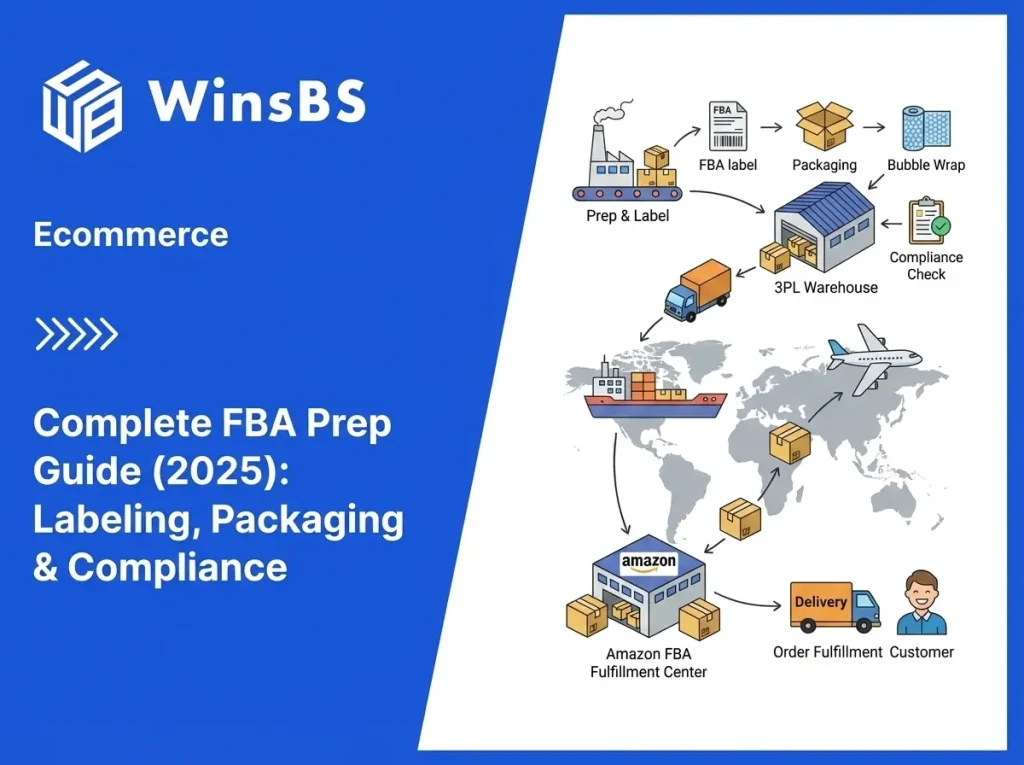
WinsBS logo with title "Complete FBA Prep Guide (2025): Labeling, Packaging & Compliance" beside a flat-style global supply chain diagram showing China origin, 3PL warehouse, inventory management, international shipping, customs clearance, and final order fulfillment.
Ecommerce, Order Fulfillment, Shipping & Logistics

Complete FBA Prep Guide (2025): Labeling, Packaging & Compliance

Complete FBA Prep Guide: Labeling, Packaging & Compliance A U.S.-First Playbook That Also Works for Cross-Border Sellers Shipping into Amazon FBA (Updated Dec 2025) WinsBS Fulfillment – Maxwell Anderson Updated December 2025 TL;DR FBA prep is the labeling, packaging, and compliance work required so Amazon can receive, store, pick, and ship your inventory without manual intervention. Most inbound failures come from barcode conflicts, missing carton/pallet identifiers, and packaging that opens, leaks, breaks, or separates in warehouse handling. Starting January 1, 2026, Amazon states it will no longer offer prep and item labeling services for U.S. FBA shipments—so every unit must arrive fully prepped and fully labeled before it reaches an Amazon facility. Official notice. This guide is written for Amazon US sellers first, because the U.S. inbound network sets the baseline expectations for scan-ability and packaging integrity. But it is designed to remain useful if you sell globally and ship into EU/UK/CA/JP marketplaces—especially if you manufacture in China and route inventory cross-border before it reaches FBA. If you want a production workflow (barcode control, packaging QA, carton discipline, cross-border readiness), Get Started for Free. Contents Fast Answers: What Actually Causes Amazon Inbound Failures? Critical Update: Amazon Ending U.S. FBA Prep Services in 2026 How Amazon Receiving “Decides” If Inventory Is Acceptable Understanding FBA Prep Categories FBA Labeling Requirements (Unit, Carton, Pallet) FBA Packaging Guidelines (What Prevents Rejection) Compliance & Restricted Products (Hazmat, Expiration, Prohibited) International & Cross-Border FBA Prep Considerations Top FBA Prep Mistakes (Costs + Fixes) Tools & Workflows (Post-2026 Reality) Final Checklist Before Shipping to FBA People Also Ask: Short Answers Final Recommendation (U.S.-First, Global-Ready) FAST ANSWERS : WHAT ACTUALLY CAUSES AMAZON INBOUND FAILURES? What is FBA prep? FBA prep is the labeling, packaging, and compliance work required so each unit can be scanned correctly and handled safely inside Amazon fulfillment centers without rework. What is the #1 cause of receiving delays or rework? Barcode conflicts—more than one scannable barcode visible on a unit or carton, or labels placed where scanners can’t read them reliably. What changed in 2026 for Amazon US? Amazon states that starting January 1, 2026, it will no longer offer prep and item labeling services for FBA shipments in the U.S. store, so inventory must arrive fully prepped and labeled. Seller Central notice. What packaging mistakes cause immediate rejection risk? Packaging that opens, leaks, breaks, exposes product surfaces, or allows sets to separate during handling—especially liquids, fragile items, and sharp products. Does this apply to cross-border sellers shipping from China? Yes. Inbound requirements apply to inventory arriving at U.S. FBA, regardless of where it was manufactured. Cross-border sellers face extra failure points at customs and carrier handoffs before inventory reaches Amazon. CRITICAL UPDATE: AMAZON ENDING U.S. FBA PREP SERVICES IN 2026 Amazon’s official FBA Prep Service page includes this note: starting January 1, 2026, it will no longer offer prep and item labeling services for FBA shipments in the U.S. store. Official policy page. What this means operationally (U.S.-first, global impact): If you relied on Amazon for labeling, bagging, bubble wrap, or bundling, that safety net is gone for U.S. inbound. All units must arrive “scan-ready” and “damage-ready” before they reach an Amazon facility. Cross-border sellers must shift prep upstream: factory, origin warehouse, or a fulfillment partner. Reality Check: “We’ll fix it later” stops working in 2026 Common situation: A brand produces in China, ships into the U.S., and assumes Amazon will relabel or re-bag whatever is imperfect. Why it fails: After 2026, Amazon US prep/label services are discontinued. Inbound errors surface as delays, rework charges, or refused/blocked inventory. What to do now: Standardize a prep workflow with barcode control, packaging QA, carton/pallet discipline, and documented checks before shipment creation. HOW AMAZON RECEIVING “DECIDES” IF INVENTORY IS ACCEPTABLE The best way to think about FBA prep is not “Did we follow a checklist?” It is “Will Amazon’s system accept this inventory without intervention?” Amazon receiving outcomes are driven by two root causes: Identity failures (scan problems): barcode conflicts, unreadable labels, missing carton/pallet identifiers Integrity failures (handling problems): packaging opens/leaks/breaks, sets separate, sharp items puncture, liquids leak Ready rule of thumb: After prep, each unit should have one scannable identity and packaging that remains intact through warehouse handling. UNDERSTANDING FBA PREP CATEGORIES Amazon prep categories are less about product “type” and more about how products behave in storage and picking. If you classify based on marketing categories, you miss the real risk profile. Prep Category What Amazon Is Preventing Seller Decision Rule Loose products Units falling out of packaging, loose components Nothing opens or separates during handling Sold as set Set components split into separate inventory Physically bundle + “do not separate” marking Poly-bagged Contamination, leaks, exposed surfaces, warning non-compliance Secure seal + required warnings + barcode visibility Case-packed Receiving exceptions due to mixed quantities/SKUs Same SKU + same quantity per carton as shipment plan Special handling Damage, puncture, leakage, safety concerns Overprotect fragile/liquid/sharp products for warehouse touches Amazon’s packaging guidance is the baseline reference for packaging and bagging expectations. Product packaging requirements. FBA LABELING REQUIREMENTS (UNIT, CARTON, PALLET) Most expensive labeling mistake: Leaving multiple scannable barcodes visible after applying an FNSKU or other label. If a scanner reads the wrong code, receiving results become unpredictable. 1) Unit labeling: FNSKU vs manufacturer barcode Most U.S. sellers choose FNSKU to control unit identity. The practical goal is not “use FNSKU,” it is one scannable identity per unit. If any other barcode remains scannable, you have created a receiving failure condition. Place unit labels on flat, visible surfaces Do not wrap labels around curves or edges Fully cover or render other barcodes unscannable Run a quick scan test before cartons are sealed 2) Carton labeling: FBA Box ID labels Each box must have its own FBA Box ID label printed from the shipment workflow. Label placement matters: put it on a flat surface next to the carrier label so barcodes do not fold over edges. Shipping label requirements. 3) Pallet labeling: LTL / FTL shipments If

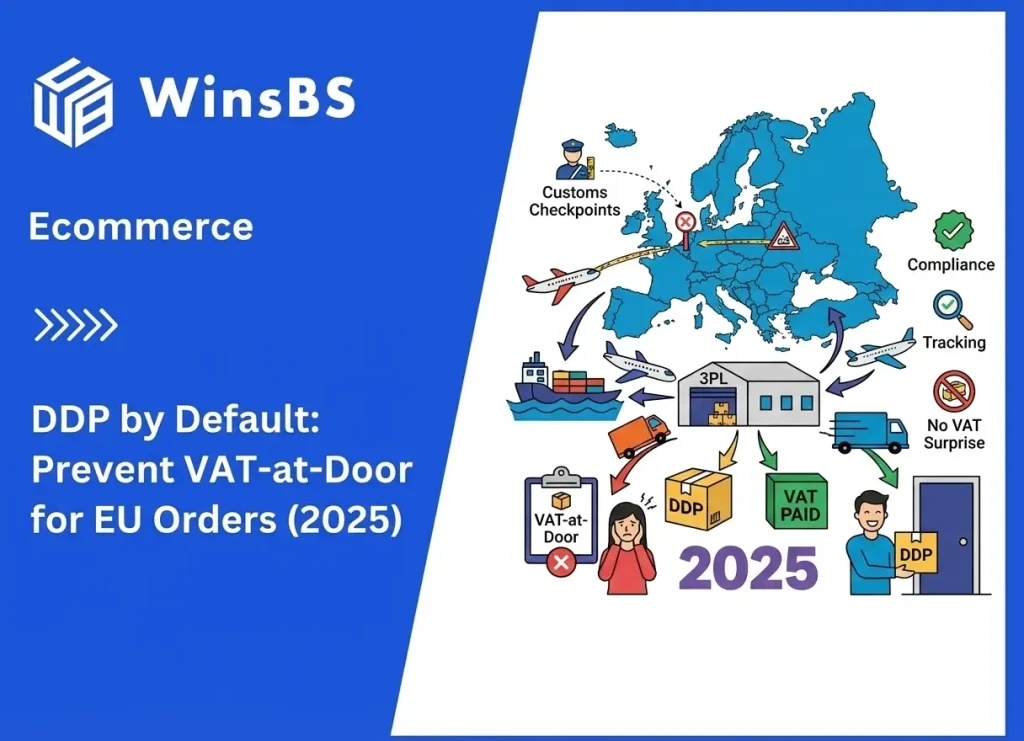
Infographic titled "DDP by Default: Prevent VAT-at-Door for EU Orders (2025)" beside WinsBS branding, illustrating 3PL order fulfillment to Europe using DDP shipping to handle customs and VAT, contrasting VAT-at-door issues with smooth VAT-paid delivery.
Ecommerce, Order Fulfillment, Shipping & Logistics

DDP by Default: Prevent VAT-at-Door for EU Orders (2025)

DDP by Default: EU Delivery That Prevents VAT-at-Door Practical IOSS/DDP Routing, Carrier Selection, and DDP vs DAP Decisions (2025) WinsBS Fulfillment – Maxwell Anderson Updated December 2025 TL;DR DDP (Delivered Duty Paid) means the seller pre-pays duties and VAT and executes customs clearance so the buyer receives the parcel with no payment request at the door. DAP (Delivered at Place) pushes VAT/duties and clearance actions to the buyer at arrival, which commonly causes customs holds, refusals, and RTS (return-to-sender). In 2025, with stricter EU VAT compliance under IOSS, tighter import scrutiny, and platform pressure from Shopify, TikTok Shop, and Amazon FBM, “DDP by default” is no longer a premium feature. It is the baseline execution standard for cross-border parcels. Brands switching from DAP-style shipping to DDP-style execution typically see: Higher checkout conversion because pricing becomes tax-inclusive and predictable Fewer refusals and RTS events caused by surprise VAT, duties, and brokerage fees More stable customs clearance outcomes and lead times Better delivery performance signals that support platform ranking and account health If you want to deploy a production-ready DDP workflow across EU/UK/US lanes (including IOSS and Section 321 routing), Get Started for Free. Contents Incoterms for eCommerce: A Practical Overview What Is DDP (Delivered Duty Paid)? What Is DAP (Delivered at Place)? DDP vs DAP: Side-by-Side Comparison DDP, DAP, and DDU: Definition Cluster Total Landed Cost: Why DDP Is Cheaper Than It Looks How DDP and DAP Change Buyer Behavior DDP vs DAP in 2025: Regulatory Context DDP vs DAP: Country Compliance Matrix DDP vs DAP for Shopify, TikTok Shop, and Amazon FBM IOSS/DDP Routing and Carrier Selection Why “DDP” Still Gets VAT-at-Door: Failure Modes How a DDP Workflow Actually Operates DDP or DAP: Scenario-Based Decision Framework DDP Readiness Checklist People Also Ask: Short Answers Outlook: Why DDP Will Continue to Dominate Through 2026 Final Recommendation for Cross-Border Sellers INCOTERMS FOR ECOMMERCE: A PRACTICAL OVERVIEW Incoterms are standardized trade rules published by the International Chamber of Commerce (ICC). They define who pays for freight, who handles customs, who pays duties and taxes, and where risk transfers from seller to buyer along the route. Traditional freight forwarders work with a longer list of Incoterms, but for cross-border eCommerce parcels, two terms do almost all of the work: DDP — Delivered Duty Paid DAP — Delivered at Place On paper, the difference between DDP and DAP looks like a small shift in who pays for duties and VAT. In practice, they create completely different customer journeys and P&L outcomes. For a Shopify, TikTok Shop, Amazon FBM, or crowdfunding brand, choosing the wrong term can be the difference between profitable scaling and constant firefighting. WHAT IS DDP (DELIVERED DUTY PAID)? Under DDP (Delivered Duty Paid), the seller takes responsibility for the entire cross-border parcel journey. That includes export procedures, international transport, import customs clearance, duties and VAT, and final-mile delivery to the buyer’s door. In a DDP setup, the seller or their logistics partner typically handles: Export clearance from the origin country (for example, China) Line-haul via air freight or express lanes Customs declaration in the destination country Payment of duties, VAT, and any import taxes Handover to last-mile carriers such as USPS, UPS, DHL, DPD, or Royal Mail The buyer receives a parcel that feels almost identical to a domestic purchase: the price shown at checkout is the price paid, with no extra door charges, no customs forms to fill, and no surprise visits from carriers asking for taxes. This is why DDP has become the default for modern cross-border eCommerce. It matches expectations shaped by Amazon Prime and other domestic delivery standards: transparent pricing, predictable timing, and minimal friction. WHAT IS DAP (DELIVERED AT PLACE)? DAP (Delivered at Place) is the mirror image of DDP when it comes to taxes and customs. Under DAP, the seller pays for transportation to the destination country or specified place, but the buyer is responsible for duties, VAT, and any clearance fees when the parcel arrives. In a DAP workflow, the buyer must often: Pay duties and VAT before release Pay carrier handling or brokerage fees Interact with customs or a postal operator Authorize the release of the parcel This may be acceptable for professional importers in a B2B context. For consumer parcels, it is a major break in the customer journey. Most retail buyers are not prepared to handle paperwork, unexpected charges, or customs deadlines. Many will refuse the parcel outright. As regulators, platforms, and buyers have evolved, DAP has shifted from “cost-saving shortcut” to “legacy freight term that does not fit eCommerce.” It still has a place in bulk B2B transactions but is a poor choice for direct-to-consumer shipping. DDP VS DAP: SIDE-BY-SIDE COMPARISON Putting both terms in a side-by-side matrix makes the trade-offs clearer: Aspect DDP (Delivered Duty Paid) DAP (Delivered at Place) Duties & VAT Paid by seller; taxes can be embedded at checkout Paid by buyer at arrival; often a surprise Customs Clearance Handled by seller or logistics partner Requires buyer action and payment Buyer Experience Like domestic delivery; no extra steps “Pay to get your package” experience Refusal Rate Typically under 5% when executed end-to-end Often 20–40% for retail parcels Delivery Speed Fewer holds and faster customs decisions Delays when buyers do not act quickly Total Cost Lower when returns, holds, and penalties are included Higher long-term due to operational friction Platform Performance Supports strong delivery scores and rankings Increases risk of penalties and demotion Best Use Case Cross-border B2C parcels High-value B2B freight with professional importers For cross-border parcels, this DDP vs DAP Incoterms comparison makes the conclusion straightforward: DDP aligns with how eCommerce actually works; DAP fights both buyer behavior and regulatory direction. DDP, DAP, AND DDU: COMPLETE DEFINITION CLUSTER Search engines and readers both benefit from a clear cluster of key term definitions. In the Incoterms space, three acronyms show up again and again: DDP (Delivered Duty Paid) means the seller assumes all responsibility for delivering the goods to the agreed destination, including paying duties, VAT,

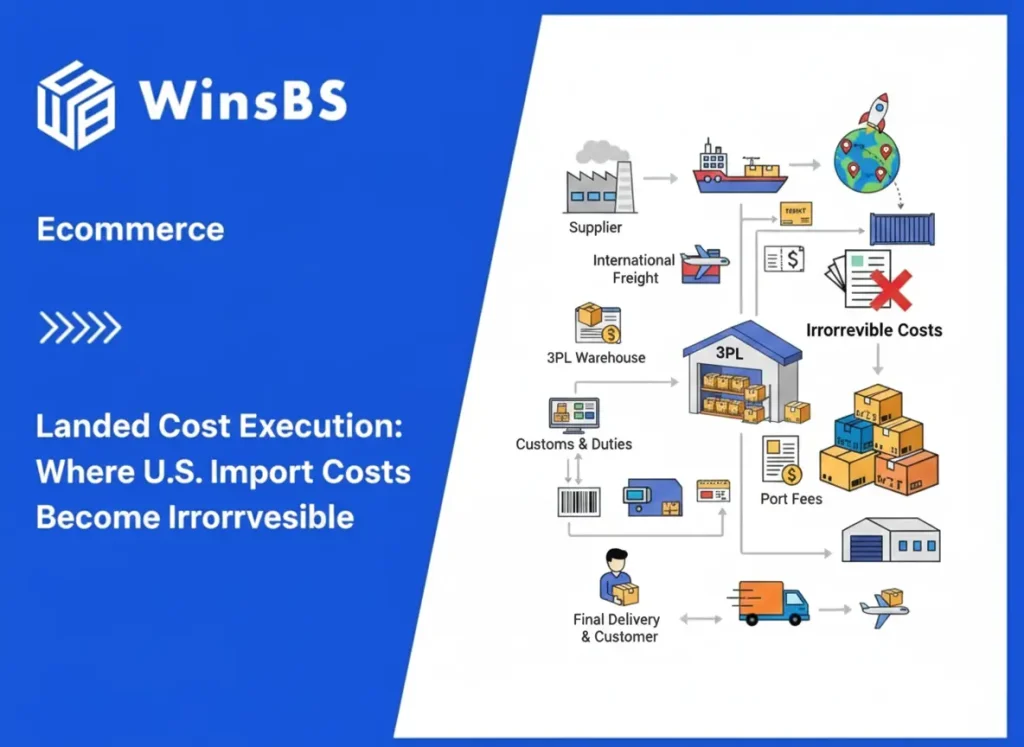
Logistics flow diagram beside WinsBS logo and title, illustrating supplier, international freight, customs, 3PL warehouse, irreversible import costs, and final delivery, highlighting 3PL order fulfillment and landed cost execution.
Ecommerce, Order Fulfillment, Shipping & Logistics

Landed Cost Execution: Where U.S. Import Costs Become Irreversible

Landed Cost Execution: Duty, Freight, Fees, and Fulfillment Costs A U.S. Import Framework That Shows When Costs Become Irreversible and What You Can Still Control By Maxwell Anderson · Updated 2025 DEC In U.S. import fulfillment, landed cost problems rarely start with a math mistake. They start when execution decisions are delayed until execution has already removed the option to redesign the path. Most cost overruns, missed delivery windows, and margin collapses are not caused by incomplete cost categories. They are caused by incomplete execution conditions: product definition gaps, responsibility gaps, and coordination gaps between nodes. Landed cost is not a static number. It is an execution path where adjustment room shrinks step by step as real actions happen. Cost control is the ability to make the right decision before each irreversible milestone. LANDED COST EXECUTION NODES (U.S. IMPORT FULFILLMENT) In the U.S. market, landed cost does not “appear” at the quote stage. It becomes locked in progressively as execution advances. This framework does not restate a logistics flowchart. It answers three operational questions at every node: Which costs are already irreversible at this node Which variables can still be corrected or redesigned How real constraints differ by product category at the same node EXECUTION NODE OVERVIEW (COST LOCK-IN VIEW) Node Core Action Costs Largely Locked Variables Still Adjustable Common Risk Pattern Node 0: Product Definition Define product, declaration name, category attributes None All Incorrect definition propagates downstream Node 1: Quote Confirmation Select execution path and responsibility boundaries Some freight assumptions Duty pathway, exception rules False certainty at the quote stage Node 2: Cargo Ready Freeze specifications and documentation Duty pathway Freight execution method Spec and compliance mismatch Node 3: Main Transport Sailing/flight execution, schedule reality Main transport cost Time-driven fees ETA drift converts into cost exposure Node 4: U.S. Customs Clearance Entry filing, inspection risk, release All duty Limited fee levers Inspection multiplies time and cost Node 5: 3PL Receiving Inbound warehouse execution starts Fulfillment structure Operational efficiency Warehouse deviations create additive fees Node 6: First Orders Shipped Order-level cost validation Full landed cost None Margin is realized too late to fix This table is an execution reference. It helps operators identify which node they are in right now, and which variables are still realistically controllable. NODE 0 — PRODUCT DEFINITION COMPLETED (PRE-QUOTE) Engineering definition: “Product definition completed” means the product is defined in a stable, auditable way that is usable for U.S. customs, transportation, warehouse receiving, WMS configuration, and order fulfillment. This is not marketing language. It is execution language. Key execution actions: Freeze three definitions: commercial product name, customs declaration name, and category attributes (battery, high value, oversized, regulated). Freeze the final selling configuration: single unit, bundle, kit, or multi-SKU set. Define the declared value logic and split rules (unit vs set, bundle components, replacements, inserts). Confirm whether the product contains regulated elements that affect routing (battery compliance, electronics labeling, restricted materials). Required outputs: A product definition sheet that can be used consistently for quoting and for customs entry. A specification sheet (dimensions, weight, materials, functional description, intended use). A category-attribute confirmation record (battery status, value band, oversize flag, compliance pathway assumptions). U.S. reality constraints: Product definition controls customs classification behavior and compliance gating. If definition is wrong here, later correction tends to trigger rework, holds, inspection exposure, or re-processing costs. The cheaper the correction seems at Node 0, the more expensive it becomes after Node 2. Category differences: Crowdfunding products often freeze definition later than typical DTC products, because reward structure and bundles finalize late. Battery-powered and electronic products do not have the same flexibility: the compliance pathway is effectively chosen here. High-value goods increase the consequence of every downstream mistake, including insurance, claims, and discrepancy handling. Oversized products magnify freight and warehouse handling exposure. Time-sensitive or seasonal SKUs convert every delay into revenue loss, not just expense. Node check: Can you produce a single definition that both your broker and your warehouse can use without rewriting it? Are product name, declaration name, and category attributes aligned? Is the selling configuration frozen, including bundles and inserts? NODE 1 — QUOTE & ROUTING CONFIRMATION (TRANSPORT + CUSTOMS) Engineering definition: This node does not determine “the price.” It determines the execution path, responsibility boundaries, and which assumptions will become the importer’s liability when reality changes. Key execution actions: Confirm trade terms and responsibility logic (who owns duty, who owns clearance outcomes, who owns exceptions). Confirm Importer of Record structure and who controls broker relationship. Break costs into auditable components: duty, freight, fees, and fulfillment charges, not a single bundled number. Document execution assumptions explicitly: port pair, routing, service level, timing window, free time assumptions, cargo parameters assumptions. Document exception triggers: re-routing, port change, inspection, holds, detention/demurrage, documentation repair, warehouse non-standard work. Define decision authority and spend authority for exceptions (who can approve, what thresholds trigger escalation). Required outputs: An itemized cost sheet that can be audited and compared later against invoices and warehouse charges. A responsibility matrix: who is responsible, who pays, who controls, and who bears exception cost. A written assumption and trigger file that removes “default handling” from the execution path. U.S. reality constraints: Assumptions that are not written become importer exposure. When execution deviates, added charges will be treated as “normal adjustments” unless the trigger and authority were defined upfront. Category differences: Crowdfunding needs a re-quote mechanism for bundle changes. Battery and regulated goods require the compliance pathway assumptions to be written, not implied. High-value goods require insurance responsibility and claims documentation standards to be defined at this node. Oversized goods require a re-rating trigger for dimension/weight changes. Time-sensitive goods require pre-authorization for mode switching or partial air uplift. Node check: Do you have an auditable split of duty, freight, fees, and fulfillment charges? Do you have a responsibility matrix that closes the “not my problem” gap? Are exceptions defined with decision authority, not just described as possibilities? NODE 2 — CARGO READY (SPEC + DOCUMENTATION FREEZE) Engineering definition: Cargo ready means assumptions meet

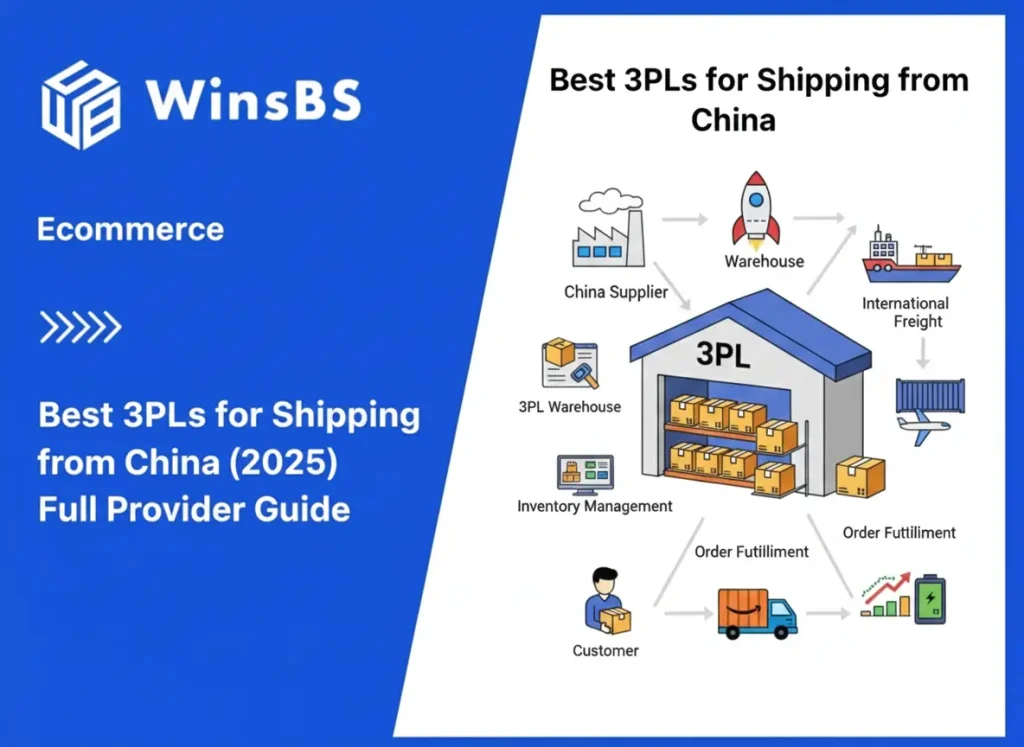
Cross-border eCommerce flowchart showing China suppliers, international freight, 3PL warehouse, inventory management, and order fulfillment leading to the customer, displayed beside the WinsBS logo and blog title, symbolizing 3PL fulfillment and cross-border order fulfillment services.
Ecommerce, Order Fulfillment, Shipping & Logistics

Best 3PLs for Shipping from China (2025) | Full Provider Guide

Best 3PLs for Shipping from China in 2025 Provider Landscapes Backed by the Vertical Fulfillment Performance Model (VFPM-2025) By Michael · Updated 2025 DEC On This Page Executive Summary VFPM Overview Shopify / DTC Amazon FBA Prep Crowdfunding Electronics / Battery Apparel & Fashion Beauty & Personal Care Heavy / Bulky Supplements / Food B2B / Omnichannel Section 321 / IOSS Final Recommendations Methodology EXECUTIVE SUMMARY The search for the “best 3PL in China” is misleading. WinsBS Research’s VFPM-2025 dataset shows that 25–48% of SLA variance and 30–55% of cost-per-order variance comes from vertical differences—not warehouse size, automation level, or geographic footprint. A 3PL that excels in fashion accuracy performs poorly in batteries; a 3PL optimized for crowdfunding waves fails under everyday Shopify volatility. This means that any universal ranking is inherently flawed. Instead, brands need a vertical-specific Provider Landscape. This report introduces 10 vertical landscapes—each with: a vertical profile grounded in VFPM-2025 cost, risk, and volatility models, a curated 6–12 provider evaluation pool (with external links), a Capabilities Matrix (SLA, SKU entropy, compliance readiness, volatility handling), a Why Included justification for every provider, and a vertical-specific RFP checklist. The goal is simple: give decision-makers an actionable, research-backed map of which 3PLs fit which products, channels, and compliance regimes when shipping directly from China. For brands planning China→US/EU expansions, WinsBS offers a free VFPM-aligned assessment: Get Started for Free. VFPM-2025 MODEL OVERVIEW The Vertical Fulfillment Performance Model (VFPM-2025) is WinsBS Research’s analytical framework for understanding why fulfillment performance differs dramatically across product categories—even inside the same warehouse. VFPM-2025 decomposes fulfillment into five structural components: Cost Structure — fixed vs. variable handling, packaging intensity, DIM exposure. SLA Stability — P50/P80/P95 transit distributions and last-mile variance. Labor Intensity — touchpoints, QC minutes, returns friction. Compliance & Risk — battery/DG rules, VAT/IOSS/321 requirements, regulator exposure. Volatility Handling — promo spikes, seasonality, crowdfunding waves. These metrics are normalized using VFPM’s trimmed mean and IQR median methodology to prevent outliers from dominating any vertical. The full methodology is documented in the VFPM-2025 Benchmark Report. This article applies VFPM-2025 to the specific context of shipping from China, where additional factors like customs clearance, long-haul reliability, and tax structuring materially change a 3PL’s suitability for each vertical. SEGMENT 1 — SHOPIFY / DTC BRANDS SHIPPING FROM CHINA Vertical Profile Shopify / DTC brands shipping 1,000–20,000 orders per month from China operate within a mid-volatility, mid-labor cost structure. VFPM-2025 shows that these brands experience predictable order waves around promotions, but relatively stable SKU entropy compared with apparel or beauty. What distinguishes this vertical is the emphasis on: carrier diversification for multi-region lanes, Shopify-native visibility for branded tracking events, tax orchestration (321 / IOSS / DDP) handled upstream, and the ability to maintain 6–12 day CN→US / CN→EU consistency. Provider Landscape (Evaluation Pool) The following 3PLs form the recommended evaluation pool for Shopify / DTC brands shipping directly from China. Providers may appear in multiple verticals when their operating model supports several product classes. NextSmartShip — Website Capabilities: China-based global fulfillment, strong Shopify integrations, branded tracking, EU/UK duty workflows. Best For: 2k–20k orders/month mid-complexity DTC catalogs. Limitations: Not ideal for Class 9 battery products. Why Included: Stable CN→US 6–10 day performance, high SKU accuracy, and strong presence in VFPM DTC lanes. SendFromChina (SFC) — Website Capabilities: Mature China 3PL with marketplace and DTC flows, broad carrier network, multi-region fulfillment. Best For: blended Amazon + Shopify international sellers. Limitations: System UI less modern than Shopify-native 3PLs. Why Included: Long-standing performance in CN→US/EU cross-border lanes and strong operational redundancy. EcommOps — Website Capabilities: DTC-focused China 3PL offering cost modeling, carton optimization, and Shopify-native workflows. Best For: brands needing analytics-driven routing and packaging efficiency. Limitations: Less ideal for very large catalogs (2,000+ SKUs). Why Included: Strong VFPM alignment for cost transparency and SKU stability in mid-volume DTC. ShipBob — Website Capabilities: Global network with CN inventory intake, strong tech stack, fast U.S./EU regional delivery. Best For: brands wanting CN production + U.S./EU distributed nodes. Limitations: Higher pricing for low-AOV DTC brands. Why Included: Shopify-native support and scalable multi-node routing useful for China-origin expansion. FF Logistics — Website Capabilities: China-based fulfillment for beauty/lifestyle DTC, strong QC workflows. Best For: design-led DTC brands needing packaging consistency. Limitations: Limited support for heavy/oversized items. Why Included: High repeatability in QC-heavy verticals, consistent with VFPM labor-intensity models. ShipSmartly.io — Website Capabilities: Shopify automation, CN-origin duty-optimized routing, branded tracking flows. Best For: 1k–8k orders/month stores needing rapid setup. Limitations: Less suitable for large multi-region B2B shipments. Why Included: Lightweight but fast implementation ideal for newer Shopify brands. SHIPHYPE Fulfillment — Website Capabilities: U.S./Canada-based hubs fed by CN production, strong returns handling. Best For: brands selling heavily in North America. Limitations: Higher storage than CN-based facilities. Why Included: Provides hybrid CN→US workflows aligned with VFPM multi-node strategies. Salesupply — Website Capabilities: multi-region EU/U.S. network with CN integration, strong CX focus. Best For: brands scaling into EU markets. Limitations: Not a China warehouse operator—relies on inbound flows. Why Included: Strong EU footprint helps brands mix CN origin with regional warehousing. WAPI — Website Capabilities: distributed EU/UK fulfillment with CN routing and marketplace tools. Best For: multi-marketplace sellers (Amazon + Shopify + eBay). Limitations: Not ideal for custom packaging workflows. Why Included: High fit for brands prioritizing Europe expansion from CN production. J&T Express (Cross-Border Unit) — Website Capabilities: CN-origin parcel network, fast lanes into Southeast Asia and U.S. consolidators. Best For: cost-sensitive high-volume DTC brands. Limitations: Not a full 3PL; limited pick/pack depth. Why Included: Strong for brands prioritizing speed and cost over customization. Capabilities Matrix (DTC Segment) The following matrix summarizes qualitative capabilities relevant to Shopify / DTC brands: SLA Stability: High — NextSmartShip, SFC, ShipBob SKU Complexity Fit: Strong — NextSmartShip, EcommOps Compliance Readiness (IOSS / 321): High — ShipSmartly.io, NextSmartShip Cost Structure Transparency: High — EcommOps, SFC Volatility Handling: Strong — SFC, ShipBob RFP Questions for Shopify / DTC Fulfillment from China Provide P50 / P80 / P95 transit distributions for U.S., EU, UK, AU. Show