
Kickstarter Fulfillment Delays After China Shipping: What U.S. Warehouses Can and Cannot Fix
For creators searching for warehouse delays after China shipping, the real bottleneck is usually earlier: carton truth, receiving-file cleanup, packaging consistency, and a shipment that left China before those pieces were fully closed.
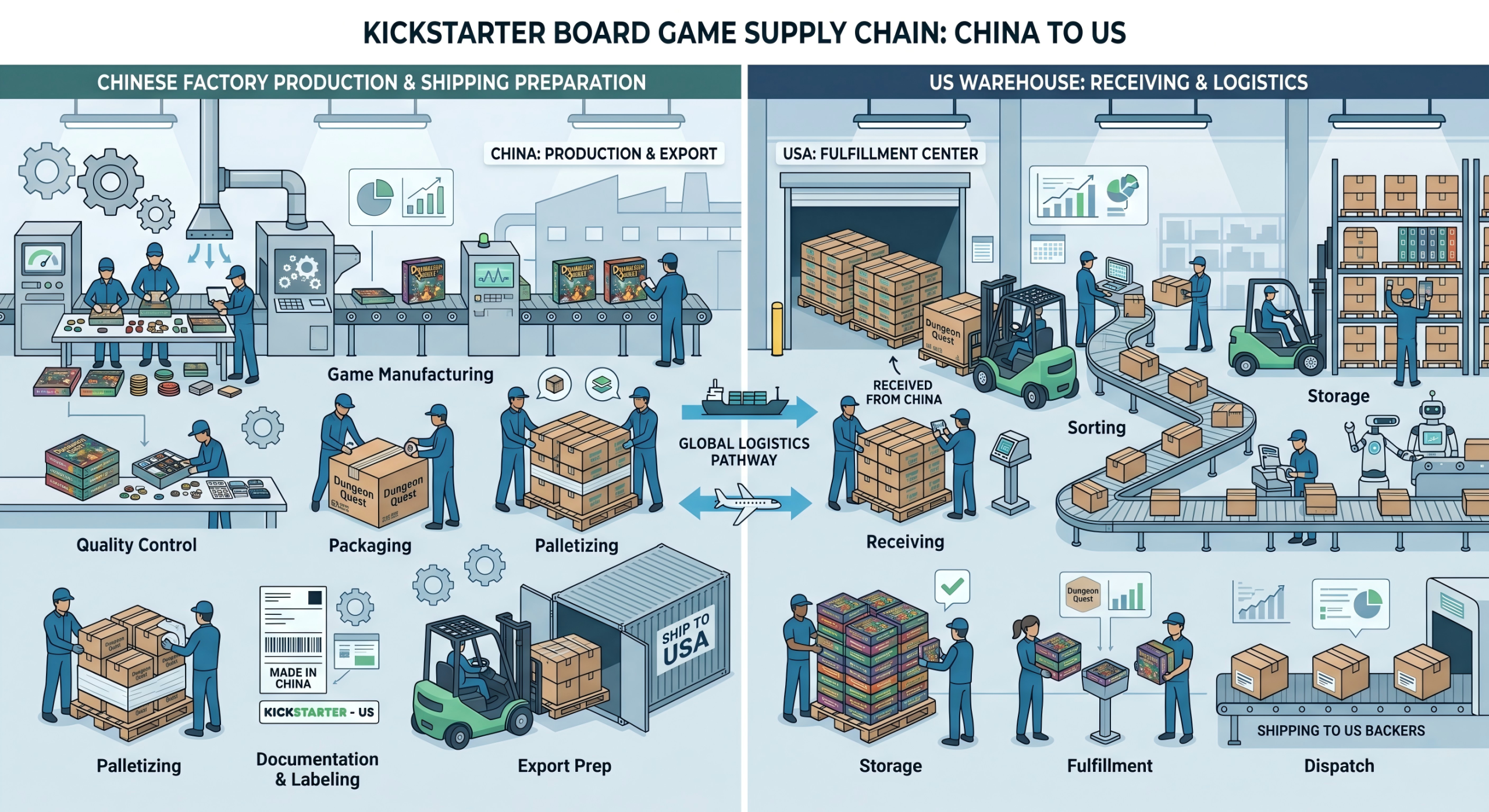
If your board game is made in China and the shipment is still changing when freight leaves, a faster U.S. warehouse will not save the launch. It will expose the same problems faster. Warehouse speed helps when the cartons, labels, bundle names, and landed-cost assumptions already match the shipment on the floor. If they do not, the warehouse becomes the first place everyone discovers the handoff was never really finished.
Why This Decision Gets Hard
If you are searching for warehouse receiving delays, inbound receiving issues after import, or China-to-U.S. fulfillment handoff problems, this is usually the decision underneath them.
- Your game is made in China and the U.S. warehouse conversation started before the inbound file stopped moving.
- You still have late add-ons, collector-box standards, tariff or DDP assumptions, or release rules that are not fully closed.
- You already booked freight or intake, but the carton list, receiving file, and backer-facing shipping message do not cleanly describe the same shipment.
- Inventory is already in the U.S., inspected, labeled, and stable enough that the real choice is between domestic 3PLs.
- The project is simple, the SKU map is fixed, and there is no meaningful China-origin execution risk left to solve.
- You are only comparing warehouse pricing, pick speed, or service response for a shipment that is already clean.
If the left column feels current, the next purchase is not warehouse speed yet. It is handoff cleanup before the shipment creates a bigger U.S.-side problem.
The warehouse gets judged late, but most campaign mistakes are created earlier.
The container lands. The intake appointment is on the calendar. The warehouse is the first local partner touching the goods, so it becomes the easiest thing to blame. It is also the point where the cheap correction options are mostly gone.
By the time a China-made board game reaches a U.S. warehouse, the shipment may already be carrying weeks of unresolved decisions: late add-ons that changed bundle names, carton counts that drifted after the first booking, packaging that looked fine in production but not in long transit, or a backer-facing shipping message that hardened before the physical file stopped moving.
Stonemaier's Kickstarter fulfillment infographic is useful because it shows how late the warehouse sits in the workflow. Factory release, freight planning, and the regional handoff all happen first. The practical lesson is simple: the warehouse receives the consequences of origin prep. It does not get a cheap chance to rewrite them.
That is why tabletop campaigns feel this so sharply. Heavy cartons, collector-grade boxes, add-on complexity, and backer scrutiny make every late correction more visible. If the shipment arrives clean, a fast warehouse helps. If it arrives unstable, the same warehouse starts spending time on inspection, quarantine, relabeling, bundle clarification, and replacement handling instead of release.
By that point, the problem is not just operational. It is a launch-timing risk, a support-overflow risk, and sometimes a margin problem once replacement reserve, extra labor, or unplanned exceptions start stacking up.
The bottom line: A fast U.S. warehouse can accelerate clean inventory. It cannot cheaply repair weak China-origin prep.
Origin Prep Reality Check
A Familiar Creator Pattern
Freight is booked, the warehouse appointment is set, and the team thinks the hard part is over. Then two late add-ons change the bundle map, carton labels are not fully updated, and nobody writes down the release rules for mixed bundles before the shipment leaves China.
The pallets still land on time. The warehouse still receives them. But release slows because the file on the floor no longer matches the file in the campaign. That is the moment many creators call a warehouse-delay problem. In reality, it is usually the first visible handoff problem.
What Weak Origin Prep Turns Into On The Business Side
| Upstream Problem | Launch Risk | Labor Cost | Replacement Pressure | Support Burden | Margin Erosion |
|---|---|---|---|---|---|
| Moving bundle map or carton file | High if intake pauses while the warehouse reconciles the shipment. | Relabeling, recounting, and mixed-bundle sorting. | Medium when wrong kits or damaged mixed units surface late. | High once promised ship timing slips. | High when rework and extra outbound touches stack up. |
| Weak packaging standard | Medium to high if collector-box quality has to be screened at receipt. | Inspection, quarantine, and repacking decisions. | High when visible box damage is not clearly ship-ready. | High because damage complaints are visible and emotional. | High through damaged stock, replacement reserve, and slower release. |
| Unwritten release rules and damaged-unit actions | High if intake teams have to invent thresholds at the dock. | Escalations, exceptions, and repeated approvals. | Medium to high when borderline inventory cannot be classified quickly. | Medium because updates stay fuzzy longer. | Medium through slower launch and exception handling. |
| Shipping promise hardens before the shipment does | Medium if fees or duties need re-explaining after receipt. | Manual adjustments and cross-team cleanup. | Usually indirect, unless the promise hid packaging risk too. | High because backers feel the mismatch immediately. | High if the campaign absorbs underpriced shipping or tariff gaps. |
Moving Bundle Map Or Carton File
Launch risk: high if intake pauses for reconciliation.
Labor cost: relabeling, recounting, mixed-bundle sorting.
Replacement pressure: medium when wrong kits surface late.
Support burden: high once promised ship timing slips.
Margin erosion: high when rework stacks up.
Weak Packaging Standard
Launch risk: medium to high if collector-box quality must be screened at receipt.
Labor cost: inspection, quarantine, repacking decisions.
Replacement pressure: high when visible damage is not clearly ship-ready.
Support burden: high because the damage is visible.
Margin erosion: high through damaged stock and slower release.
Unwritten Release Rules
Launch risk: high if intake teams invent thresholds at the dock.
Labor cost: escalations and repeated approvals.
Replacement pressure: medium to high when borderline inventory cannot be classified.
Support burden: medium because updates stay fuzzy.
Margin erosion: medium through slower launch and exception handling.
Shipping Promise Hardens Too Early
Launch risk: medium if fees or duties need re-explaining.
Labor cost: manual adjustments and cleanup.
Replacement pressure: indirect unless packaging risk was hidden too.
Support burden: high because backers feel the mismatch immediately.
Margin erosion: high if the campaign absorbs the gap.
Decision Logic
Ask one practical question: if the truck backed into the dock tomorrow, would the warehouse know exactly what it is looking at?
If the answer is yes, speed matters. If the answer is no, speed only shortens the time it takes to discover the gap.
Do not book speed as the cure for a moving file. Freeze the bundle map, carton truth, and fee assumptions first, then compare warehouse options.
Treat the next step as damage control. Write the release rules, damaged-unit actions, and hold logic before the cartons reach the dock.
This is the point where warehouse speed, service quality, and domestic 3PL pricing become the main comparison again.
| Situation | What Warehouse Speed Can Do | What Must Be Fixed Earlier | Why |
|---|---|---|---|
| Clean, stable imported inventory | Accelerate receiving release and outbound speed. | Very little origin correction remains. | This is when a fast domestic warehouse creates real value. |
| Late SKU or add-on changes | Very little beyond exposing the mismatch faster. | Final file, carton counts, and shipping logic. | Wrong inputs move faster into rework, not into clean fulfillment. |
| Packaging weakness or unstable packout | Catch damage or release risk sooner. | Packaging standard, carton protection, and exception plan. | Damage discovered late is expensive, visible, and hard to reverse. |
| Tariff, DDP, or region-friendly promise still unstable | Ship after import if the order is otherwise clean. | Landed-cost logic and backer communication plan. | Backer trust problems are created before pick and pack starts. |
| Inventory already stable inside the U.S. | Usually enough on its own. | Nothing meaningful cross-border remains. | This is where domestic-only 3PL models fit best. |
Clean Imported Inventory
Warehouse speed can: accelerate release and outbound.
Fix earlier: very little.
Why: speed helps once the shipment is already stable.
Late SKU Or Add-On Changes
Warehouse speed can: expose the mismatch faster.
Fix earlier: final file, carton counts, shipping logic.
Why: wrong inputs move into rework, not clean fulfillment.
Packaging Weakness
Warehouse speed can: catch damage sooner.
Fix earlier: packaging standard and exception plan.
Why: late damage is expensive and visible.
Tariff Or DDP Uncertainty
Warehouse speed can: ship after import.
Fix earlier: landed-cost logic and backer communication.
Why: trust problems start before picking begins.
Stable U.S. Inventory
Warehouse speed can: be enough on its own.
Fix earlier: little or nothing.
Why: cross-border execution risk is already gone.
Five-Minute Decision Check
Open the inbound sheet, the carton list, the latest shipping-fee worksheet, and the warehouse intake note. If two or more of these fail, the project still has an origin-side problem.
- 1. Final SKU map locked: the file no longer depends on placeholder bundle names, late add-on notes, or chat context to explain what ships.
- 2. Carton truth locked: the warehouse intake sheet still matches the factory packing list for counts, dimensions, and weights.
- 3. Receiving file ready: each row tells the warehouse what the carton is and what to do if it arrives damaged, mixed, or unclear.
- 4. Packaging standard stable: the team is no longer debating soft corners, insert fit, carton grade, or whether borderline units can still ship.
- 5. Fee logic still matches the shipment: the latest shipping sheet is not leaning on estimated weight, provisional dimensions, or open tariff treatment.
- 6. Release rules are written down: holds, inspections, and split-bundle exceptions live in the handoff file, not in chat history.
- 7. Replacement handling has an owner: someone already owns spare units, damaged-unit rules, and approval on non-perfect collector boxes.
You are close enough that warehouse speed, rate, and service quality are worth comparing directly.
Pause any hard shipping promise and finish the handoff first. The warehouse is about to become the messenger for unresolved upstream work.
Treat it as an origin-prep reset. Booking faster warehouse execution now will mostly move expensive confusion downstream.
Simple rule: miss two or more, and the project still has an origin-side problem. The warehouse may be where the pain becomes visible, but it is not the first place that needs fixing.
A Handoff That Keeps Repeating: Late Add-Ons Reopen The Intake File
WinsBS keeps seeing the same tabletop handoff failure: the shipment looks ready because freight is booked and the warehouse appointment is set, then late add-ons change bundle names and carton truth after that booking. The pallets still land on time, but mixed bundles end up on hold because the labels on the floor no longer describe the file the warehouse received.
A Second One: The Pallet Arrives, The Collector Box Still Is Not Release-Ready
WinsBS also sees premium-box launches that look fine from a distance. Counts are there. Pallets are upright. But soft corners, shifting inserts, or uneven retail-box condition mean part of the stock is not obviously ready for outbound. The warehouse can receive it, but it cannot skip the judgment call it just inherited.
And Another: The Shipping Message Hardens Before The Shipment Does
WinsBS has handled the same pattern across similar China-to-U.S. tabletop projects: the team wants a cleaner duty and shipping message for backers while add-ons and final carton weights are still moving. The message looks settled before the physical file is settled. By the time the inventory hits the U.S., the support problem shows up at the warehouse stage, but the real mistake happened earlier when the promise hardened too early.
Key takeaway: Warehouse speed matters after the handoff is clean. Before that point, it mostly measures how expensive late correction has become.
Key Pressure Points
1. Receiving File Quality
Bad labels, wrong carton counts, mixed bundle logic, or vague receiving instructions turn the first warehouse appointment into diagnosis work. That slows release even when the warehouse team itself is moving quickly.
The practical test is simple: open the inbound file and read it row by row. If the sheet still needs chat context to explain what the carton is, whether it belongs in a mixed bundle, or what happens when a unit arrives damaged, the warehouse will start by solving your spreadsheet instead of releasing inventory.
Key takeaway: When the receiving file is weak, the warehouse is not the delay. It is the first place the delay becomes visible.
2. Packaging And Release Quality
Weak packout turns speed into inspection. If cartons arrive soft, corners come in uneven, inserts shifted, or sealed units show inconsistent condition, the warehouse has to slow down and decide what can ship cleanly.
If that is the pressure you are seeing, read this alongside the board game packaging standards guide for China-to-U.S. fulfillment. Packaging is not separate from warehouse speed. It decides whether receiving becomes release, quarantine, or replacement handling.
Stonemaier's 2026 fulfillment commentary helps here because it treats packaging quality, communication, and autonomous problem solving as part of fulfillment quality. The practical takeaway is that "fast" only means something when the inventory is releasable.
A packaging standard is usually stable only after the retail box, internal fit, outer carton, and damaged-unit rules all point to the same release plan. If the team is still debating insert thickness, corner protection, carton grade, or whether visibly soft boxes can still ship, the warehouse is inheriting a product decision, not just a fulfillment task.
Key takeaway: A warehouse that receives unstable inventory does not become a fulfillment center. It becomes a correction point.
3. Freight Release And Routing Lock
Once freight is moving, the cheapest correction point is gone. That does not mean no correction is possible. It means every correction now happens after more time, more cost, and less flexibility.
The Freightos / Baltic FBX guide is useful as a reminder that routing itself is still a live variable before export. If cartons, route timing, and receiving readiness are all moving, the warehouse should not be expected to absorb the instability created upstream.
Key takeaway: The later the correction starts, the more warehouse speed gets wasted on recovery instead of execution.
4. Pledge-Manager Shipping Logic
BackerKit or Kickstarter shipping rules are only as accurate as the shipment they describe. If add-ons, packaging weight, or address logic are still moving, a fast warehouse does not solve the mismatch. It just becomes the place where the mismatch starts hurting.
BackerKit's shipping options guidance and Kickstarter's shipping-through-pledge-manager guidance both support waiting until fulfillment is clearer before final charges harden. For creators, that means shipping logic should follow physical stability, not race ahead of it.
If you are deciding whether fees are ready to lock, look at four things first: final carton weight, final dimensions, add-on bundle map, and whether the tariff or DDP model still matches the shipment. If one of those is still open, or the last worksheet still leans on provisional inputs, the fee is not really final yet.
If you are already deciding between recovery inside the pledge manager and a cleaner landed-cost promise, compare this with the BackerKit shipping fees vs DDP guide before the warehouse becomes the first place that bad assumptions get measured.
Key takeaway: Shipping tables do not create operational stability. They expose whether the underlying packout and routing model was ever stable.
5. Tariff, DDP, And Backer Promise Timing
Backer-facing trust problems are created before the first order is picked. A warehouse can move quickly after import, but it cannot fix a landed-cost promise that was built on unstable tariff assumptions or a region-friendly claim that still depends on last-minute cleanup.
That is why this topic connects directly to the region-friendly shipping guide and the broader Kickstarter shipping cost model. The promise reaches the backer before the warehouse gets a chance to prove anything.
A cleaner U.S. operation can support that promise later. It cannot rescue a promise that hardened before tariff treatment, route timing, and carton reality described the same shipment.
Key takeaway: The backer feels this as a warehouse problem only because the earlier commercial mistake becomes visible there.
What Can Still Be Fixed In The U.S., And What Is Already Too Late?
| Issue | Can Still Be Fixed In The U.S.? | What Is Already Too Late Or Expensive? | Best Correction Point |
|---|---|---|---|
| Relabeling otherwise good inventory | Often yes, if the product identity and carton counts are otherwise clean. | Using the warehouse as the first place to figure out what each unit should have been. | U.S. warehouse if the rest of the inbound file is stable. |
| Minor carton-count reconciliation | Sometimes, if the variance is small and the bundle logic is clear. | Mixed-SKU confusion, unclear bundle names, or no documented hold rules. | Before export, while the inbound file can still be corrected cleanly. |
| Packaging damage on sealed retail units | The warehouse can screen, quarantine, or repack some units. | Undoing corner crush, tray movement, or inconsistent collector-box quality at scale. | China packout review before freight release. |
| Shipping-fee mismatch | It can be communicated or absorbed, but not made cheap. | Pretending the warehouse caused a fee model that never matched the shipment. | Before the pledge-manager or final charge hardens. |
| DDP or tariff-promise mismatch | Support can explain it, but the promise itself is already weakened. | Removing backer friction after an unstable landed-cost message has already gone out. | Before import timing and backer communication are locked. |
Relabeling Good Inventory
Still fixable: yes, if product identity and carton counts are clean.
Too late: using the warehouse to figure out what each unit should have been.
Best point: U.S. warehouse, if the file is otherwise stable.
Minor Carton Reconciliation
Still fixable: sometimes, if the variance is small and bundle logic is clear.
Too late: mixed-SKU confusion and no documented hold rules.
Best point: before export.
Packaging Damage
Still fixable: screening or quarantine is possible.
Too late: undoing corner crush or tray movement at scale.
Best point: China packout review.
Shipping-Fee Mismatch
Still fixable: it can be communicated or absorbed.
Too late: pretending the warehouse caused the mismatch.
Best point: before final fees harden.
DDP Or Tariff Promise Mismatch
Still fixable: support can explain it.
Too late: removing backer friction after the promise is out.
Best point: before import and communication lock.
Industry Benchmark: Flexible Shipping Fees Still Depend On Stable Physical Inputs
BenchmarkBackerKit and Kickstarter both describe workflows where final shipping can be charged closer to fulfillment, once more variables are known.
Commercial CommentaryThat flexibility helps only if the team uses it to finish the real work: lock carton truth, clean the receiving file, confirm route timing, and tighten the backer-facing promise.
WinsBS RecommendationIf that work is still unfinished, the warehouse stage will expose the gap no matter how competent the outbound operation looks on paper.
Special Scenarios
Mostly U.S. Backers, China Manufacturing
This is the most common case where bulk freight to a U.S. warehouse still makes sense. The trap is thinking the warehouse decision comes first. It does not. The receiving file, packaging standard, and tariff or DDP path have to be closed before warehouse speed becomes the main buying criterion.
Lock next: close the receiving file, release rules, and tariff or DDP path before you compare warehouse speed as if the handoff were already finished.
Heavy Game With Late Add-Ons
Late add-ons do not just change postage. They change bundle names, carton counts, replacement logic, and what the warehouse thinks it is receiving. In that situation, keep fee logic flexible longer than you want to, then rebuild the release rules from the final carton truth.
Keep flexible: the final shipping charge, until the add-on file and carton truth stop moving together.
Premium Collector Edition
This is where packaging and release rules matter more than a generic fast-warehouse pitch. If the team still has not agreed what counts as ship-ready box condition, the warehouse will make that call under pressure, with backers already waiting.
Lock next: decide what counts as ship-ready box condition before intake starts, not when the pallet is already at the dock.
Inventory Already In The U.S.
This is the real boundary case. If inventory is already imported, inspected, labeled, and stable, a domestic-only 3PL may be enough. At that point the right comparison is warehouse speed, pricing, and service quality, not China-origin execution control.
Boundary: if nothing meaningful cross-border remains to solve, a domestic 3PL review is usually the better next step.
Freight Already Booked But Receiving Rules Are Still Fuzzy
This is usually a damage-control situation, not a clean launch. Write the release rules before intake starts. If inspection thresholds, hold logic, or damaged-unit handling are still fuzzy when the cartons land, the warehouse will end up writing those rules for you.
Lock next: spell out what gets released, held, or escalated on day one before the truck arrives.
Final Recommendation
For most China-made board game campaigns, the mistake is not choosing the wrong U.S. warehouse first. It is sending the shipment into the U.S. before the handoff is actually finished.
A fast warehouse is valuable only after the cartons, labels, release rules, packaging standard, and backer-facing shipping message all describe the same shipment. Until then, the warehouse is being asked to decode inventory instead of ship it.
If inventory is already fully imported, inspected, labeled, and stable inside the U.S., a domestic-only warehouse may be enough. Not every project needs a more involved China-to-U.S. execution layer.
If The Handoff Is Really Ready, You Can Usually Say Yes To These
- The intake file matches the cartons on the floor: counts, names, labels, and bundle logic line up.
- The packaging standard already answers the hard questions: soft corners, unstable inserts, and borderline units do not need a dockside debate.
- The shipping message still matches the physical shipment: weight, dimensions, and tariff treatment did not drift after the promise went out.
- The warehouse has written release rules: holds, inspections, and split-bundle exceptions are already defined.
- Replacement handling is not being invented at intake: someone already owns spare logic and damaged-unit approval.
Choosing Between A Domestic 3PL And China-U.S. Execution Support
Inventory is already in the U.S., the SKU map is fixed, cartons are labeled correctly, damaged-unit rules are written, and the warehouse is being asked to receive and ship, not to decode the shipment.
The shipment is still changing across factory packout, freight timing, packaging calls, shipping-fee logic, or intake rules. In that case the real need is someone to close the handoff before the U.S. warehouse becomes the first place the gaps are measured.
Questions To Ask Before Choosing Either Model
- Can the warehouse identify every carton without chat context? If not, the handoff is still open.
- Would the factory, warehouse, and campaign owner describe the same shipment today? If not, the file is still moving.
- Are damaged-unit and hold rules written where intake teams can use them? If not, the warehouse is being asked to improvise.
- Are shipping fees and tariff assumptions still dependent on provisional weights or dimensions? If yes, the commercial model is still unstable.
- Is there any meaningful China-origin decision left after import? If no, a domestic 3PL comparison may be enough.
- Is the current vendor choice about speed, or about finishing upstream work? Those are different purchases.
WinsBS is the better fit when the project still needs someone to connect China packout, freight timing, packaging judgment, shipping-rule cleanup, and U.S. intake before backers start feeling the gap.
Bottom line: When cartons, labels, and release rules are wrong before export, warehouse speed only lets the team discover the same mistake faster.
FAQ
Can a fast U.S. warehouse fix weak China-origin prep?
Not cheaply. A fast warehouse can move clean inventory faster, but weak China-origin prep usually shows up as receiving holds, rework, inspection, relabeling, damaged-unit decisions, or replacement handling after the shipment reaches the U.S.
What does weak China-origin prep usually mean?
It usually means the shipment can move, but the carton truth, labels, packout standard, receiving file, or landed-cost message still need chat context, last-minute exceptions, or cross-checking to make sense.
Why is my U.S. warehouse slow after inventory arrives from China?
Common causes include wrong carton counts, weak labels, unclear bundle logic, packaging damage, unstable add-on files, missing receiving instructions, and landed-cost decisions that were never fully locked before export.
When is a receiving file actually ready?
A receiving file is usually ready when each carton row includes the final SKU or bundle name, carton count, carton ID or label reference, and a clear action for release, hold, or damage escalation. If the warehouse still needs chat context to decode the sheet, it is not ready.
What should be finalized before freight leaves China?
Creators should finalize the SKU and add-on file, carton counts, packaging standard, receiving labels, freight timing, tariff or DDP logic, and the rules for what the warehouse should release, inspect, hold, or escalate.
When is it safe to lock Kickstarter shipping fees?
It is usually safe only after final carton weight, dimensions, add-on bundle logic, and tariff or DDP treatment are stable enough to describe the real shipment. If the last fee sheet still contains estimates, provisional inputs, or unresolved add-on combinations, the fee model is still provisional.
How does packaging affect warehouse speed?
Packaging affects whether inventory can be released cleanly. Weak carton protection, inconsistent box condition, or unstable inserts can force inspection, quarantine, replacements, or slower receiving even when the warehouse itself is operating well.
Is DDP or region-friendly shipping enough to protect the backer experience?
No. Those choices can improve the landed-cost experience, but they do not fix unstable packout, weak labels, or damaged inventory. A cleaner fee model still fails if the warehouse receives a shipment that cannot release cleanly.
What can a U.S. warehouse still fix, and what is already too late?
A warehouse can often relabel otherwise good inventory, reconcile small count issues, or quarantine damaged units. It usually cannot cheaply undo weak packaging, a bad shipping-fee model, or a landed-cost promise that was built from unstable inputs before export.
When is a domestic-only 3PL enough?
A domestic-only 3PL may be enough when inventory is already fully imported, inspected, labeled, cartonized, and stable inside the U.S. At that point, the cross-border execution risk has already been removed.
Methodology
Public sources used: Stonemaier Games for the creator-to-warehouse workflow and fulfillment-quality framing, BackerKit and Kickstarter for shipping-fee timing and pledge-manager logic, and Freightos / Baltic FBX documentation for freight-risk framing. Those sources establish workflow, not a claim that any one operator is best.
Operational judgment used: the recommendation also reflects WinsBS planning experience across similar tabletop projects involving China-origin prep, receiving-file quality, packaging release risk, warehouse handoff, and backer-facing execution pressure. The recurring examples above describe patterns WinsBS keeps seeing in similar work, not a quantified dataset or a named client story. No invented warehouse-delay percentages, unverified transit-time promises, or guessed publication timestamps were used as facts.
What To Do Next
Choose the next move that matches the project you actually have, not the one everyone hopes is already clean.
If you need one asset to circulate internally, use the seven lines below as the shared handoff review. If the factory owner, freight contact, U.S. warehouse, and backer-facing owner would each answer them differently, the handoff is still open.
Shareable Handoff Checklist
- Final SKU and add-on file: one current version with no placeholder bundle names or side-note exceptions.
- Carton and packout truth: counts, dimensions, weights, and bundle mapping still match the factory packing list.
- Receiving labels and instructions: the warehouse can identify every carton and knows what to do with mixed, damaged, or unclear units.
- Freight route and timing: booking, arrival window, and intake plan still reflect the shipment actually leaving China.
- Tariff or DDP logic: the landed-cost message still matches the import model being used.
- Warehouse release rules: someone has written what ships, what gets held, and what needs approval.
- Backer-facing shipping communication: the promise still matches the inventory, costs, and timing on the floor.
Pass rule: if two or more lines still depend on a different spreadsheet, a different inbox, or a different person's memory, pause the promise and close the handoff first.
If You Are Still Self-Checking
Run the seven-line review across the factory file, carton list, fee sheet, and intake note. If two or more lines fail, stop comparing warehouse speed and close the origin handoff first.
If Freight Is Already Booked
Freeze bundle changes, write the release and damaged-unit rules, and send the same intake truth to the factory team and the U.S. warehouse before the cartons land.
If U.S. Receipt Is Close
Switch to exception triage. Decide what can still be relabeled or quarantined, what needs replacement reserve, and what backer message should stay soft until intake truth is confirmed.
If one of those answers is still sitting in a different spreadsheet, a different inbox, or a different person's head, the handoff is not really closed yet. If the factory, the U.S. warehouse, and the backer-facing message would each get a different version today, the problem is still upstream.
If you cannot answer the seven checks above cleanly, do not let freight departure become the forcing function. Some problems can still be repaired in a U.S. warehouse at a higher cost. Others, especially visible collector-box damage and a shipping promise that no longer matches carton reality, usually turn into losses.
If those decisions are still spread across separate spreadsheets, read this alongside the guides on China-to-U.S. board-game crowdfunding fulfillment, Kickstarter shipping costs, board game packaging standards, and BackerKit shipping fees vs DDP.
If the file, packaging standard, and release rules still do not describe the same shipment, review that gap before the container lands. That is the part WinsBS is built to help with.