

Online Support
Typically replies within 5 minutes
Hello! How can we assist you today?

2026

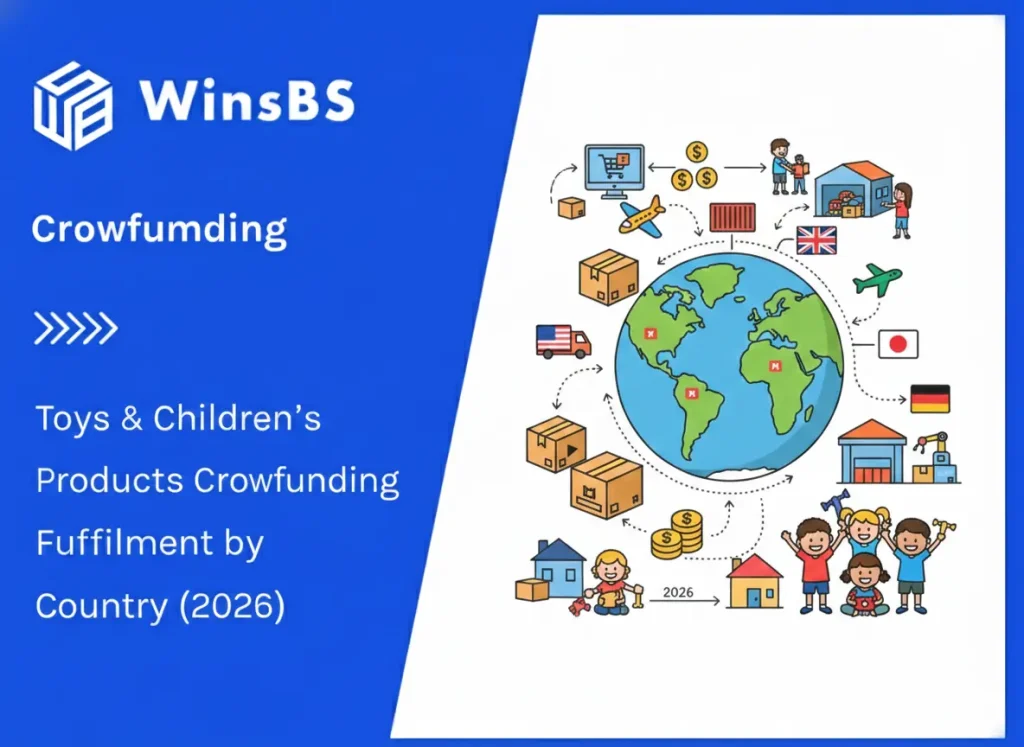
WinsBS logo with title "Toys & Children’s Products Crowdfunding Fulfillment by Country (2026)", showing a global crowdfunding order fulfillment workflow from online orders and overseas warehousing to cross-border shipping and worldwide delivery.
Crowdfunding Fulfillment, Ecommerce, Order Fulfillment, Shipping & Logistics

Toys & Children’s Products Crowdfunding Fulfillment by Country (2026)

Toys & Children’s Products Crowdfunding Fulfillment by Country (2026) What DDP Fixes — and What Still Breaks at Safety Proof, Age Grading, and Market Permission WinsBS Fulfillment — Maxwell Anderson Updated February 2026 This page is a country-outcomes expansion of: Toys & Children’s Products DDP Risk in Crowdfunding Fulfillment . Table of Contents The Observable Pattern: Same Toy, Same DDP, Different Outcomes The Mechanism: Why Toys Fail as “Permission” Problems, Not Shipping Problems Where It Breaks in the Execution Flow Fulfillment Reality by Country (US, EU, UK, Canada, Australia) Bundles & Stretch Goals: The Hidden Compliance Multiplier Replacement & Recall: Why Reship Often Recreates the Failure Country Outcome Matrix Operational Implications for 2026 Campaigns Children’s toy crowdfunding fulfillment outcomes differ by country — even under identical DDP terms. In 2026, many creators choose DDP to remove the most visible historical failure: backers being charged at the door. That decision often works. Complaints about surprise VAT and duties drop sharply. But toy campaigns rarely fail at the payment layer anymore. They fail at the safety proof + age grading + accountable operator layer — the layer that decides whether a toy can enter the child-consumer channel in that market. The observable pattern across modern campaigns is consistent: the same toy configuration clears quickly in one country, freezes for weeks in another, and is treated as non-placeable in a third. DDP pays the bill. It cannot prove a toy is safe, correctly age-graded, correctly labeled, and documented in the way that market enforcement expects at the moment of scrutiny. The Mechanism: Why Toys Fail as “Permission” Problems, Not Shipping Problems Toys are not operationally treated as “just another consumer product.” In most developed markets, toys and children’s products sit inside enforcement systems designed to prevent unsafe items from reaching children. That enforcement surface is broad: it can be triggered by age claims, small parts risk, magnets, batteries, coatings, cords, projectiles, or mismatched labeling. In crowdfunding, this becomes structurally fragile for one reason: the “product” is not a single SKU. The product is the pledge bundle as shipped — core toy, stretch goals, add-ons, accessories, and replacement parts. If any component shifts the hazard profile, the shipment becomes a different object from an enforcement perspective. Observed execution reality: When enforcement triggers, the shipment stops behaving like freight and starts behaving like a permission test. That is why DDP predictability can coexist with delivery failure. Where It Breaks in the Execution Flow The fastest way to misread toy fulfillment risk is to assume “customs clearance = success.” For toys, many failure events occur after the moment a shipment enters the domestic network: documentation requests, post-clearance checks, market surveillance actions, or retailer/channel-level gating. Execution Stage What Creators Assume What the System Actually Tests How Failure Presents Pre-ship (final packaging) “Labels are marketing.” Age grading + warnings + traceability consistency Hold triggered by mismatch between claims and physical toy Entry / clearance “DDP means it will clear.” Operator responsibility + required documentation availability Document request; release timeline becomes unpredictable Post-clearance / market surveillance “Tracking moved; it’s fine.” Safety compliance evidence; risk-based checks Tracking freezes; partial-country delays emerge Replacement wave “We’ll just reship.” Same permission checks apply to replacements Reship loop; support meltdown accelerates Fulfillment Reality by Country (US, EU, UK, Canada, Australia) The Country Divergence Pattern One campaign ships a single “global” toy pledge set under DDP. Freight, packaging, and labeling look identical. Yet delivery outcomes diverge by market because each system enforces permission at a different control point: some markets concentrate on post-clearance documentation and certification traceability, others on market placement proof and accountable operators, and others on age grading and specific hazard enforcement (small parts, coatings, batteries). United States — Post-Clearance Proof and Certificate Availability In the U.S., many toy shipments appear to move normally until the moment a request is made for children’s product certification proof. The operational trap is that a campaign can be “shipping-correct” while being “proof-fragile”: when a proof request is triggered, release depends on whether the required certification record exists and is retrievable fast enough to keep the flow intact. In practice, the system does not care whether the team is confident the toy is safe; it cares whether the campaign can produce the required artifact on demand. That artifact is commonly referred to as a CPC, and its function is formalized under the U.S. framework described as the Children’s Product Certificate . When a campaign cannot produce it quickly, the shipping terms (including DDP) do not change the outcome — the flow still freezes. Observed U.S. failure presentation: tracking begins, then stalls; some states/regions deliver while others pause; the support narrative shifts from “shipping” to “why is it held if you already paid?” European Union — Market Placement Permission and CE as a Declaration Chain The EU’s toy failure mode is structurally different: the system is built around market placement permission. The operational question becomes: can this toy be legally placed on the EU market as shipped? That is why a shipment can arrive physically and still be operationally non-shippable inside EU flows. This is not a “link says so” point; it is how the EU’s control surface is designed to work. The EU frames the entry boundary around the concept of market placement, described as placing toys on the EU market . The key execution implication is that CE is treated as the end of a responsibility chain (product identity + documentation + accountable operator), not as a packaging shortcut. If any part of that chain is mismatched, EU inventory becomes “present but non-shippable.” Observed EU failure presentation: “inventory exists but doesn’t ship,” country-specific stalls inside the EU, and long quiet periods followed by sudden movement (or rework). United Kingdom (GB) — Split Regimes, UKCA/CE Boundary, and Market-Specific Gating UK toy fulfillment divergence often appears as an “EU is fine / UK is stuck” pattern. The failure is not that the toy is unshippable in general; it is that the GB market has its own placement
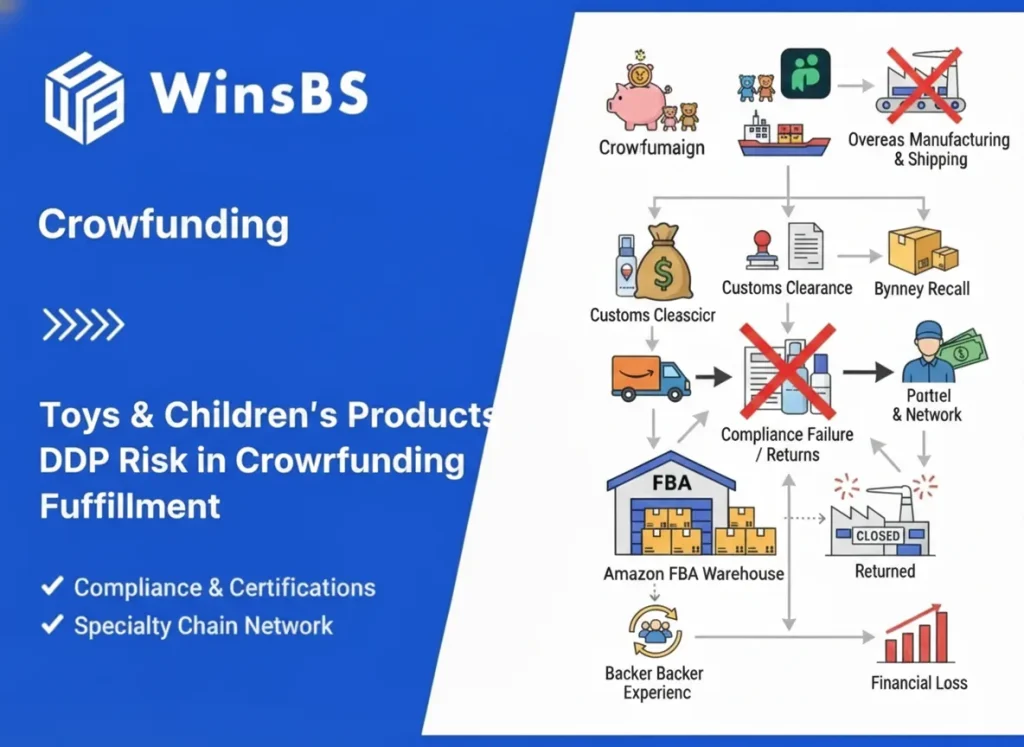
Professional infographic cover showing WinsBS branding and the title "Toys & Children’s Products DDP Risk in Crowdfunding Fulfillment" on the left, with a logistics flow diagram on the right illustrating crowdfunding order fulfillment, cross-border shipping, customs clearance, compliance risk, and potential financial loss.
Crowdfunding Fulfillment, Ecommerce, Order Fulfillment, Shipping & Logistics

Toys & Children’s Products DDP Risk in Crowdfunding Fulfillment

Toys & Children’s Products DDP Risk in Crowdfunding Fulfillment Why “Taxes Included” Fails Once a Product Is Classified as a Children’s Product WinsBS Fulfillment – Maxwell Anderson Updated February 2026 Table of Contents TL;DR: why DDP fails before shipping for toys 1. Why toys and children’s products are most often misjudged in crowdfunding 2. The three intuitive assumptions that fail under children’s product classification 3. How systems actually decide “children’s product” status 4. Why DDP becomes structurally unstable once compliance is the entry gate 5. Country differences are not “strictness,” but different entry gates 6. Why responsibility becomes non-transferable once problems appear 7. When DDP can work — and why these conditions are rare 8. Why crowdfunding timelines conflict with children’s product timelines 9. What this means before you commit to “taxes included” TL;DR Toys and children’s products repeatedly fail in crowdfunding fulfillment not because shipping is difficult, but because the product’s regulatory identity is unstable at the moment delivery commitments are made. During the campaign phase, products are commonly treated as ordinary consumer goods. Once shipments approach clearance, platform review, or market entry, the same items are reclassified as children’s products, triggering a compliance-first execution path where responsibility cannot be transferred. At that point, DDP (“taxes included”) does not reduce risk. It amplifies it. DDP can prepay duties and taxes, but it cannot override children’s product classification, testing requirements, or certification obligations. The failure often appears as a logistics or customs problem, but the breakdown occurs earlier — at the moment the product crosses from “general merchandise” into a regulated children’s product without a fixed identity. 1. Why Toys and Children’s Products Are Most Often Misjudged in Crowdfunding Toys are familiar. That familiarity creates a dangerous confidence gap in crowdfunding. Creators see toys sold everywhere, shipped everywhere, and featured on major platforms. They assume “normal commerce” equals “normal entry.” The recurring failure pattern is not that a team ignored shipping execution. It is that the product’s identity stayed commercially flexible while the system required it to be regulatorily fixed. In the United States, toys fall into a compliance environment where mandatory toy safety standards apply. Once a product is treated as a children’s toy, the “can we ship it?” question becomes secondary to whether the product can be certified under the CPSC toy safety framework . Crowdfunding reverses the normal order. In mature toy supply chains, age grading, materials, and safety documentation are stabilized before scale. In crowdfunding, teams often scale first — and only discover that the system will not accept a moving definition. 2. The Three Intuitive Assumptions That Fail Under Children’s Product Classification Most toy crowdfunding failures begin with three intuitions that feel reasonable in consumer commerce, but fail under children’s product classification. The first intuition is that a toy is not regulated like sensitive goods. In reality, children’s product certification obligations are part of the entry gate, formalized through the Children’s Product Certificate (CPC) framework , which places testing and documentation responsibility on the manufacturer and importer. The second intuition is that a product marketed for “kids and adults” will avoid children’s product treatment. Systems do not accept “everyone” as a stable category. Objective design, foreseeable use, and presentation determine classification. The third intuition is that DDP solves the problem because taxes are prepaid. DDP only reallocates payment and import responsibility. It does not change what the product is, as defined under the Incoterms framework . 3. How Systems Actually Decide “Children’s Product” Status Toys and children’s products are evaluated as defined physical instances intended for defined user groups. In practice, children’s product status emerges from the interaction of age grading, materials and components, and objective presentation. Identity variable What the system asks first How crowdfunding breaks it What failure looks like later Age grading Who is this intended for (≤12 triggers children’s product posture) Campaign language is vague (“for families,” “educational,” “kids and adults”) Reclassification and documentation demands appear during clearance or review Materials & components What materials are accessible Supplier or component changes after funding Testing no longer matches the shipped instance Presentation How it is marketed and used Children shown using it while disclaiming “not a toy” Objective presentation overrides disclaimers In the U.S., once children’s product status attaches, certification expectations become structural. The CPC must be based on testing by a CPSC-accepted laboratory and be furnished under CPC availability requirements . Children’s product identity also implies traceability discipline. The tracking label requirement defines traceability obligations under the tracking label rule , which crowdfunding teams often encounter too late. Chemical and material controls are also not theoretical. U.S. rules treat children’s products above the lead limit as banned hazardous substances under the total lead content limit . 4. Why DDP Becomes Structurally Unstable Once Compliance Is the Entry Gate DDP only works when the declared product identity is already stable. It assumes that the description used for customs declaration, the certification posture relied on for admissibility, and the documentation attached to the shipment will not change while goods are in motion. For toys in crowdfunding, that assumption is frequently false. The most common failure pattern is not that duties or taxes were miscalculated. It is that the physical product delivered no longer matches the identity under which responsibility was committed. Teams change materials, components, finishes, packaging, or internal structures because they are racing toward mass production. Those changes are normal inside product development. They become destabilizing the moment the system treats the item as a children’s product. Once children’s product classification attaches, DDP stops behaving like a convenience and starts behaving like a liability concentrator. Under the Incoterms framework, DDP assigns the seller responsibility for import clearance and delivery , which means the party making the crowdfunding promise also becomes the party expected to defend product identity, certification posture, and admissibility outcomes. At that point, paying more does not resolve the issue. The system is not asking a pricing question. It is asking whether the shipped instance can be defended as

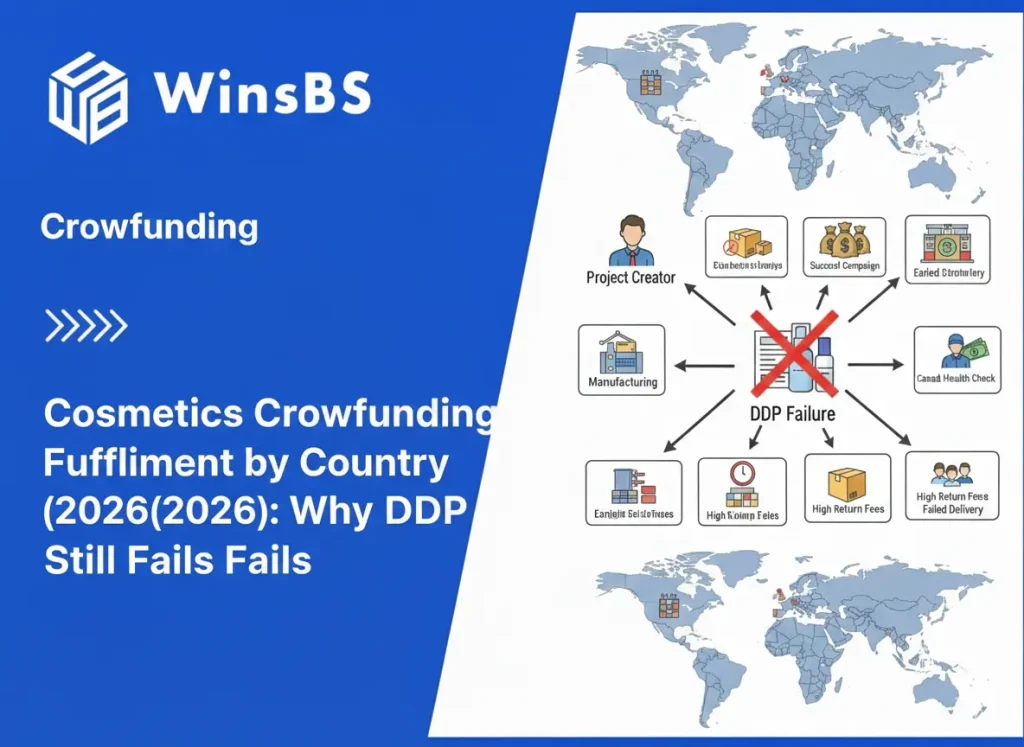
WinsBS infographic showing global cosmetics crowdfunding fulfillment in 2026, with DDP failure highlighted across creators, manufacturing, warehousing, customs checks, and successful campaigns on a world map.
Crowdfunding Fulfillment, Ecommerce, Order Fulfillment, Shipping & Logistics

Cosmetics Crowdfunding Fulfillment by Country (2026): Why DDP Still Fails

Cosmetics Crowdfunding Fulfillment by Country (2026) What DDP Fixes — and What Still Breaks at Customs, Compliance, and Batch Release WinsBS Fulfillment — Maxwell Anderson Updated February 2026 Table of Contents Cosmetics Fulfillment Outcomes Differ by Country What Modern Cosmetics Crowdfunding Actually Ships What Actually Changes Under DDP What DDP Does Not Change (Regulatory Reality) Why Cosmetics Fulfillment Breaks Differently by Market Why Cosmetics Campaigns Get Held at Customs The Batch & Lot Number Fulfillment Trap Replacement & Recall Fulfillment Reality Fulfillment Outcomes by Country Practical Execution Guidance for 2026 Campaigns Cosmetics fulfillment outcomes differ by country — even under identical DDP terms. In 2026, many cosmetics crowdfunding creators default to DDP in order to stabilize taxes, duties, and backer-facing surprises at delivery. That choice successfully removes one of the most visible historical failure points: supporters being asked to pay unexpected fees at the door. But cosmetics campaigns rarely fail at the payment layer anymore. They fail at the compliance and batch-control layer — where ingredients, claims, labeling, or traceability collide with local enforcement. After reviewing dozens of beauty crowdfunding campaigns between 2023 and 2025, the pattern is consistent: identical DDP shipments clear smoothly in one market, stall for weeks in another, and face outright blocks in a third. DDP pays the bill. It cannot make an ingredient compliant, a claim cosmetic rather than drug-like, a label truthful, or a batch traceable enough for release. What Modern Cosmetics Crowdfunding Actually Ships Modern cosmetics crowdfunding rarely ships “one product.” A typical campaign includes a base SKU (serum, cream, balm, foundation), multiple shades or scents, different sizes, limited-edition add-ons, and high-volume “gift with purchase” items required to preserve pledge integrity. From a fulfillment perspective, cosmetics are regulatorily coupled. A single problematic claim, INCI naming mismatch, missing Responsible Person detail, or documentation inconsistency can freeze an entire production lot. Unlike tabletop games or apparel, partial release is often impossible — enforcement treats the lot as a single regulatory unit. Batch logic amplifies this risk. Inventory is tracked by lot or batch number, supported by safety and composition documentation. When a batch fails compliance, the outcome is not “some orders delayed.” The outcome is inventory that cannot legally enter the domestic delivery network in that market. Observed reality (2024–2025 campaigns): Many projects arrive at the warehouse physically ready: production complete, cartons packed, freight booked, and DDP arranged. Fulfillment halts anyway, because the first enforcement checkpoint questions product permission — not shipping execution. What Actually Changes Under DDP DDP delivers three genuine improvements for cosmetics crowdfunding: cost predictability, improved backer perception at delivery, and clear assignment of import responsibility. It sharply reduces “pay to receive” complaints, particularly in VAT-heavy markets. It also aligns with how customs workflows assign responsibility and payment, smoothing the financial handoff layer. From a creator’s perspective, this often creates the impression that the hardest part of fulfillment is now behind them. Observed reality: DDP campaigns see support tickets shift away from fee surprises toward “why is it held?” and “why is only my country delayed?” These questions originate entirely outside the payment layer. This is where many cosmetics creators misread DDP. Because payment issues disappear, it feels as though fulfillment risk has been resolved. In practice, DDP simply moves campaigns from a financial failure mode into a regulatory one. What DDP Does Not Change (Regulatory Reality) DDP does not make a product compliant. It does not reclassify a drug-like claim as cosmetic. It does not fix labels, replace the required Responsible Person, or supply missing batch traceability. In the United States, the cosmetic-versus-drug boundary hinges on claims rather than ingredients, as defined under FDA cosmetics labeling rules . Once claims imply treatment or physiological effect, products can be escalated into a different regulatory category regardless of shipping terms. MoCRA expanded FDA enforcement authority, including access to batch and safety records during inspections. When compliance questions arise, refusal or delay in producing documentation can itself become a prohibited act. The repeal of U.S. de minimis thresholds increased tariff prepayment pressure under DDP, but clearance outcomes still depend on compliance alignment, not on whether duties were prepaid. In the European Union, market access requires a designated Responsible Person, a safety assessment, and a completed CPNP notification . Notification enables placement. It does not function as approval. Great Britain applies a separate notification regime through SCPN. Canada enforces its own notification framework. Australia evaluates products based on claim-driven classification. Observed reality: Once regulatory review is triggered, DDP becomes irrelevant. Release depends solely on whether the product, paperwork, and batch are legally placeable. Once compliance becomes the limiting factor, fulfillment outcomes stop being uniform. The same product configuration can behave very differently, depending on which market’s rules are applied at entry. Why Cosmetics Fulfillment Breaks Differently by Market Enforcement triggers vary sharply by jurisdiction. The EU blocks access without complete CPNP and Responsible Person setup. Great Britain requires SCPN even for EU-notified products. Canada enforces notification alignment. Australia reclassifies products based on claim interpretation. Observed reality: Identical campaigns ship on time to the United States but stall in the EU, or clear Canada while facing Australian holds — all under the same DDP terms. Why Cosmetics Campaigns Get Held at Customs Customs holds usually stem from mismatches: claims implying treatment, INCI formatting errors, missing Responsible Person information, label language issues, or paperwork that fails to substantiate batch composition. These triggers are not enforced uniformly. Some markets prioritize claims, others notification completeness, others import description accuracy. The most damaging assumption creators make at this stage is that delays will remain localized. In cosmetics, regulatory intervention almost never affects a single order. The Batch & Lot Number Fulfillment Trap Fulfillment breaks at the batch level. Campaigns plan by pledge or wave; enforcement and recalls operate on lot identity. Shared lots across multiple variants create fragility — one shade’s issue can immobilize everything. Replacement & Recall Fulfillment Reality In cosmetics crowdfunding, replacements are compliance events. Reserve stock sharing the disputed lot often reproduces the original failure. In

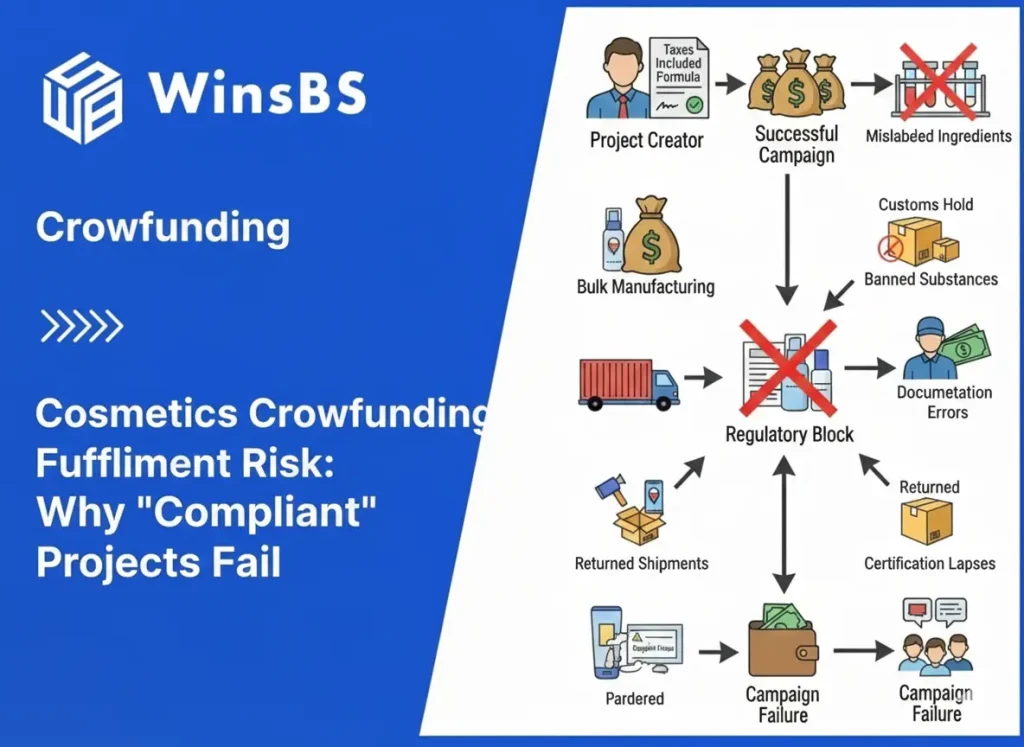
WinsBS infographic showing how cosmetic crowdfunding campaigns fail, with a process flow from project launch to regulatory block due to labeling, customs, and compliance issues, resulting in order fulfillment disruption and campaign failure.
Crowdfunding Fulfillment, Ecommerce, Order Fulfillment, Shipping & Logistics

Cosmetics Crowdfunding Fulfillment Risk: Why “Compliant” Projects Fail

Cosmetics Crowdfunding Fulfillment Risk Why “Compliant on Paper” Projects Still Get Stopped, Returned, or Destroyed — After Funding Succeeds WinsBS Fulfillment – Maxwell Anderson Updated January 2026 Table of Contents TL;DR 1. Why Cosmetics “Look Compliant” and Still Fail 2. The Failure Pattern: Compliance Is a Gate, Not a Spectrum 3. Why DDP / “Taxes Included” Often Breaks in Cosmetics 4. Why the Same Product Triggers Different Paths by Country 5. Why Responsibility Can’t Move After the First Declaration 6. Why Detention, Return, or Withdrawal Has Little Fulfillment “Fix Space” 7. Two Public Cases That Show the Mechanism, Not the Drama 8. When DDP Can Work — and Why This Window Is Narrow 9. Pre-Commitment Risk Checklist 10. What This Is Not: The Fulfillment Boundary in Cosmetics Methodology & Sources TL;DR Cosmetics crowdfunding fails in a specific way: the project can be “operationally ready” and still be commercially doomed, because cosmetics is not a shipping category first. It is a regulatory-gated category where the market decides whether the product can exist, not whether a box can travel. “DDP / Taxes Included” often fails in cosmetics because the promise is interpreted by backers as a service guarantee, while the enforcement reality treats it as a responsibility lock. Once an importer identity and product identity are asserted at first declaration, responsibility becomes sticky rather than transferable. The same formula can trigger different admissibility paths across the U.S., EU, and UK. The failure is not that rules differ. The failure is that creators budget and schedule as if one global path exists, then discover the paths diverge after commitments are public. When a cosmetics shipment is detained, withdrawn, or blocked from the market, fulfillment has limited corrective leverage. The window that mattered was before public promises: product identity freeze, claims freeze, labeling freeze, and responsibility assignment. Kickstarter also reminds backers that duties and taxes may be their responsibility depending on country rules, which is exactly where creator promises can collide with platform reality. Kickstarter: customs fees responsibility. 1. Why Cosmetics “Look Compliant” and Still Fail “Looks compliant” usually means a creator has ingredient lists, packaging files, and a manufacturer who claims they have shipped similar products before. In crowdfunding, that feels like a finished state. In cosmetics enforcement, it is often only a collection of documents that may or may not match the declared product in the destination market. Cosmetics is a high-compliance, high-sensitivity, high-return-impact category. If a board game arrives late, the problem is time. If a cosmetic is blocked, withdrawn, or detained, the problem is admissibility. That difference matters because time problems can be absorbed; admissibility failures can terminate the plan. A creator can do “normal fulfillment planning” correctly and still lose control at first declaration: the moment a product is defined by label, claim, ingredient identity, and responsible party. In cosmetics, that first definition is the point where later fixes become expensive, slow, or impossible. 2. The Failure Pattern: Compliance Is a Gate, Not a Spectrum Crowdfunding teams often budget for operational variance: damaged units, address errors, replacement parcels, and wave sequencing. Cosmetics adds a different variance type: regulatory outcomes that are not negotiated by better packing or faster dispatch. The product is either acceptable to enter the market path, or it is not. This is why cosmetics failures feel irrational to creators. The team sees effort and preparation. The market sees mismatches: a color additive issue, a prohibited substance, a claim that changes the regulatory posture, or a missing responsible-party framework. When enforcement triggers, the failure can become binary. A project that planned to “ship everything, then clean up the rest” discovers that cosmetics does not reliably allow “ship first, fix later.” 3. Why DDP / “Taxes Included” Often Breaks in Cosmetics DDP is often chosen to prevent backer anger and abandonment. It can remove surprise duties and VAT from the doorstep experience. But in cosmetics, DDP frequently creates a hidden responsibility concentration: one party becomes accountable for entry, labeling posture, and declarations at scale. Kickstarter’s own support language is a clue to the mismatch: it tells backers that customs-related fees may be their responsibility and that country rules differ. When a creator promises “Taxes Included” without a proven, market-specific admissibility path, the promise becomes a liability statement rather than a shipping perk. Kickstarter guidance on customs fees. Risk rises sharply under these conditions: the formula or claims are still shifting, labels are being finalized late, and the creator assumes DDP is mainly a tax math problem. In practice, DDP becomes a compliance bet placed after the campaign already made public commitments. 4. Why the Same Product Triggers Different Paths by Country Cosmetics is not harmonized across the U.S., EU, and UK in the way creators intuitively expect. Even if the ingredient deck is stable, the admissibility posture is shaped by local rules, enforcement priorities, notification systems, and who carries the responsible-party role. In Great Britain, a cosmetics product made available to consumers must have a Great Britain “Responsible Person” who ensures legal obligations are met, and the responsible person must have a UK-established address. That is not an optional operational preference; it is a placement condition. UK guidance: Responsible Person requirement. In the EU, market surveillance and product safety systems are designed to remove unsafe or non-compliant products from the market. When a prohibited substance appears on an ingredient list, the outcome is often not “fix the shipping,” but “stop the product.” European Commission: Safety Gate dangerous products (April 2025). 5. Why Responsibility Can’t Move After the First Declaration Crowdfunding teams sometimes believe they can “switch partners” if the first route fails. That logic works when the issue is execution throughput. It breaks when the issue is the identity of the responsible party and the declared identity of the product at entry. In GB cosmetics, the Responsible Person concept exists precisely to define who carries the legal obligations for the product made available to consumers. Once a product has been positioned for a market, late responsibility swaps

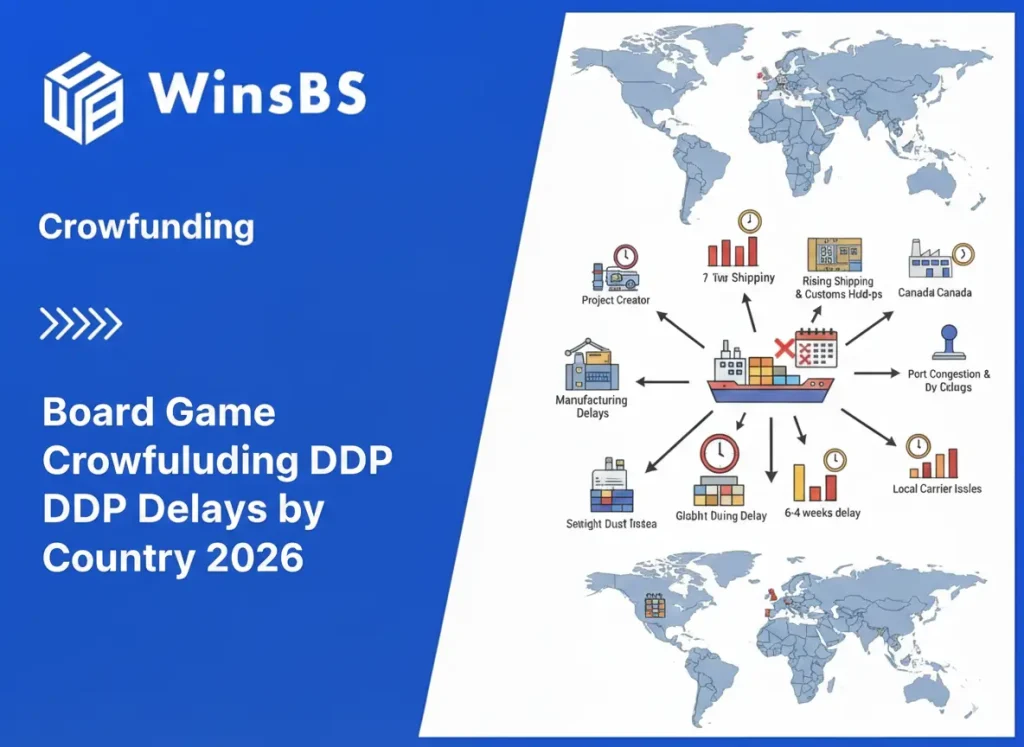
Blue-and-white industry infographic with WinsBS branding and the title "Board Game Crowdfunding DDP Delays by Country 2026", showing a global trade map, container ship, and logistics icons representing manufacturing delays, port congestion, customs clearance issues, and order fulfillment delays under DDP shipping.
Crowdfunding Fulfillment, Ecommerce, Order Fulfillment, Shipping & Logistics

Board Game Crowdfunding DDP Delays by Country 2026

Board Game Crowdfunding Fulfillment by Country (2026) What Actually Changes Under DDP — and What Still Breaks Waves, Replacements, and Delivery Windows WinsBS Fulfillment — WinsBS Research Updated January 2026 Table of Contents Board Game Fulfillment Outcomes Differ by Country What Fulfillment Looks Like for Modern Board Game Campaigns What Actually Changes Under DDP What DDP Does Not Change (But Creators Expect It To) Why Crowdfunding Waves Break So Easily The Replacement Parts Fulfillment Trap Fulfillment Outcomes by Country Observed Campaign Patterns (2024–2025) Practical Execution Guidance for 2026 Campaigns System-Level Conclusion Board game fulfillment outcomes differ by country — even under identical DDP terms. In 2026, DDP has become the default choice for many tabletop crowdfunding campaigns. It reliably stabilizes duties, VAT, and backer-facing cost surprises. What it does not stabilize are warehouse execution, wave sequencing, replacement fulfillment, or delivery windows. As a result, the same board game campaign routinely produces on-time deliveries in one region, visible wave collapses in another, and months-long replacement delays elsewhere — even though all shipments move under DDP. What Fulfillment Looks Like for Modern Board Game Campaigns Most modern board game crowdfunding campaigns no longer ship a single box. A typical pledge now includes a base game, multiple expansions, stretch-goal packs, miniatures or upgraded components, language-specific materials, and optional add-ons. From a fulfillment-system perspective, this creates a product that is both heavy and operationally coupled. Items cannot be picked independently without breaking pledge integrity. A single missing expansion can stall an otherwise complete order. This complexity matters far more than shipping terms. Once inventory reaches a regional fulfillment center, execution speed is governed by picking density, kitting accuracy, labor availability, and wave enforcement — not by whether duties were prepaid. Observed reality: In a representative tabletop campaign shipped during this period, factory output arrived on time and freight was booked as planned. However, inventory reached fulfillment centers in bulk pallets, separated by base games, expansions, and stretch-goal components. At no point did a “ready-to-ship” backer order exist upon arrival. Each shipment required manual kitting across multiple storage locations. Even when all components were physically present in the warehouse, orders could not be released until wave sequencing and SKU matching were verified. From the outside, this appeared as unexplained delay. Internally, it was normal fulfillment backlog. What Actually Changes Under DDP DDP meaningfully changes three things in board game crowdfunding: cost predictability, backer perception at checkout, and customs handoff friction. Prepaid duties and VAT eliminate one of the most visible failure modes of early crowdfunding campaigns — backers being asked to pay unexpected fees at delivery. This is particularly impactful in the EU and UK, where VAT collection failures historically triggered large complaint spikes. DDP also simplifies customs processing by clarifying who is responsible for payment at entry, as reflected in standard import guidance from U.S. Customs and Border Protection . Observed reality: In practice, prepaid VAT and duties removed delivery-time payment requests entirely. Parcels entered domestic delivery networks without customs-related holds. Support inquiries related to tax collection dropped sharply, particularly from EU backers. What DDP Does Not Change (But Creators Expect It To) DDP does not accelerate warehouse processing. It does not reduce pick complexity. It does not simplify wave logic. And it does not make replacement fulfillment cheaper or faster. These expectations persist because DDP feels like an “end-to-end” solution. In reality, it only governs cost allocation and tax settlement. Once goods clear customs, DDP disappears from the execution path entirely. At that point, fulfillment outcomes are driven by physical constraints — the number of SKUs per order, the size and weight of cartons, and how aggressively wave promises were marketed. Observed reality: Even after customs clearance was confirmed, thousands of cartons remained staged inside fulfillment centers awaiting final kitting or wave validation. Tracking numbers existed, but cartons had not yet entered outbound flow. From the system’s perspective, DDP had already completed its role. Why Crowdfunding Waves Break So Easily Wave shipping is one of the most fragile constructs in tabletop fulfillment. It exists to manage expectations, not to optimize warehouse throughput. Waves require warehouses to hold complete orders while waiting for the final component in that wave. If even one SKU lags — a late expansion, a delayed miniature mold — the entire wave stalls. Under DDP, creators often assume waves will be easier to manage. In practice, prepaid shipping removes cost friction, making wave collapse less visible until delays accumulate. Observed reality: In one observed campaign, some expansion inventory arrived earlier than planned, while a subset of stretch-goal items arrived late. To preserve wave commitments, fulfillment teams held otherwise complete orders rather than ship early and violate promises. The Replacement Parts Fulfillment Trap Replacement parts represent a second, hidden fulfillment lifecycle. Once the main campaign ships, replacements compete with new inbound projects for warehouse labor and attention. Replacement shipments are typically low-volume, geographically dispersed, and margin-negative. Under DDP, they still require tax settlement, but they do not benefit from the economies of scale that supported the original waves. This is why many campaigns see replacement delays stretch far longer than original fulfillment — particularly in Canada and Australia, where distance magnifies every processing delay. Observed reality: In a representative tabletop campaign, a small batch of wooden components required replacement due to cosmetic defects. While production of replacements was fast, fulfillment lagged once orders entered the warehouse, especially for Canada and Australia, where low-volume shipments could not be efficiently batched. Fulfillment Outcomes by Country Region Observed Outcome Common Backer Reaction United States Staggered delivery tolerated if tracking is consistent. Lower complaint volume. European Union Partial waves trigger immediate scrutiny. High sensitivity to delays. United Kingdom Delays framed as fulfillment failure. Escalation to public comments. Canada Heavy parcels amplify regional slowdowns. Replacement frustration. Australia Distance magnifies warehouse delays. Extended patience, late backlash. Practical Execution Guidance for 2026 Campaigns Limit fulfillment waves to one or two wherever possible. Reserve 10–15% of inventory for replacements. Group pledges by region early in the pledge manager.

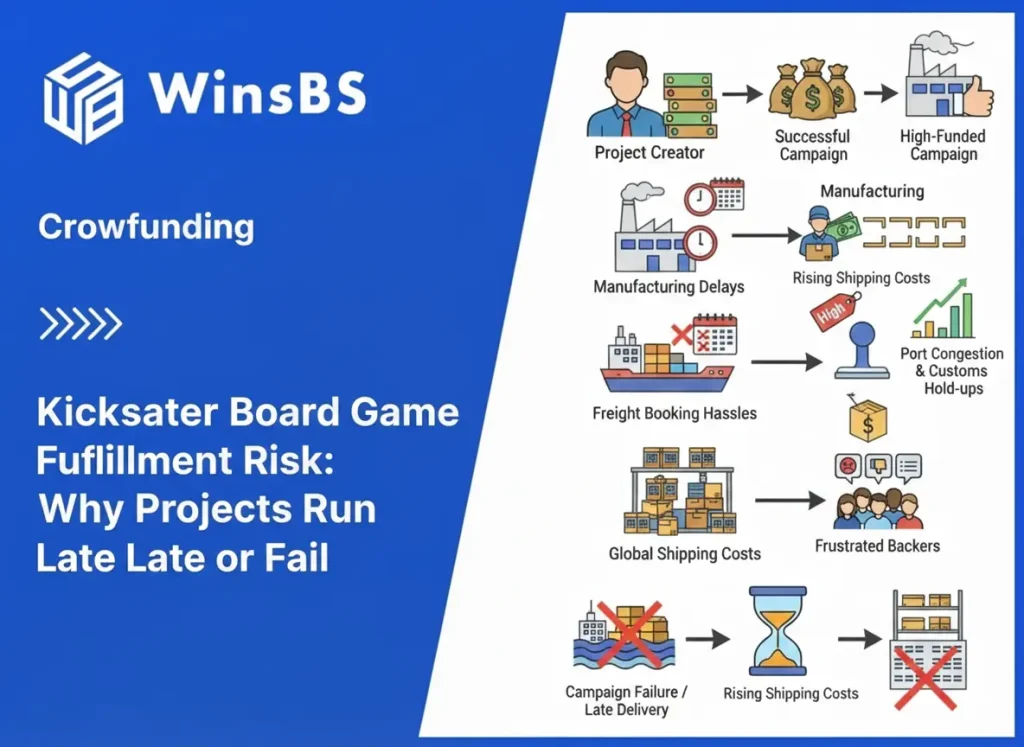
Blue and white crowdfunding logistics risk diagram with WinsBS logo and title on the left, and an illustrated supply chain showing manufacturing delays, shipping disruptions, port congestion, and delayed board game fulfillment for Kickstarter projects.
Crowdfunding Fulfillment, Ecommerce, Order Fulfillment, Shipping & Logistics

Kickstarter Board Game Fulfillment Risk: Why Projects Run Late or Fail

Kickstarter Board Game Fulfillment Risk Why Projects Run Late, Ship Damaged, or Arrive Missing Pieces — Even After “Solid Planning” WinsBS Fulfillment – Maxwell Anderson Updated January 2026 Table of Contents TL;DR 1. Why Board Game Fulfillment Gets Misjudged in Kickstarter Campaigns 2. The 5 Most Common Board Game Kickstarter Failure Modes 3. Real-World Cases Show Chain Reactions, Not Single Mistakes 4. DDP: When It Helps — and When It Amplifies Risk 5. Practical Fixes That Reduce Tabletop Fulfillment Risk 6. A Pre-Commitment Risk Checklist Common Questions Creators Ask After Funding Succeeds TL;DR Board games are not “just a box” in fulfillment terms. They are a tightly coupled system of components where a single missing token, warped board, or broken miniature can turn a shipped reward into a failed promise. Independent research on Kickstarter reward delivery suggests that roughly 9% of funded projects never deliver rewards, with an estimated range of 5–14%, a finding summarized both in Ethan Mollick’s analysis of Kickstarter outcomes and in Kickstarter’s own fulfillment education materials . Within tabletop specifically, a BoardGameGeek community data analysis shows an average delay of about 3.5 months. Delivered Duty Paid (DDP) shipping can improve the backer experience by avoiding surprise import charges, but without spare-parts buffers and stable wave planning, heavy parcels and replacement shipments can turn DDP into a cost amplifier rather than a safeguard. 1. Why Board Game Fulfillment Gets Misjudged in Kickstarter Campaigns In many Kickstarter board game campaigns, fulfillment risk is evaluated through familiarity. Creators have playtested prototypes, visited factories, and held finished samples. Compared to regulated categories like food or electronics, tabletop products feel straightforward. The misjudgment comes from treating fulfillment as a shipping problem rather than a completeness obligation. Fulfillment success is not defined by whether cartons move, but by whether each backer receives a fully correct set of components. One missing die or one incorrect insert is enough to invalidate the reward. When post-campaign iteration continues after delivery promises are locked, small variances accumulate. Those variances do not remain isolated. They surface as support tickets, replacement requests, and wave delays that compound over time. 2. The 5 Most Common Board Game Kickstarter Failure Modes 1. Invisible component drift. Stretch goals, add-ons, and late design tweaks change what “complete” means. Kitting rules built on earlier assumptions quietly break, even when manufacturing quality itself is acceptable. 2. Predictable damage in dense parcels. Miniatures snap, boards warp, and corners crush during international handling. Without packaging tested under real transit conditions and regional spares, damage rates exceed what campaign budgets expect. 3. Multi-wave shipping that resets responsibility. Wave 1 success does not guarantee Wave 2 stability. Addresses expire, add-ons shift, and replacement demand drains inventory, introducing new error surfaces with each wave. 4. Replacement workflows that compound. Every replacement is a second fulfillment cycle: picking, packing, postage, tracking, and communication. Without a buffer, replacements become a parallel campaign. 5. Post-commitment reward redefinition. Late localization, material substitutions, or tier rebundling mean the same pledge name can represent different physical realities. Operationally, the SKU is not fixed at the campaign page, but when component allocation finally stops changing. 3. Real-World Cases Show Chain Reactions, Not Single Mistakes Mythic Games and the Darkest Dungeon Board Game In early 2026, it was publicly confirmed that Mythic Games had been liquidated and was no longer able to manufacture or deliver several crowdfunding projects, including the Darkest Dungeon board game. Whatever the upstream causes, the downstream lesson is clear: once cash flow, production capacity, and delivery obligations fall out of alignment, fulfillment planning turns into triage rather than execution. Reporting from BoardGameWire and coverage by Eurogamer document how undelivered rewards ultimately forced rights holders to release files for DIY use. At the other end of the spectrum, delay without collapse is also well documented. Community-driven analysis on BoardGameGeek, which includes shared data and methodology, suggests that tabletop campaigns commonly ship months later than planned. This does not predict the fate of any single project, but it reinforces a practical planning principle: “on-time” should be treated as an optimistic scenario, not a default assumption. 4. DDP: When It Helps — and When It Amplifies Risk Delivered Duty Paid shipping is often chosen to improve the backer experience, particularly for EU and UK destinations where unexpected import charges can generate frustration. In stable retail-style operations, DDP can work well. Risk increases when DDP is combined with heavy parcels, unresolved component variance, and multi-wave fulfillment. In those conditions, damage or missing components trigger replacement shipments, and each replacement behaves like a second import event with its own cost stack. DDP tends to remain manageable when the bill of materials is frozen early, kitting rules are validated through pilot runs, packaging is tested under real handling conditions, spare parts are pre-positioned in-region, and wave logic is locked before commitments are made. The issue is not DDP itself, but applying it while the reward definition is still moving. 5. Practical Fixes That Reduce Tabletop Fulfillment Risk Measure completeness, not just shipment. The meaningful KPI is the percentage of backers receiving fully correct rewards, not the number of labels printed. Run pilot kitting before scaling. Pilot batches expose ambiguous instructions and easy-to-miss components before exceptions propagate across thousands of orders. Plan spare parts explicitly. Successful tabletop publishers routinely hold replacement inventory and define clear triggers for when and how replacements are issued. This prevents later waves from being cannibalized. Lock data and wave boundaries. Address validation, pledge manager exports, and wave definitions should be treated as controlled processes, not ad-hoc adjustments. Freeze iteration before commitments lock. This same structural rule appears in other crowdfunding categories: when commitment precedes stability, responsibility and cost concentrate rapidly rather than dissipate. 6. A Pre-Commitment Risk Checklist Before promising delivery dates or “taxes included” shipping, creators should be able to answer yes to all of the following: Are components, inserts, and localization fully frozen? Has packaging been tested for international handling? Do regional spare parts exist with a defined replacement workflow? Are wave

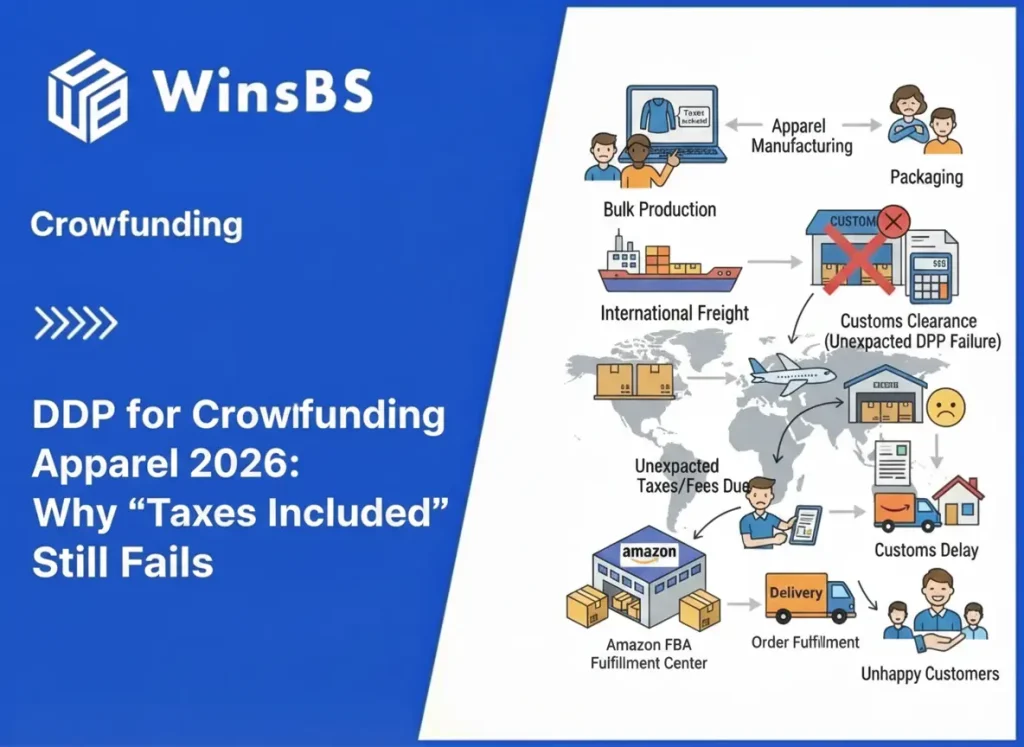
WinsBS branded infographic showing DDP failure in crowdfunding apparel fulfillment, with blocked customs clearance, unexpected taxes, delivery delays, and unhappy customers in cross-border order fulfillment.
Crowdfunding Fulfillment, Ecommerce, Order Fulfillment, Shipping & Logistics

DDP for Crowdfunding Apparel 2026: Why “Taxes Included” Still Fails

DDP for Crowdfunding Apparel 2026: Why “Taxes Included” Still Breaks Clothing Campaigns Origin Enforcement, Importer Responsibility, UFLPA Exposure, and Why Apparel DDP Fails Differently WinsBS Fulfillment – Maxwell Anderson Updated January 2026 Table of Contents Why Apparel DDP Feels Safe — and Why It Isn’t What DDP Actually Covers for Apparel Regulatory Sequencing: Origin Before Payment Responsibility That Never Transfers Under DDP How Apparel DDP Fails in Crowdfunding Why Apparel DDP Behaves Differently by Market When Apparel DDP Becomes Predictable When the Risk Comes From the Promise 5-Point Apparel DDP Reality Check A Practical Way to Think About Apparel DDP TL;DR Apparel looks like the “safe” DDP category. It doesn’t require product approvals and ships daily under DDP terms. That apparent simplicity hides the real risk. For apparel, customs evaluates origin, material disclosure, and importer responsibility before tax payment ever matters. Duties can be prepaid. Enforcement outcomes cannot. This is why apparel DDP often fails quietly at first—and then collapses publicly, after “Taxes Included” has already become a campaign promise. What DDP Actually Covers for Apparel (and What It Never Touches) In apparel crowdfunding, DDP is chosen to prevent backers from receiving surprise duty or VAT bills. On paper, this makes sense. Apparel duties are predictable. VAT is calculable. Carriers can collect and remit. What DDP never touches is the part regulators care about most: where the garment comes from, how it is made, and who is legally responsible for that determination. DDP governs payment. It does not govern origin enforcement, fiber verification, forced-labor scrutiny, or importer liability. In crowdfunding, this distinction matters because the promise is public. When “Taxes Included” fails, it fails in front of backers, not accountants. This pattern mirrors a broader structural issue in crowdfunding logistics: payment certainty is mistaken for delivery certainty. The full DDP failure model is detailed here. Regulatory Sequencing for Apparel: Origin Before Payment Apparel DDP does not fail because taxes are miscalculated. It fails because enforcement evaluates apparel in a specific order. For apparel, the real sequence is: origin determination → enforcement screening → importer responsibility → tax payment. If origin is questioned, the process stops. Prepaid duties do not accelerate that decision. In the United States, this logic is formalized under the Uyghur Forced Labor Prevention Act (UFLPA) , which places the burden of proof on importers to demonstrate that goods were not made with forced labor. CBP enforcement data shows apparel and textiles remain among the most frequently reviewed categories under forced-labor screening. See CBP forced labor enforcement statistics . When a shipment is paused for origin review, the system is not at the payment stage. DDP has nothing to attach to. Responsibility Under Apparel DDP: What Never Transfers DDP is often misunderstood as “the logistics provider takes responsibility.” In apparel, that assumption collapses quickly. Responsibility remains fixed on the importer of record. This includes origin accuracy, fiber content declarations, manufacturing traceability, and compliance with forced-labor enforcement regimes. None of these obligations transfer under DDP. Incoterms govern cost allocation—not regulatory liability. See the Incoterms® 2020 rules overview (ICC) . In crowdfunding, this creates a dangerous mismatch: a consumer-facing promise paired with non-transferable regulatory responsibility. How Apparel DDP Actually Fails in Crowdfunding Apparel DDP failures follow repeatable patterns, largely because enforcement timelines do not align with crowdfunding expectations. The campaign promises “Taxes Included” to reduce friction. Manufacturing spans multiple factories or material sources. Origin declarations are simplified for speed. Customs flags the shipment for enforcement review. The shipment stalls without a clear release timeline. Backers experience silence instead of delivery. At this point, the DDP payment itself has not failed. The failure occurred earlier, at the enforcement layer. From the backer’s perspective, nuance disappears. The promise was clear. The delay is public. Why Apparel DDP Behaves Differently by Market Apparel enforcement is global, but priorities differ by market. Understanding what each region evaluates first predicts DDP stability better than any shipping quote. Market Primary Enforcement Focus Key Reference United States Origin & forced-labor enforcement CBP apparel & textile import requirements European Union Fiber composition & labeling EU Textile Regulation (EU) No 1007/2011 United Kingdom Importer responsibility & labeling UK textile labelling guidance When Apparel DDP Becomes Predictable (Narrow Conditions) Apparel DDP becomes predictable only in a narrow operational window. Some mature campaigns do operate successfully within it. The problem is that the window is far smaller than most creators assume. Stable origin: fully traceable manufacturing. Consistent materials: no mixed-fiber ambiguity. Locked SKUs: no late-stage fabric changes. Prepared importer: enforcement responsibility understood. Conservative promises: delivery language allows variance. When the Risk Comes From the Promise, Not the Shipment “Taxes Included” is not a shipping term in crowdfunding. It is a public guarantee. In apparel, enforcement does not respect campaign language. When identity questions exist, the promise itself becomes the liability. 5-Point Apparel DDP Reality Check Origin clarity: Can you defend origin claims? Material consistency: Do SKUs match declarations? Importer readiness: Is responsibility understood? Change control: Are fabrics locked pre-fulfillment? Promise discipline: Is language enforcement-aware? DDP smooths payment after enforcement acceptance. It does not smooth enforcement itself. When enforcement is stable, DDP works. When it is not, failure is delayed—and public. For apparel crowdfunding campaigns that need enforcement-aware planning, review fulfillment structure before commitments lock. Apparel Fulfillment Structure Overview If you need a pre-launch risk check, Start a Fulfillment Fit Check Methodology & Sources — WinsBS Research Compiled by: Maxwell Anderson, Data Director, WinsBS Research. Follow on X This analysis models apparel crowdfunding DDP outcomes through regulatory sequencing and enforcement responsibility, rather than carrier performance or shipping speed. It is written to explain why apparel DDP outcomes diverge from general merchandise DDP outcomes, even when duties and taxes are prepaid correctly. The framework prioritizes how customs authorities evaluate apparel shipments in practice: origin determination, forced-labor enforcement, material disclosure, and importer-of-record responsibility. These factors are assessed before tax payment or delivery timelines are considered. U.S. CBP apparel & textile import enforcement Uyghur Forced Labor Prevention Act (UFLPA) CBP forced-labor enforcement statistics EU

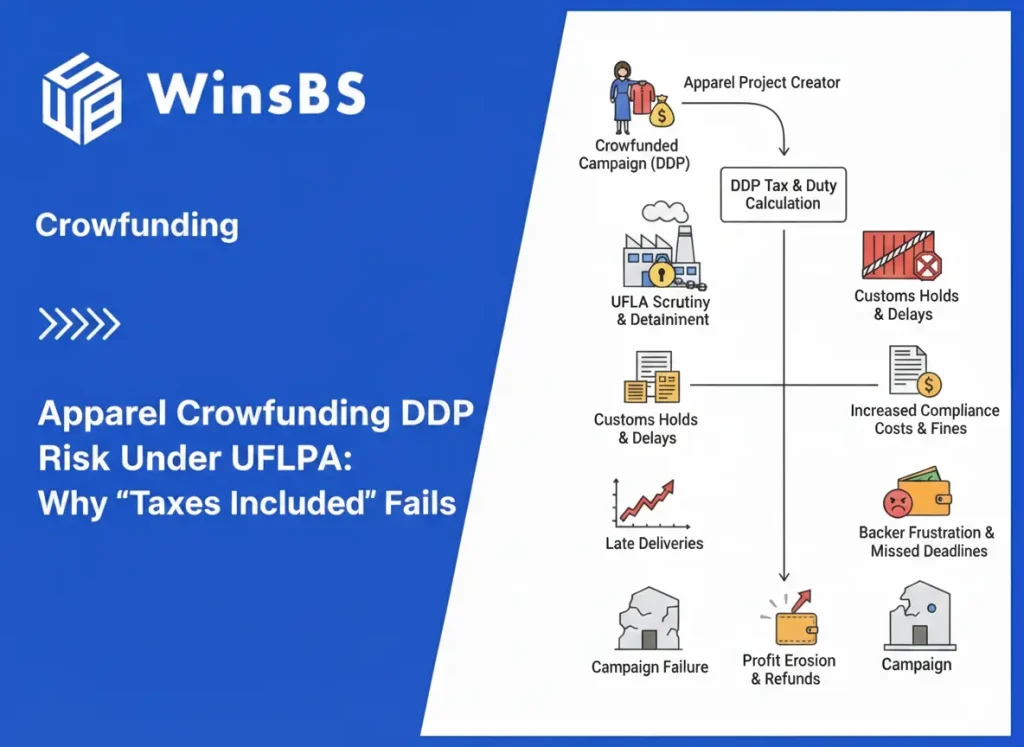
Infographic showing apparel crowdfunding DDP order fulfillment risks under UFLPA, illustrating DDP tax calculation, UFLPA scrutiny, customs delays, rising compliance costs, backer frustration, and campaign failure impacting apparel order fulfillment.
Crowdfunding Fulfillment, Ecommerce, Order Fulfillment, Shipping & Logistics

Apparel Crowdfunding DDP Risk Under UFLPA: Why “Taxes Included” Fails

Apparel DDP Risk in Crowdfunding Fulfillment Why “Taxes Included” Fails When Product Identity, Origin, and Responsibility Are Not Fixed WinsBS Fulfillment – Maxwell Anderson Updated January 2026 Table of Contents Key Judgment 1. Why Apparel Is Misjudged in Crowdfunding 2. The False Comfort of “Taxes Included” 3. DDP vs DDU/DAP Risk Matrix 4. Why DDP Becomes Structurally Unstable 5. How Apparel Entry Rules Differ by Country 6. Why Responsibility Becomes Non-Transferable 7. When DDP Is Not an Option Key Judgment Apparel products are repeatedly misjudged in crowdfunding because they look operationally simple and commercially familiar. In practice, apparel is a category where origin, material composition, and upstream sourcing define admissibility long before shipping price or tax payment matters. DDP (“taxes included”) can prepay duties and VAT, but it cannot stabilize a product whose identity is still moving. When a campaign commits to DDP while fabrics, blends, suppliers, or SKUs remain fluid, responsibility is locked at the exact moment uncertainty is highest. As of late 2025, U.S. Customs and Border Protection reported hundreds of apparel and textile shipments detained under UFLPA reviews, with outcomes driven primarily by cotton-origin uncertainty and upstream traceability gaps rather than tariff miscalculation, based on data published in its official enforcement dashboard. CBP — Uyghur Forced Labor Prevention Act (UFLPA) 1. Why Apparel Is Misjudged in Crowdfunding Apparel feels familiar. Creators wear similar products every day, see clothing shipped globally at massive scale, and assume that garments behave like ordinary consumer goods. This familiarity produces confidence. The problem is not ignorance of rules. It is the use of the wrong mental model. Commercial normality is not regulatory normality. A T-shirt that sells freely on a marketplace is not evidence that its origin, fiber composition, or supply chain can survive cross-border scrutiny at scale. Crowdfunding magnifies this gap. Campaigns commit to thousands of deliveries while fabrics are still being sourced, suppliers are still being negotiated, and SKUs are still being rationalized. What looks like late-stage optimization to a creator often represents a material identity change to enforcement systems. 2. The False Comfort of “Taxes Included” “Taxes included” sounds like certainty. It suggests that complexity has been priced in and risk has been transferred. For apparel, that impression is misleading. DDP changes who pays and who files, but it does not change what the product is. If a garment’s admissibility is questioned, payment does not resolve the hold. It only clarifies who is responsible. This is why apparel projects often experience a psychological trap: everything looks like logistics until the moment it is not. When the system stops evaluating cost and starts evaluating legality, DDP stops functioning as a convenience mechanism and becomes a responsibility amplifier. 3. DDP vs DDU/DAP Risk Matrix for Apparel Crowdfunding Dimension DDU / DAP DDP Importer of Record Local recipient or downstream entity Campaign / seller entity Exposure to Enforcement Fragmented across shipments Concentrated on seller Burden of Proof May shift downstream Fixed on importer Failure Mode Delay or re-routing Non-admission or seizure 4. Why DDP Becomes Structurally Unstable for Apparel DDP fails for apparel for two fundamentally different reasons. One is tax instability. The other is admissibility failure. Confusing them leads to incorrect decisions. Tax instability arises when changes to fiber blends, garment construction, or SKU definitions shift classification and duty rates. In these cases, DDP still technically functions, but margins erode and timelines stretch. Admissibility failure operates at a different level. Under forced-labor enforcement regimes, the system does not ask whether duties were calculated correctly. It asks whether the product is legally allowed to enter the market at all. Once this question is triggered, payment, carrier selection, and routing become irrelevant. 5. How Apparel Entry Rules Differ by Country Crowdfunding teams often assume that apparel behaves consistently across markets. It does not. What differs is not strictness, but which question each system asks first. United States. The U.S. applies a rebuttable presumption under UFLPA. Apparel linked to certain regions or entities is treated as prohibited unless the importer proves otherwise. The system prioritizes upstream cotton origin and end-to-end traceability. Failure results in detention or non-admission at the border. European Union. The EU focuses first on conformity, labeling accuracy, and origin declarations. Forced-labor due-diligence obligations are expanding, but enforcement typically centers on documentation review and market surveillance rather than immediate presumptive prohibition. United Kingdom. The UK treats apparel primarily through origin declarations and labeling compliance. Modern slavery obligations exist, but border outcomes more often involve requests for documentation rather than immediate exclusion. Practical implication. A garment that clears the EU or UK under DAP or DDU may still fail U.S. entry under DDP. Cross-market success is not proof of U.S. admissibility. 6. Why Responsibility Becomes Non-Transferable When an enforcement review is initiated, responsibility does not disperse. It concentrates. Under DDP, the importer-of-record role is fixed at the moment the delivery promise is made. Once scrutiny begins, that responsibility cannot be reassigned to carriers, brokers, or fulfillment partners. Evidence cannot be created after shipment. Supply-chain certainty must already exist. Crowdfunding projects that discover gaps late do not face an execution problem. They face a structural responsibility event. 7. When DDP Is Not an Option for Apparel Crowdfunding DDP is not an option if cotton origin cannot be conclusively proven at commitment. DDP is not an option if fabrics, suppliers, or SKUs remain unfixed. DDP is not an option if sourcing relies on opaque upstream suppliers. DDP is not an option if campaign timelines precede supply-chain finalization. Under these conditions, DDP does not reduce risk. It concentrates it. Validate whether DDP is selectable for your apparel crowdfunding campaign Author: Maxwell Anderson is a Content Marketing Manager at WinsBS Fulfillment, focused on crowdfunding fulfillment strategy, cross-border execution risk, and regulatory-driven failure analysis for apparel and consumer product campaigns. Methodology & Sources — WinsBS Research Compiled by: Maxwell Anderson, Content Marketing Manager, WinsBS Fulfillment. Follow on X This analysis is structured as a regulatory-sequencing and responsibility model for apparel crowdfunding shipments delivered under DDP (Delivered Duty

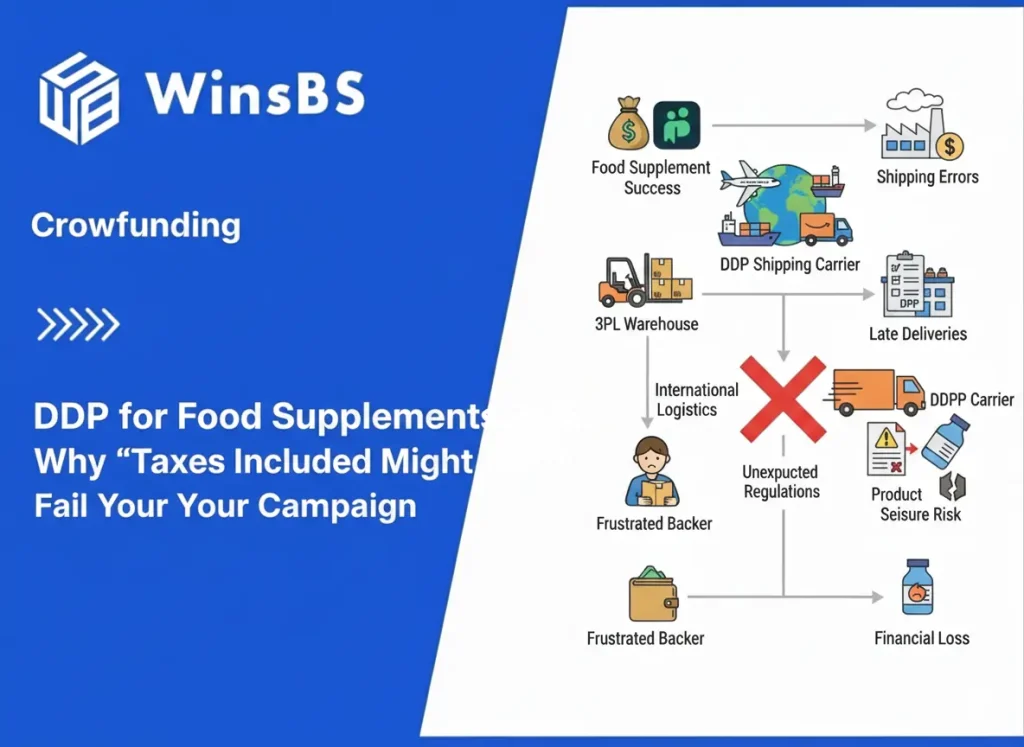
WinsBS infographic showing crowdfunding DDP order fulfillment risks for food supplements in 2026, illustrating 3PL warehouse handling, DDP shipping, international logistics, regulatory risks, product seizure, and potential financial loss.
Crowdfunding Fulfillment, Ecommerce, Order Fulfillment, Shipping & Logistics

DDP for Food Supplements 2026: Why “Taxes Included” Might Fail Your Campaign

DDP for Crowdfunding Food Supplements 2026: How It Works, Where It Breaks, and Why “Taxes Included” Can Collapse Regulatory Sequencing, Importer Responsibility, Novel Food/Claims Triggers, and Practical Risk Controls WinsBS Fulfillment – Maxwell Anderson Updated January 23, 2026 Table of Contents Why Food Supplement DDP Gets Misunderstood What DDP Actually Does (and Does Not Do) for Supplements Regulatory Sequencing: Why Supplements Are Judged Before They’re Taxed Responsibility Under DDP: What Never Transfers What Happens When Supplement DDP Fails Country Differences: What Each Market “Looks For” First Formula & Claims Risk: Why “Small Changes” Become Big Regulatory Events When DDP Becomes Predictable (Narrow Conditions) When Risk Comes From the Promise, Not the Shipment 5-Point DDP Safety Checklist A Practical Way to Think About DDP for Supplements Most creators treat DDP as a billing decision: “I’ll pay duties and taxes so backers don’t get surprised.” That framing works for many consumer product shipments where clearance is dominated by valuation, classification, and paperwork. Food supplements behave differently because customs is only one gate. The other gate is permission: is this product allowed to enter the market as a food supplement at all? Here’s the simplest translation of the risk: DDP pays the bill, but it doesn’t open the gate. For food supplements, the gate is regulatory permission—not customs payment. This is why two shipments can share the same DDP term and the same carrier, yet diverge completely at the border. For supplements, regulators evaluate ingredients, claims, and labeling early. In the U.S., that “permission layer” starts as early as FDA Prior Notice, which exists so FDA (with CBP support) can target import inspections. In the EU, “permission” can include whether an ingredient falls under the Novel Foods Regulation (EU) 2015/2283 before it can be placed on the market. What DDP Actually Does (and Does Not Do) for Supplements DDP can clean up the backer experience. Duties and taxes get prepaid, so the package doesn’t arrive with a surprise bill. That matters in crowdfunding because the first public complaints are never about tariff schedules. They’re about broken expectations: “You said taxes included.” The most important correction is this: prepaid duties do not convert an uncertain supplement into an accepted supplement. DDP affects who pays and how charges are collected. It does not change how regulators decide admissibility. DDP can make the money side smoother after acceptance—but it cannot make acceptance happen. Bottom line: For supplements, DDP is an experience tool built on top of regulatory permission. If the permission layer is unstable, DDP doesn’t reduce uncertainty—it makes the consequences of uncertainty arrive later and more publicly. Regulatory Sequencing: Why Supplements Are Judged Before They’re Taxed If you sell a gadget, many “bad outcomes” still look like delivery: higher landed cost, brokerage, or a reclassification dispute. If you sell a supplement, many “bad outcomes” look like non-delivery because regulators treat supplements as products that can mislead or harm consumers if composition or claims are wrong. In the U.S., Prior Notice is not a “nice-to-have.” FDA describes Prior Notice as a required advance notification for imported foods, designed to support targeted inspection and food supply protection. The operational impact is simple: the system expects accurate notice and consistent shipment details before “DDP” has any chance to behave the way creators imagine. If you want the procedural anchor, FDA’s “Filing Prior Notice” page explicitly ties Prior Notice to 21 CFR Part 1, Subpart I and explains submission routes. In the EU, the sequence is even more visible. The European Commission’s own “Food supplements” overview places supplements inside a defined policy framework tied to Directive 2002/46/EC. And where an ingredient is treated as “novel,” the Novel Foods Regulation requires authorization pathways before market placement. That means a “taxes included” promise can be financially accurate and still operationally wrong, because the first gate is not the tax bill—it’s whether the product definition is accepted. Bottom line: Supplements do not clear like general merchandise. They clear through a permission-first sequence. DDP sits after that sequence, not before it. A Common Crowdfunding Failure Pattern (Supplements) A creator launches with a formula that looks straightforward on a product page. During the pledge manager, the team adds an “improved” blend and stronger benefit copy. The shipping quote doesn’t change. The campaign still says “Taxes Included.” Then the shipment is evaluated as a supplement product with composition + claims questions. In the EU, the framework that constrains health-related claims is Regulation (EC) No 1924/2006, and the Commission maintains an EU Register of nutrition and health claims used to verify what’s permitted and under what conditions. In the U.S., FDA’s industry pages describe the notification expectations for structure/function and related claims under section 403(r)(6) and how those claims should be substantiated. The point is operational: your campaign promise was priced on a shipping variable. Your shipment is being judged on a regulatory variable. Those two variables do not move together. Responsibility Under DDP: What Never Transfers DDP is often interpreted as “the carrier takes it from here.” For supplements, that mental model breaks fast. Regulators attach responsibility to the importer and the party placing products on the market—not to the payment method. If you want a concrete, non-theoretical statement of this responsibility framing, the UK Food Standards Agency guidance on importing food supplements and health foods is written for businesses and focuses on what importers must watch for (labelling, contaminants, and category boundaries). “DDP” does not erase any of that responsibility. It simply changes how duties and taxes are paid once the product is permitted through the relevant gates. Bottom line: Under DDP, responsibility doesn’t disappear. It becomes more concentrated—because you’ve paired a public promise (“no surprises”) with a system that may stop a shipment for reasons unrelated to payment. What Happens When Supplement DDP Fails When supplement DDP fails, it typically fails through a small number of repeatable system behaviors. Not because every country is identical, but because regulators tend to act on the same inputs: ingredients, claims, labeling, and importer accountability. In

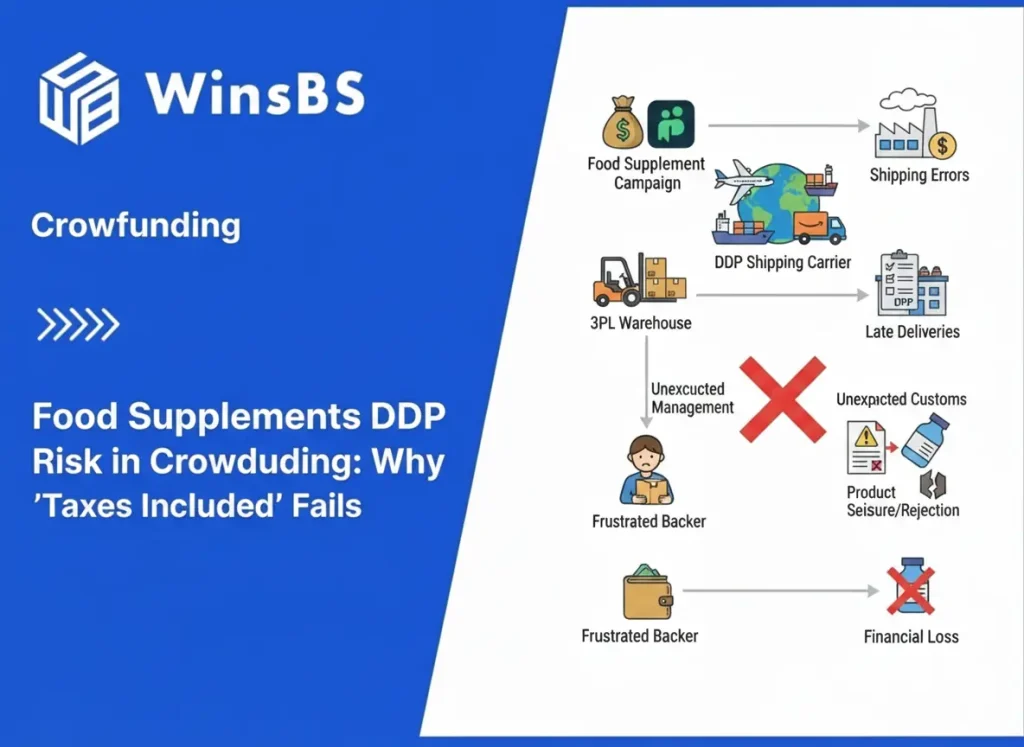
WinsBS crowdfunding logistics risk infographic showing food supplement DDP fulfillment flow, highlighting order fulfillment risks, customs issues, shipment delays, and financial loss in crowdfunding campaigns.
Crowdfunding Fulfillment, Ecommerce, Order Fulfillment, Shipping & Logistics

Food Supplements DDP Risk in Crowdfunding: Why “Taxes Included” Fails

Food Supplements DDP Risk in Crowdfunding Fulfillment Why “Taxes Included” Fails When Ingredients and Claims Aren’t Fixed WinsBS Fulfillment – Maxwell Anderson Updated January 2026 Table of Contents Key judgment: why DDP fails before shipping 1. Why food supplements are most often misjudged in crowdfunding 2. The three intuitive assumptions that fail under regulatory review 3. How regulatory systems actually define food supplements 4. Why DDP becomes structurally unstable for supplements 5. Country differences are not “strictness,” but entry gates 6. Why responsibility becomes non-transferable once problems appear 7. When DDP can work — and why these conditions are rare 8. Why crowdfunding timelines conflict with regulatory timelines 9. What this means before you commit to DDP Key judgment Food supplements are repeatedly misjudged in crowdfunding because they feel like “normal consumer goods.” Regulatory systems do not treat ingestible products that way. Once ingestion and health-related claims are involved, the category shifts into a compliance-first domain where admissibility determines outcomes long before duty payment matters. DDP (“taxes included”) can prepay duties and taxes, but it cannot make an inadmissible product admissible. When a campaign commits to DDP while ingredients, dosage, or label claims are still moving, DDP becomes structurally unstable: it locks responsibility at the exact moment the product identity is least stable. The failure often appears later as a “shipping problem,” but it begins earlier as a product-definition problem. A small post-campaign change that looks minor to backers can materially change how a supplement is treated at the border or in-market. 1. Why Food Supplements Are Most Often Misjudged in Crowdfunding Food supplements feel familiar. Creators have used similar products, seen them sold on major marketplaces, and watched countless brands ship them cross-border. Compared with categories that obviously “look regulated,” supplements can feel routine. That familiarity creates confidence. The problem is not that creators ignore rules. The problem is that they use the wrong mental model. Retail normality is not regulatory normality. A product being common in commerce is not evidence that it is stable under regulatory definitions. In the United States, the “dietary supplement” category is clearly defined by statute, placing direct responsibility on companies to assess safety and finalize labeling before marketing — a core principle the FDA continues to highlight in its ongoing guidance. Explore the FDA’s current overview of dietary supplements and regulatory responsibilities for firms. In the EU, the framework splits responsibilities: one directive sets the basic rules for food supplements as a product category, while a separate regulation strictly governs nutrition and health claims. This division alone disrupts many crowdfunding assumptions, since category approval and allowable claims don’t always align. See Directive 2002/46/EC on food supplements and Regulation (EC) No 1924/2006 on nutrition and health claims. Crowdfunding amplifies this mismatch because it commits to delivery terms while the product is still evolving. In established trade, supplements that ship reliably do so under stable formulas, stable labels, and stable claims. In crowdfunding, those elements often remain negotiable after funding. 2. The Three Intuitive Assumptions That Fail Under Regulatory Review Most supplement crowdfunding failures begin with three intuitions that feel reasonable in consumer commerce but fail under regulatory review. The first intuition is: “It’s just vitamins, herbs, protein, or probiotics — it’s not dangerous.” Regulatory control is not limited to “dangerous goods.” Ingestible products are controlled because they can be misleading, adulterated, misbranded, or positioned as medicines through claims. The question is not whether the product feels safe. The question is whether its identity and labeling fall cleanly inside the lawful category you are using to ship it — precisely the framework explained in the FDA’s detailed questions and answers on dietary supplements under DSHEA. FDA Questions and Answers on Dietary Supplements (DSHEA framework). The second intuition is: “Similar products sell on Amazon, so ours will be fine.” Marketplace presence is not proof of regulatory stability. Many products exist in commerce under inconsistent labeling quality, inconsistent claim discipline, and inconsistent ingredient documentation. Crowdfunding turns “inconsistency” into “failure” because you commit to thousands of cross-border deliveries under one promise. The third intuition is: “DDP solves it because taxes are prepaid and someone else handles the import.” DDP can change who pays and who arranges clearance, but it does not change what the product is. If the product’s admissibility is questioned, payment does not resolve the hold. DDP is a payment structure, not an admissibility guarantee — as the U.S. Department of Commerce clearly outlines in its practical guide to Incoterms. U.S. Department of Commerce — Know Your Incoterms (DDP overview). These assumptions appear “true” in mature supply chains because mature brands typically freeze formula and claims before scaling cross-border delivery. Crowdfunding reverses that sequence. 3. How Regulatory Systems Actually Define Food Supplements Supplements are not evaluated as “a product type people buy.” They are evaluated as a defined ingestible item with a defined composition and a defined label-claim posture. In practice, systems define supplements through the interaction of ingredients, dosage, intended-use framing, and claims language. In the U.S., “dietary supplement” is defined in statute. That definition does not magically make every ingestible “a supplement.” It describes the category boundaries that your product must actually fit — laid out in the legal text at 21 U.S.C. § 321 — Definitions (including dietary supplement definition). Manufacturing and handling expectations for supplements also sit inside formal compliance frameworks, including current good manufacturing practice requirements specific to supplements. This matters operationally because once a campaign scales, any mismatch in traceability, lot identity, or label control becomes a systemic exposure rather than a one-off mistake. The FDA’s small-entity compliance guide walks through these requirements in clear, practical detail. 21 CFR Part 111 — cGMP for dietary supplements and FDA Small Entity Compliance Guide for 21 CFR Part 111. Note that even as recently as mid-2025, the FDA released new educational videos and fact sheets to help companies better navigate the New Dietary Ingredient (NDI) notification process, underscoring how pre-market safety evaluations remain a key focus for certain ingredients. FDA’s latest