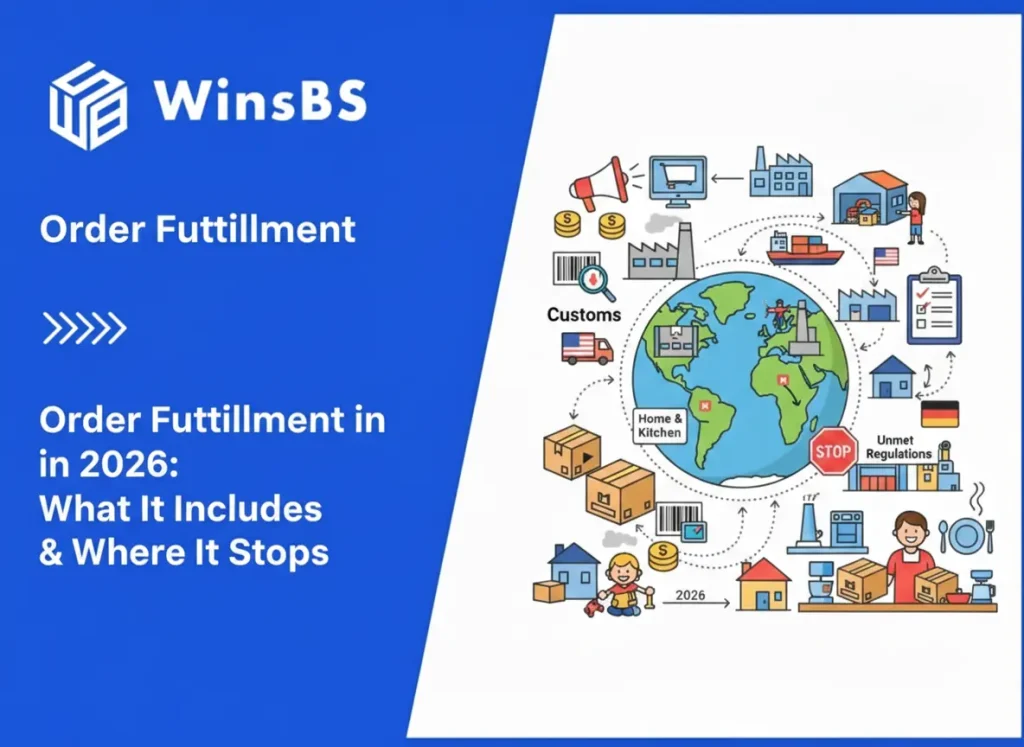










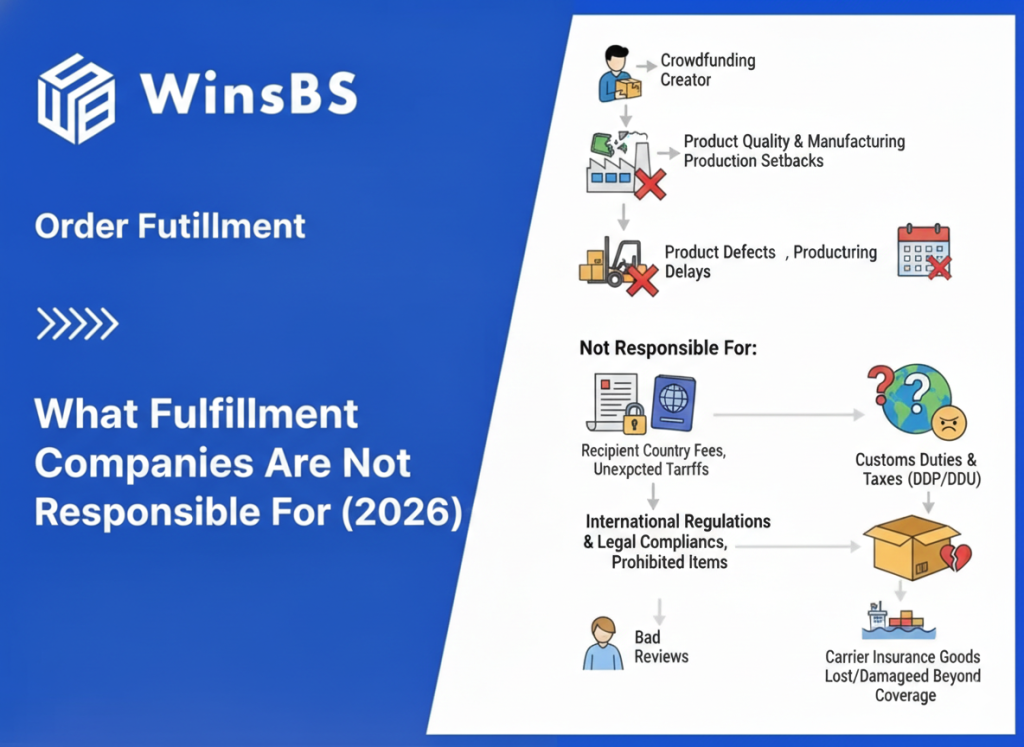
What Fulfillment Companies Are Not Responsible For (2026)
What Fulfillment Companies Are Not Responsible For: Why “We Paid the 3PL” Still Doesn’t Move Accountability (2026) WinsBS Fulfillment — Maxwell Anderson Updated February 2026 Positioning note: This page is not a “what 3PLs do” explainer. It documents a single recurring fulfillment moment in 2026: warehouse execution is finished, the shipment stops advancing, and responsibility still points back to the creator. Contents 0. When Fulfillment Closed — and Responsibility Didn’t Move 1. What Fulfillment Companies Are Actually Contracted to Do 2. Where the System Stops Treating Fulfillment as the Decision Maker 3. Why Responsibility Defaults Back to You — Even After You Paid a 3PL 4. Capability Is Not Responsibility — and Never Was 5. When Expecting Fulfillment to Carry Responsibility Stops Making Sense 6. Where This Leaves You — and Why It Keeps Repeating Methodology & Sources — WinsBS Research 0. When Fulfillment Closed — and Responsibility Didn’t Move With It By the time this question comes up, most creators already understand what happened operationally. The warehouse finished its work. Orders were packed. Labels were generated. Shipments entered the network. This is the same moment described in Order Fulfillment in 2026: What It Includes (and What It Doesn’t) — the point where fulfillment closes its checklist, but the shipment stops advancing for reasons unrelated to warehouse execution. What follows is not confusion about what failed. It’s confusion about who the system is now waiting on. From the creator’s perspective, the logic feels straightforward: a fulfillment provider was paid, the work was completed, and shipping moved forward. So when questions surface later — about value, documentation, or shipment structure — the instinctive response is to turn back to the 3PL. That’s when the disconnect becomes visible. Support replies arrive quickly, but they don’t escalate. There is no “next step” inside the fulfillment dashboard. The answer is always some variation of: this is outside our scope. At this point, most creators aren’t disputing the process anymore. They’re disputing the outcome: if fulfillment execution is finished, why does responsibility still point back to them? This article exists to answer only that question — not by revisiting how fulfillment works, but by clarifying where responsibility was never transferred in the first place. 1. What Fulfillment Companies Are Actually Contracted to Do Once fulfillment closes its operational checklist, the system doesn’t become ambiguous. It becomes specific. The shift that catches creators off guard isn’t procedural — it’s contractual. Fulfillment companies are engaged to perform a defined set of actions, not to guarantee downstream outcomes. Those actions are concrete, measurable, and confined to execution inside the fulfillment environment. In practice, that scope looks like this: receiving and checking inventory into the warehouse storing units under agreed handling conditions picking, packing, and labeling orders generating shipping labels and handoff records tendering parcels into the carrier network Every one of these steps can be verified. They either happened or they didn’t. Once they have happened, the fulfillment provider’s obligation is considered complete in formal terms. There is no pending responsibility waiting to activate later. This is where many creators assume there must be a hidden second layer — some implied continuation of responsibility once shipping begins. There isn’t. Fulfillment contracts are written around execution boundaries, not around shipment admissibility or post-handoff decisions. The provider is responsible for doing the work correctly, not for what happens when the shipment is later evaluated by external systems. That distinction is easy to miss because, operationally, everything still looks connected: tracking updates, carriers scan, and parcels keep moving. From a contractual standpoint, it isn’t one continuous responsibility chain. The fulfillment agreement closes when warehouse execution ends. What follows may still involve shipping, but it no longer involves the same responsibility structure. This is why fulfillment providers can confirm that all required actions were completed — and still have no authority to respond when questions surface later. Understanding this boundary breaks a common business assumption: paying for execution transfers accountability for outcomes. In fulfillment, it doesn’t. 2. Where the System Stops Treating Fulfillment as the Decision Maker The moment fulfillment closes its part, the shipment doesn’t enter a gray area. It enters a different decision framework. Up to this point, progress responds to execution. If something is wrong, it can be fixed. If something is missing, it can be added. If something slows down, more effort often restores movement. That logic ends when fulfillment finishes. What replaces it is not another operational checklist, but an evaluation phase that no longer measures effort or quality of execution. It measures whether the shipment can proceed exactly as it is. This is where creators often feel the system has gone silent. There is no error message. No failed task. No actionable alert inside the fulfillment dashboard. Internally, the system has stopped asking whether the order was fulfilled correctly. It is asking whether the shipment qualifies to move forward without changes. That question does not belong to fulfillment. Once a shipment is being evaluated beyond warehouse execution, fulfillment providers no longer have the authority to adjust inputs, reinterpret details, or reframe how the shipment is presented. They cannot revise structure mid-stream. They cannot substitute responsibility. They cannot respond on behalf of another party when the shipment is questioned. At this point, continuing to escalate within the fulfillment relationship produces no result — not because the provider is unwilling, but because the system is no longer listening to them. This is why responses start to sound repetitive: “We’ve completed our scope.” “There’s nothing further we can do on our end.” “This is outside our responsibility.” Those statements are signals that the decision-making layer has moved elsewhere. From the creator’s perspective, it feels like abandonment. From the system’s perspective, the correct party is now expected to answer. Responsibility doesn’t follow the boxes. It remains anchored to a role that fulfillment execution never included — and once the system reaches that point, no amount of warehouse performance can substitute for it. 3. Why Responsibility Defaults Back to You