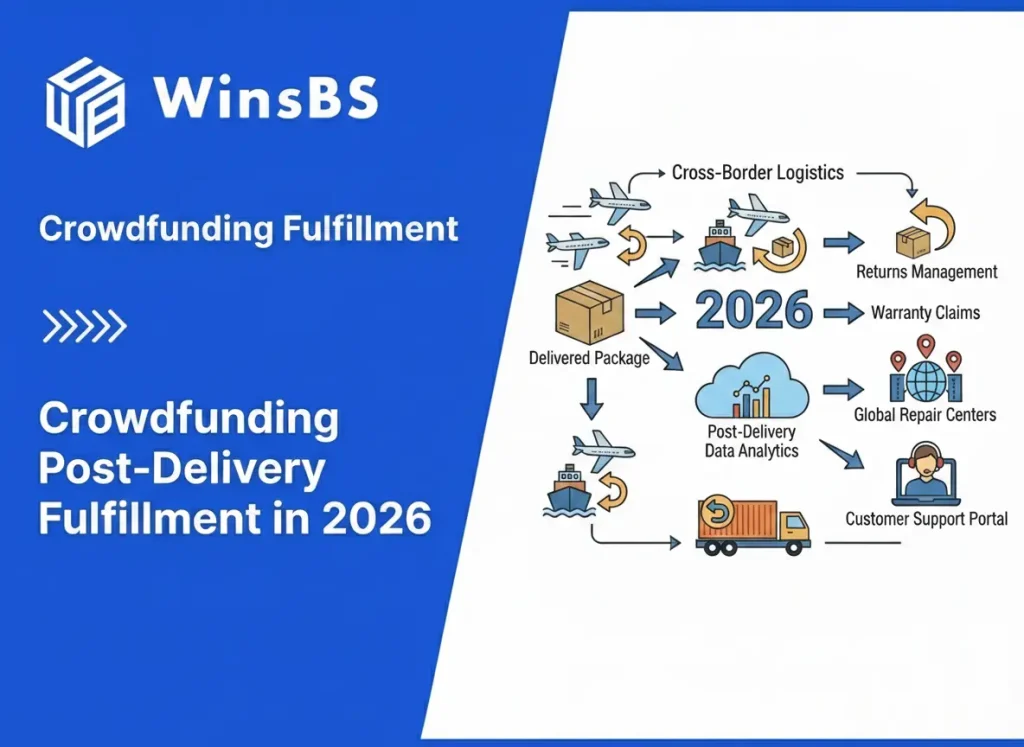
Crowdfunding Post-Delivery Fulfillment in 2026
The Second Fulfillment Cycle in Crowdfunding (2026) Post-delivery replacements, reships, inventory pressure & public visibility — optimized for US creators WinsBS Fulfillment — Maxwell Anderson Updated March 2026 · Crowdfunding Fulfillment · Post-Delivery Support · Reship & Replacement TL;DR: In physical-reward crowdfunding, fulfillment does not end when tracking shows Delivered. Most campaigns enter the Second Fulfillment Cycle — a structured post-delivery phase driven by replacements, reships, inventory buffer depletion, and public visibility pressure. Typical replacement rate: 1–3 %. The real impact depends on category-specific risks (tabletop bundles, electronics defects, beauty leakage, apparel sizing, etc.). This pillar guide + linked deep-dives gives US creators the complete framework. On this page You Finally Exhale — Then Support Starts Again A Reship Is a Decision — And Every Decision Has a Cost Inventory Planning Decides Whether Replacements Feel Manageable — or Chaotic Replacement Costs Rarely Mean “One More Label” — They Accumulate Public Visibility Changes the Pressure of Every Replacement Route Design Multiplier: How Fulfillment Architecture Amplifies or Compresses the Second Cycle Industry-Specific Second Fulfillment Cycle Challenges Controlled Closure: Turning the Second Cycle Into a Defined Phase A Practical Post-Delivery Checklist Before You Call It “Done” FAQ Methodology & Sources The Second Fulfillment Cycle Begins After “Delivered” Structural Definition — The Second Fulfillment Cycle In physical-reward crowdfunding, fulfillment does not end when tracking shows Delivered. Most campaigns enter what we define as the Second Fulfillment Cycle — a structured operational phase that begins after main-wave delivery and ends only when replacement demand stabilizes. Across campaign types, this phase is typically shaped by four recurring forces: Trigger Events: lost parcels, transit damage, incomplete tiers, late address changes Inventory Buffer Pressure: replacement allocation reducing remaining stock Cost Accumulation: shipping, duties, handling, and processing compounding quietly Public Visibility Amplification: comment threads accelerating perception risk Most creators believe fulfillment ends when the main wave ships. In practice, that moment marks a transition — not a conclusion. Pallets leave the warehouse. Orders are marked fulfilled. Tracking updates move steadily toward Delivered. Operationally, the hardest part appears finished. Then support begins again — not with mass refund demands, but with small, specific, and entirely normal edge cases. “Delivered — but nothing was at my door.” “The box arrived crushed.” “My pledge tier is missing one add-on.” “I moved after the survey — can you resend?” None of these represent campaign failure. They represent variance — and variance is structural in crowdfunding fulfillment. Each case usually requires a decision: allocate inventory, confirm the correction, generate a new shipping label, and send a replacement. That decision triggers inventory movement, cost exposure, and often public visibility. Platform-level research summarized in Kickstarter’s fulfillment analysis (with Professor Ethan Mollick’s research) shows that most projects do deliver. However, a measurable minority of backers experience delays, non-receipt, or fulfillment discrepancies. The structural implication is not high failure. It is predictable post-delivery variance. Put that into operational terms. If you shipped 8,000 rewards, even a conservative 1–3% post-delivery variance rate translates into 80–240 replacement cases. Each one requires inventory allocation, processing time, and additional shipping spend. On a 2,000-unit campaign, the same percentage still creates 20–60 reships — enough to materially impact remaining buffer stock if production matched pledge quantity exactly. Main-wave fulfillment ends when you ship. The Second Fulfillment Cycle ends when replacement demand stabilizes and buffer inventory remains intact. In crowdfunding, returns are rarely the defining operational burden. Replacement logistics are. If inventory and budget were planned only for the first wave, the second cycle does not appear as dramatic failure. It appears as scattered cost, fragmented workload, and increasing pressure as public comments surface unresolved cases. Pro Tip for US Creators: Treat the crowdfunding second fulfillment cycle as a budgeted 60–90 day operational phase from day one. This single mindset shift prevents 80% of the “surprise cost” complaints we see from first-time campaigners. 1. A Reship Is a Decision — And Every Decision Has a Cost When a backer writes in, it feels like support work. You read the message. You check the order. You verify the tracking. Then you face the real question: Do we send a replacement? That decision is simple emotionally. Of course you want to fix it. But operationally, it has consequences. Every reship touches three things: inventory, cash flow, and public trust. First, inventory. If you produced exactly what you pledged — no overage — every replacement comes out of the same limited pool. A missing add-on from a mid-tier pledge is not just “one small item.” It may be the last remaining unit in your buffer. Second, cash flow. Even when the product cost is already absorbed, the replacement still requires shipping spend. International parcels especially are not symbolic amounts. Multiply that by dozens of cases and the numbers stop feeling minor. Third, visibility. In ecommerce, a slow replacement can stay inside a private ticket. In crowdfunding, delays are often discussed in comment threads. Other backers read them. Patterns get noticed quickly. This is why replacements feel heavier in crowdfunding than in standard DTC operations. They are not just operational corrections — they are public signals. The most common real-world cases are rarely dramatic: A parcel marked delivered but not received. A corner impact that damages a collector’s box. An accessory missing from a multi-item pledge tier. An address change that came in one week too late. None of these suggest your campaign failed. But each one forces a choice: send now and absorb the cost, delay and investigate, or deny and risk reputation damage. At scale, even modest replacement rates accumulate. On a few thousand orders, a small percentage translates into dozens of real decisions — each touching inventory and budget. The main wave tests your logistics. The replacement phase tests your reserves. This is not where a campaign collapses. It’s where the real ongoing work begins. Pro Tip for US Creators: Treat every crowdfunding reship as a three-part decision (inventory + cash + visibility). Document the first 10 cases in a simple spreadsheet — you’ll