

Online Support
Typically replies within 5 minutes
Hello! How can we assist you today?

Warehousing

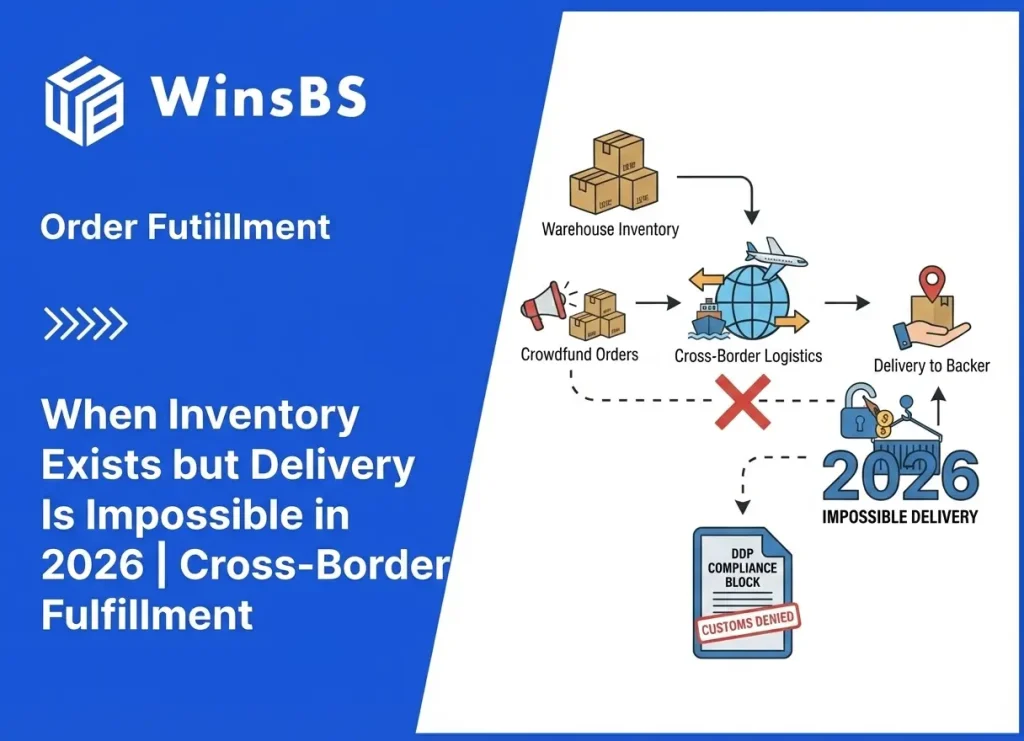
Logistics infographic banner beside WinsBS logo and title, showing warehouse inventory and crowdfunding orders blocked from cross-border logistics by compliance and customs restrictions, symbolizing order fulfillment challenges and cross-border fulfillment barriers in 2026.
Crowdfunding Fulfillment, Ecommerce, Order Fulfillment, Shipping & Logistics, Warehousing, Winsbs

When Inventory Exists but Delivery Is Impossible in 2026 | Cross-Border Fulfillment

When Inventory Exists but Delivery Is Impossible in 2026 Why “In Stock” Doesn’t Always Mean “Deliverable” in Cross-Border Fulfillment WinsBS Fulfillment — Maxwell Anderson Updated February 2026 · Cross-Border Fulfillment · DDP Shipping · Customs Clearance · Inventory Availability TL;DR: In 2026, many ecommerce sellers are facing a new reality: inventory can show in stock inside the warehouse, yet the shipment is blocked at the border. This often appears as a customs hold despite inventory availability or a DDP shipment blocked at border 2026. The reason is structural. Warehouse systems confirm physical availability. Customs clearance and carrier routing systems confirm legal admissibility and route eligibility. Since the Section 321 de minimis ended impact on ecommerce shipments in August 2025, more parcels now move through formal entry review in the United States. In the EU, the upcoming €3 customs duty on low value parcels (effective July 1, 2026) adds another validation layer. In Canada, full enforcement of CARM importer responsibility increases entry-level scrutiny. If you have not reviewed where warehouse control ends, see what fulfillment actually includes in 2026 . On this page 0. The Inventory Is Available. The Shipment Isn’t Moving. 1. Inventory Exists in One System — Delivery Is Decided in Another 2. The Three Status Layers: Physical, Legal, and Route 3. Why the Warehouse Cannot Fix a Customs or DDP Block 4. Same Inventory, Different Market — Different Customs Outcome 5. When Inventory Actually Becomes Deliverable in 2026 6. The Moment “In Stock” Stops Being the Right Question Methodology & Sources 0. The Inventory Is Available. The Shipment Isn’t Moving. You log into your fulfillment dashboard and see available inventory. Units were received, scanned, and stored correctly. Nothing is backordered. Nothing is out of stock. An order is placed. It moves through pick and pack. A shipping label is generated. Tracking activates. From an operational standpoint, the order has been fulfilled under your cross-border fulfillment workflow. Then the tracking status changes. Clearance delay Held at customs Importer information required Entry under review Undeliverable — return to sender At this stage, inventory is still accurate. The warehouse shows no processing error. DDP shipping may have been selected. Duties may have been prepaid. Yet the shipment is not moving. This is the scenario behind many searches such as “in stock but cannot deliver” or “customs hold despite inventory.” Sellers are discovering that inventory availability does not guarantee customs clearance once a parcel enters formal entry review. “In stock” is a warehouse status. “Deliverable” is determined later — at customs entry and route validation. The warehouse confirms possession. Customs authorities and carriers confirm permission. 1. Inventory Exists in One System — Delivery Is Decided in Another Most ecommerce operators assume that once inventory is available inside a fulfillment warehouse, delivery becomes a matter of transportation timing. If the warehouse can pick it and the carrier can scan it, shipment completion feels inevitable. That assumption increasingly breaks down in 2026. A warehouse management system (WMS) tracks physical control: units received, units stored, units allocated, and units shipped. It verifies inventory accuracy and confirms operational execution. Customs clearance systems evaluate something different: declared value, classification, importer identity, and compliance triggers. Carrier systems evaluate route eligibility, service-level compatibility, and automated risk flags. These systems do not share a single definition of “ready.” The warehouse defines ready as physically available. Customs defines ready as legally admissible. Carriers define ready as route-compatible. This structural separation became more visible after the Section 321 de minimis ended impact on ecommerce shipments in August 2025. As more U.S.-bound parcels shifted into formal entry, customs hold rates increased — even when inventory was correctly processed and DDP shipping was selected. If you want a deeper breakdown of where warehouse responsibility ends, review what fulfillment actually includes in 2026 . When sellers search for “why shipment stuck at customs 2026,” they are often encountering this separation between physical inventory status and entry-level validation systems. 2. The Three Status Layers: Physical, Legal, and Route To make “in stock but cannot deliver” situations predictable, separate the shipment into three statuses that operate independently in cross-border fulfillment: the warehouse status, the customs clearance status, and the carrier route status. The first is physical status. This is what your fulfillment warehouse and WMS can prove: units exist, were received, and can be picked, packed, and shipped. This is the layer that shows inventory availability. The second is legal status. This becomes visible at customs entry. Even when DDP shipping is selected, customs clearance can pause if the entry record requires validation of importer identity, classification, valuation, or other admissibility triggers. This is where “customs hold despite in stock” happens. The third is route status. Carriers apply route eligibility and service-level screening. A shipment can be physically shipped and still become undeliverable if the chosen route or service level is not permitted for that shipment profile. Physical availability does not guarantee customs clearance. Customs clearance does not guarantee route eligibility. Inventory vs Deliverability: Physical, Legal, Route Layers (2026) Diagram showing that inventory availability is confirmed by the warehouse, while deliverability depends on customs clearance and carrier route eligibility. PHYSICAL STATUS Fulfillment Warehouse / WMS • Inventory received & counted • “In stock” / available quantity • Pick / pack / label executed • Parcel tendered to carrier handoff LEGAL STATUS Customs Entry / Clearance • Importer identity validation • Classification / valuation review • Admissibility triggers • Holds can occur even under DDP release ROUTE Carrier Validation • Service-level rules • Route eligibility • Automated exceptions • “Undeliverable” Inventory availability lives in the warehouse layer — deliverability is decided by customs clearance and route eligibility. The three layers that create “customs hold despite in stock” outcomes: warehouse inventory availability, customs legal admissibility, and carrier route eligibility. Once you can name these three statuses, most “DDP shipment blocked at border 2026” cases stop looking random. The warehouse can be correct and complete, while customs clearance or carrier routing is still unresolved. 3. Why the Warehouse Cannot
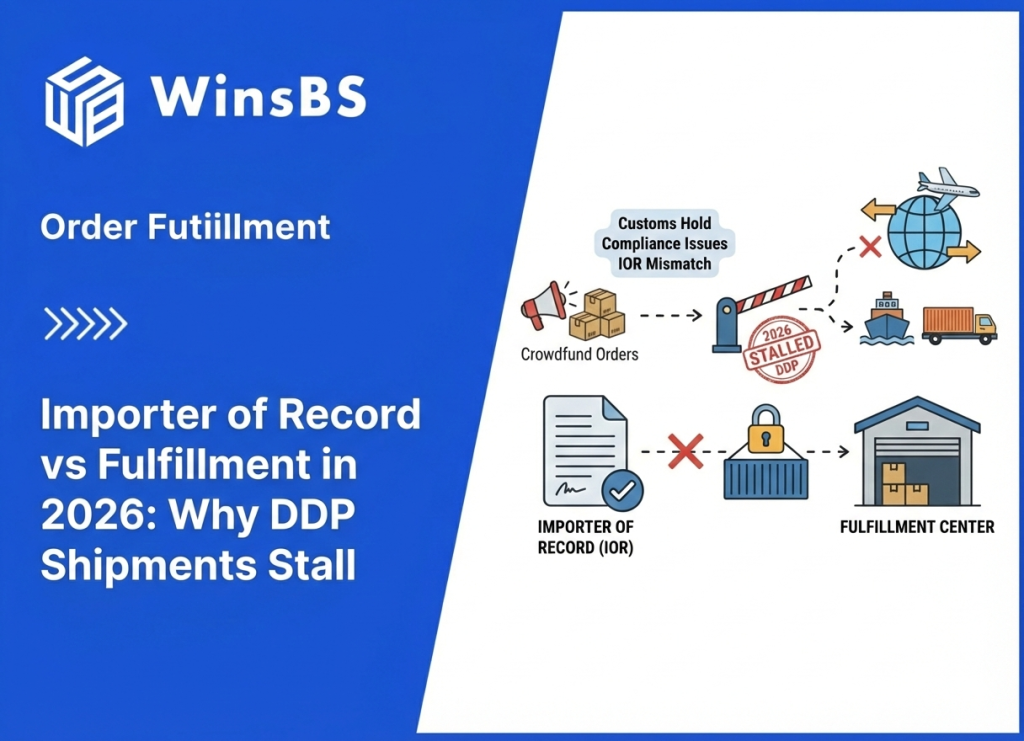
Logistics infographic beside WinsBS logo and title showing crowdfunding orders routed to a customs hold with a stalled DDP shipment stamp, illustrating importer of record mismatch and order fulfillment delays in cross-border 3PL fulfillment.
Crowdfunding Fulfillment, Ecommerce, Order Fulfillment, Shipping & Logistics, Warehousing, Winsbs

Importer of Record vs Fulfillment in 2026: Why DDP Shipments Stall

Importer of Record vs Fulfillment in 2026 Why DDP Shipments Stall at Customs After US De Minimis End, EU €3 Duty & Canada CARM WinsBS Fulfillment — Maxwell Anderson Updated February 2026 · Cross-Border Entry · Customs Clearance · DDP · Importer Liability Positioning note: This article continues the execution boundaries and responsibility splits documented in Order Fulfillment in 2026: What It Includes & Where It Stops , What Fulfillment Companies Are Not Responsible For (2026) , Where DDP Fulfillment Ends , and “Taxes Included” ≠ Import Guarantee (DDP VAT 2026) . It documents a repeatable 2025–2026 shift in cross-border execution: “DDP shipping” can still stall at customs when the entry record cannot validate a legally recognized importing entity. Confirmed system changes that increased importer validation frequency: CBP — E-Commerce FAQs (US, de minimis suspension effective Aug 29, 2025) , European Commission — €3 customs duty on low-value e-commerce packages from July 1, 2026 , and CBSA — CARM (Canada Assessment & Revenue Management) . You Shipped Correctly. Customs Still Asked Who the Importer Is. You did what any cross-border ecommerce seller would reasonably do. You paid the supplier. You moved inventory into a fulfillment warehouse. You confirmed carton markings and declared value. You selected DDP shipping to avoid delivery-time tax surprises. The warehouse executed normally. Inventory was received. Orders were picked and packed. A shipping label was generated. Electronic customs data was transmitted. Tracking went live. For several days, the shipment behaved like a normal international delivery. Then the status changed. Held at customs — pending importer clarification Clearance delay — importer information required Entry under review — declaration validation Nothing in your dashboard showed unpaid tax. Nothing in the warehouse workflow showed error. The carrier confirmed receipt. Yet customs clearance did not proceed. Because the customs system was no longer evaluating fulfillment execution. It was evaluating whether a legally accountable importing entity was recognized inside the entry declaration. Fulfillment moves goods. Customs releases goods only when a recognized importing party stands behind the declaration. If that legal layer was never configured — or cannot be validated at entry — shipment pauses. Fulfillment vs Customs vs Legal Import Layer 2026 Visual representation of fulfillment execution layer versus customs importer validation layer. FULFILLMENT Pick · Pack · Label DDP Shipping Data Transmission CUSTOMS ENTRY Declaration Review Importer Validation Liability Recognition HOLD Importer Not Recognized Structural separation in 2026: warehouse execution and importer validation occur in different system layers. 1. What Fulfillment Actually Completed — And Where It Stops When the shipment stalled, the first instinct was to look backward. Did the warehouse miss something? Was the commercial invoice incomplete? Did DDP not apply correctly? But look at what fulfillment had already completed. Inventory received and logged Order transmitted from ecommerce platform Pick and pack executed Shipping label generated Electronic customs data transmitted Parcel tendered and accepted by carrier From an operational standpoint, fulfillment execution ended successfully. What changed in 2025–2026 is not warehouse performance — it is customs entry behavior. On August 29, 2025, U.S. Customs and Border Protection suspended broad use of Section 321 de minimis treatment for many shipments, increasing the volume of parcels moving through formal entry channels. Formal entry requires a recognized importing party to be declared in the customs record. This shift increased the frequency of situations where warehouse execution completes normally — but clearance pauses at the legal validation layer. Public Case Example (U.S., 2025-2026) Following the issuance of Executive Order 14324, “Suspending Duty-Free De Minimis Treatment for All Countries,” U.S. Customs and Border Protection (CBP) initiated a systemic shift in how low-value ecommerce parcels are processed. By late 2025, trade reports from legal and logistics analysts confirmed that the $800 de minimis threshold—previously the backbone of direct-to-consumer fulfillment—effectively hit a “zero-tolerance” phase. This resulted in significant cargo holds at key entry points like Los Angeles (LAX) and New York (JFK), specifically targeting shipments where the legal “Importer of Record” was not clearly distinguished from the “Fulfillment Provider.” Source: White House — Executive Order on Suspending De Minimis Treatment . The warehouse did not change. The customs validation threshold did. Fulfillment completes physical movement. Customs entry requires validated legal accountability. Once the shipment enters formal review, fulfillment cannot supply that accountability if it was never declared in advance. 2. When Entry Systems Tighten, Legal Identity Becomes Visible The United States is not the only system that increased importer validation. In the European Union, customs reform scheduled for July 1, 2026 introduced a €3 fixed duty for parcels valued under €150 — including shipments where VAT was prepaid at checkout. Even when VAT is handled through IOSS, customs entry still evaluates the declared importing entity separately. Tax linkage and legal responsibility operate as different validation layers. If the declaration cannot validate the responsible importing party, clearance pauses — regardless of prepaid tax. Canada implemented a similar structural tightening through full rollout of the Canada Assessment and Revenue Management (CARM) system. Official reference: CBSA — CARM Registration . Under CARM, businesses acting as importers must register directly with CBSA. Without recognized registration status, entry validation cannot finalize. Public Case Example (EU, 2025–2026) Following increased enforcement of customs controls on low-value e-commerce imports (particularly from China via platforms like Temu and Shein), EU authorities reported widespread non-compliance issues, including inaccurate declarations, safety risks, and valuation mismatches. This led to a surge in parcel holds and clearance delays where importer data or entry records did not align properly. Reuters and the European Commission highlighted how tightened checks and the upcoming customs reforms have impacted direct-to-consumer shipments, with many low-value parcels facing additional scrutiny or holds due to declaration inconsistencies. Key Sources: Reuters — EU to tighten checks on cheap products from sites like Temu and Shein (Feb 2025) — Covers EU-wide customs operations prioritizing safety and compliance risks on e-commerce goods. European Commission — Large-scale EU customs control action shows most third-country e-commerce goods do not follow standards (Jan 2026) — Official report on non-compliance in billions

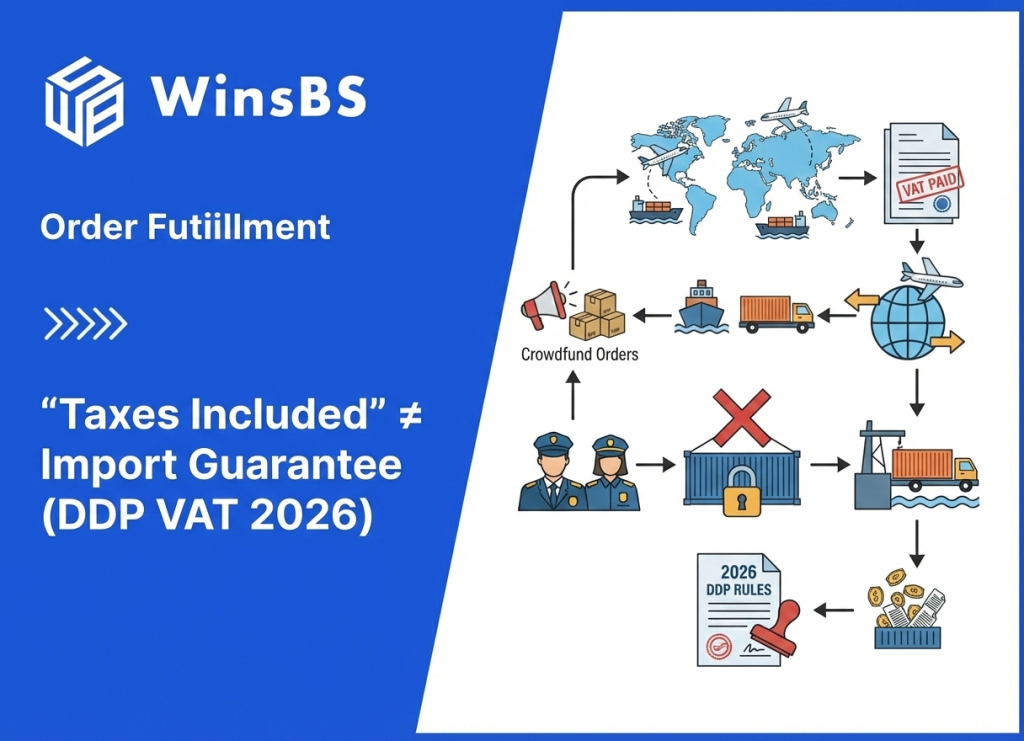
Cross-border logistics infographic beside WinsBS logo and title, showing VAT paid documents, global shipping routes, customs inspection, and a locked container symbolizing DDP order fulfillment risks and import compliance in crowdfunding fulfillment.
Crowdfunding Fulfillment, Ecommerce, Order Fulfillment, Shipping & Logistics, Warehousing, Winsbs

“Taxes Included” ≠ Import Guarantee (DDP VAT 2026)

“Taxes Included” ≠ Import Guarantee (DDP VAT 2026) Why VAT & GST Get Recalculated at EU, UK & Canada Borders WinsBS Fulfillment — Maxwell Anderson Updated February 2026 · Cross-Border DDP · VAT / GST · Customs Validation Positioning note: This article builds on the execution boundaries explained in Order Fulfillment in 2026: What It Includes & Where It Stops , What Fulfillment Companies Are Not Responsible For (2026) , and Where DDP Fulfillment Ends . It documents a repeatable cross-border scenario in 2026: VAT or GST is collected at checkout — yet import tax is requested again at entry in the EU, UK, or Canada. Contents 0. The Parcel Arrived. The Tax Bill Arrived Too. 1. The Order That Looked Fully Settled 2. Where the Recalculation Actually Begins 3. Why the 3PL Cannot Repair This Stage 4. Route Differences: EU, UK, Canada, US 5. 2026 Confirmed Validation Variables 6. When the Buyer Says, “But I Already Paid” 0. The Parcel Arrived. The Tax Bill Arrived Too. The shipment was sent under DDP. At checkout, your buyer saw “taxes included.” The order total already reflected VAT or GST. No additional fee was expected at delivery. The warehouse packed the order. A label was generated. Tracking went live. For several days, everything moved normally. Then one of two things happened. If the parcel was entering the UK, Royal Mail sent a payment request before delivery. If it entered Canada, the courier issued a GST collection notice. If it entered parts of the EU, the parcel paused in customs with VAT under review. The buyer forwarded the message to you. “I thought tax was included.” From your side, it was. The dashboard shows prepaid shipping. The invoice shows tax collected. Nothing is marked unpaid. But the import system is not looking at your checkout page. It is evaluating the parcel as it enters the country. This is the moment where the logic breaks: You paid the tax at sale. The import system is calculating tax at entry. Both are real. They are not the same system. This article starts from that split. 1. The Order That Looked Fully Settled The order was simple. A €120 skincare device shipped from Shenzhen to Germany under a DDP cross-border fulfillment structure. VAT was calculated at checkout. The buyer paid €142.80 in total, including 19% VAT. On your dashboard, the order showed: Product value: €120 VAT collected at checkout: €22.80 Shipping: prepaid (DDP) Status: paid The fulfillment system received that order exactly as shown. The warehouse picked the unit. A DDP shipping label was generated. Electronic customs declaration data was transmitted with: Declared value: €120 HS code attached for EU import classification Sender: your entity Importer: auto-assigned under the shipping structure The parcel left the warehouse. Up to this point, every number matched. The VAT collected at checkout matched the invoice. The invoice matched the shipment record. Nothing was missing from the fulfillment side. Three days later, the parcel reached the EU entry point. Now the EU import system evaluated the parcel independently as an import declaration, not as a checkout transaction. It did not look at the Shopify checkout page. It did not see the buyer-facing “tax included” confirmation. It evaluated: Is there a valid VAT or IOSS linkage inside the entry data? Does the importer registration match the declared responsible party? Is the declared goods value consistent with EU entry thresholds? If any of those elements do not reconcile inside that customs validation system, the parcel is treated as taxable at entry — regardless of what was paid at sale. That is the split. At checkout, VAT was a pricing component. At EU border entry, VAT becomes a compliance validation event. Those two events reference the same amount. They do not share the same verification logic. And that structural separation between checkout tax collection and import tax validation only becomes visible when the parcel reaches the border. 2. Where the Recalculation Actually Begins Three days after dispatch, the parcel reaches the EU entry hub. At that moment, the shipment is no longer treated as an order. It is treated as an import declaration under EU customs validation. The system now checks whether the VAT that was collected at sale is properly linked inside the electronic entry data. For the €120 device shipped from China to Germany, one of four recurring validation triggers typically initiates re-evaluation. 1) VAT or IOSS linkage mismatch If an IOSS number was used for EU VAT-at-sale collection, it must be correctly attached to the customs declaration and match the declared goods value. If the number is missing, expired, misformatted, or not recognized inside the EU import dataset, the system does not assume VAT was paid at checkout. It calculates VAT again at entry. 2) Importer identity inconsistency The checkout invoice lists your company as seller. The EU entry declaration may list a different acting importer depending on the DDP routing structure. If those identities do not reconcile inside the customs validation system, VAT is not considered validated. The parcel pauses for tax assessment. 3) Value structure difference between sale and entry Checkout total: €142.80 (goods + VAT). Declared import value: €120 (goods only). The EU customs system evaluates the declared goods value, not the buyer-facing checkout total. If VAT linkage does not successfully validate against that declared value, VAT is recalculated against €120 at entry. 4) Multi-parcel split creating independent entry records If the shipment was operationally split into two parcels for routing efficiency, each parcel is evaluated independently at EU entry. If one parcel crosses a validation threshold differently, or loses IOSS linkage in data transmission, it may fall outside the prepaid VAT structure. One parcel clears normally. The other enters VAT reassessment. At this stage, the EU import system is not “charging twice.” It is performing its own tax validation cycle based on the customs declaration record. And once that validation cycle begins, the checkout record is no longer relevant to the import decision. In standard cross-border

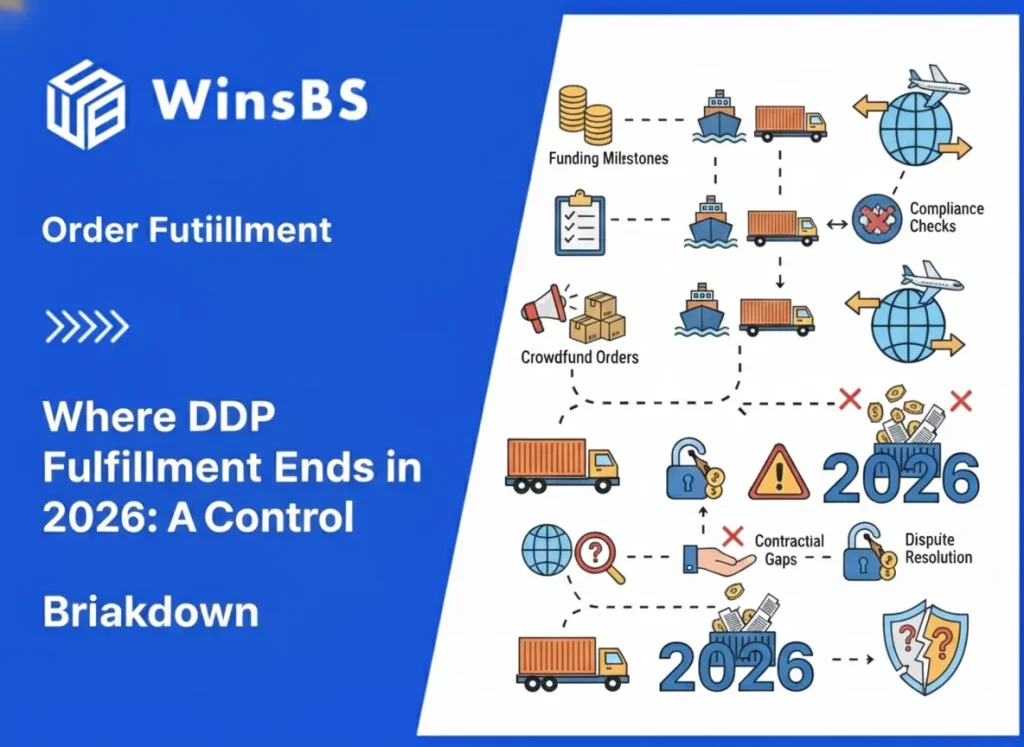
Cross-border logistics and crowdfunding fulfillment infographic beside WinsBS logo and title, showing ships, cargo planes, trucks, and global delivery icons illustrating where DDP fulfillment control ends in 2026 and the order fulfillment process.
Crowdfunding Fulfillment, Ecommerce, Order Fulfillment, Shipping & Logistics, Warehousing, Winsbs

Where DDP Fulfillment Ends in 2026: A Control Breakdown

Where DDP Fulfillment Fails A Stage-by-Stage Breakdown of Where Control Actually Ends (2026) WinsBS Fulfillment — Maxwell Anderson Updated February 2026 Positioning note: This article does not explain what DDP is. It documents a single, repeatable fulfillment moment in 2026: DDP finishes its role — and the shipment continues into a system it does not control. Contents 0. When Everything Looked Done — and Then Nothing Moved 1. What DDP Has Already Finished — Before You Start Looking for Answers 2. When the Flow Stops Responding — Even Though Nothing Is Broken 3. What Happens When You Go Back to the Fulfillment Provider 4. The Stage Where DDP Stops Deciding Anything 5. When DDP Changes the Experience — and When It Doesn’t Change the Outcome 6. Returning to the Moment You Realized Nothing Else Would Move Methodology & Sources — WinsBS Research 0. When Everything Looked Done — and Then Nothing Moved By the time this problem shows up, you have already done the reasonable thing. You didn’t cut corners. You didn’t improvise. You selected DDP, accepted “taxes included,” and paid in full. From your perspective, the risky parts were handled up front. There should be no surprise charges, no doorstep friction, no last-minute decisions left unresolved. And for a while, everything confirms that assumption. Orders are packed. Labels are generated. Tracking numbers appear. The warehouse shows the work as complete. The carrier accepts the shipment. Nothing in the dashboard signals a problem. Then progress stops. Not with an error message. Not with a rejection notice. Just… no movement. At first, this feels like a normal delay. You wait, because waiting still makes sense. Nothing looks broken enough to act on. When waiting turns into checking, the confusion begins. You refresh tracking. You compare it to other shipments. You look for an exception code, a missing scan, any clue that explains the pause. There isn’t one. So you go back one step. You open the fulfillment dashboard again. Everything there looks finished. Orders are closed. Tasks are completed. There is no pending action to click into. This is the moment that feels wrong. If the shipment exists, and shipping has already started, there should still be a way to move it forward. You don’t feel like something failed. You feel like something should still be working — and isn’t. That assumption is what creates the stall. Not because you missed a step, but because the part of the system you are trying to push has already stopped responding. This page starts from that exact moment — the moment where everything looks complete, and yet nothing you do seems to matter anymore. 1. What DDP Has Already Finished — Before You Start Looking for Answers By the time the stall becomes obvious, DDP is no longer doing anything in the background. That sounds counter-intuitive, because from your side, everything that DDP promised seems to have happened. You saw the payment go through. You saw “taxes included” at checkout. You saw shipping proceed without any doorstep charges. Those are not illusions. They are confirmations that DDP has already completed the part of the flow it controls. Money has been collected and allocated. The shipment has been labeled and routed under a prepaid structure. The carrier accepted the handoff on that basis. This is why the dashboards feel calm. There is no unpaid balance, no missing fee, no billing exception waiting to be resolved. From a usage perspective, DDP looks “done” because it is. What it does not do — and never shows you — is stay attached as an active lever. There is no background process where DDP keeps checking whether the shipment is moving. There is no status where prepaid shipping can be re-applied to unlock the next step. Once payment and routing are complete, DDP leaves the flow quietly. What follows still looks like shipping. Tracking updates may appear. The parcel may move between nodes. But those movements no longer respond to how shipping was paid for. This is the first mismatch most creators run into. From your perspective, the condition that should enable progress — payment — has already been satisfied. From the system’s perspective, that condition has already been consumed. This is the same boundary described earlier in Order Fulfillment in 2026: What It Includes (and What It Doesn’t) and What Fulfillment Companies Are Not Responsible For (2026) : execution finishes cleanly, and the shipment continues into a stage that no longer reacts to execution signals. Nothing is wrong with the payment. Nothing is missing from the shipment. The confusion starts because you are still trying to push a lever that has already disengaged. 2. When the Flow Stops Responding — Even Though Nothing Is Broken After DDP has finished its part, the shipment does not stop immediately. That is what makes this stage difficult to recognize. For a while, things still move. Tracking updates may appear. The parcel may pass through one or two nodes. Carrier status changes at least once. From the outside, this looks like normal transit. There is no clear signal telling you that anything has changed. Then the movement slows. Not into an error. Not into a failed state. Just into stillness. At this point, most creators do what they have done successfully before: they try to trigger progress through action. They wait a bit longer. They refresh tracking more frequently. They compare this shipment to others that are still moving. When that does not work, they try intervention. They ask whether something is missing. They ask whether a document needs to be re-uploaded. They ask whether the shipment can be “re-processed” or “pushed.” Nothing changes. Not because the questions are wrong, but because the flow you are now watching does not react to those inputs. This is the first practical sign that the role of the system has shifted. Earlier, progress followed execution. Doing something — packing faster, paying earlier, resubmitting information — produced a visible effect. Here, action no longer

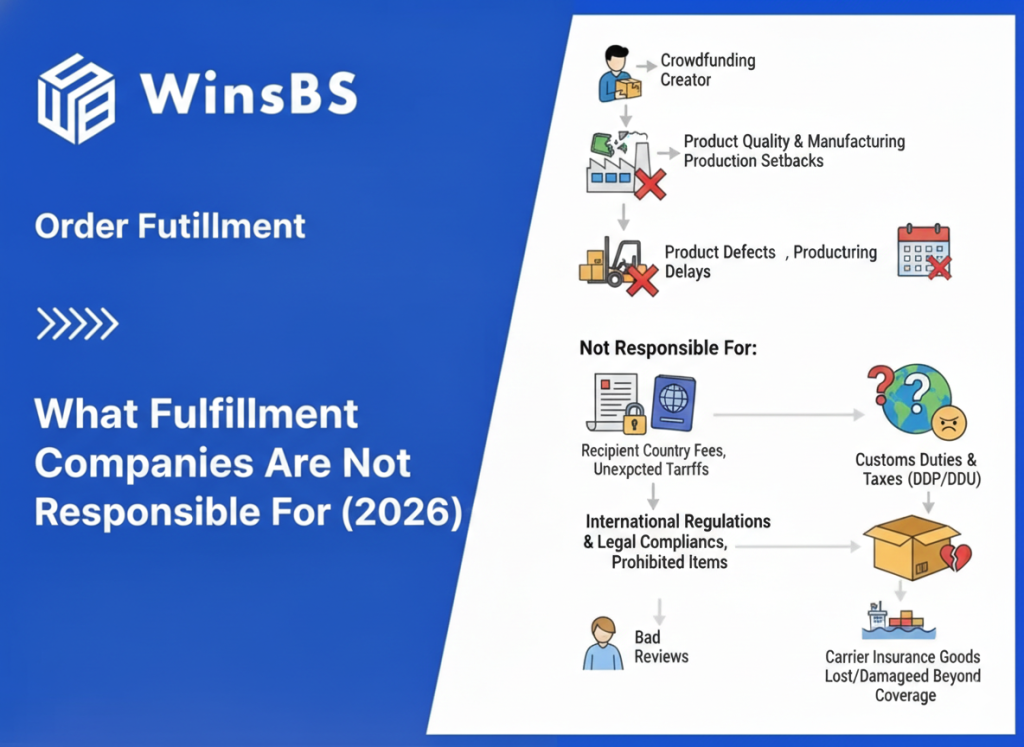
Crowdfunding fulfillment responsibility chart beside WinsBS logo and title, illustrating what 3PL order fulfillment companies are not responsible for, including production delays, customs duties, international regulations, and post-delivery reviews.
Crowdfunding Fulfillment, Ecommerce, Order Fulfillment, Shipping & Logistics, Warehousing, Winsbs

What Fulfillment Companies Are Not Responsible For (2026)

What Fulfillment Companies Are Not Responsible For: Why “We Paid the 3PL” Still Doesn’t Move Accountability (2026) WinsBS Fulfillment — Maxwell Anderson Updated February 2026 Positioning note: This page is not a “what 3PLs do” explainer. It documents a single recurring fulfillment moment in 2026: warehouse execution is finished, the shipment stops advancing, and responsibility still points back to the creator. Contents 0. When Fulfillment Closed — and Responsibility Didn’t Move 1. What Fulfillment Companies Are Actually Contracted to Do 2. Where the System Stops Treating Fulfillment as the Decision Maker 3. Why Responsibility Defaults Back to You — Even After You Paid a 3PL 4. Capability Is Not Responsibility — and Never Was 5. When Expecting Fulfillment to Carry Responsibility Stops Making Sense 6. Where This Leaves You — and Why It Keeps Repeating Methodology & Sources — WinsBS Research 0. When Fulfillment Closed — and Responsibility Didn’t Move With It By the time this question comes up, most creators already understand what happened operationally. The warehouse finished its work. Orders were packed. Labels were generated. Shipments entered the network. This is the same moment described in Order Fulfillment in 2026: What It Includes (and What It Doesn’t) — the point where fulfillment closes its checklist, but the shipment stops advancing for reasons unrelated to warehouse execution. What follows is not confusion about what failed. It’s confusion about who the system is now waiting on. From the creator’s perspective, the logic feels straightforward: a fulfillment provider was paid, the work was completed, and shipping moved forward. So when questions surface later — about value, documentation, or shipment structure — the instinctive response is to turn back to the 3PL. That’s when the disconnect becomes visible. Support replies arrive quickly, but they don’t escalate. There is no “next step” inside the fulfillment dashboard. The answer is always some variation of: this is outside our scope. At this point, most creators aren’t disputing the process anymore. They’re disputing the outcome: if fulfillment execution is finished, why does responsibility still point back to them? This article exists to answer only that question — not by revisiting how fulfillment works, but by clarifying where responsibility was never transferred in the first place. 1. What Fulfillment Companies Are Actually Contracted to Do Once fulfillment closes its operational checklist, the system doesn’t become ambiguous. It becomes specific. The shift that catches creators off guard isn’t procedural — it’s contractual. Fulfillment companies are engaged to perform a defined set of actions, not to guarantee downstream outcomes. Those actions are concrete, measurable, and confined to execution inside the fulfillment environment. In practice, that scope looks like this: receiving and checking inventory into the warehouse storing units under agreed handling conditions picking, packing, and labeling orders generating shipping labels and handoff records tendering parcels into the carrier network Every one of these steps can be verified. They either happened or they didn’t. Once they have happened, the fulfillment provider’s obligation is considered complete in formal terms. There is no pending responsibility waiting to activate later. This is where many creators assume there must be a hidden second layer — some implied continuation of responsibility once shipping begins. There isn’t. Fulfillment contracts are written around execution boundaries, not around shipment admissibility or post-handoff decisions. The provider is responsible for doing the work correctly, not for what happens when the shipment is later evaluated by external systems. That distinction is easy to miss because, operationally, everything still looks connected: tracking updates, carriers scan, and parcels keep moving. From a contractual standpoint, it isn’t one continuous responsibility chain. The fulfillment agreement closes when warehouse execution ends. What follows may still involve shipping, but it no longer involves the same responsibility structure. This is why fulfillment providers can confirm that all required actions were completed — and still have no authority to respond when questions surface later. Understanding this boundary breaks a common business assumption: paying for execution transfers accountability for outcomes. In fulfillment, it doesn’t. 2. Where the System Stops Treating Fulfillment as the Decision Maker The moment fulfillment closes its part, the shipment doesn’t enter a gray area. It enters a different decision framework. Up to this point, progress responds to execution. If something is wrong, it can be fixed. If something is missing, it can be added. If something slows down, more effort often restores movement. That logic ends when fulfillment finishes. What replaces it is not another operational checklist, but an evaluation phase that no longer measures effort or quality of execution. It measures whether the shipment can proceed exactly as it is. This is where creators often feel the system has gone silent. There is no error message. No failed task. No actionable alert inside the fulfillment dashboard. Internally, the system has stopped asking whether the order was fulfilled correctly. It is asking whether the shipment qualifies to move forward without changes. That question does not belong to fulfillment. Once a shipment is being evaluated beyond warehouse execution, fulfillment providers no longer have the authority to adjust inputs, reinterpret details, or reframe how the shipment is presented. They cannot revise structure mid-stream. They cannot substitute responsibility. They cannot respond on behalf of another party when the shipment is questioned. At this point, continuing to escalate within the fulfillment relationship produces no result — not because the provider is unwilling, but because the system is no longer listening to them. This is why responses start to sound repetitive: “We’ve completed our scope.” “There’s nothing further we can do on our end.” “This is outside our responsibility.” Those statements are signals that the decision-making layer has moved elsewhere. From the creator’s perspective, it feels like abandonment. From the system’s perspective, the correct party is now expected to answer. Responsibility doesn’t follow the boxes. It remains anchored to a role that fulfillment execution never included — and once the system reaches that point, no amount of warehouse performance can substitute for it. 3. Why Responsibility Defaults Back to You

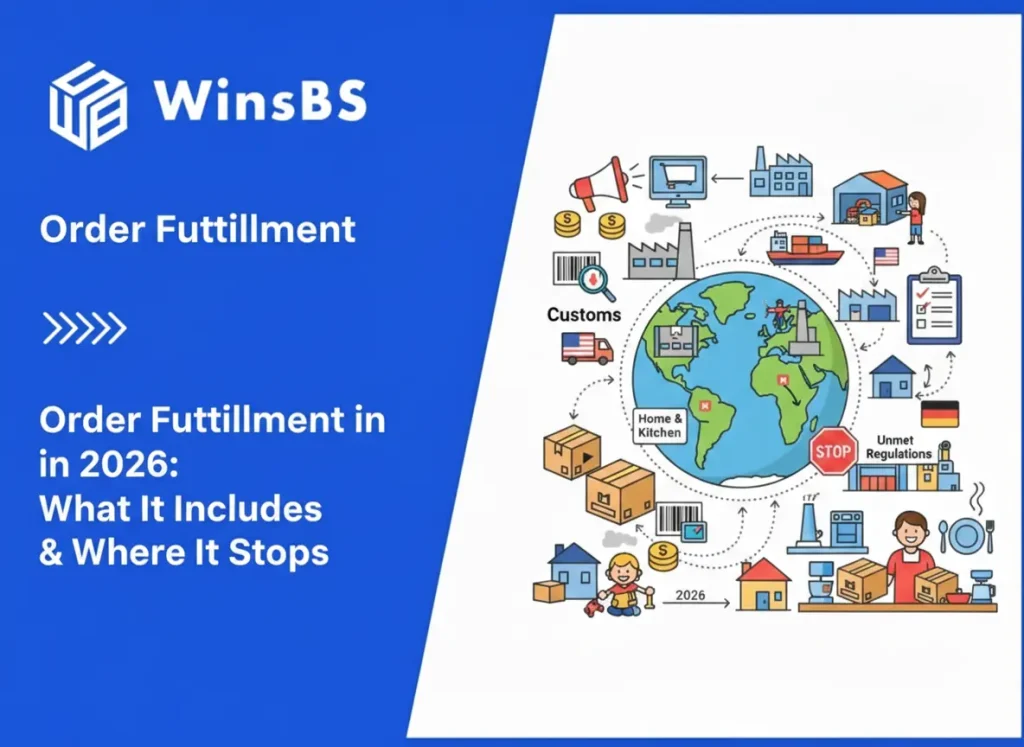
Global supply chain illustration with cargo ships, trucks, warehouses, customs checkpoints, and international flags beside WinsBS logo and title, symbolizing global order fulfillment and cross-border 3PL fulfillment services.
Crowdfunding Fulfillment, Ecommerce, Order Fulfillment, Shipping & Logistics, Warehousing, Winsbs

Order Fulfillment in 2026: What It Includes & Where It Stops

Order Fulfillment in 2026: What It Includes (and What It Doesn’t) WinsBS Fulfillment — Maxwell Anderson Updated February 2026 Positioning note: Order fulfillment remains operationally mature in 2026. Its limits appear not in warehousing or shipping, but in cross-border and DDP scenarios where customs clearance becomes the first hard boundary. A fully executed fulfillment floor — inventory received, orders packed, and parcels staged for outbound movement. This is the point where most teams assume uncertainty is behind them. Contents 0. When Everything Looked Finished 1. What “Fulfilled” Actually Meant 2. Where Outcomes Stop Following Fulfillment 3. Why This Comes Back to You 4. Why This Got Harder After 2025 5. What Keeps Applying Pressure in 2026 6. Where This Leaves You 0. When Everything Looked Finished — and Nothing Moved By the time most creators reach this point, the work already feels complete. The campaign closed. Funds settled. Inventory arrived. Orders were packed. Labels printed. Tracking sent. None of that is assumed. Those steps really happened. In most shipping contexts, this is where uncertainty fades. Not because delivery is instant, but because what remains is procedural. Movement continues. Problems, if they appear, surface later — at the door, on an invoice, or in customer support. That expectation is learned. In domestic shipping, and in many cross-border flows for years, this was the moment when things stopped going backward. Delays were possible. Reversals were not. So when progress slows here, it feels wrong. Tracking still updates. Nothing shows as “exception.” The warehouse confirms completion. The carrier confirms pickup. Yet nothing advances. Days pass without a status change that explains anything. Replies arrive, but answers don’t. Backers don’t accuse — they ask whether this is normal. You refresh the dashboard, expecting to find a switch you missed. There isn’t one. At this point, most creators assume something failed earlier. A packing error. A missed scan. A warehouse mistake. A carrier issue. Those assumptions are reasonable. Until now, outcomes followed execution. What’s actually happening is quieter. The shipment hasn’t failed. Nothing has “broken.” It has entered a part of the journey where progress is no longer decided by how well fulfillment was done — and no one tells you when that transition occurs. From your perspective, this still looks like shipping. From the system’s perspective, it isn’t. 1. What “Fulfilled” Actually Meant — in the System, Not in Your Head Fulfillment outcomes are shaped long before inventory reaches a warehouse. Documentation, unit structure, and compliance decisions begin at the factory level. In practice, order fulfillment refers to warehouse execution — receiving inventory, picking and packing orders, and handing shipments into the carrier network. When creators say an order was “fulfilled,” they’re usually referring to something concrete. Inventory arrived. It was checked in. Orders were picked and packed. Labels printed. Boxes left the building. That work was real. And it was completed. Where confusion starts is assuming that “fulfilled” is a global milestone. It isn’t. It’s a local one. It means the warehouse finished its responsibility. It means the fulfillment system closed its checklist. It does not mean the shipment finished being evaluated. From your side, the process still feels continuous. You don’t experience stages. You experience momentum: money in, product out, boxes moving. The system doesn’t see it that way. Fulfillment exists to answer one question well: Was this order executed correctly? Once the answer is yes, the system moves on. What follows is not an extension of fulfillment. It’s a handoff. And handoffs are where assumptions matter. Up to this point, outcomes track effort. If something slows, you fix it. If something goes wrong, you correct it. After fulfillment closes its part, that relationship weakens. Not because anything failed. But because the question being asked has changed. The system is no longer checking execution. It’s evaluating the shipment as an entry. That shift comes without an alert. Nothing in your dashboard says you’re now in a different decision framework. So creators keep pulling the same levers — re-checking packing, asking the 3PL to confirm details, hunting for a missed scan. Those actions make sense. Until they don’t work. At this stage, effort no longer restarts movement. Because effort is no longer what’s being measured. This is the first point where the intuition — if fulfillment was done right, delivery will follow — stops matching reality. Not because fulfillment failed. But because fulfillment already finished. 2. Where the Outcome Stops Following Fulfillment There is a point in every cross-border shipment where effort stops producing movement. Up to that point, progress responds to execution. If something slows, you fix it. If something breaks, you correct it. Then the relationship ends. Not gradually. Not with a warning. From the outside, everything still looks normal. Tracking updates. Statuses stay neutral. The box keeps moving. Internally, the shipment has crossed into a different decision path. It is no longer being processed as cargo in transit. It is being evaluated as an entry. That distinction is the first hard boundary fulfillment cannot cross. Before this point, mistakes are operational. After it, they are structural. The question being asked is no longer whether the order was executed correctly. It becomes whether the shipment qualifies to move forward exactly as it arrived. Speed doesn’t matter here. Efficiency doesn’t help. Past shipments are irrelevant. Once evaluation begins, progress is no longer linear. You can’t push it through with tickets. You can’t repack your way out of it. You can’t ship faster next time and fix this one. This is why the pause feels so disorienting. From your perspective, the work is already done. From the system’s perspective, the deciding step has only just begun. And because that step does not belong to fulfillment, it doesn’t appear where creators expect to see it. This is where good fulfillment guarantees delivery stops working. Not because fulfillment failed. But because fulfillment is no longer the system making the decision. 3. Why This Always Comes Back to You — Even After You Paid a

Map of the United States with WinsBS 3PL warehouses, 30-day free storage, $0.80 flat-rate fulfillment, and nationwide delivery icons, representing flexible eCommerce 3PL fulfillment and order fulfillment services for SMBs in 2025.
Ecommerce, Order Fulfillment, Warehousing

3PL for SMBs in 2025 — $0.50 Core Fulfillment Fee, Free 30-Day Storage, and Warehouse Flex You Actually Control

3PL for SMBs in 2025 — $0.50 Core Fulfillment Fee, Free 30-Day Storage, and Warehouse Flex You Actually Control WinsBS Fulfillment Research Team – Maxwell Anderson October 2025 Executive Summary Overview: Real Warehouse Control for U.S. SMBs in 2025 If you’re running a U.S. e-commerce business making under $500K a year, choosing a fulfillment setup shouldn’t feel like a gamble between “too big” or “too stuck.” Most 3PLs push small brands into rigid plans—multi-warehouse setups that bleed cash or single-site options that crush margins with long-zone shipping. At WinsBS, we hand control back to you. Pick your site — Beaverton (West), Dallas (Central), or Carteret (East). Go single or multi; test, scale, or stop anytime. Every order ships at a flat $0.80 for core pick, pack, duties, and labeling (shipping separate). Plus, your first 30 days of storage are on us. We’ve helped 300+ SMBs like crowdfunded D2C startups cut fulfillment costs 25–30% and hit 80–85% 3-day nationwide delivery, based on USPS and UPS ground zone analysis. Core Findings: Why Flexibility Wins Cost Clarity: Traditional single-site adds $15K–$20K/year in cross-zone shipping; multi-site piles on $200–$500 per transfer and 30%+ idle space. WinsBS eliminates both — all coordination priced at single-site rates. Operational Control: You set inventory rules via live dashboard — safety buffers, split logic, routing preferences. Stockouts under 3%; misroutes under 1%. Risk-Free Testing: 30-day free storage + no-code Shopify/Amazon API sync = live in 14 days. Run 100 test orders, validate speed and accuracy, walk away if it’s not right. Real SMB Wins: Nesugar : Scaled from single-site to multi-warehouse, cutting logistics costs 34% and boosting accuracy to 99.7%. Read full case study Weber’s : Cut fulfillment costs 31% and achieved 2-day delivery with 98.5% accuracy using optimized single-site routing. Read full case study This isn’t theory — it’s a proven system built for how real SMBs operate: lean, agile, and allergic to lock-ins. Key Recommendations: Start Smart, Scale Confidently Week 1: Submit inquiry with “requesting incentives” — unlock free 30-day storage, 10–20% off transfers, and a no-cost Fulfillment Checkup Report (5-minute output). Week 2: Pick your model — single-site for regional focus, multi-site with data-assisted allocation for national reach. Adjust splits manually until it fits. Week 3: Go live with zero-code integration. Test 100 orders. Scale or stop — your call. Expected ROI: SMBs using WinsBS typically save $10K–$40K annually in fulfillment waste, gain 15–20% faster inventory velocity, and improve customer retention through reliable 3-day delivery. Why Traditional 3PLs Hurt SMB Margins Running lean means every dollar counts, but old-school 3PLs’ stiff rules pile on costs and headaches. These three issues stand out: Cross-Zone Shipping Eating into Margins with Single Sites: Locking into one warehouse sends distant orders via pricey USPS Zone 6+ lanes. A 10kg box from Dallas to Miami? That’s 30-40% more than local rates—tacking on $15K-$20K a year for 10K orders, or basically wiping out a couple months’ profit. Unused Space Draining Cash in Multi-Site Plans: Getting pushed into coastal warehouses often leaves one sitting idle at 30%+ vacancy. With national averages hitting $9.12 per sq ft in 2025, you’re out $2,500 monthly, and closing one triggers penalties. No Say in the Details, No Peace of Mind: Providers call the shots on stock splits and routing by hand, with updates lagging 24 hours and stockouts over 8%. An outdoor gear SMB we know lost $30K-$40K in Black Friday buzz from a single-site glitch. Fees That Add Up Quietly: Customs snags cost $200-$400 per container; returns drag 5-7 days with just 45% resale value. Transfers between sites run $200-$500 a pop, locking $10K-$15K quarterly that could stock your top sellers. Key Takeaway: Most SMBs bleed money not from volume, but from lack of control and hidden markups. Keep It Lean: Smart Single-Site Fulfillment at $0.80 How to Lower SMB Fulfillment Costs with One Warehouse Got 30 or fewer SKUs and customers mostly on one coast or the middle? Single-site keeps things simple and cheap—but skip the basic versions. Our data-driven single-site option squeezes out max value without the downsides. Traditional Single-Site Issue WinsBS Flexible Single-Site Fix Cross-zone costs up 30-40% ZIP-based routing picks the best path; Beaverton to Rockies drops from $1.20 to $0.80 per order, still 3-day delivery. Stockouts over 8% Live dashboard for setting your own buffers (like daily sales x3 plus 20% extra); alerts hit 99.7% accuracy, keeping stockouts under 3%. Sneaky add-ons DDP (Delivered Duty Paid) folds duties into the $0.80 rate, exceptions under 3%; 24-hour returns check lifts resale to 70%, netting $250-$300 extra per 100 orders. Labeling and basic polybagging included—no surprises. Quick Case: Weber Weber is a family-owned outdoor brand specializing in durable camping essentials like lightweight tents, portable stoves, and hiking backpacks for weekend adventurers, was shipping 400+ units monthly from a single West Coast warehouse. Cross-zone fees to East Coast customers ate 28% of margins, with stockouts hitting 9% during summer peaks. Switching to our Beaverton single-site: Free 30 days saved $700 on initial storage; incentives trimmed transfer costs by $350. Optimized routing cut shipping premiums $2.5K-$3.5K yearly; returns processing added $1.8K back via 68% resale rate. Real-time dashboard kept inventory synced—no misses on tent kits, boosting repeat orders 18% from satisfied campers. Key Takeaway: For most SMBs under $500K revenue, start single-site—test, learn, and scale later. Nationwide in 3 Days—Without Paying Multi-Site Premiums Nationwide 3-Day Delivery Without Paying Multi-Warehouse Premiums More than 50 SKUs and eyeing the whole U.S.? Multi-site gets you speed as a real edge—but not if it means stacking sites and fees. Our coordinated multi-site lets you set the rules; we run it smooth, priced like single-site. Traditional Multi-Site Issue WinsBS Flexible Multi-Site Fix Vacancy over 30% Data-driven allocation tool crunches your SKU sales and buyer ZIPs for a quick plan: Hot A-items over three sites, slow C-items in Dallas—redundancy under 5%, no extra space needed. $200-$500 per transfer No added cost for moves; electric trucks trim 30%, incentives drop another 10-20%—we shifted 100K Black Friday units free. 5% wrong shipments

Warehouse exterior with multiple trucks beside WinsBS logo and blog title, symbolizing 3PL fulfillment, US warehouse network, and order fulfillment services.
Ecommerce, Order Fulfillment, Warehousing

3PL Fulfillment: Do You Need Many Warehouses in the US?

Does a 3PL Really Need Many Warehouses Across the US in 2025? Why More Warehouses Often Slow Ecommerce Fulfillment Instead of Improving It Updated December 2025 · US Ecommerce Fulfillment TL;DR In 2025, the performance of a 3PL fulfillment provider is no longer determined by how many warehouse order fulfillment centers appear on a map. For most ecommerce fulfillment services and crowdfunding brands, excessive warehouse count introduces inventory fragmentation, routing errors, higher storage fees, and slower exception handling. High-performing order fulfillment companies focus instead on inventory truth, execution speed, and system coordination. WinsBS operates a deliberately lean U.S. warehouse network because fewer, well-engineered fulfillment centers consistently outperform sprawling networks. Contents Why “More Warehouses” Became a Marketing Myth What Merchants Actually Pay for in 3PL Fulfillment Inventory Fragmentation: The Hidden Cost of Multi-Warehouse Models Speed vs. Distance: What Really Determines Delivery Time Why WinsBS Uses Fewer US Fulfillment Centers When More Warehouses Do Make Sense WHY “MORE WAREHOUSES” BECAME A MARKETING MYTH In the last decade, many 3PL fulfillment providers promoted warehouse count as a proxy for capability. Sales pages proudly advertise “40+ US warehouses” or “nationwide order fulfillment centers,” implying that geographic saturation alone delivers faster ecommerce fulfillment services. This narrative emerged by borrowing consumer expectations from Amazon’s internal logistics model, but it ignores a fundamental difference: most merchants do not operate with Amazon-level inventory depth, forecasting accuracy, or system maturity. For independent ecommerce sellers and crowdfunding brands, inventory is finite, volatile, and often replenished cross-border. In that environment, spreading inventory across too many warehouse order fulfillment centers creates more operational risk than benefit. WHAT MERCHANTS ACTUALLY PAY FOR IN 3PL FULFILLMENT According to the 2025 Third-Party Logistics Study (Langley et al.), shipper satisfaction correlates most strongly with three variables: order accuracy, fulfillment speed, and total landed fulfillment cost. Warehouse count ranks far below these execution metrics. When brands evaluate ecommerce fulfillment services, they are rarely asking: “How many warehouses do you have?” They are asking: How quickly does inventory become available to sell after inbound arrival? How often are orders shipped incorrectly? How predictable are delivery promises during peak demand? How expensive does fulfillment become as volume scales? A 3PL with dozens of underutilized warehouse order fulfillment centers cannot answer these questions better than a focused operator. In many cases, it answers them worse. INVENTORY FRAGMENTATION: THE HIDDEN COST OF MULTI-WAREHOUSE MODELS Inventory fragmentation is the most common failure pattern in large warehouse networks. When stock is split across too many US fulfillment centers, no single location holds enough units to fulfill demand cleanly. The result is a cascade of operational problems: Orders are split across multiple warehouses, increasing pick, pack, and shipping costs. One location stocks out while another holds excess inventory. Forecasting errors multiply because demand signals are diluted. Returns are processed far from original outbound locations. For ecommerce fulfillment services, these issues directly degrade customer experience. Customers see partial shipments, inconsistent delivery times, and higher shipping charges, even though the merchant technically operates “closer” warehouses. SPEED VS. DISTANCE: WHAT REALLY DETERMINES DELIVERY TIME A common misconception is that warehouse proximity alone determines delivery speed. In reality, ecommerce order fulfillment time is driven by a chain of execution events: Inbound receiving speed and accuracy Inventory system availability Pick and pack throughput Carrier cutoff alignment Exception handling discipline A well-run warehouse order fulfillment center shipping via ground services often outperforms a closer but congested facility relying on air upgrades. In 2025, carrier networks favor predictable volume and clean handoffs far more than marginal distance reductions. WHY WINSBS USES FEWER US FULFILLMENT CENTERS WinsBS is an order fulfillment company, not a warehouse landlord. Our U.S. ecommerce fulfillment services are designed around execution reliability, not warehouse proliferation. We operate a limited number of strategically placed US fulfillment centers covering the West Coast, Midwest, and East Coast. This structure allows us to: Maintain high inventory accuracy across all SKUs Prevent unnecessary order splitting Optimize ground shipping coverage to most US customers Control storage and labor costs for our clients By concentrating volume instead of diluting it, WinsBS achieves faster order fulfillment and lower total ecommerce fulfillment costs than many larger 3PL fulfillment providers with sprawling networks. WHEN MORE WAREHOUSES DO MAKE SENSE It would be misleading to claim that a multi-warehouse strategy is never appropriate. There are scenarios where expanding warehouse order fulfillment centers is justified — but these scenarios are far narrower than most 3PL marketing suggests. More US fulfillment centers tend to work when: The brand operates at very high and stable order volumes nationwide. SKU counts are limited and demand is evenly distributed. Inventory forecasting accuracy is consistently high. Systems are capable of real-time inventory synchronization across nodes. The cost of inventory imbalance is lower than the cost of slower delivery. This profile fits large, mature retail operations with deep capital reserves. It does not fit most ecommerce fulfillment services clients, and it rarely fits crowdfunding brands where demand spikes are unpredictable and inventory replenishment is time-sensitive. WHY LARGE WAREHOUSE NETWORKS STRUGGLE OPERATIONALLY As warehouse count increases, operational complexity grows non-linearly. Each additional fulfillment center adds: Another inventory reconciliation process Another inbound receiving schedule Another set of labor constraints Another failure point for routing and exceptions For many 3PL fulfillment providers, technology maturity lags behind network expansion. Inventory may appear “available” at a system level, but execution-level realities — delays in receiving, mis-slotted pallets, or carrier cutoff mismatches — undermine promised delivery times. This is why merchants often experience slower ecommerce order fulfillment after migrating to a provider with more warehouse order fulfillment centers, despite higher advertised coverage. TOTAL COST OF FULFILLMENT VS. PERCEIVED SPEED Warehouse expansion is expensive. Facilities near major population centers command higher rent, higher labor costs, and higher local compliance burdens. Those costs do not disappear. They are passed directly to ecommerce fulfillment services clients through storage fees, handling charges, and peak surcharges. In many cases, brands pay more to ship from a closer warehouse than they would to ship ground from a