









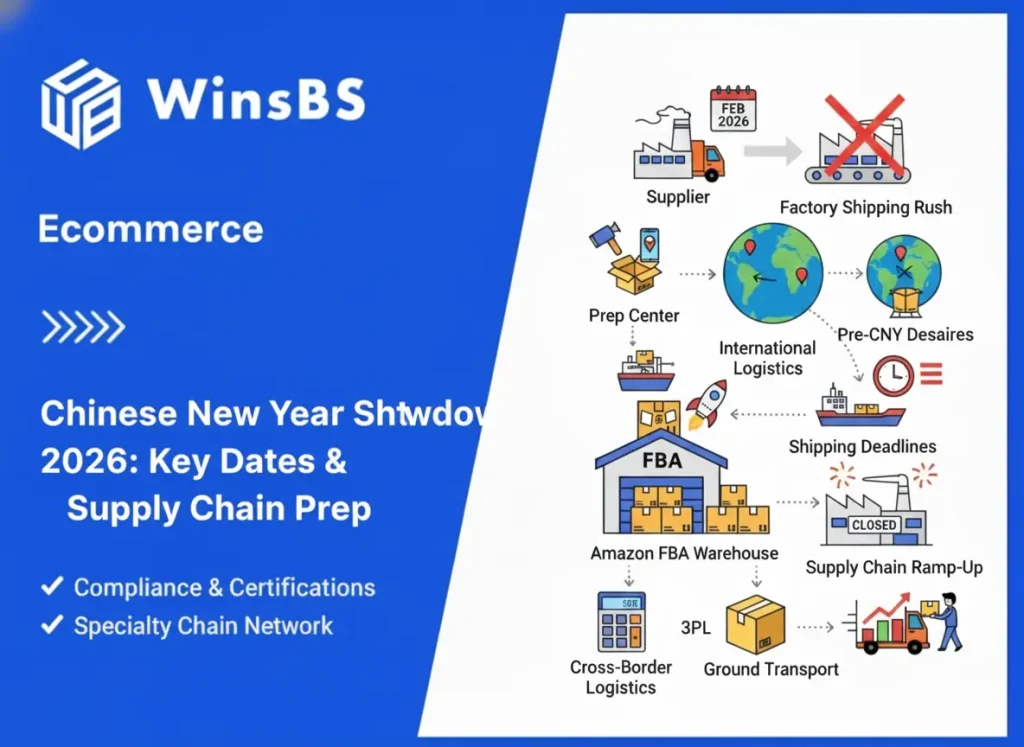
Chinese New Year Shutdown 2026: Key Dates & Supply Chain Prep
Chinese New Year Shutdown 2026: Key Dates, Global Timelines & Supply Chain Risk How US, UK, EU, AU & CA Brands Should Plan Around Factory Closures and Logistics Capacity Drops By Maxwell Anderson · Updated 2025 Chinese New Year Shutdown 2026 — Key Dates You Must Plan Around Chinese New Year (CNY) in 2026 falls on February 17. For most manufacturers and logistics providers in mainland China, the disruption window is much wider than the public holiday itself. CNY 2026: February 17, 2026 Typical Final Production Window Before Shutdown: February 7–10, 2026 Initial Restart Window After CNY: February 24–26, 2026 (often only 20–40% capacity) More “Normal” Capacity: Early to mid March 2026 In practice, many factories wind down output in the 7–10 days before CNY, and only begin to ramp back up roughly 7+ days after the holiday. If you rely on China for production, your true planning window spans several weeks before and after February 17 — not just the holiday week itself. TL;DR FOR BUSY OPERATORS Chinese New Year shutdowns in 2026 will not only pause production in China for roughly two weeks — they will also squeeze logistics capacity before, during, and after the holiday. Most brands underestimate two things: how early freight capacity tightens, and how long it takes factory and logistics networks to return to something close to normal. If you sell into the US, UK, EU, Australia, or Canada, you should treat CNY as a multi-week disruption window, and build market-specific timelines for purchase orders, production, and shipping. This guide walks through what actually shuts down during CNY, how it impacts different markets, and how to build a destination-based, mode-based plan that protects Q1 revenue. WHY CNY 2026 MATTERS MORE THAN MOST BRANDS EXPECT Chinese New Year happens every year, but 2026 is not “just another holiday.” The timing and broader trading context make it especially sensitive for cross-border brands. First, CNY 2026 is later in the calendar than in 2025. That pushes the shutdown period deeper into February, closer to several demand events in key markets: Valentine’s Day, US tax refund season, and early spring launches for apparel, beauty, and consumer electronics. Second, the disruption is not limited to a single week of public holiday. Capacity starts to tighten weeks in advance as workers travel home, factory schedules freeze, carriers adjust sailings and flights, and trucking capacity thins out. Third, the recovery is slow. Even once factories officially reopen, labor does not return all at once, and logistics networks work through a backlog of cargo that built up before and during the holiday. The result is a practical disruption window that often spans four to six weeks. Brands that plan only around the public holiday dates typically find themselves short on inventory, stuck with delayed shipments, or paying much higher rates for last-minute air freight. WHAT ACTUALLY SHUTS DOWN DURING CNY 2026 (FACTORIES + LOGISTICS) Most discussions about Chinese New Year focus on “factory shutdowns.” In reality, what matters to your business is the combined effect of two different but overlapping slowdowns: production and logistics capacity. PRODUCTION: A GRADUAL STEP-DOWN, NOT A SINGLE CUT-OFF Factories in China rarely go from full speed to zero overnight. Instead, output tapers off over the two to three weeks leading into CNY, then ramps back up gradually over the following two to three weeks. Roughly three to four weeks before CNY, many factories begin to close their pre-holiday production schedule. New orders may still be accepted, but most will be booked for after the holiday. In the two weeks before CNY, certain workers — especially those who travel long distances — start leaving early. Some factories consolidate lines or reduce shifts. Output may drop meaningfully, even though the factory is technically operating. In the final three to five days before CNY, most assembly lines shut down. Remaining staff focus on wrapping up open orders and securing equipment. During the public holiday period, production stops almost entirely. After the holiday, workers return in waves. In the first week back, many factories operate at a fraction of normal output. It can take one to three weeks for staffing and quality processes to stabilize. Electronics and complex assemblies tend to slow down earlier and restart more cautiously. Apparel and soft goods may run closer to the holiday date and restart faster. LOGISTICS: THE REAL BOTTLENECK OF CNY DELAYS For many brands, logistics is the real problem. Even if a factory completes your order, you still need trucks, warehouse handling, and space in a container or on a flight. In the two to three weeks before CNY, exporters race to ship goods before shutdown, pushing trucking, warehouse operations, and terminal capacity into peak strain. During the CNY holiday week, logistics operates in a minimal mode. Some flights and sailings depart, but inland movement is extremely constrained due to driver shortages and terminal closures. After the holiday, a second congestion wave emerges as factories restart and release accumulated orders into the logistics network. This is why CNY-related delays often extend well into March. GLOBAL IMPACT: WHY DIFFERENT MARKETS REQUIRE DIFFERENT TIMELINES Even though the CNY date is fixed, its impact varies dramatically based on distance, customs, demand timing, and your fulfillment model. Two brands using the same supplier may need very different plans depending on: Transit time Customs clearance variability Market demand timing Local vs cross-border fulfillment Effective CNY planning begins with the market and works backward — not from the factory calendar alone. CNY 2026 REVERSE PLANNING TIMELINES BY DESTINATION MARKET To plan correctly, start with when you need inventory in each market, then subtract transit time, customs, and pre-CNY congestion. Destination Typical Ocean Transit Recommended PO Placement Recommended Ship-Out Window Safe Arrival Window Notes United States (West Coast) 30–35 days Early–Mid December 2025 Late Dec–Mid Jan Before Early Feb LA/LB congestion likely before CNY. United States (East Coast) 35–45 days Late Nov–Early Dec Mid Dec–Early Jan Before Late Jan Longer transit requires earlier planning. United Kingdom 35–50 days Late