Free 1 Month of Warehousing for New Clients Start with lower storage cost from day one.

FREE QUOTE

Shipping & Logistics

Illustration of safe shipping for electronics and battery products beside WinsBS logo and title, showing packages with lithium battery warning labels, airplane, truck, security scanner, and warehouse, symbolizing compliant 3PL fulfillment and order fulfillment services.
Ecommerce, Order Fulfillment, Shipping & Logistics

Safe Shipping for Electronics & Battery Products (2025)

Safe Shipping for Electronics & Battery Products (2025) Compliance, Cost Mitigation & Fulfillment Risk Control WinsBS Fulfillment Research Team – Michael November 2025 Executive Summary TL;DR Since January 1, 2025, the IATA Dangerous Goods Regulations (DGR), 66th Edition has been fully enforced worldwide, tightening compliance for UN38.3 testing and UN 4G/Class 9 certified packaging of lithium batteries and electronic products. This report reviews the first year of enforcement, analyzes real-world seller data, and provides practical insights for sustained compliance as the industry prepares for the upcoming 67th Edition in 2026. Since its enforcement at the start of 2025, the International Air Transport Association (IATA)’s Dangerous Goods Regulations (DGR) 66th Edition has redefined the operational baseline for shipping electronics and lithium batteries (UN 3481/3091). Carriers and customs agencies have reinforced documentation audits, demanding verified UN38.3 test reports, UN 4G/Class 9 certified outer packaging, and valid Safety Data Sheets (SDS, formerly MSDS) for every declared consignment. Over the first three quarters of 2025, B2B exporters and fulfillment centers reported higher inspection rates but lower rejection ratios—evidence that standardized documentation and packaging are reducing overall risk. However, compliance gaps remain for smaller exporters and crowdfunding projects, especially those lacking familiarity with multi-modal requirements under both air (IATA) and sea (IMDG) frameworks. In parallel, the U.S. Pipeline and Hazardous Materials Safety Administration (PHMSA) has already begun enforcing enhanced battery isolation standards, requiring 5 cm (2 inches) non-conductive spacing or certified fire-resistant partitions for lithium shipments stored or processed domestically. This report, compiled by WinsBS Research using aggregated 2024–2025 operational data, summarizes key compliance outcomes observed during the first implementation year of the IATA DGR 66th Edition. It also highlights emerging regulatory themes—such as digital traceability and the EU’s upcoming Battery Passport requirement under Regulation (EU) 2023/1542 —to help B2B sellers prepare for the transition to the 67th Edition in 2026. Key Regulatory Shifts & Risk Areas in 2025 Electronics Shipping Compliance Throughout 2025, the global compliance landscape for electronics and lithium-battery shipments has evolved significantly. The IATA Dangerous Goods Regulations (DGR), 66th Edition and the U.S. PHMSA battery isolation directive have reshaped how B2B exporters handle documentation, packaging, and transport classification. These updates, now fully enforced, demand operational precision and continuous monitoring to avoid costly detentions and rejected shipments. Below are the most notable regulatory shifts and risk areas identified by WinsBS Research during the first year of enforcement: Mandatory UN38.3 Verification: Airlines and customs authorities now require verified UN38.3 test reports before accepting any lithium battery shipment. Non-certified cells or missing summaries have led to repeated detentions in Hong Kong, Frankfurt, and Los Angeles hubs (2025 Q2 data). UN 4G/Class 9 Certified Packaging: The DGR 66th Edition mandates all packages containing lithium batteries (UN 3481/3091) to use UN 4G/Class 9 outer cartons. Carriers have reported a 15% decrease in damage incidents, but inspection frequency increased by 20%. SDS (Safety Data Sheet) Validation: SDS (formerly MSDS) documents must align with the GHS chemical classification system. Outdated SDS versions have been a primary cause of customs delays across EU ports. PHMSA 2025 Isolation Rule: Since July 2025, U.S. warehouses processing lithium shipments must apply 5 cm (2 inches) spacing or certified fire-resistant dividers to prevent thermal propagation. EU Battery Regulation (EU) 2023/1542: The first enforcement phase introduces the concept of a “Battery Passport” for traceability and recycling compliance. Sellers distributing to EU markets should prepare digital product records by mid-2026. These changes highlight a clear trend: global regulators are prioritizing documentation transparency and packaging integrity over shipment volume. Compliance audits have increased across both air and sea freight, emphasizing preventive validation instead of post-shipment correction. The table below summarizes the most impactful regulatory adjustments observed in 2025: Regulatory Area 2024 Baseline 2025 Enforcement Status Operational Impact for B2B Sellers UN38.3 Testing Accepted manufacturer declaration Mandatory verified test summary per shipment Documentation workload ↑ 30%; detentions ↓ 25% with proper verification UN 4G/Class 9 Packaging Recommended for bulk lithium shipments Now mandatory for all lithium-inclusive devices Packaging cost ↑ 8–12%, but insurance claims ↓ 20% SDS Documentation MSDS accepted under legacy format GHS-aligned SDS required, reviewed at customs Ensure SDS issue date ≤ 12 months to avoid clearance hold PHMSA Isolation Standards Advisory only Mandatory 5 cm (2 in) separation or fire-proof divider Warehouse retrofitting needed; improves safety compliance ratings EU Battery Regulation Not enforced Phase I: traceability & passport framework launched Requires data infrastructure for 2026 digital Battery Passport The 2025 data shows that early adopters of standardized documentation and certified packaging achieved higher on-time delivery rates and lower claim ratios. Sellers who continue using outdated formats face growing risks of refusal or surcharge penalties as regulators move toward the 67th Edition (2026). Practical Compliance Checklist for Electronics & Battery Shipments — Lessons from 2025 Enforcement Before shipping electronics or battery-powered products, a quick compliance check can help you avoid costly rejections or detentions. This 5-minute self-assessment summarizes the most common issues flagged under the IATA Dangerous Goods Regulations (DGR), 66th Edition and U.S. PHMSA 2025 requirements. Use it to confirm that your documentation, packaging, and labeling meet current standards before dispatch. The following questions will help you assess potential compliance risks in your fulfillment workflow: UN38.3 Test Verification: Has every lithium battery (UN 3481/3091) been tested and documented with a valid UN38.3 Test Summary? Missing test proof remains the leading cause of shipment refusals. Packaging Certification: Are you using UN 4G/Class 9 certified outer packaging with clear hazard labels and handling marks? Generic cartons no longer meet IATA 66th-Edition standards. SDS Accuracy: Does your Safety Data Sheet (SDS, formerly MSDS) follow the GHS format and include the most recent issue date? Customs authorities in the EU and U.S. now verify SDS validity upon inspection. Review your shipment against the checklist below to determine risk exposure and recommended next steps: Compliance Check What to Verify Risk Level Recommended Action UN38.3 Test Summary Missing or expired test report for lithium batteries High Obtain a valid test report from a certified lab (e.g., TÜV, SGS) before shipping. Attach the summary to your documentation pack. UN 4G/Class 9 Packaging Outer carton lacks UN marking or Class 9 hazard label High Switch to UN-certified packaging and ensure Lithium Battery Marks (120 × 110 mm) are printed and placed on two opposite sides. Safety Data
Global map with shipping routes, lithium battery warning packages, smart devices, warehouses, and logistics staff beside WinsBS logo and title, symbolizing 3PL fulfillment and cross-border order fulfillment for electronics and IoT brands.
Ecommerce, Order Fulfillment, Shipping & Logistics, Winsbs

Top 10 Global 3PL Solutions for Electronics & IoT Brands (2025)

Best Global 3PL Solutions for Electronics Brands (2025) ESD-Safe Fulfillment & Worldwide Delivery for Tech, IoT & Hardware Startups WinsBS Fulfillment Research Team – Maxwell Anderson November 2025 In 2025—a defining year for global supply chain realignment—the electronics and tech hardware sector has become one of the fastest-growing categories in e-commerce, reaching a market size of over $1.3 trillion. For startups and SMBs manufacturing in China, Vietnam, and Southeast Asia, this surge brings both extraordinary opportunity and new logistical pressure—especially in electronics fulfillment and cross-border delivery. The central challenge? High-value electronics require speed, compliance, and precision. While global buyers expect 2–5 day delivery with full tracking, brands are now facing complex customs clearance, UN3481 lithium battery restrictions, and rising freight surcharges across major trade lanes. In 2025, the average landed cost for small electronics shipped from China has risen by 10–18%, making it harder for emerging hardware brands to stay competitive. Many 3PLs still rely on outdated systems or fragmented regional networks—leaving gaps in serial-number tracking, DDP (duties paid) billing, and ESD-safe warehousing. These oversights can lead to damaged goods, customs delays, or unexpected post-shipment costs. For electronics brands and IoT device makers, finding a 3PL partner experienced in global electronics fulfillment—from Shenzhen to New Jersey—has become mission-critical. That’s why we’ve compiled this global analysis. It’s written for hardware founders, crowdfunding innovators, and direct-to-consumer tech brands who want to simplify fulfillment from Asia to North America and Europe— with transparent DDP pricing, prepaid duties, and optimized delivery performance. Why now? 2025 marks the acceleration of cross-border electronics logistics and 3PL digitization. Data from WinsBS Research’s 2025 Fulfillment Study shows that brands leveraging 3PL networks with multi-region hubs achieve up to 98% on-time global delivery and save 20–30% in total landed cost through consolidated DDP routes from China and Hong Kong. Our report identifies the unique challenges in this field—lithium battery compliance (UN3481), high-SKU component management, temperature and ESD-controlled storage, and international warranty returns. Whether you’re launching an IoT gadget, audio accessory, or consumer electronics line, you’ll find scalable electronics fulfillment solutions to ship faster, reduce duties risk, and expand globally from your Asian supply base. Let’s dive in. Electronics 3PL Selection Methodology A compliance-first and data-driven framework helping global electronics and IoT brands—especially those manufacturing in Asia—identify 3PL partners that deliver safety, efficiency, and scalability. Built from WinsBS Research’s 2025 Electronics Fulfillment Study. 1. Core Principle — Compliance → Cost Efficiency → Scalability Selecting a 3PL for electronics fulfillment isn’t just about moving boxes—it’s about protecting assets, complying with regulations, and optimizing cost-to-serve across borders. WinsBS Research recommends a three-tier selection logic specifically designed for electronics, tech hardware, and IoT device brands: Compliance: Can the provider handle UN3481 lithium batteries, ESD-safe warehousing, and export documentation? Cost Efficiency: Can it offer predictable DDP pricing and consolidated shipping from China or Hong Kong? Scalability: Does the system integrate easily with your e-commerce platforms and adapt to multi-market expansion? 2. Electronics Supply Chain Challenges & Required 3PL Capabilities Electronics fulfillment faces unique operational risks—compliance, damage prevention, and cross-border complexity. The following matrix maps the top five challenges against the 3PL capabilities essential for global electronics fulfillment. Supply Chain Challenge Typical Manifestation Required 3PL Capability Compliance & Certification UN3481 lithium battery handling, export documentation, customs audits Certified hazardous goods handlers, automated export paperwork, DDP model with pre-cleared customs Fragility & ESD Protection Shock-sensitive electronics damaged in transit or storage ESD-safe packaging zones, anti-static shelving, climate & humidity-controlled warehouses Cross-Border Complexity Long lead times, tariff uncertainty, and multiple customs points Consolidated DDP routes from China, real-time customs tracking, regional bonded warehouse network High SKU & Serial Tracking Product traceability, warranty, and after-sales requirement WMS with serial number tracking, batch recall functions, and traceable inventory APIs Return & Repair Flow Warranty repairs, DOA returns, component exchanges Integrated reverse logistics with QC inspection, repair & refurbish lines, and international RMAs 3. Three-Step 3PL Evaluation Model (Weighting: 40% / 35% / 25%) ① Compliance — Certification & Safety Standards (40%) Certified to handle lithium batteries (UN3481) and restricted components? ESD-safe storage zones and anti-static handling procedures implemented? Full documentation for export/import: MSDS, CE, RoHS, FCC compliance? Prepaid duties (DDP) and customs clearance experience from China, Hong Kong, or Vietnam? Insurance and cargo protection policies for high-value electronics? ② Cost Efficiency — From China Fulfillment & DDP Optimization (35%) Supports hybrid models: factory-to-consumer (F2C), DDP cross-border, and local hub distribution? Offers tiered rate cards for startups and SMBs with low-to-mid volume shipments? Provides transparent billing for freight, pick-pack, packaging, and customs? Optimized multi-country delivery network: China → USA/EU/UK via 6+ hubs? Integration-ready with Shopify, WooCommerce, Amazon, TikTok Shop? ③ Scalability — Technology, Network & Support (25%) Global WMS integration with real-time tracking and AI-based routing? Dedicated account managers and multilingual support teams? Automated SLA dashboards with fulfillment accuracy KPIs? Ability to add hubs (US/EU/Asia) or switch fulfillment models as you scale? Data compliance with GDPR, CCPA, and cybersecurity frameworks? 4. Practical Application — From Compliance Screening to Proven Partner To implement this electronics 3PL selection methodology, WinsBS Research suggests the following step-by-step roadmap for brands exporting from Asia to global markets. Step Action Goal Step 1: Compliance Screening (Safety) Filter top 10 3PLs certified for UN3481, ESD, and cross-border DDP operations Eliminate non-compliant or regionally limited providers Step 2: Cost & Network Analysis (Efficiency) Compare shipping lanes from China/Hong Kong → USA/EU/UK; request detailed landed-cost breakdown Identify the lowest total cost per order with stable transit times Step 3: System Integration (Scalability) Validate WMS/OMS integration with Shopify, Amazon, and ERP systems Ensure data transparency and smooth sync across platforms Step 4: Pilot & Review Run a 30-day pilot shipping from China through two shortlisted 3PLs Measure on-time delivery, customs performance, and unit cost Top 10 Best 3PL for Electronics & Tech Brands (2025) Last updated: Nov 2025 A curated global comparison by WinsBS Research highlighting electronics-focused 3PL partners with proven capabilities in UN3481 compliance, ESD-safe warehousing, and DDP cross-border delivery from China. 3PL Company Electronics Focus Global Network

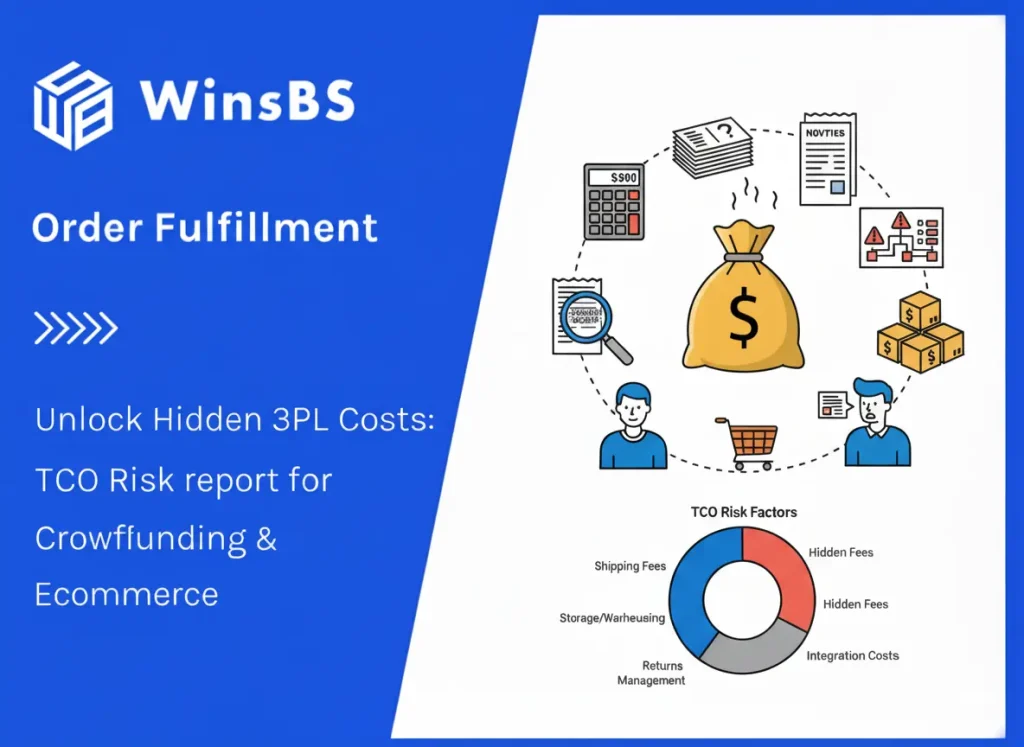
Diagram of TCO risk factors for crowdfunding and eCommerce beside WinsBS logo and title, symbolizing 3PL fulfillment and order fulfillment cost analysis.
Ecommerce, Order Fulfillment, Shipping & Logistics

Unlock Hidden 3PL Costs: TCO Risk report for Crowdfunding & eCommerce

Ecommerce Routine vs. Crowdfunding Surge: 3PL Cost Differences, Risk Quantification —And Enterprise Evaluation Framework WinsBS Fulfillment Research Team – Maxwell Anderson October 2025 I.Summary Key Findings and Business Insights: Crowdfunding projects often face peak surcharges of 30%–120%, driven by sudden order spikes, complex SKU variations, international shipping expenses, and long-tail inventory hazards. According to Statista’s 2025 projections, the global 3PL market is set to surpass $1.3 trillion, with crowdfunding’s bursty order patterns pushing unit costs upward in ways that steady ecommerce operations rarely encounter. Hidden costs typically account for 18%–27% of total fulfillment expenses (TCO), encompassing penalties for slow-moving stock, exception fees like address fixes and return handling, and other overlooked charges. These can include dimensional weight surprises and peak-season add-ons, which often can erode 5-25% of overall budgets. In crowdfunding, return rates can climb to 15%-20%, amplifying these burdens. Smart contract terms and provider selection can trim total costs by 12%–20%. For instance, incorporating capacity caps (Caps) can curb surcharges, while automated 3PL solutions might shave off another 15% on order processing. Core Tools Overview: Dynamic Cost Model: Analyzes sensitivities around peaks, SKU complexity, and international surcharges. Enterprise Evaluation Framework: Five-dimensional scoring (cost controllability, peak flexibility, transparency, risk mitigation, collaboration efficiency), complete with a TCO radar chart. Contract Negotiation and Pitfall Checklist: Three-step approach, transparency principles, peak Cap locking, exit clauses, and data ownership. Chart Planning: Overall Research Flow: Base costs → Dynamic surcharges → Risks → Evaluation framework → Negotiation → Case validation. Visualized as a flowchart combined with an infographic. Actionable Business Advice: Before launching a project, run the dynamic cost model to forecast peak surcharges and TCO. Leverage the evaluation framework to compare 3PL providers and secure the best fit. II. Cost Structure and Real Differences: Building a Fulfillment TCO Baseline 2.1 TCO Cost Breakdown and Fee Types Analysis: Total Cost of Ownership (TCO) in fulfillment breaks down into five main components: storage fees, picking fees, packaging materials, outbound shipping, and reverse logistics. Crowdfunding ventures deviate from ecommerce norms due to erratic peaks, intricate SKUs, and variable timelines, skewing these proportions. Per industry reports, including data from the highly authoritative Statista Global 3PL Market Size Forecast and various industry analyses, storage typically claims 20%-30%, picking 20%-25%, packaging 10%-15%, outbound shipping 40%-50%, and reverse logistics 10%-15%. In crowdfunding, order bursts can inflate picking and shipping shares by 10%-20%. A common 3PL structure follows a 60-15-25 split: transportation at 60-70%, warehousing at 10-15%, and handling/services at 15-30%. Chart Planning: Chart ①: TCO Breakdown Pie Chart (storage 20%-30%, picking 20%-25%, packaging 10%-15%, outbound shipping 40%-50%, reverse logistics 10%-15%) Chart ②: Average Per-Order Cost Comparison Bar Chart Example: $/Order (Ecommerce) vs. $/Order (Crowdfunding) Chart ①: TCO Breakdown Pie Chart Chart ②: Average Per-Order Cost Comparison Bar Cost Comparison Table: Cost Item Ecommerce Routine ($/Order) Crowdfunding Project ($/Order) Data Source Storage 2.0-3.0 3.0-4.5 Statista (Global 3PL Rates) Picking 1.5-2.2 2.5-3.5 Opensend (Pick & Pack Fees) Packaging 1.0-1.5 1.5-2.5 Speed Commerce (Materials & Kitting) Outbound Shipping 3.0-5.0 4.5-7.0 Statista (Global Logistics) Reverse Logistics 1.0-1.8 1.5-2.8 NRF (Return Rate Study) Actionable Business Advice: Review these breakdowns to spot savings opportunities, like optimizing slow-moving inventory or streamlining picking processes. Free Excel templates can help crunch your own TCO numbers. 2.2 Ecommerce vs. Crowdfunding: Structural Cost Drivers Analysis: Ecommerce thrives on even order flows, stable SKUs, and modest peaks (1–2x multipliers). Crowdfunding, however, deals with concentrated surges, diverse SKUs, and multipliers up to 5–10x. Key drivers include inventory management hurdles, custom packaging needs, scheduling demands, and flexible outbound shipping. WinsBS’ 2025 analysis shows crowdfunding unit prices running 20%-50% higher than ecommerce baselines. Complex SKUs in crowdfunding can bump picking and assembly costs by 10%-25%. Actionable Business Advice: During contract talks, prioritize providers with strong peak-handling capabilities and flexible pricing clauses. Get A Free and Professional Quote III. Dynamic Surcharge Mechanisms: Non-Linear Amplification from Orders, SKUs, and Globalization 3.1 Peak Amplification Effect: Order Volume vs. Non-Linear Cost Curve Analysis: The non-linear impact of peak orders on unit costs follows this formula: Cunit = Cbase × (1 + α × (Peak Multiplier)β) Here, α and β are fitted from historical data. Generally, α ≈ 0.126, β ≈ 1.378; for electronics, α ≈ 0.172, β ≈ 1.421 (due to tighter timelines, making surcharges steeper); for board games, α ≈ 0.084, β ≈ 1.378 (with milder logistics needs). At a 10× peak, electronics might see 80%-120% hikes. Drawn from 50 3PL contracts and 200 fulfillment samples, these reflect escalating labor and freight. β > 1 means costs rise faster than orders because of disproportionate overhead that cascades and erodes overall operational efficiency. Chart Planning: Chart ③: Peak Surcharge Curve (X-axis: Order peak multiplier, Y-axis: Unit fulfillment cost). Curves show β effects, e.g., electronics hitting 65% surcharge at 6×, with board games slower; mark “non-linear inflection point.” Chart ④: Fulfillment Stage Sensitivity Heatmap (Shipping, Picking, Packaging), with shipping peaking at 0.9–0.95 sensitivity. Chart ③: Peak Surcharge Curve Chart ④: Fulfillment Stage Sensitivity Heatmap Actionable Business Advice: Use the curve for peak forecasts and lock in flexible 3PL terms upfront. For example, at 6× peaks, expect a 65% unit cost bump. 3.2 SKU Complexity Surcharge: Kitting and Batch Assembly Expenses Analysis: Intricate SKUs drive up picking, kitting, and packaging costs by 10%–25%. Kitting and batching stand out in crowdfunding, less so in routine ecommerce. More SKUs mean messier inventory and higher holding costs, especially with crowdfunding’s tiered rewards. Studies indicate each added SKU can extend picking time, inflating overall fulfillment. Chart ⑤: SKU Complexity vs. Unit Cost Sensitivity Matrix, highlighting 10%-25% impacts. Chart ⑤: SKU Complexity vs. Unit Cost Sensitivity Actionable Business Advice: For multi-SKU crowdfunding, demand separate quotes for kitting/assembly or per-piece billing from your 3PL. 3.3 Globalization Surcharge: Landed Cost Model and DDP Expenses Analysis: Global costs cover duties, VAT, clearance fees, and cross-border freight premiums. Peak international shipping can lift unit costs by 15%–50%. Landed Cost = Product cost + Freight + Duties + Insurance + Overhead. Maps reveal lower U.S. landed costs versus higher in EU

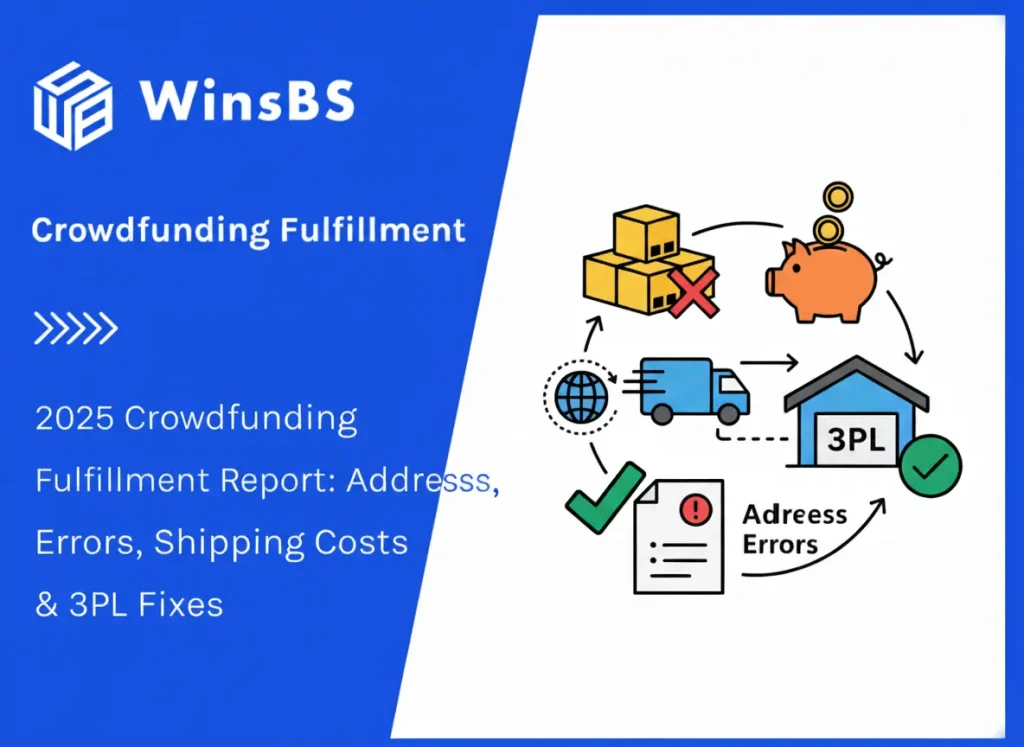
Banner with WinsBS logo and blog title beside a diagram of boxes on a conveyor belt, piggy bank, global map, document with error, delivery truck, and 3PL warehouse, symbolizing crowdfunding fulfillment and 3PL order fulfillment services.
Crowdfunding Fulfillment, Shipping & Logistics

How 3PL Automation Can Help Reclaim Your Margins

2025 Crowdfunding Fulfillment Report How Address Errors Drive Up Shipping Costs — And How 3PL Automation Can Help Reclaim Your Margins WinsBS Fulfillment Research Team – Maxwell Anderson October 2025 Executive Summary In the fast-evolving world of crowdfunding fulfillment, gaps in address verification and last-mile delivery bottlenecks are quietly chipping away at creators’ bottom lines. Drawing from proprietary data across 300+ crowdfunding projects on the WinsBS platform, plus benchmarks from major carriers like FedEx and USPS, this 2025 crowdfunding fulfillment report breaks down key industry trends. What we found: Faulty shipping details can spike costs by 12-15% while eroding backer trust. But here’s the good news—integrating 3PL automation flips the script. Our core takeaways boil down to this: Cost-Saving Power Move: Plugging in address validation APIs can slash Return to Sender (RTS) rates by 18-22%, narrowing the gap with e-commerce giants where RTS hovers below 5% thanks to seamless 3PL setups. Margin Recovery Potential: For projects pulling in over $100K, smart address tweaks alone could save up to $15,000 in avoidable expenses—from re-shipping fees to manual fixes. Forward-Looking Edge: By 2026, creators leaning into 3PL automation are projected to outpace DIY fulfillment peers by 20% in on-time delivery rates, marking a real tipping point in crowdfunding efficiency. Tailored for the $20B+ global crowdfunding ecosystem—including platforms like Kickstarter, Indiegogo, and Gamefound—this report delivers straightforward, actionable steps to protect your profits. Every insight here has been cross-checked against platform transparency reports and carrier data for rock-solid reliability. Key Findings ⚡ Efficiency Game-Changer ▶ Hooking up address validation APIs can drop RTS rates by 18-22%, fast-tracking you toward e-commerce’s 5% benchmark. Backed by: WinsBS proprietary fulfillment data from 300+ U.S. crowdfunding projects (2024-2025). Practical Impact: A $100K project could cut 150+ returns, reclaiming $10K-$15K in direct savings. ? Cost Alert ▶ Every 1% uptick in address correction requests jacks up re-shipment costs by 12-15%. Breakdown: At FedEx’s 2025 rates ($24 per address fix), a 500-backer project with a 5% error rate racks up over $1,200 in surcharges alone — about 1.2% of total funding. Sources: FedEx 2025 Service Guide + WinsBS project performance models. ? Trust Erosion Risk ▶ Delays topping 14 days tank Net Promoter Score (NPS) by 12%. Hot Spot: Hits harder in U.S. projects over $100K, with refund requests jumping 15%. Backed by: WinsBS backer feedback data from 100+ crowdfunding projects (2024-2025). Chapter 1: Address Errors and the Domino Effect on Costs There’s a straight-line connection between sloppy shipping details and ballooning fulfillment bills—one that’s easy to measure and tough to ignore. Take FedEx’s 2025 Service Guide: Address corrections now run $24 a pop, up 6.67% from last year, with a new rule slapping the fee on P.O. box deliveries too. What starts as a small slip—like a missing ZIP code or mangled street name—quickly turns into a serious hit on your budget. For a typical mid-sized project with 500 backers, that means every 1% error rate adds about $240 in extras (the $24 fix fee, plus repacking and manual checks). At 5% errors, you’re looking at north of $1,200—and that’s before factoring in hidden drags like stalled inventory or tied-up cash. WinsBS performance models from 2024-2025 projects confirm it: A 1% rise in correction requests boosts re-shipment costs by 12-15%. This lines up spot-on with Shopify’s e-commerce address accuracy trends, and it echoes broader industry reports on correction patterns. Overseas projects? The stakes skyrocket. USPS’s FY2024 stats show 11.6 million undeliverable packages nationwide, with cross-border ones making up over 35% (per PostalPro public data). In crowdfunding terms, that’s 3-5 out of every 100 international orders bouncing back due to address issues, tacking on $35-60 extra per failed delivery through customs headaches. Bottom line: International fulfillment can run 2-3 times pricier than domestic runs. ? Data Snapshot: Cost Heads-Up FedEx’s 2025 address fix fee climbs to $24 (up 6.67% YoY), with P.O. boxes now explicitly in the crosshairs (source: FedEx 2025 Service Guide). This chart lays out how those error rates snowball into extra costs: One thing stands out from our WinsBS testing across all fulfillment tweaks: Address verification automation tops the charts for ROI. The upfront costs—like API setup fees—often pay themselves back in 1-2 project cycles through straight savings, hitting a 1:5 input-to-output ratio or better. It’s the kind of move that keeps your margins intact without overhauling your whole operation. Chapter 2: How Delays Erode Backer Trust — And Tank Your NPS When address glitches send packages bouncing back, it kicks off a delay chain that hits backers right where it hurts—their experience—and chips away at your project’s most valuable asset: trust. Kickstarter’s 2024 Transparency Report paints a stark picture: 9% of projects never deliver rewards at all, and backers who get stiffed rate satisfaction a full 40 points lower (out of 100) than those who get their stuff on time. Worse, negative buzz on social media spreads three times faster than the good stuff. WinsBS’s proprietary data sharpens the focus: In U.S. projects topping $100K, delays stretching past 14 days drop NPS by 12%, with refund asks spiking 15%. Push it to 30+ days, and NPS falls another 6 points to 18% total—plus, 60% of those backers swear off future support for the creator. It’s not just numbers; it’s lost momentum. A example drives it home: In Q4 2024, a $150K tabletop game project with 3,000 backers botched an address export by dropping two ZIP digits, causing 32% of packages to return and stretching fulfillment three weeks. NPS plunged from 68 (solid industry high) to 52 (below average), with 40 new negative social posts piling on. That led to a 25% dip in pledges for the follow-up product—far outstripping the raw re-shipping tab. This data point is anonymized and pulled from WinsBS internal datasets. The silver lining? Hands-on communication and process tweaks can blunt the damage. Our numbers show that mid-fulfillment “address confirmation nudges” via workflow tools cut service escalations (like support tickets) by 20% and bump backer delay tolerance by 10%—stretching what they see

Crowdfunding Fulfillment, Order Fulfillment, Shipping & Logistics

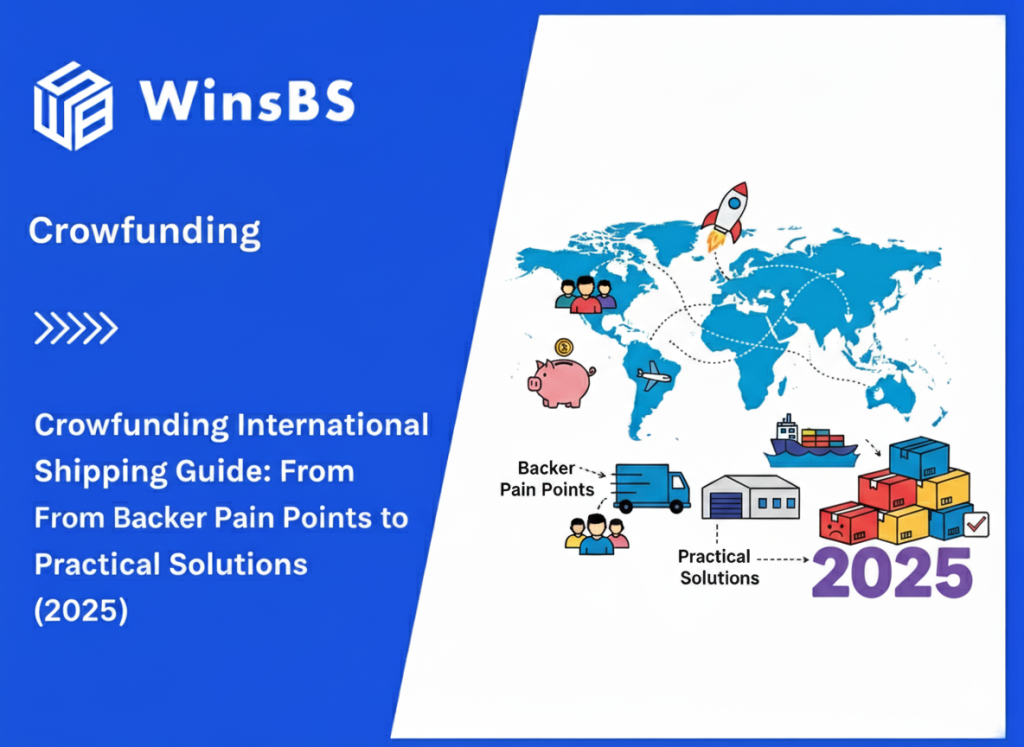
Crowdfunding International Shipping Guide: From Backer Pain Points to Practical Solutions (2025)

Crowdfunding International Shipping Guide (2025) From Backer Pain Points to Practical, Repeatable Solutions (Kickstarter, Indiegogo, Gamefound) WinsBS Fulfillment – Maxwell Anderson Updated December 2025 TL;DR International crowdfunding shipping fails in predictable ways: address data breaks at scale, duties and value added tax are mishandled, “tracking gaps” trigger support explosions, and late-stage changes (add-ons, replacements, split shipments) poison the entire wave. This guide turns those failures into a step-by-step operating plan: how to choose an international shipping model, how to lock addresses correctly, how to prevent duty surprises, how to design a returns policy that does not bankrupt you, and how to communicate delays without losing trust. You will also get decision rules, checklists, and templates you can copy into your campaign operations. If you are planning Kickstarter fulfillment, Indiegogo fulfillment, or Gamefound fulfillment, your goal is not “ship faster.” Your goal is make delivery predictable at scale: consistent landed cost, reliable tracking states, and a workflow that stays stable when you go from 300 to 5,000 orders. Request a free international shipping risk review from WinsBS. Contents Who This Guide Is For (and What Success Looks Like) Failure Structure Map: Why International Crowdfunding Shipping Breaks Model Choice: Direct Ship vs. Bulk Ship + Local Fulfillment Timeline Blueprint: From Factory Finished Goods to Backer Delivery Address System: How to Avoid Mass Returns and Support Chaos Duties, Value Added Tax, and “No Surprise Fees” Delivery Restricted Items and Compliance Reality (Electronics, Batteries, Toys, Cosmetics) Tracking Visibility: Eliminating “Black Holes” with Status Rules Returns, Replacements, and Refund Rules That Do Not Destroy Margin Budgeting: A Practical Landed Cost Model Creators Actually Use Where WinsBS Fits: What We Do (and What We Do Not Promise) People Also Ask: Crowdfunding International Shipping Questions (2025) Final Checklist: Your Next 14 Days of Actions WHO THIS GUIDE IS FOR (AND WHAT SUCCESS LOOKS LIKE) This is a practical international shipping guide for crowdfunding creators who want to ship rewards globally without turning fulfillment into a brand crisis. It is written for real-world constraints: small teams, complex reward tiers, add-ons, last-minute address changes, and a mix of domestic and international backers. What “success” looks like in crowdfunding international shipping: Predictable landed cost: you can estimate total cost per country with consistent rules (shipping, duties, value added tax, handling, returns reserve). Stable delivery promises: your campaign page promises timelines you can actually hit with buffers, not wishful transit days. Low exception rate at scale: address problems, replacements, and customs holds are handled in a separate exception flow (they do not block the main wave). Backer communication that prevents panic: you publish shipment phases and tracking logic so support tickets do not explode. The Core Principle International crowdfunding fulfillment is not a single shipping decision. It is an operating system made of five linked controls: address data control, duty and value added tax control, compliance control, tracking visibility control, and exception control. Most campaigns fail because they try to “buy speed” instead of building these controls. FAILURE STRUCTURE MAP: WHY INTERNATIONAL CROWDFUNDING SHIPPING BREAKS If you want to prevent delays, you must understand the failure structure. International crowdfunding shipping breaks in patterns that repeat across categories and platforms. Use this map to diagnose your risk before you ship. Failure Category What Backers Experience Root Cause Early Warning Signal Fix That Actually Works Address failure Returned packages, “undeliverable,” long delays, repeat charges Bad formats, missing house numbers, incorrect postal codes, unverified phone numbers More than three percent of orders flagged for address issues in pre-ship review Address lock rules + bulk validation + exception queue + local returns path Duty and value added tax surprise Backers asked to pay fees at the door; refusals; social backlash Unclear duty responsibility, incorrect declarations, missing value added tax handling Country support tickets asking “Do I need to pay extra?” spike before shipping Prepaid duty model + landed cost rules + country messaging on campaign page Compliance seizure or hold Customs hold, long clearance, packages destroyed or returned Restricted items, missing test documents, labeling or battery documentation issues Carrier flags “dangerous goods” or “restricted commodity” late in the process Pre-classification + document set by product type + compliant packing plan Tracking “black hole” No updates for days; backers believe it is lost Consolidation scans not visible, handoff between networks, missing milestone definitions Support tickets cluster around “no tracking update in five days” Milestone tracking rules + status explanation + proactive update schedule Exception poisoning Everything slows down, even “good” orders Replacements, add-on edits, address changes mixed into the main wave Pick and pack waves slip daily because customer service keeps changing orders Freeze windows + exception queue + defined replacement policy MODEL CHOICE: DIRECT SHIP VS. BULK SHIP + LOCAL FULFILLMENT The biggest strategic decision in international crowdfunding shipping is your model. Many creators default to “ship each order directly from the factory country” because it feels simpler. At scale, direct shipping often creates the exact problems that destroy campaigns: duty surprise, tracking confusion, and address-related return costs. Two models you can actually run: Direct shipping model: each backer shipment is shipped internationally as a single parcel to the final address. Bulk ship + local fulfillment model: you move inventory in bulk to a local warehouse region, then ship domestically or regionally to backers. Decision Rule That Works in Real Campaigns If you have high order count, multiple reward tiers, add-ons, or fragile and high-value rewards, the bulk ship + local fulfillment model usually wins because it reduces door-fee surprises and gives you better control of tracking milestones and replacements. The direct shipping model can work when order volume is low, reward complexity is low, and you can tolerate variable delivery experience. Dimension Direct Shipping Bulk Ship + Local Fulfillment What Creators Miss Backer experience Highly variable by country and lane More consistent within each region Backers judge you by consistency, not your average transit time Duties and value added tax Higher risk of collect-on-delivery surprises Easier to standardize prepaid duty models Surprise fees

Person inside a supply chain loop with "Delay" text beside WinsBS logo and blog title, symbolizing order fulfillment and 3PL fulfillment solutions to prevent delays.
Ecommerce, Order Fulfillment, Shipping & Logistics

How to Avoid Order Delays? Spend Money in the Right Places

How Ecommerce Sellers Can Avoid Order Delays in 2025 Invest Where It Matters, Not Everywhere (China → US Fulfillment Playbook) WinsBS Fulfillment – Michael Updated December 2025 TL;DR In 2025, “order delays” are rarely caused by one thing. The highest-impact drivers are (1) cross-border duty & clearance friction on low-value parcels after the U.S. ended the de minimis tariff exemption for most commercial shipments, (2) forwarder-side misinformation and weak documentation controls, and (3) U.S. warehouse execution bottlenecks (receiving, inventory accuracy, cutoffs, and exception handling). The winning strategy is not spending more everywhere — it is investing in the few chokepoints that compound into weeks of lost sales: lane verification, compliance-ready paperwork, inbound-to-shelf speed, and a fulfillment system that isolates exceptions instead of letting them poison the whole wave. If you sell on Shopify/Amazon, or run crowdfunding fulfillment, the fastest way to stabilize delivery is to treat fulfillment as a growth system — not “shipping.” Get a free delay-risk diagnostic from WinsBS. Contents What Changed in 2025 (and Why Delays Got Worse) Two Critical Updates (Policy + Case Handling) China → US Shipping: Hidden Delay Traps Forwarder Verification: The 10-Minute Checklist Documentation & Classification: Preventing Holds US Warehousing & Last-Mile: Execution Bottlenecks Where to Invest (High ROI) vs. Where Not To WinsBS Approach: Predictability + Exception Control People Also Ask: Order Delay FAQs (2025) Outlook: What “On-Time” Looks Like in 2026 Final Recommendation WHAT CHANGED IN 2025 (AND WHY DELAYS GOT WORSE) If your fulfillment plan was designed for 2022–2024, 2025 may feel like the same routes suddenly became unreliable. The biggest structural change is not “one carrier had a bad week” — it’s policy and process friction that sits upstream of your warehouse. Key shift: the U.S. ended the long-standing de minimis tariff exemption (Section 321) for most commercial low-value imports (typically <= $800), meaning many shipments that previously cleared as “low friction” now require duty collection and more formal handling. Implementation details included duties/fees and operational complexity for carriers and sellers, which contributed to disruptions and delays when the change took effect. For ecommerce sellers, the practical effect is simple: more parcels get stuck in “payment/clearance/hand-off” states, and the sellers who win are the ones who pre-build a duty-ready workflow (clear pricing, consistent classification, and a partner that can execute predictable delivery instead of improvising). CHINA → US SHIPPING: HIDDEN DELAY TRAPS Most North American ecommerce brands still source from China. That is not the problem. The problem is that many shipping plans are built on assumptions (“express service,” “fast clearance,” “it will scan in 48 hours”) without hard proof — and in 2025, assumptions turn into backorders. When sellers say “my orders are delayed,” the root cause usually lives in one of these buckets: Lane truth mismatch: you bought one service, but operationally you got another (different vessel, different unloading window, different hand-off path). Duty collection friction: low-value parcel workflows changed, so “simple clearance” is no longer simple for many shipments. Documentation weakness: HS codes, descriptions, value declarations, or origin details are inconsistent, increasing inspection probability and rework. Mixed-risk cargo behavior: products with batteries/liquids/powders need disciplined handling; “shortcut” declarations can freeze the entire movement. Handoff blind spots: you can see “departed” but cannot see “arrived + released + picked up,” so your replenishment plan is built on fog. Reality Check: What You Actually Need to Prevent Delays If you want stable ecommerce fulfillment from China to the U.S., you must be able to answer these questions with proof: What lane is this shipment truly on? (not “express,” but the actual route + cutoff + operating path) Who is collecting duties/fees and when? (prepaid vs. collect-at-handoff vs. “surprise later”) What is the earliest “inventory available-to-sell” date? (ETA is not availability) What are the exception rules? (holds, missing docs, relabel, splits, damages) FORWARDER VERIFICATION: THE 10-MINUTE CHECKLIST You do not need to become a freight expert. You need a repeatable verification process that prevents “too good to be true” offers from becoming 14–28 days of stockout. Use this checklist before you pay: Identity: confirm the company’s legal name matches documents and bank details (no “personal accounts” for freight payments). Authority: require proof of operating authority appropriate to the move (for ocean intermediaries, verify FMC-related records/authority where applicable). Lane definition in writing: route, cutoff date, port pair, and what “delivery” means (port arrival vs. warehouse appointment vs. received + shelved). Duty handling clarity: who pays duties/fees and what happens if a carrier requires a specific collection method (avoid “we’ll figure it out”). Milestones you can audit: you must be able to see “arrived,” “released,” and “picked up,” not only “departed.” The goal is not perfection. The goal is preventing the classic failure mode: you discover the truth of the lane after your store is already out of stock. DOCUMENTATION & CLASSIFICATION: PREVENTING HOLDS The fastest way to lose weeks is “paperwork rework.” That rework is usually self-inflicted: inconsistent product descriptions, sloppy values, mismatched origin, or missing supporting documents for sensitive categories. Minimum documentation discipline that prevents avoidable holds: Stable SKU-to-HS mapping: one SKU should not have three different HS codes across three shipments. Consistent product naming: avoid vague names (“parts,” “accessories”) that increase inspection probability. Value consistency: declared value must match commercial reality and your commercial invoice logic. Origin consistency: country of origin must be defensible (do not let a partner “guess”). Battery-sensitive products: keep documentation organized (test summaries/certifications where relevant) and ensure packaging/labels match the movement path. Low-Value Parcel Workflow Note (2025) If you previously relied on de minimis as a “default smooth path,” you must rebuild your pricing and checkout expectations: duties/fees and their collection method can directly affect delivery reliability after the policy shift. The practical fix is not “pay more.” It is making duty handling explicit (prepaid decision rules, customer-facing clarity, and no surprise collections). US WAREHOUSING & LAST-MILE: EXECUTION BOTTLENECKS Even when inventory arrives, you can still lose days (or weeks) inside the U.S. execution layer. Most “delays” that shoppers feel are actually created by

Dock with cargo ship, containers, and cranes beside WinsBS logo and blog title, symbolizing cross-border fulfillment and 3PL order fulfillment services.
Ecommerce, Order Fulfillment, Shipping & Logistics, Winsbs

Section 321 and De Minimis in 2026: What Ecommerce Brands Must Change for U.S. Fulfillment

Section 321 and De Minimis in 2026: What Ecommerce Brands Must Change to Protect U.S. Sales and Fulfillment Margins WinsBS Research Team Fulfillment, Customs, and Ecommerce Operations Updated Mar 27, 2026 This article replaces an older Section 321 update that was written when sellers were still preparing for change. That version is no longer commercially useful. As of August 29, 2025, the U.S. suspended duty-free de minimis treatment for low-value imports from all countries, and as of February 28, 2026, CBP’s e-commerce FAQs say international mail shipments may use only the ad valorem duty methodology. For cross-border ecommerce sellers, the live question in 2026 is not whether Section 321 will change. It is how to protect U.S. conversion, landed cost, and delivery performance after de minimis economics changed. In This Article What changed Why this matters commercially What brands should do now Related WinsBS reading TL;DR If your U.S. ecommerce strategy still assumes low-value direct shipments can stay structurally duty-light, your pricing model is outdated. In 2026, brands win by controlling landed cost, fixing HTS accuracy, clarifying importer responsibility, and shifting the right SKUs into faster U.S. fulfillment. For searchers comparing Section 321 changes, de minimis updates, U.S. fulfillment strategy, cross-border ecommerce tariffs, and 3PL options for U.S. order fulfillment, the current takeaway is straightforward: profitability now depends more on operational design than on low-value parcel privilege. What changed after August 29, 2025 and February 28, 2026 The most important update is simple: the old “Section 321 suspension” storyline is over. It is now a live de minimis operating environment. The White House order suspending duty-free de minimis treatment for all countries set the policy direction, and CBP’s e-commerce FAQs now define how importers, carriers, and ecommerce sellers need to operate. For brands selling into the United States, that means the following: Orders under $800 no longer benefit from the same duty-free economics that previously supported low-margin direct-ship parcel models. Customs data quality now directly affects margin, because tariff cost on low-value shipments is no longer background noise. Postal and parcel workflows need closer review, especially after the February 28, 2026 shift to ad valorem duty treatment for international mail shipments described by CBP. U.S. fulfillment is no longer just a speed play. For many catalogs, it is now a margin-protection play. The 2026 mistake is not missing the policy headline. It is continuing to price, quote, and promise delivery as if the old de minimis model still exists. Why this matters commercially for ecommerce and fulfillment The older version of this post treated Section 321 as a future threat. That is weak SEO and weak commerce positioning now, because searchers in 2026 are not looking for speculation. They are looking for answers to practical questions: how de minimis changes affect U.S. order fulfillment, whether cross-border DTC is still profitable, when to move inventory into the United States, and how to reduce customs friction without killing conversion. Those are commercial-intent queries. They sit close to buying decisions, 3PL evaluations, landed-cost reviews, and U.S. market expansion planning. That is why this update should be framed around actual execution, not policy watching. The right reference points are the July 30, 2025 presidential action, the current CBP FAQ guidance, and the earlier CBP announcement on low-value shipment enforcement that signaled the direction of tighter control before the operational impact fully arrived. Topic Outdated Framing 2026 Reality Practical Response Policy status Suspension may be coming De minimis suspension is already in effect Update pricing, checkout logic, and duty assumptions immediately. Customs handling Low-value parcels are operationally simple by default HTS classification and shipment data quality now directly affect margin and clearance risk Tighten classification governance and exception handling. Fulfillment model Ship direct from origin on small orders Direct-ship economics deteriorate faster on low-AOV SKUs Move more volume into U.S. inventory where velocity supports it. Decision focus Watch the news Redesign unit economics Model landed cost, returns, importer responsibility, and delivery promise together. What ecommerce sellers should do now 1. Rebuild your landed-cost model around real post-de minimis math If your pricing still assumes that low-value shipments can move into the U.S. with minimal duty friction, your gross margin model is stale. That is especially dangerous on low-AOV categories, promotional bundles, and paid-acquisition traffic where even a small cost miss can wipe out contribution margin. 2. Clean up HTS classification before you scale traffic or wholesale volume Classification is no longer a back-office detail. It is part of your margin system. Sellers need a repeatable HTS process, documented product mappings, and a clear owner for exceptions. WinsBS covered the operational side in its HTS classification guide for cross-border ecommerce sellers. 3. Separate fulfillment responsibility from importer responsibility One of the more common 2026 mistakes is assuming a 3PL or fulfillment partner automatically absorbs importer-of-record obligations. That assumption is weak. If brokerage, customs, and liability boundaries are not explicit, you are carrying hidden operational risk. WinsBS broke this down in its 2026 guide to importer of record versus fulfillment responsibility. 4. Move faster on U.S. inventory placement where demand is already proven Not every catalog belongs in domestic stock, but proven fast-moving SKUs often do. Once de minimis is gone, the old tradeoff between inventory commitment and parcel flexibility changes. Duty cost, delivery promise, stock depth, and returns handling now interact much more tightly. 5. Stop treating cross-border DTC margin as a static assumption Brands still asking whether cross-border DTC can work after de minimis are asking the right question, but they need a 2026 answer tied to actual unit economics. WinsBS addressed that directly in its analysis of whether cross-border DTC is still profitable after de minimis. 6. Use current U.S. fulfillment content to move readers toward evaluation Commercial SEO should not stop at explaining the rule change. It should move qualified readers toward the next decision. For brands comparing providers, WinsBS’ article on efficient U.S. order fulfillment without hidden fee inflation is more useful than sending traffic back into outdated Section 321-era assumptions.

Kickstarter and rocket with Indiegogo beside WinsBS logo and title, symbolizing creative crowdfunding fulfillment and fast 3PL order fulfillment services.
Crowdfunding Fulfillment, Ecommerce, Shipping & Logistics

Order Surge Crowdfunding Fulfillment – Reliable 3PL for Kickstarter & Indiegogo

Crowdfunding Fulfillment for Order Surges Cost-Effective 3PL Solutions for Kickstarter & Indiegogo Creators WinsBS Fulfillment – Michael Updated December 2025 TL;DR Crowdfunding fulfillment is not just “shipping a big batch of boxes.” A real order surge stress-tests your entire execution chain: production readiness, inbound timing, warehouse throughput, inventory accuracy, carrier capacity, and backer communication. The safest way to survive viral spikes, multi-wave shipping, and global DDP decisions is to pre-build a campaign-specific fulfillment architecture before you print labels. For creators preparing a Kickstarter, Indiegogo, or Gamefound launch, the most expensive mistakes usually come from fulfillment, not ad spend. Get Your Free Crowdfunding Fulfillment Plan. Contents Why Crowdfunding Order Surges Are a Stress Test Order Surge Solutions for Kickstarter & Indiegogo Fulfillment Crowdfunding Fulfillment Pricing & Cost Structure Technology & System Upgrades for Crowdfunding Surges Real-Time Data, Forecasting & Stress Testing Contingency Plans for Disasters, Weather & Policy Shocks When Your Campaign Goes Viral Overnight How to Prepare Your Next Kickstarter or Indiegogo Launch People Also Ask: Crowdfunding Fulfillment & 3PL FAQs Outlook: What “Good” Will Look Like in 2026 Final Recommendation WHY CROWDFUNDING ORDER SURGES ARE A STRESS TEST Hitting an order surge is the dream headline for any crowdfunding campaign on Kickstarter, Indiegogo, or Gamefound. But for anyone who has run e-commerce at scale, a spike from a few hundred orders to thousands (or tens of thousands) in days is less a victory lap and more a live stress test of your entire supply chain. Without a plan, order surges quickly turn into refund waves, angry backer comments, chargebacks, and long-term damage to your brand. The problem is rarely just “warehouse speed.” A surge exposes weak links across the whole stack. An order spike stress-tests your: Production readiness — whether factories can ramp without sacrificing consistency. Inbound logistics — how fast freight can clear, deconsolidate, and become pick-ready inventory. Warehouse operations — whether your fulfillment partner can switch from steady-state to wave-based picking. Inventory accuracy — especially for multi-component sets, bundles, and add-ons. Carrier performance — during peak periods when capacity and scan reliability degrade. Customer support — how you handle delays, address changes, and damaged shipments in public. In crowdfunding, surges rarely appear in isolation. They overlap with other demand spikes and external constraints, stacking operational risk. Order surges typically hit during: Campaign launches and early-bird windows when urgency-based tiers drive front-loaded backing. Major peak weeks (holiday congestion, marketplace sales events) when parcel networks run hot. Viral exposure from creator content, press coverage, or community-driven sharing. Seasonal demand shifts tied to gifting windows, back-to-school, or category cycles. There is nothing worse than watching a dream campaign devolve into a fulfillment failure in full view of thousands of backers. A surge-safe playbook is built before the wave arrives, not during the wave. ORDER SURGE SOLUTIONS FOR KICKSTARTER & INDIEGOGO FULFILLMENT The key to managing crowdfunding order surges is not heroics in the warehouse. It is preparation: building a fulfillment architecture that can flex from a few hundred units to multi-wave global shipping without collapsing under pressure. The most reliable campaigns treat fulfillment as a project with gates and rules: data lock windows, wave segmentation, packaging standards, exception handling, and routing decisions (DDP vs DAP) defined before labels start printing. The objective is simple: when a surge hits, the system should already know what to do. That means: Defining shipping waves by pledge tier, region, or SKU complexity instead of dumping everything into one mega batch. Pre-building sorting and routing logic inside the WMS for early birds, main wave, late pledges, and replacements. Reserving warehouse and carrier capacity around your specific shipping windows instead of “finding space later.” Locking in DDP/VAT workflows for EU/UK/CA/AU before you generate international labels. WinsBS Fulfillment supports campaign execution with wave planning, multi-region routing, and cross-border DDP decisioning. Unlike traditional 3PLs that are tuned for steady, daily Shopify volume, campaign shipping is bursty and constraint-heavy: it needs wave logic, exceptions queues, and backer-facing clarity. CROWDFUNDING FULFILLMENT PRICING & COST STRUCTURE Most creators underestimate how complex crowdfunding fulfillment costs become once order surges, multi-wave shipping, and global backers enter the picture. A clean per-parcel number is attractive in a pitch, but it rarely survives contact with real campaign behavior. At a minimum, any crowdfunding fulfillment cost model needs to account for: Inbound receiving and prep — pallet receiving, carton checks, labeling, and QC for factory defects. Storage — especially if manufacturing finishes before surveys close or shipping begins. Pick and pack — including bundle logic, add-ons, and multi-component sets. Packaging and materials — mailers, cartons, inserts, foam, and fragile handling for collector editions. Carrier labels — domestic vs international, tracked vs untracked, DDP vs DAP execution. Exceptions and special projects — address corrections, repacks, reworks, and replacements. For campaigns, the problem is not only cost. It is volatility. Small “invisible” line items (relabels, reworks, address corrections, partial reships) can erase margin if they are not predictable up front. Pricing that matches how crowdfunding actually behaves typically includes: Project-based models that align with waves (early bird, main wave, late pledges) instead of only monthly minimums. Transparent pick/pack tiers for single-SKU rewards, multi-item bundles, and expansion-heavy pledge levels. Defined landed-cost rules for common reward value bands so EU/UK/CA/AU outcomes stay predictable. Explicit exception rules for address corrections, partial shipments, and repacks so exposure is understood before launch. Instead of forcing you into a pure DTC-style rate card, campaign pricing maps to the lifecycle of a campaign: Inbound and prep while production is ramping. Peak shipping over a fixed wave window when most revenue is realized. Long-tail late pledges, replacements, and small retail allocations. For lean teams without full-time operations staff, predictability matters more than chasing a theoretical lowest per-parcel number. Predictable campaign fulfillment costs make it possible to set realistic shipping charges, protect margin, and keep backer communication honest. For Kickstarter and Indiegogo projects with tight budgets, a clear fulfillment model is as important as your creative. Get a costed crowdfunding fulfillment scenario for your campaign. TECHNOLOGY

Warehouse with truck loading goods beside WinsBS logo and blog title, symbolizing 3PL fulfillment and order fulfillment services.
Crowdfunding Fulfillment, Order Fulfillment, Shipping & Logistics

How 3PL Drives Business Growth (2025) — Benefits, Limits & Outlook

How 3PL Drives Business Growth (2025) — Benefits, Limits & Outlook Data-Backed Benefits, Real-World Examples, and the 2025 3PL Market Outlook By Michael · Updated 2025 DEC TL;DR 3PL (third-party logistics) helps brands grow by converting fixed logistics capacity into scalable execution across warehousing, transportation, and fulfillment. The upside is speed, cost control, and faster market entry; the downside is integration risk, visibility gaps, and dependency on provider maturity. In 2025, the strongest outcomes come from digital-first execution: clean data, API connectivity, measurable SLAs, and disciplined exception handling that protects customer experience at scale. Contents Understanding 3PL and Its Strategic Role Why 3PL Matters for Business Growth Limitations of Traditional 3PL Models Core Benefits of 3PL for Shippers 3PL’s Impact on Order Fulfillment Emerging Trends Shaping 3PL The Future of 3PL: A Strategic Partner for Growth People Also Ask: Short Answers References UNDERSTANDING 3PL AND ITS STRATEGIC ROLE Judgment context: This section clarifies what third-party logistics was originally designed to optimize, and why that original design still shapes how 3PL influences business growth today. Third-party logistics (3PL) has moved from a basic transportation service into a strategic growth lever for businesses operating in global supply chains. Instead of owning every warehouse and truck, companies increasingly partner with specialized providers that focus solely on logistics execution and optimization. This shift reflects a broader change in how organizations view logistics: not merely as a back-office cost center, but as an operational system that directly affects speed, cost control, and market responsiveness. Third-party logistics (3PL) refers to outsourcing logistics activities—such as transportation, warehousing, and order fulfillment—to external providers that specialize in these operations. Manufacturers, retailers, and ecommerce brands rely on 3PLs to handle the physical movement and storage of goods while they focus on product, brand, and customer experience. This definition matters because it establishes where operational responsibility is transferred and where it remains internal once logistics functions are outsourced. This model allows businesses to streamline operations and free internal teams to concentrate on product development, marketing, and long-term market expansion. As early as the 1990s, research already showed that large manufacturers were using 3PL to sharpen focus and support growth, rather than treating logistics as an internal cost center (Lieb & Randall, 1992). However, the pressures that drove 3PL adoption in the 1990s are not identical to the forces shaping logistics decisions today. 3PL first took off in the 1980s as a way to convert fixed assets such as warehouses, trucks, and in-house labor into flexible, variable-cost capacity. Since then, it has evolved into an integrated model powered by advanced technologies including artificial intelligence, the Internet of Things (IoT), and, in some cases, blockchain-based visibility platforms. This evolution expanded what 3PLs could offer, but it did not automatically redefine how execution accountability is enforced as volume, data complexity, and customer-facing requirements increase. Modern 3PLs sit at the intersection of data, infrastructure, and operations—making them a strategic part of how brands scale. Understanding this structural background is necessary before evaluating whether a specific 3PL relationship supports sustainable growth or merely scales logistical capacity. WHY 3PL MATTERS FOR BUSINESS GROWTH Judgment context: This section examines why companies adopt 3PL during growth phases, and what those adoption patterns reveal—and do not reveal—about actual growth outcomes. The 3PL sector has become a measurable growth driver for both individual businesses and the global economy. Industry data shows that logistics outsourcing now shapes how companies structure costs, enter new markets, and manage risk across their supply chains. Adoption rates alone, however, do not explain whether growth objectives are actually achieved after outsourcing decisions are made. Armstrong & Associates (2023) reports that U.S. 3PL net revenue reached $131.5 billion in 2024, with projections suggesting sustained expansion through 2025. Globally, Statista (2024) projects North American 3PL revenue at $356.7 billion by 2025, with a compound annual growth rate (CAGR) of 2.71% through 2030. At the shipper level, Langley et al. (2025) note that 89% of shippers view their 3PL relationships as successful, and roughly one in four is expanding outsourcing to handle more complex supply chains. These figures explain why 3PL adoption continues to rise, but they do not explain how execution performance changes once logistics responsibilities are externalized. Case Study: Hewlett-Packard’s Supply Chain Transformation Hewlett-Packard’s experience illustrates how 3PL can reshape cost structure, service quality, and innovation capacity. In 1999, HP partnered with TNT Logistics to overhaul its European supply chain. Rather than building out its own logistics footprint, HP leveraged TNT’s expertise in inventory management, warehousing, and transportation coordination. By shifting to a 3PL-led model, HP reduced logistics costs by approximately 15%, improved inventory turnover by about 20%, and shortened European delivery times by around 30% (Rushton & Walker, 2007). These gains mattered not only because of cost savings, but because they released management attention and capital for research, product development, and competitive positioning in fast-moving technology markets. HP’s case demonstrates how logistics structure can either constrain or enable broader strategic priorities during periods of business growth. LIMITATIONS OF TRADITIONAL 3PL MODELS Judgment context: This section explains why traditional 3PL operating models often fail when fulfillment becomes data-driven, customer-facing, and exposed to demand volatility. Traditional 3PL models were designed primarily to reduce cost and manage physical flows of goods. Their core assumptions were built around stable volumes, predictable replenishment cycles, and limited customer visibility. Under these conditions, cost efficiency was the dominant success metric, and execution variability was relatively contained. Many traditional providers still rely on legacy warehouse management systems, manual exception handling, and fragmented data pipelines that predate modern ecommerce requirements. Problems begin to surface when fulfillment becomes real-time, omnichannel, and directly visible to customers. In these environments, inventory accuracy, data latency, and exception response speed become first-order performance drivers. Gartner (2022) found that many businesses view traditional 3PL systems as insufficient for digital-era needs, particularly in areas such as real-time planning, cross-channel synchronization, and rapid response to disruption. These limitations are not abstract technology gaps. They translate directly into delayed shipments, incorrect inventory availability, and