Free 1 Month of Warehousing for New Clients Start with lower storage cost from day one.

FREE QUOTE

Order Fulfillment

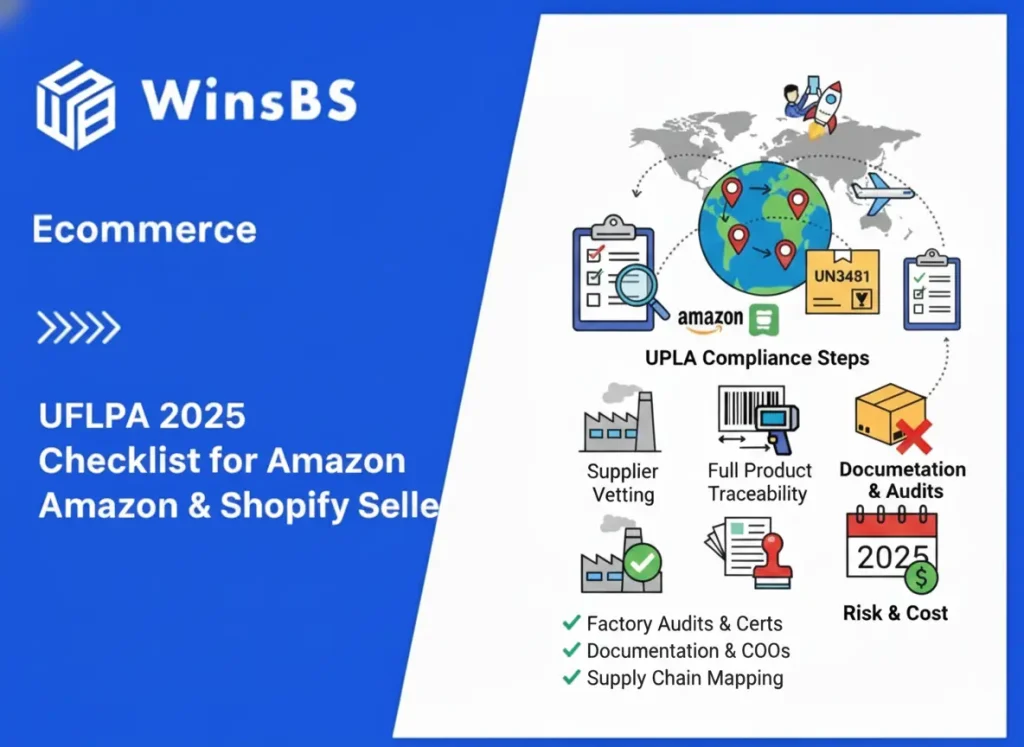
WinsBS logo and blog title "UFLPA & Amazon FBA Guide 2025: Zero-Detention Logistics Playbook" beside an illustration showing compliance documents, global trade routes, and supply chain traceability icons, symbolizing 3PL order fulfillment and efficient FBA logistics under UFLPA regulations.
Ecommerce, Order Fulfillment

UFLPA & Amazon FBA Guide 2025: Zero-Detention Logistics Playbook

UFLPA & Amazon FBA: The 2025 Playbook for Zero-Detention Logistics A 7-Layer Defense Model for Sellers Targeting 0% Detention Rate WinsBS Fulfillment Research Team – Michael November 2025 Executive Summary TL;DR The 2025 enforcement cycle eliminated the Substantial Transformation loophole and shifted Amazon FBA detention risk from apparel to metals and lithium compounds. Vietnam and Thailand are no longer “safe” alternatives; CBP now follows the origin of the raw input, not the country of assembly. This playbook outlines the 7-layer Zero-Detention Framework used by multiple 8-figure Amazon brands maintaining less than 0.5% detention rate in 2025. Since early 2025, CBP and DHS/FLETF have intensified UFLPA enforcement across all FBA-bound supply chains. Over 16,700 shipments have been detained since mid-2022, totaling an estimated 3.7 billion dollars in restricted goods. A record 78 new entities were added to the UFLPA Entity List in the past 18 months, including a large-scale update in January 2025 affecting upstream metals and battery materials. For many sellers, the legacy strategy of shifting final assembly to Vietnam, Thailand, or Malaysia no longer mitigates risk. CBP now evaluates the “economic nationality” of a product based on its mineral or chemical origin — steel billet, copper cathode, lithium hydroxide, aluminum ingot, PVC resin — regardless of where the finishing assembly occurred. The combined tightening of UFLPA audits, Entity List expansion, and risk profiling of transshipment routes has created a new operational baseline for Amazon FBA importers. Traceability must now be batch-level, supplier declarations must be transaction-specific, and freight forwarders must maintain verifiable detention statistics to avoid unnecessary holds during Q4 and Q1 peak seasons. This report provides a structured 7-layer framework to help Amazon sellers, direct-to-consumer brands, and global exporters maintain zero-detention logistics in 2025 and prepare for DHS/FLETF 2026 updates. 2025 Enforcement Reality: What Changed and Why Legacy Playbooks Died By early 2025, CBP fully closed the Substantial Transformation workaround. Sellers relying on “final assembly in Vietnam or Thailand” discovered it no longer protects inbound FBA shipments from UFLPA detention. Origin now follows the mine, not the factory floor — meaning any product containing upstream materials traced to restricted regions remains prohibited regardless of downstream assembly. Enforcement volume has surged across metals, battery materials, and industrial inputs. CBP and DHS/FLETF data show a rapid shift in the profile of detained commodities as upstream minerals became the dominant signal in risk scoring models. 2025 Enforcement Snapshot Over 16,700 shipments detained since June 2022 Total estimated value exceeding 3.7 billion dollars 144 entities on the UFLPA Entity List, including 78 added in the past 18 months A major update in January 2025 added 37 upstream mining and processing entities Top flagged origins in 2025: China (#1), Vietnam (#2), Malaysia (#3), Thailand (#4) Transshipment now increases — not decreases — risk scoring The acceleration of metals enforcement, especially in steel, copper, and lithium compounds, has caught many Amazon sellers unprepared. These products typically pass through multiple tiers of suppliers, most of whom cannot provide raw-material provenance without a structured documentation system. 2025 Risk Velocity: Where Detentions Are Actually Moving Sector 2023–2024 Share 2025 Risk Velocity Why It Matters Cotton & Apparel ~45% Baseline Zero-tolerance is permanent; predictable but still strictly enforced Steel (New Priority) Less than 1% Explosive Growth Shelving, cookware, tools, auto parts — large spike in upstream-material detentions Copper (New Priority) Less than 1% Explosive Growth Wiring harnesses, electronics, plumbing fixtures — materials traced to upstream cathodes Aluminum ~6% High Increase Frames, foils, cookware — new mining entities added to the list Lithium / Batteries ~4% Sharply Targeted Power banks, EV accessories, toys — increased upstream hydroxide tracing PVC & Plastics ~5% Rising Vinyl flooring, shower curtains, packaging — resin tracing required Polysilicon / Solar ~12% Moderate Decline Share shrinking as metals rise — but still heavily policed Red Dates / Agri Negligible Emerging Early-stage enforcement expansion into agriculture Takeaway: Apparel is now “routine enforcement,” while metals and lithium compounds have become the silent drivers of new detentions — primarily because most sellers lack Tier-2 and Tier-3 documentation for these inputs. The 2025 Zero-Detention Framework: The 7 Layers Used by 8-Figure Brands Across Amazon FBA and cross-border ecommerce, the brands consistently maintaining less than 0.5% detention rate in 2025 all follow the same seven-layer system. This framework operationalizes UFLPA compliance into repeatable, shipment-level processes rather than one-time supplier paperwork. 1. Supplier Governance — Contractual Lockdown Every Master Service Agreement and Purchase Order includes a mandatory UFLPA/ESG addendum. Tier-1 suppliers must disclose Tier-2 and Tier-3 sourcing for all high-priority inputs (steel, copper, lithium, PVC, aluminum). Annual CBP-format Supplier Declaration is required, but not accepted as sufficient for shipment clearance. 2. Transaction-Level Traceability — The New Minimum Standard Annual certificates are now rejected by CBP. Each shipment requires a batch-tied packet: Raw-material invoice with batch or lot number Exact origin province or administrative region Third-party due-diligence report addressing forced-labor indicators Batch-linked Certificate of Origin or sworn statement 3. Four-Way Perfect Alignment (Non-Negotiable) These four fields must match exactly across all documents: Physical product label Commercial invoice Packing list Amazon ASIN “Country of Origin” field Province-level detail is now expected (e.g., “Guangdong Province, China”). 4. Freight Forwarder as Insurance Only work with forwarders that publish detention rates by commodity. Less than 1% detention on your category is the benchmark. Forwarders must be able to document routing integrity for Q4 peak season. 5. Document Readiness — Never Pre-Submit to Tier-1 Seller Support Proactive Amazon cases trigger mis-flags in 2025 more than any other behavior. Correct procedure: Prepare one encrypted ZIP (20 MB or less) per shipment. Upload only when the official request is generated — within two hours. 6. Real-Time Early-Warning Stack Top performers use automated signals: Helium 10 and Jungle Scout Sellerboard or API-connected dashboards Slack or Telegram alerts for “Reserved – Compliance Review” events 7. Quarterly Independent Audits — The Actual Competitive Moat Performed by Verité, Elevate, UL Responsible Sourcing, or Arche Advisors. Top sellers audit their 10 most important suppliers every 90 days. Rebuttal success rate rises from 35%

Illustration showing global crowdfunding reward shipping with a lithium battery warning package, supporter group icon, world map with airplane, and compliance checklist beside WinsBS logo and title, symbolizing safe and compliant 3PL order fulfillment for eCommerce crowdfunding.
Crowdfunding Fulfillment, Order Fulfillment, Shipping & Logistics

Lithium Battery Compliance for Crowdfunding Rewards

Lithium Battery Compliance for Crowdfunding — 2025 Guide The Hidden Risk Behind Global Rewards Shipping A Practical Playbook for Kickstarter, Indiegogo & Gamefound Creators WinsBS Fulfillment Research Team – Maxwell Anderson November 2025 Executive Summary Overview: Battery Compliance Is Now the First Gate in Global Rewards Shipping If your Kickstarter or Indiegogo campaign includes any type of lithium battery—built-in, removable, or simply sitting inside the box—your project enters one of the most heavily regulated categories in cross-border shipping. Kickstarter’s 2025 tech review shows that over 30% of electronics campaigns contain lithium batteries, yet most creators only learn the rules after a carrier rejects pickup or customs stops an entire batch. Lithium batteries aren’t “hard” to move. They’re hard to move when the documentation isn’t aligned with aviation and customs rules. A factory safety test does not guarantee air approval. Air approval does not guarantee customs approval. And clearing customs doesn’t automatically authorize delivery into 80+ countries. This guide distills what WinsBS has learned from 500+ battery-inclusive crowdfunding projects (2023–2025): from paperwork mismatches that caused last-minute refusals, to route failures in the EU and Australia, to full recovery operations that brought delayed shipments back on track. If your priority is simple—delivering rewards on time without upsetting backers—this is the reference U.S. creators wish they had before launch day. Core Findings: Where Battery Projects Fail—and Why Factory tests ≠ transport compliance: Factories test for product safety, not aviation laws. Expired or outdated UN38.3/SDS files remain the single biggest reason DHL, UPS, and FedEx refuse battery shipments. Section 321 suspension increases manual checks: As of Aug 29, 2025, 321 de minimis is suspended for commercial imports. Battery products are now pulled for inspection far more often—even if the shipment value is low. Acceptance varies dramatically by region: Hong Kong and Taiwan handle battery parcels reliably. U.S. warehouses face stricter outbound checks. Australia requires mandatory SoC restrictions and performs frequent inspections. Documentation mismatches drive 15–20% failure rates: Incorrect Wh declarations, wrong HS codes (especially 8507), outdated SDS formats, and missing labels are the most common triggers for EU/UK/AU delays. Crowdfunding ≠ ecommerce: Shipping to 60–120 countries in a single wave multiplies compliance touchpoints that normal Shopify or Amazon operations never see. The point many creators miss: delays rarely come from the battery itself—they come from paperwork sequencing, packaging decisions, and route selection. Key Recommendations: How Creators Avoid Battery-Driven Delays Step 1 — Run a pre-launch compliance check: Validate UN38.3 (100Wh batteries. 9/10 Taiwan → U.S./EU Stable outbound inspection; predictable battery handling; high reliability for mid-sized campaigns. Slightly slower EU processing; limited postal flexibility for battery parcels. 8/10 Mainland China → Direct Air Strong price competitiveness; deep manufacturing integration; fast entry for U.S.-bound shipments. Strict document checks; higher “documentation mismatch” returns; occasional route downgrades to ground. 5/10 EU Hubs (Germany / Netherlands / Belgium) Germany = consistent, stable inspections. Netherlands = flexible battery handling. Belgium = strong for EU DDP flows. Occasional HS 8507 flagging; EU states differ in supplemental SDS requests. 7/10 Australia Predictable once accepted; ideal for local backers requiring ground-based redistribution. Extremely strict lithium rules; mandatory SoC limits; high return rate if labels aren’t perfect. 3/10 Canada Strong U.S.–Canada routing; predictable ground networks; smooth processing under 100Wh. Supplemental SDS requests for >100Wh batteries; inconsistent peak-season inspections. 6/10 Key Takeaway: The “correct” route isn’t the cheapest — it’s the one that aligns with your battery type, documentation, and target countries. Using a hub with strong lithium acceptance (HK/TW) dramatically lowers the chance of mid-route rejections or customs delays. 7 Common Battery Compliance Pitfalls in Crowdfunding (With Real Cases) Even well-prepared campaigns run into battery issues—not because the product is unsafe, but because global carriers and customs offices expect paperwork, labeling, and routing to match their exact standards. After supporting hundreds of battery-inclusive Kickstarter and Indiegogo projects, these are the seven failure patterns we see most often. The 7 Pitfalls That Derail Battery Shipments Pitfall What Actually Happens Typical Impact on Creators 1. No UN38.3 Report Carrier system flags the battery as untested; DHL/UPS refuse pickup immediately. Shipment returned to origin; creators lose 1–2 weeks and pay $1K–$3K in fees. 2. Expired UN38.3 Batteries technically “safe,” but treated as unverified if report is older than 12 months. Warehouse hold + reinspection; backers receive delays of 2–6 weeks. 3. SDS Not in GHS Format UPS/FedEx instantly reject outdated SDS templates from factories. Forced reissue of SDS; campaign loses 5–10 days during relabel and reapproval. 4. Missing or Incorrect IATA Battery Labels Cargo inspectors flag parcels; route gets downgraded from air → ground. Shipping times double; costs increase 15–30% depending on lane. 5. Wrong Watt-Hour (Wh) Declaration Carrier reclassifies shipment as “hazmat” or forces manual verification. Unexpected hazmat fees; 7–14 day delay; EU lanes heavily impacted. 6. Using Postal Routes That Don’t Accept Lithium National postal networks reject or destroy parcels containing lithium batteries. Zero recovery—backers never receive their rewards; campaign absorbs full loss. 7. Wrong HS Code (Especially 8507) EU/UK systems trigger extra checks or override DDP; backers are asked to pay duties. Backer frustration spikes; refund and support workload increases dramatically. Key Takeaway: These seven issues have almost nothing to do with the product itself. They’re paperwork, labeling, and routing decisions — and all of them are preventable with proper pre-shipment audits and a 3PL that understands global battery workflows. How a Specialized Crowdfunding 3PL (Like WinsBS) Prevents All These Issues Battery-inclusive campaigns don’t fail because creators lack effort — they fail because global carriers, customs offices, and regional hubs follow different playbooks. A standard ecommerce 3PL isn’t built for this. Crowdfunding requires workflows that anticipate document gaps, label mismatches, route restrictions, and country-by-country variations before shipments ever move. WinsBS built dedicated SOPs for Kickstarter, Indiegogo, and Gamefound campaigns from 2023–2025. The table below summarizes how these workflows directly neutralize the most common failure points. How WinsBS Removes Battery Shipping Risk Issue WinsBS SOP Outcome Missing / Expired UN38.3 Pre-flight document audit; expiration check; factory coordination to reissue compliant reports. Prevents DHL/UPS/FedEx rejection;

Illustration of safe shipping for electronics and battery products beside WinsBS logo and title, showing packages with lithium battery warning labels, airplane, truck, security scanner, and warehouse, symbolizing compliant 3PL fulfillment and order fulfillment services.
Ecommerce, Order Fulfillment, Shipping & Logistics

Safe Shipping for Electronics & Battery Products (2025)

Safe Shipping for Electronics & Battery Products (2025) Compliance, Cost Mitigation & Fulfillment Risk Control WinsBS Fulfillment Research Team – Michael November 2025 Executive Summary TL;DR Since January 1, 2025, the IATA Dangerous Goods Regulations (DGR), 66th Edition has been fully enforced worldwide, tightening compliance for UN38.3 testing and UN 4G/Class 9 certified packaging of lithium batteries and electronic products. This report reviews the first year of enforcement, analyzes real-world seller data, and provides practical insights for sustained compliance as the industry prepares for the upcoming 67th Edition in 2026. Since its enforcement at the start of 2025, the International Air Transport Association (IATA)’s Dangerous Goods Regulations (DGR) 66th Edition has redefined the operational baseline for shipping electronics and lithium batteries (UN 3481/3091). Carriers and customs agencies have reinforced documentation audits, demanding verified UN38.3 test reports, UN 4G/Class 9 certified outer packaging, and valid Safety Data Sheets (SDS, formerly MSDS) for every declared consignment. Over the first three quarters of 2025, B2B exporters and fulfillment centers reported higher inspection rates but lower rejection ratios—evidence that standardized documentation and packaging are reducing overall risk. However, compliance gaps remain for smaller exporters and crowdfunding projects, especially those lacking familiarity with multi-modal requirements under both air (IATA) and sea (IMDG) frameworks. In parallel, the U.S. Pipeline and Hazardous Materials Safety Administration (PHMSA) has already begun enforcing enhanced battery isolation standards, requiring 5 cm (2 inches) non-conductive spacing or certified fire-resistant partitions for lithium shipments stored or processed domestically. This report, compiled by WinsBS Research using aggregated 2024–2025 operational data, summarizes key compliance outcomes observed during the first implementation year of the IATA DGR 66th Edition. It also highlights emerging regulatory themes—such as digital traceability and the EU’s upcoming Battery Passport requirement under Regulation (EU) 2023/1542 —to help B2B sellers prepare for the transition to the 67th Edition in 2026. Key Regulatory Shifts & Risk Areas in 2025 Electronics Shipping Compliance Throughout 2025, the global compliance landscape for electronics and lithium-battery shipments has evolved significantly. The IATA Dangerous Goods Regulations (DGR), 66th Edition and the U.S. PHMSA battery isolation directive have reshaped how B2B exporters handle documentation, packaging, and transport classification. These updates, now fully enforced, demand operational precision and continuous monitoring to avoid costly detentions and rejected shipments. Below are the most notable regulatory shifts and risk areas identified by WinsBS Research during the first year of enforcement: Mandatory UN38.3 Verification: Airlines and customs authorities now require verified UN38.3 test reports before accepting any lithium battery shipment. Non-certified cells or missing summaries have led to repeated detentions in Hong Kong, Frankfurt, and Los Angeles hubs (2025 Q2 data). UN 4G/Class 9 Certified Packaging: The DGR 66th Edition mandates all packages containing lithium batteries (UN 3481/3091) to use UN 4G/Class 9 outer cartons. Carriers have reported a 15% decrease in damage incidents, but inspection frequency increased by 20%. SDS (Safety Data Sheet) Validation: SDS (formerly MSDS) documents must align with the GHS chemical classification system. Outdated SDS versions have been a primary cause of customs delays across EU ports. PHMSA 2025 Isolation Rule: Since July 2025, U.S. warehouses processing lithium shipments must apply 5 cm (2 inches) spacing or certified fire-resistant dividers to prevent thermal propagation. EU Battery Regulation (EU) 2023/1542: The first enforcement phase introduces the concept of a “Battery Passport” for traceability and recycling compliance. Sellers distributing to EU markets should prepare digital product records by mid-2026. These changes highlight a clear trend: global regulators are prioritizing documentation transparency and packaging integrity over shipment volume. Compliance audits have increased across both air and sea freight, emphasizing preventive validation instead of post-shipment correction. The table below summarizes the most impactful regulatory adjustments observed in 2025: Regulatory Area 2024 Baseline 2025 Enforcement Status Operational Impact for B2B Sellers UN38.3 Testing Accepted manufacturer declaration Mandatory verified test summary per shipment Documentation workload ↑ 30%; detentions ↓ 25% with proper verification UN 4G/Class 9 Packaging Recommended for bulk lithium shipments Now mandatory for all lithium-inclusive devices Packaging cost ↑ 8–12%, but insurance claims ↓ 20% SDS Documentation MSDS accepted under legacy format GHS-aligned SDS required, reviewed at customs Ensure SDS issue date ≤ 12 months to avoid clearance hold PHMSA Isolation Standards Advisory only Mandatory 5 cm (2 in) separation or fire-proof divider Warehouse retrofitting needed; improves safety compliance ratings EU Battery Regulation Not enforced Phase I: traceability & passport framework launched Requires data infrastructure for 2026 digital Battery Passport The 2025 data shows that early adopters of standardized documentation and certified packaging achieved higher on-time delivery rates and lower claim ratios. Sellers who continue using outdated formats face growing risks of refusal or surcharge penalties as regulators move toward the 67th Edition (2026). Practical Compliance Checklist for Electronics & Battery Shipments — Lessons from 2025 Enforcement Before shipping electronics or battery-powered products, a quick compliance check can help you avoid costly rejections or detentions. This 5-minute self-assessment summarizes the most common issues flagged under the IATA Dangerous Goods Regulations (DGR), 66th Edition and U.S. PHMSA 2025 requirements. Use it to confirm that your documentation, packaging, and labeling meet current standards before dispatch. The following questions will help you assess potential compliance risks in your fulfillment workflow: UN38.3 Test Verification: Has every lithium battery (UN 3481/3091) been tested and documented with a valid UN38.3 Test Summary? Missing test proof remains the leading cause of shipment refusals. Packaging Certification: Are you using UN 4G/Class 9 certified outer packaging with clear hazard labels and handling marks? Generic cartons no longer meet IATA 66th-Edition standards. SDS Accuracy: Does your Safety Data Sheet (SDS, formerly MSDS) follow the GHS format and include the most recent issue date? Customs authorities in the EU and U.S. now verify SDS validity upon inspection. Review your shipment against the checklist below to determine risk exposure and recommended next steps: Compliance Check What to Verify Risk Level Recommended Action UN38.3 Test Summary Missing or expired test report for lithium batteries High Obtain a valid test report from a certified lab (e.g., TÜV, SGS) before shipping. Attach the summary to your documentation pack. UN 4G/Class 9 Packaging Outer carton lacks UN marking or Class 9 hazard label High Switch to UN-certified packaging and ensure Lithium Battery Marks (120 × 110 mm) are printed and placed on two opposite sides. Safety Data

Global map with shipping routes, lithium battery warning packages, smart devices, warehouses, and logistics staff beside WinsBS logo and title, symbolizing 3PL fulfillment and cross-border order fulfillment for electronics and IoT brands.
Ecommerce, Order Fulfillment, Shipping & Logistics, Winsbs

Top 10 Global 3PL Solutions for Electronics & IoT Brands (2025)

Best Global 3PL Solutions for Electronics Brands (2025) ESD-Safe Fulfillment & Worldwide Delivery for Tech, IoT & Hardware Startups WinsBS Fulfillment Research Team – Maxwell Anderson November 2025 In 2025—a defining year for global supply chain realignment—the electronics and tech hardware sector has become one of the fastest-growing categories in e-commerce, reaching a market size of over $1.3 trillion. For startups and SMBs manufacturing in China, Vietnam, and Southeast Asia, this surge brings both extraordinary opportunity and new logistical pressure—especially in electronics fulfillment and cross-border delivery. The central challenge? High-value electronics require speed, compliance, and precision. While global buyers expect 2–5 day delivery with full tracking, brands are now facing complex customs clearance, UN3481 lithium battery restrictions, and rising freight surcharges across major trade lanes. In 2025, the average landed cost for small electronics shipped from China has risen by 10–18%, making it harder for emerging hardware brands to stay competitive. Many 3PLs still rely on outdated systems or fragmented regional networks—leaving gaps in serial-number tracking, DDP (duties paid) billing, and ESD-safe warehousing. These oversights can lead to damaged goods, customs delays, or unexpected post-shipment costs. For electronics brands and IoT device makers, finding a 3PL partner experienced in global electronics fulfillment—from Shenzhen to New Jersey—has become mission-critical. That’s why we’ve compiled this global analysis. It’s written for hardware founders, crowdfunding innovators, and direct-to-consumer tech brands who want to simplify fulfillment from Asia to North America and Europe— with transparent DDP pricing, prepaid duties, and optimized delivery performance. Why now? 2025 marks the acceleration of cross-border electronics logistics and 3PL digitization. Data from WinsBS Research’s 2025 Fulfillment Study shows that brands leveraging 3PL networks with multi-region hubs achieve up to 98% on-time global delivery and save 20–30% in total landed cost through consolidated DDP routes from China and Hong Kong. Our report identifies the unique challenges in this field—lithium battery compliance (UN3481), high-SKU component management, temperature and ESD-controlled storage, and international warranty returns. Whether you’re launching an IoT gadget, audio accessory, or consumer electronics line, you’ll find scalable electronics fulfillment solutions to ship faster, reduce duties risk, and expand globally from your Asian supply base. Let’s dive in. Electronics 3PL Selection Methodology A compliance-first and data-driven framework helping global electronics and IoT brands—especially those manufacturing in Asia—identify 3PL partners that deliver safety, efficiency, and scalability. Built from WinsBS Research’s 2025 Electronics Fulfillment Study. 1. Core Principle — Compliance → Cost Efficiency → Scalability Selecting a 3PL for electronics fulfillment isn’t just about moving boxes—it’s about protecting assets, complying with regulations, and optimizing cost-to-serve across borders. WinsBS Research recommends a three-tier selection logic specifically designed for electronics, tech hardware, and IoT device brands: Compliance: Can the provider handle UN3481 lithium batteries, ESD-safe warehousing, and export documentation? Cost Efficiency: Can it offer predictable DDP pricing and consolidated shipping from China or Hong Kong? Scalability: Does the system integrate easily with your e-commerce platforms and adapt to multi-market expansion? 2. Electronics Supply Chain Challenges & Required 3PL Capabilities Electronics fulfillment faces unique operational risks—compliance, damage prevention, and cross-border complexity. The following matrix maps the top five challenges against the 3PL capabilities essential for global electronics fulfillment. Supply Chain Challenge Typical Manifestation Required 3PL Capability Compliance & Certification UN3481 lithium battery handling, export documentation, customs audits Certified hazardous goods handlers, automated export paperwork, DDP model with pre-cleared customs Fragility & ESD Protection Shock-sensitive electronics damaged in transit or storage ESD-safe packaging zones, anti-static shelving, climate & humidity-controlled warehouses Cross-Border Complexity Long lead times, tariff uncertainty, and multiple customs points Consolidated DDP routes from China, real-time customs tracking, regional bonded warehouse network High SKU & Serial Tracking Product traceability, warranty, and after-sales requirement WMS with serial number tracking, batch recall functions, and traceable inventory APIs Return & Repair Flow Warranty repairs, DOA returns, component exchanges Integrated reverse logistics with QC inspection, repair & refurbish lines, and international RMAs 3. Three-Step 3PL Evaluation Model (Weighting: 40% / 35% / 25%) ① Compliance — Certification & Safety Standards (40%) Certified to handle lithium batteries (UN3481) and restricted components? ESD-safe storage zones and anti-static handling procedures implemented? Full documentation for export/import: MSDS, CE, RoHS, FCC compliance? Prepaid duties (DDP) and customs clearance experience from China, Hong Kong, or Vietnam? Insurance and cargo protection policies for high-value electronics? ② Cost Efficiency — From China Fulfillment & DDP Optimization (35%) Supports hybrid models: factory-to-consumer (F2C), DDP cross-border, and local hub distribution? Offers tiered rate cards for startups and SMBs with low-to-mid volume shipments? Provides transparent billing for freight, pick-pack, packaging, and customs? Optimized multi-country delivery network: China → USA/EU/UK via 6+ hubs? Integration-ready with Shopify, WooCommerce, Amazon, TikTok Shop? ③ Scalability — Technology, Network & Support (25%) Global WMS integration with real-time tracking and AI-based routing? Dedicated account managers and multilingual support teams? Automated SLA dashboards with fulfillment accuracy KPIs? Ability to add hubs (US/EU/Asia) or switch fulfillment models as you scale? Data compliance with GDPR, CCPA, and cybersecurity frameworks? 4. Practical Application — From Compliance Screening to Proven Partner To implement this electronics 3PL selection methodology, WinsBS Research suggests the following step-by-step roadmap for brands exporting from Asia to global markets. Step Action Goal Step 1: Compliance Screening (Safety) Filter top 10 3PLs certified for UN3481, ESD, and cross-border DDP operations Eliminate non-compliant or regionally limited providers Step 2: Cost & Network Analysis (Efficiency) Compare shipping lanes from China/Hong Kong → USA/EU/UK; request detailed landed-cost breakdown Identify the lowest total cost per order with stable transit times Step 3: System Integration (Scalability) Validate WMS/OMS integration with Shopify, Amazon, and ERP systems Ensure data transparency and smooth sync across platforms Step 4: Pilot & Review Run a 30-day pilot shipping from China through two shortlisted 3PLs Measure on-time delivery, customs performance, and unit cost Top 10 Best 3PL for Electronics & Tech Brands (2025) Last updated: Nov 2025 A curated global comparison by WinsBS Research highlighting electronics-focused 3PL partners with proven capabilities in UN3481 compliance, ESD-safe warehousing, and DDP cross-border delivery from China. 3PL Company Electronics Focus Global Network

Illustration showing warehouse inventory, IPI score charts, ROI, and a calendar beside WinsBS logo and blog title, symbolizing Amazon FBA IPI management strategies for reducing AIS fees and maximizing ROI.
Ecommerce, Order Fulfillment

2025 Amazon FBA IPI : Avoid Aged Inventory Surcharge (AIS) & Maximize ROI

2025 Amazon FBA IPI Policy Deep Dive How to Avoid the Aged Inventory Surcharge (AIS) and Maximize Your ROI A Complete Guide for Shopify & FBA Sellers WinsBS Fulfillment Research Team – Michael November 2025 Executive Summary TL;DR You’ve hit your funding goal, but hidden fees in FBA could cost you thousands in excess storage and AIS penalties. WINSBS has helped thousands of US sellers avoid overpaying, reducing fulfillment costs by up to 30%. Read this 5-minute guide to avoid FBA AIS traps and save your margin. You’re a Shopify seller or FBA user, and your business is thriving. The excitement is high, and your customers are waiting. Now comes the real challenge: fulfilling your orders without draining your profits due to hidden Amazon fees. The new 2025 FBA IPI policy means your inventory management is more critical than ever. Incorrectly timed shipments or underestimating your storage needs can cost you significant extra fees, especially with the Aged Inventory Surcharge (AIS). You could end up spending 30%–50% more than expected, draining your profits. Amazon FBA is a vital platform for U.S. sellers, but it comes with its own unique challenges. From inventory limitations to the Aged Inventory Surcharge (AIS), managing your stock effectively is the key to avoiding unnecessary costs. That’s where WINSBS comes in. We’ve successfully helped over 3,000+ U.S. sellers (2025 YTD) optimize their FBA operations, saving them an average of 25% on fulfillment costs. This guide will walk you through the critical FBA IPI updates, how to avoid AIS penalties, and how WINSBS can help protect your margins. Key Changes in 2025 FBA IPI & AIS Risks – What You Need to Know The landscape for U.S. sellers is shifting in 2025 as Amazon updates its Inventory Performance Index (IPI) policy and introduces stricter regulations for the Aged Inventory Surcharge (AIS). Understanding these changes is crucial for managing your fulfillment strategy and avoiding unnecessary costs. Here are the key updates you need to be aware of: IPI Update Frequency: In 2025, the IPI score is now updated weekly instead of quarterly, which means your inventory health will be evaluated more frequently. This change requires proactive management to avoid penalties and keep your score above the threshold. Capacity Limits: Starting in May 2025, storage limits will be reduced to 5 months of forecasted sales, down from the previous 6-month threshold. This is especially important during peak seasons like Q4 to avoid exceeding storage limits. Aged Inventory Surcharge (AIS): AIS penalties now begin at 181 days, and the surcharge gradually increases as inventory ages. Proper inventory management is key to avoiding these increasing fees. With these updates, it’s more important than ever to ensure you’re working with a specialized fulfillment partner who understands the intricacies of Amazon’s new policies and how to avoid costly mistakes that could impact your bottom line. Below is a quick summary of the most important changes: Change 2024 Policy 2025 (Nov Update) Impact on Shopify/FBA Sellers IPI Update Frequency Quarterly Evaluation Weekly Refresh + Monthly Reset Real-time inventory monitoring is critical. Sync your data with tools like Zapier to stay ahead of changes. Storage Limits 6 months’ forecasted sales 5 months’ forecast (Effective May 2025) Reduced storage limits mean you’ll need to check your inventory regularly and plan shipments more frequently to avoid penalties. Aged Inventory Surcharge (AIS) Starts at 271 days Starts at 181 days Early action is required to clear excess stock before it incurs AIS penalties. Plan removals or sell off slow-moving items. Understanding these updates is the first step in adjusting your strategy to minimize risks and costs. Proper inventory management and timely actions can help you avoid unnecessary penalties and ensure that you are operating within Amazon’s rules. 5-Minute Self-Check: Is Your FBA Inventory on the AIS Path? You don’t have to wait for Amazon to surprise you with hidden fees. Take control of your inventory now before it’s too late. By performing this quick self-check, you can assess if your stock is heading straight for the Aged Inventory Surcharge (AIS) trap. The new 2025 FBA policies make inventory management more important than ever. With real-time IPI monitoring and smart inventory tools, you can stay ahead of any penalties and protect your bottom line. In this section, we’ll help you quickly assess your inventory for potential issues that could trigger AIS fees. Here are the key questions to consider: Excess Inventory: Do more than 20% of your stock have a shelf life of over 90 days? If so, you’re at risk of incurring high AIS penalties. Stockouts/Accurate Listings: Have you experienced stockouts for more than 3 days in the last 30 days? Low inventory accuracy can lead to penalties or restrictions. Sales Velocity: Are your products moving quickly? Slow-moving items increase the risk of higher AIS fees. Now, let’s dive into your self-assessment. Check your inventory against the following criteria: Inventory Check What to Look For Risk Level Suggested Action Excess Inventory More than 20% of stock over 90 days High Immediately remove excess stock from FBA or run a flash sale to move items quickly. Stockouts More than 3 days of stockouts in the last 30 days Moderate Replenish stock right away and make sure your listings accurately reflect current inventory levels. Sales Velocity Low sales velocity (under 60% sell-through rate) Moderate Run promotional offers or bundle products to boost sales and reduce slow-moving inventory. If your inventory check reveals any red flags, it’s time to act fast. Clearing out excess stock early will save you from unnecessary AIS penalties and keep your fulfillment costs under control. Use tools like WinsBS to sync your Shopify data with Amazon FBA and ensure your inventory is always up-to-date. Quick Fixes for Shopify-FBA Sellers: Emergency, Seasonal, & Long-Term Solutions Now that you’ve assessed your inventory and identified potential risks, it’s time to take action. In this section, we’ll go over some quick fixes to help you reduce AIS fees and keep your fulfillment costs in check. 1. Emergency Response: IPI

U.S. map with apparel items, warehouses, airplane, parcels, and money beside WinsBS logo and title, symbolizing 3PL fulfillment and order fulfillment solutions for apparel and fashion brands.
Ecommerce, Order Fulfillment, Winsbs

Top 10 Best 3PL Solutions for Apparel Brands (2025)

Best 3PL Solutions for Apparel Brands in 2026 10 providers worth comparing when returns, size curves, and channel mix start making apparel fulfillment harder to keep under control WinsBS Fulfillment Research Team RESEARCH & CONTENT | WINSBS April 2026 In Brief Apparel brands usually do not start shopping for a 3PL because warehouse theory suddenly got interesting. They start looking after too many returns, too many size and color variants, too much stock confusion, and too many ordinary order problems keep landing on the same few people. What this page is and what it is not This is a shortlist page for apparel teams trying to narrow the field. It is not a generic glossary, and it is not pretending every provider here is the same kind of fit. Some names belong because they look genuinely useful for apparel. Some belong because they are solid comparison points. That distinction matters. Table of Contents Why Brands Land Here How to Read This List 10 Apparel 3PLs to Compare Provider Notes What to Confirm Before You Sign Where to Go Next Why Apparel Brands Usually End Up on a Page Like This Most apparel teams do not come here at the beginning. They come here after the operation starts feeling heavier than it used to. The same stock issue keeps coming back. Returns take too long to get sorted. A simple color or size mistake turns into a support problem. Someone on the team starts saying, “We cannot keep doing this by hand.” That is why apparel selection is different from generic 3PL shopping. Apparel is not just cartons in and cartons out. It is variant depth, presentation standards, relabeling, kitting, return grading, and the awkward weeks where a launch or promo makes everything feel normal until the warehouse side suddenly is not normal anymore. If you already know you need an apparel-focused partner and want to see how WinsBS handles that work directly, start with the core apparel fulfillment services page. If you are still comparing options, stay here. This page is built to help you narrow the field without pretending every provider solves the same kind of problem. How to Read This 2026 Comparison Without Wasting Time No 3PL is “best” in the abstract. The real question is whether a provider is built for the kind of pressure your team is actually under. Some operations are better for small and growing DTC apparel brands. Some are better for larger omnichannel programs. Some are strong on general ecommerce reliability but are not really built around apparel-specific workflows. The filters that matter more than a polished sales page Does the provider look truly comfortable with apparel returns, variant complexity, and presentation-sensitive handling? Are they built for startup and SMB order profiles, or does everything about the public positioning point to enterprise onboarding? Do they explain how they handle DTC, wholesale, marketplaces, and value-added work such as relabeling, prep, or branded packaging? When public detail is thin, do they at least make their operating model clear, or are you expected to fill in the blanks on sales calls? Do they sound like an apparel specialist, or like a generalist that might still fit if your requirements are simpler? One important correction from the 2025 version: not every company on this list should be read as an apparel specialist. A few are here because they are still meaningful comparison points, not because they should automatically make every apparel shortlist. 10 Apparel 3PLs Worth Comparing in 2026 Treat this as a shortlist, not a leaderboard. The table is there to help you see who is built for what kind of apparel operation, where the likely tradeoffs sit, and which names deserve a real call versus a quick pass. Provider How They Show Up Publicly What Looks Useful for Apparel What to Watch For Best Fit WinsBS FulfillmentView apparel page Apparel-focused fulfillment with a clear DTC and launch-friendly posture. SKU-heavy apparel workflows, GOH handling, custom packaging, returns handling, and lower-friction onboarding for growing brands. You still need your own order profile, return behavior, and packaging requirements mapped before quoting means anything. Growing DTC apparel brands, launch-driven programs, and teams that need flexibility without a bloated rollout. Buske LogisticsView apparel page Long-established operator with an apparel page and special-handling positioning. Environmental control, SKU handling discipline, and a more infrastructure-heavy posture for apparel and footwear. Public minimums and commercial fit are not very explicit, so smaller brands may need to qualify quickly rather than assume fit. Premium apparel and footwear brands that care about operational stability more than a lightweight startup feel. eFulfillment ServiceView apparel page Lower-barrier ecommerce 3PL with a clear apparel offer. Friendly onboarding posture, simple terms, returns support, and a model that makes sense for early-stage brands. It is not the same kind of network story as larger distributed operators, so growth-stage brands should test how far the model stretches. Startups and smaller apparel brands that need a practical first outsourcing step. Red Stag FulfillmentView site Reliability-first general ecommerce 3PL with strong SLA language. Strong service discipline, accuracy-focused positioning, and useful benchmark value if you are comparing generalist operators. Red Stag publicly says it is not built to serve apparel companies as a primary category, so this is not an apparel-native recommendation. Teams benchmarking service discipline across generalist providers, not brands that need an apparel specialist first. ShipBobView apparel page Large ecommerce network with strong DTC familiarity. Distributed reach, integration depth, custom branding options, and a model many scaling DTC brands can understand quickly. Do not assume apparel returns logic, fee detail, or handling nuance from network size alone. Those points still need direct confirmation. Scaling DTC apparel brands that want nationwide speed and a familiar tech ecosystem. ShipMonkView apparel page Tech-led multi-channel 3PL with apparel positioning. B2B and DTC overlap, international posture, systems depth, and a broader operational surface for multi-channel apparel sellers. As with other larger operators, real fit depends on what your account actually gets, not just what the public page

Map of the United States with WinsBS 3PL warehouses, 30-day free storage, $0.80 flat-rate fulfillment, and nationwide delivery icons, representing flexible eCommerce 3PL fulfillment and order fulfillment services for SMBs in 2025.
Ecommerce, Order Fulfillment, Warehousing

Best 3PL for SMBs in 2026: Lower Fulfillment Costs, Faster U.S. Delivery, More Control

3PL for SMBs in 2026: How to Cut Fulfillment Waste, Keep Warehouse Control, and Avoid Hidden U.S. Logistics Costs Maxwell Anderson Fulfillment Strategy & SMB Operations Updated Mar 27, 2026 Older 3PL content for SMBs often ages badly because it over-focuses on headline pricing and under-explains what actually destroys margin: cross-zone shipping, excess storage, poor inventory placement, transfer fees, and weak operational visibility. In 2026, the right question is not just “what does a 3PL charge?” The stronger question is which fulfillment model helps an SMB control cost, improve delivery speed, and keep enough flexibility to scale without getting trapped by warehouse overhead. In This Article Why SMBs overpay Single-site vs multi-site How to evaluate a 3PL Related WinsBS reading TL;DR For most SMBs, the biggest fulfillment loss is not order volume. It is paying for the wrong warehouse model, the wrong routing logic, and the wrong fee structure. The best 3PL for SMBs in 2026 is the one that keeps U.S. fulfillment flexible, transparent, and operationally controllable. This matters more now because the U.S. Census Bureau’s quarterly retail e-commerce data shows ecommerce remains a large and growing share of retail activity. That means more brands are comparing U.S. fulfillment providers, but many still choose on headline fees instead of total operating cost. Why SMBs overpay for 3PL services Most SMBs do not lose margin because they picked a warehouse that was obviously expensive. They lose margin because the pricing model looked simple while the real cost stack stayed hidden. That usually shows up in five places: Cross-zone shipping when one site serves a national customer base. Unused storage capacity when a multi-site setup is too aggressive too early. Transfer fees and inventory imbalance across locations. Slow returns processing that drags down resale recovery. Low visibility into stock allocation, reorder triggers, and fulfillment exceptions. The SMB problem is rarely “we need more warehouses.” The real problem is “we need the right amount of warehouse coverage without paying enterprise-level waste.” That framing also fits how the broader U.S. market is moving. As ecommerce volume grows, fulfillment is no longer just a back-end function. It is tied directly to conversion, repeat purchase rate, and the cost of keeping delivery promises. Single-site vs multi-site fulfillment in 2026 The right 3PL setup for SMBs depends less on generic size labels and more on SKU count, order geography, stock turn, and delivery expectations. Model Best Fit Main Risk What to Control Single-site fulfillment Lean catalogs, region-heavy demand, tighter working capital Cross-zone cost on distant orders Routing logic, returns handling, and reorder thresholds Multi-site fulfillment National demand, higher order volume, delivery speed as a revenue lever Inventory fragmentation and transfer waste Stock splits, site-level velocity, and exception reporting Flexible warehouse network SMBs that want to start lean and scale selectively Requires stronger operational discipline When to add a site, which SKUs move first, and how service levels are measured When single-site still wins If your catalog is tight, demand is concentrated, and your order volume does not justify extra inventory duplication, single-site fulfillment can still be the right move. But it only works when the 3PL gives you enough control over routing, storage, and returns. WinsBS explored the strategic side of that in its analysis of whether warehouse order fulfillment really requires more warehouses. When multi-site starts to pay off Multi-site becomes commercially attractive when delivery speed improves conversion, when shipping distance is consistently eroding margin, or when customer geography is broad enough to support more than one inventory position. But the network only works if allocation is controlled well. Otherwise, the added site becomes an inventory tax. If you want a practical example, WinsBS’ U.S. ecommerce fulfillment case study for Nesugar is a more useful reference than generic 3PL marketing language because it ties warehouse structure back to delivery performance and returns outcomes. How SMB brands should evaluate a 3PL in 2026 Most comparison lists are too shallow. They compare brand names, not operating models. A stronger SMB evaluation framework asks the following: 1. Is pricing transparent beyond the headline fee? An SMB should care less about the first advertised number and more about what happens after receiving, storage, transfers, returns, relabeling, and carrier pass-throughs are included. WinsBS’ own 3PL fulfillment pricing page is a better benchmark format than vague “custom quote” language because it separates service categories and clarifies where pricing differs by warehouse context. 2. Can the warehouse model adapt as the business changes? SMBs need room to test, consolidate, expand, or rebalance inventory without treating every operational adjustment like a contract event. That is the real meaning of warehouse flexibility in 2026. 3. Does the 3PL improve delivery economics, not just parcel movement? A fulfillment provider should improve both service level and cost structure. If a 3PL speeds delivery but creates inventory drag, transfer waste, or poor returns economics, the win is incomplete. 4. Is the provider actually built for SMB operating reality? Small and midsize brands need shorter setup cycles, lower waste tolerance, and more visibility per SKU. Enterprise-style process without SMB-friendly control often produces the wrong outcome, even when the infrastructure looks impressive. 5. Are internal operations and external content aligned? If a provider talks about transparency, the content should show how costs, inventory, and warehouse decisions are actually managed. WinsBS’ 2025 U.S. fulfillment guide explaining what a 3PL is is useful here because it frames 3PL selection as a systems and execution decision, not just a warehouse rental decision. What old SMB 3PL content gets wrong The older version of this post leaned too hard on headline numbers and 2025 framing. That is weak in 2026 for two reasons: Fee language ages quickly when service scope, warehouse location, or product mix changes. Search intent has moved from “what is cheap?” to “how do I control U.S. fulfillment costs without losing speed and flexibility?” That is why this update shifts the page away from isolated fee claims and toward the broader commercial question: what kind of 3PL setup helps

Illustration of a red trap devouring packages and money beside WinsBS logo and title, representing hidden cost traps in U.S. crowdfunding fulfillment and 3PL order fulfillment.
Crowdfunding Fulfillment, Order Fulfillment

What’s Really in US Crowdfunding Fulfillment Cost Traps?(2025)

What’s REALLY in US Crowdfunding Fulfillment Cost Traps Kickstarter, Indiegogo & GameFound WinsBS Fulfillment Research Team – Michael October 2025 Executive Summary TL;DR You raise $100K. A bad fulfillment partner quietly drains $30K–$50K in hidden fees, delays, and damage. WINSBS has shipped 127+ US campaigns and cuts that bleed to under 25%. Read this 5-minute bunker to map every trap—and claim your free 20% savings audit. You’re a US creator who just crushed a crowdfunding goal. The money’s in. Backers are hyped. Now the real fight starts: getting every pledge into backers’ hands without torching your margin. Platform rules, order quirks, and rookie fulfillment picks can swing your total spend 30%–50%. One wrong partner = profit vaporized. Kickstarter and Indiegogo throw you global, multi-SKU chaos (hardware, swag, food). GameFound locks you into tabletop DNA (boards, tokens, stretch-goal add-ons). Each demands a precision-fit fulfillment partner—not a generic 3PL. That’s where WINSBS enters. We’ve fulfilled 127+ US campaigns (live dashboard data, 2025 YTD) and shaved **25% average cost** off every client. This guide is your field manual: visible fees, hidden black holes, platform traps, and the exact WINSBS specs that bullet-proof your profit. I. Fulfillment Cost Breakdown: Visible + Hidden Black Holes 1. Visible Costs: Platform Fees & Payment Rails (2025 Rates) Summary: These are the line items you can see on your platform dashboard—but only one of them is negotiable once the money hits your account. Cost Line Kickstarter (Generalist) Indiegogo (Generalist) GameFound (Tabletop Vertical) Platform Fee 5% of total raised (zero if goal missed) 5% (negotiable to 4%–4.5% on $500K+ raises) 5% (no category surcharges) Payment Processing 3%–5% + $0.20/tx($10-and-under: 5% + $0.08) 3% + $0.20/tx(withdrawal 0.5%–1%; PayPal cheaper) 3% + $0.20/tx(volume discounts on deluxe bundles) Special Add-Ons None (no extra for int’l) InDemand refund insurance (~1% of raise) Per-add-on split-shipment fee ($1.5–$2/order) WINSBS Payment Optimization Layer (post-platform payout): We are not a payment provider. We optimize your existing Stripe/PayPal via volume-pooled routing. 2.9% + $0.25/tx → 15%–25% savings. Zero setup. Calculate Your Savings → 2. Hidden Cost Black Holes: Platform-Specific Profit Leeches Summary: These silent killers routinely eat 20%–40% of net profit. WINSBS neutralizes 90%+ via AI-driven WMS and multi-node US warehousing. Kickstarter International Clearance Black Hole15%–25% customs surcharges on int’l shipments.WINSBS Case: Full FDA/HTS doc suite → $15K saved, 0.3% hold rate. Founder Time Drain200+ hours on order wrangling.WINSBS API sync → 80% time reclaimed. Indiegogo Surge PremiumGeneric 3PLs charge 200% rush on stretch-goal spikes.WINSBS 24h surge → $8K saved, zero premium. Refund CascadeLate ships → 40% refund rate.WINSBS co-share model → 5% refund rate. GameFound Packaging PremiumCustom tabletop boxes → 30%–50% above standard.WINSBS anti-crush cartons → $1.80/unit (vs $3.20) → $12K saved. Component Damage8%–12% in transit.WINSBS kitting + climate racking → ≤1.8%. II. Platform-Specific Trap Map Summary: These are the razor-sharp pitfalls unique to each platform. WINSBS turns them into profit multipliers—here’s the trap-to-triumph playbook. Kickstarter Compliance + Int’l Minefield Generic logistics blind to platform rules → customs seizures and 200%–300% freight spikes. WINSBS Shield: 99.7% int’l pass rate + 3 US nodes (East/West/Central). Cross-region savings: 40%. Lock In Compliance → Indiegogo Surge + Refund Quicksand Stretch goals spike 4x orders → 72 hours+ delays and 30%+ refund exposure. WINSBS Shield: 24h surge capacity + 50/50 refund co-share. Penalty-free, refund rate crushed to 5%. Test Surge Capacity → GameFound Tabletop Ops Deficit Standard 3PL can’t handle bundles → 15% mis-ships and 5%–8% damage eat. WINSBS Shield: Dedicated kitting line + climate-controlled racking. 97% accuracy, ≤2% damage guarantee. Get Tabletop Quote → III. WINSBS Selection Framework (100% Match) Summary: Stop guessing. This is the exact 3-part checklist every platform demands. WINSBS checks every box—starting at $0.80/order with 20% locked savings. Platform Core Requirement 1 Core Requirement 2 WINSBS Proof Kickstarter Compliance docs + int’l clearance mastery 3+ US warehouses (bi-coastal + central) FDA/HTS library 5 nodes → 95% 2–3 day delivery Indiegogo 24h surge response, 4× volume tolerance Refund co-share (damage/reship split) AGV-powered WMS 50/50 split → 35% lower refund burn GameFound Kitting line + multi-SKU bundle logic ≤2% damage SLA (humidity/crush-proof) Tabletop bundling station 1.8% avg damage + FSC cartons WINSBS 100% SLA Guarantee: Miss accuracy, speed, or damage targets? Full month’s fulfillment fee refunded. Claim Your Guarantee IV. Action Center: Cost Snapshot + Self-Audit Summary: One glance tells you where the money leaks. WINSBS plugs them all—with live data, instant answers, and a free audit that locks in your 20% savings. Fulfillment Cost Delta Snapshot (WINSBS Live Data) Line Item Kickstarter Indiegogo GameFound WINSBS Optimized Payment Processing 3.5% + $0.30 4% + withdrawal 3.5% + $0.30 2.9% + $0.25 Int’l Hold Cost 15–25% 10–15% N/A 0.3% Surge Premium N/A 200% N/A 24h Free Component Damage Rate N/A N/A 8–12% ≤1.8% Creator Self-Audit (WINSBS Instant Answers) Kickstarter English compliance docs?3+ US warehouses? WINSBS: Yes + Yes. Download Doc Pack Indiegogo Surge response SLA?Refund co-share? WINSBS: 24h + Yes (50/50). Run Surge Simulator GameFound Kitting line?Climate racking? WINSBS: Yes + Yes. Get Tabletop Quote Lock It In: Book Your Free Fulfillment Audit—20% savings report, zero cost. Book Audit Now WINSBS: 127+ campaigns. $0.80/order start. 97% accuracy.

Infographic showing circular hidden 3PL cost model with U.S. map, money bag, question mark, and gear icons beside WinsBS logo and title, representing hidden 3PL costs and order fulfillment solutions for U.S. eCommerce in 2025.
Ecommerce, Order Fulfillment

Top 5 Hidden 3PL Costs: Why They Hurt U.S. E-commerce & How to Fix Them in 2025

Top 5 Hidden 3PL Costs: Why They Hurt U.S. E-commerce & How to Fix Them in 2025 WinsBS Fulfillment Research Team – Michael October 2025 Executive Summary Core Challenge: How a Single $1.50 Accessorial Fee Can Cost Your Business $180,000 Annually For high-volume US-based e-commerce brands, third-party logistics (3PL) is the critical infrastructure enabling the two-day shipping and free returns consumers demand. However, for many growing U.S. eCommerce brands, profit erosion doesn’t come from base fulfillment fees—it comes from hidden accessorial charges buried deep in the fine print. Industry Insight: Logistics audit analyses indicate 92% of operators report unforeseen surcharges on returns cause a quarterly profit margin decline of 5% to 12%. This scale effect is astonishing: a trivial $1.50 surcharge per order, at 10,000 orders/month, is an annual profit drain of $180,000. This guide audits the five most predatory 3PL cost traps, offering contract negotiation and continuous auditing strategies to reclaim control. Top 5 Hidden Cost Traps in 3PL TOP 1: Storage Overages & Penalties: The FBA-Style Inventory Trap Summary : Base storage fees are rarely the issue—it’s the penalty structure behind them that silently doubles your cost. Hidden Cost Type The Problem to Watch For Mitigation Strategy (Contract Negotiation Focus) Long-Term Storage Surcharges Rates can double or triple past the 30-to-60-day “free period,” often with no cap, punishing slow-moving inventory. Negotiate Tiered Rates and Caps: Mandate a hard maximum rate cap. Require proactive WMS alerts (e.g., 15 days notice) for inventory nearing the overage threshold. Minimum Volume Commitments (MVC) You are billed for unused pallet or cubic foot capacity if your inventory falls below the required minimum. Demand Flexibility and Buffer: Negotiate a floating buffer zone (e.g., ±20% fluctuation). If penalized, negotiate paying only the “Service Fee Differential,” not the full unused fee. “Common Area” Allocation Fees Some contracts allocate non-storage costs (aisles, offices) proportionally, inflating your billable space by 10%–15%. Demand Transparency: Stipulate that storage fees must be based only on the actual footprint of your product shelves/pallets, excluding shared facility overhead. TOP 2: Accessorial Charges: The Carrier Surcharge Markup Time Bomb Summary : What really costs you isn’t the shipping fee—it’s the invisible surcharges you can’t see or control. Hidden Cost Type Core Content Mitigation Strategy (Operational Control Focus) Residential Delivery Surcharge (RDS) Rising fee (approx. $4.00–$5.35/piece) applied to residential orders (60% of US volume). A common target for 3PL markups. Third-Party Carrier Audits: Use audit software to verify the 3PL is NOT adding an administrative fee on top of the official carrier RDS. Use USPS Priority Mail for small residential parcels for lower or no RDS. Fuel Surcharge Markup A percentage fee based on carrier rates. 3PLs often add their own admin markup on top of the floating cost. Set Markup Cap: Negotiate to follow the official carrier fuel surcharge rate; prohibit any 3PL administrative markup. Require monthly reports based on the official EIA index. Dimensional Weight (DIM) Discrepancies DIM weight is greater than actual weight. Oversized packaging by the 3PL rapidly escalates your freight cost. Mandatory Package Engineering & Penalties: Enforce maximum acceptable packaging dimensions in your SLA. Include a penalty clause allowing you to charge the freight cost differential if excessive packaging leads to a carrier rate upgrade. TOP 3: Fulfillment & Labor Fees: Unexpected Manpower Bills Summary : Be wary of tasks vaguely defined as “extra labor”—they are often breeding grounds for hidden fees. Hidden Cost Type The Problem to Watch For Mitigation Strategy (Process & Documentation Focus) Inbound Prep Fees Charged if your shipment lacks necessary barcodes (UPC, GS1) or has incorrect palletization. Standard Operating Procedure (SOP): Provide a detailed Inbound SOP. Negotiate an initial grace period (e.g., first 5 shipments free adjustment). Only accept charges for non-compliance documented with photo evidence. Kitting & Re-Packaging Assembling gift sets or bundles. Rates escalate dramatically if the scope is temporarily modified mid-contract. Pre-Negotiate Rates: Define all potential kitting projects (e.g., 3-piece assembly) and set clear per-piece rates before signing. Avoid using temporary hourly labor rates unless absolutely necessary. Returns Processing Fees Cost to inspect, re-stock, and re-package returned goods. This is usually the highest variable cost. Tiered Returns Policy: Divide returns into clear Tiers (Tier 1: quick check/restock; Tier 3: refurbishment/cleaning). Negotiate a lower rate for Tier 1 returns, and aim for a total cost cap on Tier 3 processing. TOP 4: Contractual Fine Print: The Crucial Landed Cost Liability Clause Summary : Liability waivers written for the 3PL can force you to pay twice when inventory is lost. Hidden Cost Type Core Content Mitigation Strategy (Legal Review Focus) Inventory Shrinkage Liability Compensation typically defaults to Cost Price, not replacement or Landed Cost, for lost/damaged inventory. Negotiate to Landed Cost (Critical): Consult legal counsel. Negotiate compensation to cover, at minimum, Landed Cost (Cost + Inbound Freight + Duties). Define a shrinkage tolerance (e.g., 0.5% of total inventory); losses over this threshold must be the full financial responsibility of the 3PL. Early Termination Penalties Exiting a contract early (often 3 years) can trigger a massive penalty of 6 to 12 months of average service fees. Insert “Non-Performance” Escape Clause: Define clear, measurable SLA KPIs (e.g., 99.8% accuracy). Negotiate a clause allowing penalty-free termination if the 3PL fails to meet these KPIs for three consecutive months. IT/WMS Integration Fees Cost to connect your ERP/OMS (Shopify, NetSuite) to the 3PL’s WMS. Push for Fixed-Fee Agreements: Avoid hourly IT consulting rates. Negotiate a one-time, fixed implementation cost to prevent fee escalation due to unforeseen technical issues. TOP 5: Administrative & Management Fees: The Death of a Thousand Cuts Summary : Don’t let small, monthly “handling fees” bleed your long-tail profits. Hidden Cost Type Core Content Mitigation Strategy (Audit & Agreement Focus) Invoice Processing Fees A fixed monthly fee ($50–$200) to send you a bill or report. Consolidate or Waive: Negotiate to have this fee waived or included in the Minimum Monthly Commitment. If charged, demand only one consolidated master invoice per month to avoid multiple processing fees. Billing Discrepancy Surcharges Some 3PLs charge for the time

Diagram with green "Reduced Costs" arrow surrounded by icons of finance, growth, warehouse, trucks, and globe beside WinsBS logo and title, symbolizing 3PL fulfillment and order fulfillment cost reduction for mid-market sellers.
Ecommerce, Order Fulfillment

US Ecommerce 3PL Hidden Fees 2025: Don’t Let These Surprises Hurt Your Bottom Line

US Ecommerce 3PL Hidden Costs 2025: How Mid-Market Sellers Can Cut Logistics Expenses By 12-20% – A Systemic Study WinsBS Fulfillment Research Team – Maxwell Anderson October 2025 Executive Summary Overview: Unmasking 2025 US 3PL Hidden Costs In the $217.62 billion US 3PL market growing at 3.76% CAGR, mid-market ecommerce sellers ($1M-$10M revenue) are outsourcing fulfillment to streamline ops and scale efficiently. Yet, as WinsBS’s 2025 internal survey of 200+ clients reveals, surprise fees—storage premiums, return surcharges, and policy-driven add-ons—that swell costs 10-25% beyond quotes. Drawing from authoritative sources like the NTT DATA 29th Annual 3PL Study, Warehousing and Fulfillment 2025 Survey , Inbound Logistics 2025 Perspectives, and Forbes/Ryder analyses on ecommerce pitfalls, this report equips you with data-backed strategies to turn these challenges into competitive edges. Core Findings: The Hidden Toll and Hidden Opportunities Cost Structure Breakdown: Warehousing averages $0.4625/cubic foot/month (+12% YoY); order processing $3.25+/order. Traps like long-term premiums (1.5-2.5x) and returns (4-8% sales share) dominate, per Warehousing survey—WinsBS data shows mid-sellers losing $50K-$150K annually here. Policy Headwinds: $800 de minimis repeal (Aug. 29, 2025) surges DTC imports 8-15% (e.g., $10.9B consumer hit per Reuters); port strikes/delays add 15-80%; labor inflation (12-18%) passes through 6-10% via 3PLs. Seller-Specific Pressures: Seasonal ops bear 40-50% inventory burdens; high-return apparel totals 20-30% fees; small sellers hit 20-28% rates vs. large’s 10-15% (Inbound benchmarks). Bright Spots Amid Barriers: 3PLs report steady profit gains despite ops pressures; AI/automation trims labor 15-25%, unlocking scalable savings (NTT/Ryder). These insights aren’t just warnings—they spotlight leverage points where WinsBS clients have reclaimed margins through targeted audits and tech. Key Recommendations: Prioritized Path to 12-20% Savings WinsBS’s proven framework turns pain into profit—start with quick audits, scale to AI-driven ops: Immediate (1-2 Weeks): Launch contract audits with itemized quotes to expose 15-20% hidden fees; deploy cost alert systems targeting <15% sales ratio—our clients see $10K+ monthly recoups. Short-Term (1-3 Months): ABC inventory tweaks boost turnover, slashing storage 30-40%; standardize packaging and tier returns to cut fees 35-45%—ideal for seasonal/high-return flows. Mid-Term (3-6 Months): Vet multi-suppliers and integrate AI tools; buffer policies like nearshoring to offset de minimis shocks—59% adoption per Inbound yields 8-15% resilience. Expected ROI: Real Results for Mid-Market Growth Post-implementation, mid-market sellers achieve 12-20% logistics savings, per WinsBS benchmarks—translating to $50K-$150K annual gains while enhancing scalability. Full report details below. Ready to audit? Download our free WinsBS 3PL Cost Audit Checklist PDF tailored from internal 2025 data—empower your ops today. 1. Research Background and Objectives 1.1 Current State of the US Ecommerce 3PL Industry Development The rapid growth of the US ecommerce market is fueling the booming development of the third-party logistics (3PL) industry. According to the NTT DATA & Armstrong & Associates 2025 29th Annual 3PL Study, the US 3PL market is projected to reach approximately $217.62 billion in 2025, with a compound annual growth rate (CAGR) of 3.76%. This growth is driven by more ecommerce sellers opting to outsource fulfillment to professional providers to reduce operational costs and improve efficiency. The study shows that 89% of shippers report successful 3PL relationships (down 6% YoY), with 82% outsourcing freight spend and 61% warehousing; 82% say 3PLs enhance customer service, and 68% view them as innovation sources. However, behind the industry’s prosperity lies a harsh reality: many ecommerce sellers focus solely on surface quotes when selecting 3PL providers, overlooking substantial hidden costs. According to the Warehousing and Fulfillment 2025 Industry Survey (based on 600+ warehouses), actual logistics costs often exceed initial quotes by 10-25%. WinsBS 2025 internal data from 150 mid-market clients confirms this, with 65% reporting 12-18% overruns from unquoted surcharges. These differences stem from hidden fees like long-term storage premiums, special packaging, and return processing. The Inbound Logistics 2025 Perspectives Report notes 72% of 3PLs see operational costs as the top barrier, driven by labor inflation and add-ons; 69% report rising profits amid persistent pressures. The US logistics sector in 2025 faces unprecedented policy changes. The most impactful is the $800 de minimis exemption repeal, effective August 29, 2025, imposing duties on all non-postal imports ≤$800. NTT DATA highlights amplified supply chain shocks, projecting DTC return costs to $25-30/order (for $100 items) and boosting nearshoring adoption to 59%. This further complicates cost control for mid-market sellers. 1.2 Complexity of 3PL Cost Structures US ecommerce 3PL cost structures exhibit high complexity and diversity. Per the 2025 Warehousing and Fulfillment Survey, typical components include (2025 averages): Visible Cost Components: Cost Type 2025 Avg. Rate Trend Warehousing Pallet $20.17/month; Cubic Foot $0.4625/month; SKU-based +12% vs. 2024 Order Processing Picking/Packing $3.25+/order (B2C) +23% since 2017 Transportation Base + Fuel Surcharge (10-15%) + Zone Fees Peak Add-Ons 10-20% Return Processing $4.06/order 4-8% of Sales Monthly Minimum $500+ – Primary Hidden Cost Types (WinsBS 2025 internal survey: 70% mid-sellers hit by 2+ types): Long-Term Storage Premiums: >6 months incurs 1.5-2.5x rates (Ryder: Overall storage up 18%). Packaging Material Tiered Pricing: Irregular items +$1.5-3/order (Forbes: Poor packaging drives 15-25% damage costs). Inbound Processing Time Costs: Label issues add hourly fees (Forbes “Inefficiency Costs”: Human errors tie up 15-20% team time). Return Disposal Fees: Damaged items $0.5-1/piece (Forbes: 20-30% return rates erode 25-30% profits via reverse logistics). System Integration Fees: ERP-WMS one-time $500-2,000 + data transfer (NTT: Missing real-time data inflates scaling costs 12-15%). 1.3 Research Scope and Methodology This study comprehensively analyzes US ecommerce 3PL hidden costs, providing systematic control strategies for sellers. Scope: Mid-market ecommerce firms ($1M-$10M revenue), focusing on key aspects. Methodology: Literature Review: Collect/analyze WinsBS internal data, industry reports, academic papers, policy docs (integrating NTT 2025 3PL Study and Inbound scale analyses). Case Analysis: Deep dives into real cost structures across seller types. Cost Composition Analysis: Quantitative breakdown of hidden costs. Risk Assessment: Identify/evaluate key control risks (using NTT’s ADKAR change framework). Special emphasis on 2025 policy impacts like $800 de minimis repeal, port strikes, inflation. All sources (e.g., NTT DATA PDF, Warehousing data) are publicly traceable for rigor. 2. Comprehensive Analysis of 3PL Hidden Costs 2.1 Hidden Traps in Warehousing Costs 2.1.1 Long-Term Storage Premium Mechanism