
Kickstarter Fulfillment Timeline: What Delays Shipping From China to U.S. Backers After Production
If production looks done but you still cannot safely promise shipping dates, your timeline problem is probably not transit alone. It usually means the shipment is still changing hands before it is actually ready.
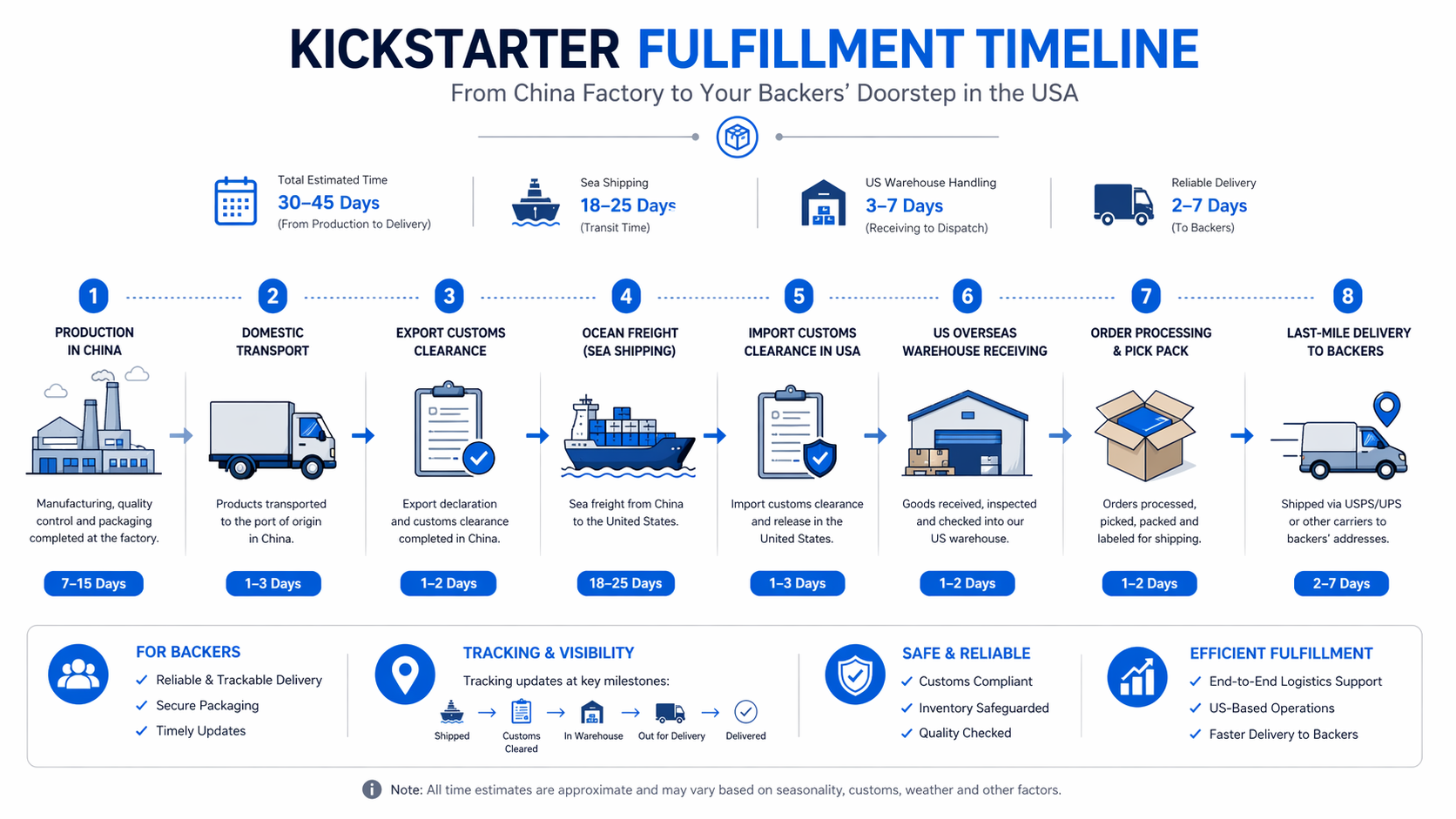
A Kickstarter fulfillment timeline from China to U.S. backers usually slips not because of ocean transit alone, but because the shipping file, carton details, routing, import plan, and warehouse release rules were not locked before freight moved. In plain English, the delay often starts before the vessel leaves, then becomes visible only when the freight team, customs, the U.S. warehouse, or backers force the next decision.
By now, three things should feel clearer
- Where the timeline is really stuck: whether the delay is still an upstream handoff issue or already a domestic execution issue.
- What to do before comparing providers: whether you should fix China-origin cleanup first or move on to a 3PL decision.
- What needs locking this week: the file, cartons, routing, import assumptions, and warehouse release rules that get more expensive if they drift.
Why It Gets Hard
You may already have a factory saying production is done, a forwarder asking you to book freight, and backers asking when shipping starts. If you still do not feel comfortable giving a real shipping date, the problem is usually not parcel speed yet. The problem is that the next handoff still is not closed.
If this stage feels harder to control than it should, that is normal. You usually are not late because one vessel is late. You are late because the shipment is still changing hands before it is ready for the next team.
Creators usually count the dates everyone can see: factory complete, vessel booked, inventory arrived, backers shipping soon. The expensive failures usually happen in the handoff gaps between those dates, when the next team realizes the shipment file, cartons, and release logic do not describe the same thing.
What the calendar shows vs what actually matters
What these terms really mean
- Shipping file: the factory, freight contact, and warehouse should all be looking at the same live version of what is in the shipment and how it is supposed to move.
- Carton truth: the cartons arriving at the dock should match the counts, labels, sizes, and weights everyone was told to expect.
- Route plan: this is the real landing path for the goods, the warehouse they feed, and the receipt window that plan is supposed to protect.
- Import plan: someone should already know how the goods clear, how duty or DDP is handled, and which assumptions are no longer allowed to drift.
- Warehouse release rules: before the first pallet lands, the warehouse should already know what can ship, what needs inspection, and what gets held or escalated.
- Your game is made in China and the project still has moving add-ons, bundle logic, or packaging questions after manufacturing looks close.
- You are trying to answer why the timeline still feels uncertain even though freight, import, or warehouse intake is already on the calendar.
- You need to decide what should be locked before factory release, before freight booking, and before U.S. warehouse receipt.
- Inventory is already fully imported, labeled, inspected, and stable inside the U.S.
- The real decision is now domestic 3PL speed, pricing, or support quality for a clean shipment.
- No meaningful China-origin file, freight, import, or packout risk remains.
If add-ons, SKU combinations, carton sizes, or packaging rules are still moving, you are not really in the freight stage yet.
If the shipment is booked but you still cannot tell backers what will ship, what will be held, and what the warehouse should do, the handoff is still open.
If import treatment, receiving instructions, or final backer timing are still moving during transit, the timeline is active, not settled.
If the warehouse might need to guess what is releasable, damaged, or mixed, the next delay will look domestic even though it started upstream.
Campaign close does not mean the shipping file is stable. Manufacturing complete does not mean packout and labels are final. Freight booking does not mean the route plan and import plan are settled. Ocean transit is not dead time if import prep, warehouse intake, and backer messaging are still moving. By the time the U.S. warehouse touches the goods, it is already late in the timeline, not early.
Stonemaier's fulfillment infographic is helpful here because it makes the sequence visible: manufacturing, freight, regional handoff, warehouse intake, then backer delivery. By the time the goods reach the warehouse, it is receiving the result of the earlier handoff. It does not get a cheap chance to redesign it.
That is also why "how long does fulfillment take from China?" often gets answered badly. The visible transit days are only part of the answer. A late shipping file looks like a freight delay only because the calendar is the first place the unfinished handoff becomes visible.
Freight movement, customs flow, drayage, warehouse appointment timing, and parcel execution for inventory that already matches its file.
Moving SKU maps, uncertain carton counts, label cleanup, route changes, unclear duty logic, and warehouse release rules that still live in separate inboxes.
The bottom line: The timeline is only as strong as its weakest handoff.
What Actually Controls the Timeline
If you are searching "How long does Kickstarter fulfillment take from China?", the honest answer is that the range widens or tightens based on what is still moving. The useful question is not only "How many days does it take?" It is "What must be locked before the next stage becomes expensive?"
If those handoffs are still open after production, the project usually does not add a few transit days. It adds hidden rework that can consume extra weeks.
| Timeline Variable | Usually Shorter When | Usually Longer When | The Real Question |
|---|---|---|---|
| Shipping file stability | SKU, add-on, and bundle logic stop moving before factory release. | Late pledge cleanup keeps changing the physical order profile. | Are you moving one final file or several almost-final versions? |
| Carton and packaging truth | Box counts, labels, and packaging rules already match the shipment. | Carton details drift after booking or visible damage rules are still unwritten. | Will the warehouse see the same shipment the factory says it shipped? |
| Routing lock | Port, lane, warehouse target, and receipt timing still fit one plan. | Freight is booked before intake timing and receipt ownership are settled. | Is the route supporting the plan, or replacing the missing plan? |
| Import readiness | Tariff, DDP, clearance ownership, and landed-cost assumptions are already aligned. | Import treatment is still being negotiated while the goods are moving. | Do customs and backer promises still describe the same shipment? |
| Warehouse release readiness | The warehouse has clear rules for ship, hold, inspect, escalate, and replace. | The U.S. team needs live interpretation to decide what inventory is releasable. | Can the warehouse act immediately, or does it need campaign archaeology? |
A mostly U.S., single-wave project with a frozen file, stable cartons, and a clean import and receipt plan usually stays on the shorter side of the range.
A heavy project with late add-ons or collector packaging usually stretches because the physical shipment keeps changing after the team wants the schedule to feel fixed.
If freight is booked before file cleanup is truly done, the timeline often looks committed on paper while the real handoff work is still unfinished.
If the goods are already moving but import treatment, warehouse rules, or backer timing are still open, the middle of the timeline stretches more than most creators expect.
Start with the variables that stretch or compress the timeline. Then look at what should already be locked at each stage. One view explains why similar campaigns move at different speeds. The other shows where the next mistake gets expensive.
| Stage | What Should Already Be Locked | What Can Still Move | Why It Matters |
|---|---|---|---|
| Campaign close / pledge cleanup | SKU map, add-on logic, and wave assumptions. | Address updates and the final shipping-charge timing. | Late file movement changes everything downstream. |
| Factory release prep | Carton truth, labels, and packaging rules. | Minor scheduling and release sequencing. | Weak packout turns into later rework and timeline confusion. |
| Freight booking | Route logic, intake target, and import assumptions. | Exact sailing date inside the lane plan. | Booking speed is not the same as route readiness. |
| Ocean transit | Import file, warehouse intake plan, and release ownership. | Limited communication details and final receipt sequencing. | This is still active planning time, not empty time. |
| U.S. warehouse intake | Release rules, damaged-unit logic, and replacement handling. | Small reconciliation or hold decisions. | The cheap correction points are mostly gone. |
| Outbound to backers | Support messaging, delivery expectations, and replacement flow. | Parcel execution details. | This stage exposes earlier mistakes faster than it fixes them. |
Is the timeline actually ready?
- Still upstream: the SKU file, carton list, and shipping promise would each tell a different story today.
- Transit is still active: import prep, intake instructions, or backer timing still depend on unresolved choices.
- Ready for warehouse speed: the warehouse can receive, release, and escalate exceptions without asking what shipment it is looking at.
- Warning sign: if freight is booked but the file still moves, the timeline is earlier than the calendar suggests.
Patterns that keep repeating
- Freight booked before file cleanup: the project looks scheduled, but the warehouse receives a shipment whose bundle logic still changed after booking.
- Transit treated as dead time: import notes, intake rules, and backer timing are left late, so the project "slips" after the goods already moved.
- Warehouse blamed for an upstream miss: intake slows because the cartons, labels, and release rules do not describe the same shipment.
- Packaging questions pushed to receipt: visible damage or collector-box thresholds are decided after inventory lands, when every correction costs more.
Where each fulfillment model helps most
- Software-led network: strong when the shipment is already clean and the team needs visibility, warehouse options, and repeatable routing across a larger network.
- U.S. warehouse SLA model: strong when inventory is already imported and stable, and the main promise is fast domestic receiving and outbound execution.
- China-plus-global convenience model: strong when the lane is straightforward and the project mainly needs easier forward movement across regions, not deep cleanup of a moving Kickstarter file.
- Where WinsBS helps most: earlier in the timeline, while packout, routing, import timing, and warehouse release rules still need to be made consistent before freight turns those gaps into cost.
What people often mix up before comparing providers
If a China-origin handoff problem gets treated like a domestic 3PL selection problem, the project usually pays for that mistake in more than one place.
- Freight booking vs route readiness: a vessel can be booked long before the project knows how the goods should land, clear, and feed the warehouse, so quote comparison keeps moving while the real blockers stay upstream.
- Warehouse speed vs shipment readiness: a fast U.S. warehouse can move clean inventory faster, but it cannot make an unstable shipment more legible, which is how low-cost cleanup turns into receiving exceptions and relabeling cost.
- Global coverage vs Kickstarter cleanup: a broad network still does not solve drifting SKU files, carton details, or release rules, and that mismatch usually gets blamed on the domestic side later than it should.
- Backer communication vs backer certainty: sending an update is not the same as having a timeline you can safely promise, and treating those as the same usually hides the cheapest correction point until it is gone.
Where the Timeline Usually Breaks
1. Campaign Close And File Movement
The timeline is already unstable if the file still moves after the team starts speaking as if fulfillment is scheduled. Heavy add-ons, collector components, split waves, and pledge-manager cleanup can all change the physical order profile after the campaign feels commercially complete.
Kickstarter's pledge-manager guidance is useful because it recognizes that final shipping charges may need to happen closer to fulfillment, once the physical and provider inputs are clearer. The commercial lesson is that fee timing should follow file stability, not replace it.
If the file is still moving, the timeline is still earlier than the calendar suggests.
2. Factory Release And Carton Truth
The timeline does not really move forward until the physical shipment is described correctly. Retail box dimensions, outer cartons, master carton counts, labels, and packout assumptions all have to match the actual goods leaving China. If they do not, every later stage works from a guess.
For tabletop campaigns, this usually gets sharper when packaging sensitivity is high. Premium boxes, trays, layered inserts, and visible corners all make carton truth more important because the warehouse cannot judge what is release-ready if the physical standard was never clearly written. For that upstream review, use the packaging standards page alongside the timeline plan.
The test is simple: not whether freight can move, but whether the shipment description is true.
3. Freight Booking And Routing Lock
A booked vessel is not a settled plan if route timing, port logic, intake timing, or import ownership are still being improvised. Freight speed matters, but it does not rescue a route that was booked before the project knew where the goods should land, how they would clear, or when the warehouse could receive them.
The Freightos Baltic Index guide is useful as a lane-volatility reference, not as a project quote. Route timing is a live decision, not a one-time email attachment.
Freight booking only counts as progress when route logic and intake timing still fit the same plan.
4. Ocean Transit And Import Prep
Ocean transit is still working time. Import documents, tariff or DDP assumptions, warehouse appointment planning, release ownership, and backer communication still need to converge while the goods are moving. If the team treats the middle of the calendar like empty time, it usually compresses the most important prep into the most expensive stage.
That is one reason creators underestimate the timeline. Transit looks passive on a chart, but the handoff is still alive. When import treatment or fee logic is unresolved, the calendar may look on track while the project is actually drifting.
Many teams get this part wrong: the middle of the timeline is active execution time, not waiting time.
5. U.S. Warehouse Intake And Release
The warehouse should receive release-ready inventory, not unresolved timeline work. It can count, inspect, quarantine, and escalate, but it should not have to rediscover the bundle map, invent damaged-unit thresholds, or decode mixed carton logic from separate inboxes.
If you are already worried the U.S. warehouse might need to save the schedule, read this together with the page on what U.S. warehouses can and cannot fix after China shipping. Most of the time, it is not slow warehouse labor. It is the warehouse becoming the first place an unfinished handoff gets exposed.
If intake has to discover the plan, the timeline was already wrong upstream.
6. Backer Communication And Final Shipping Timing
The backer feels the timeline at the point where cost, promise, and actual readiness stop matching. If the campaign locks a shipping table too early, or hardens a duty promise before import treatment is clear, the timeline pressure becomes a trust problem instead of only an operations problem.
BackerKit's shipping options and Kickstarter's tariff-surcharge guidance both support collecting certain costs closer to fulfillment. That flexibility is useful only when the physical shipment and import logic are becoming more stable at the same time.
Backer timing should follow execution readiness, not optimistic scheduling.
Situations That Change the Timeline
Mostly U.S. Backers, Single Main Wave
This is the cleanest version of the timeline, but it still fails if the team treats freight as the only long pole. For a mostly U.S. campaign, the biggest gain usually comes from locking the file, route, and receipt plan before freight becomes the longest visible stage.
Next to lock: confirm the final SKU map, carton truth, warehouse target, and release rules before the goods leave China.
Heavy Game With Late Add-Ons
Late add-ons distort the timeline because they change the shipment after the team has already started planning fulfillment. Weight, carton mix, shipping charges, and sometimes replacement reserve all move together. The pressure is not only calendar length. It is false certainty.
Do not lock yet: do not harden the shipping model or release timing until the add-on combinations stop moving.
Premium Collector Edition
Collector editions usually fail on packaging judgment before they fail on transit speed. If visible corners, lids, inserts, sleeves, or premium trays are part of the product experience, then packout and protection decisions belong before factory release, not at intake.
Next to lock: write the packaging standard and damaged-unit threshold before the shipment becomes a warehouse receiving problem.
Freight Booked But File Still Moving
This is one of the clearest signs the timeline is earlier than it looks. The team feels committed because the vessel is booked, but the real sequence is still incomplete if the bundle map, labels, or release rules remain open.
Next to lock: write the warehouse release rule, damaged-unit action, and hold logic before U.S. receipt, even if the freight move is already fixed.
Inventory Already In The U.S.
If inventory is already imported, labeled, inspected, and stable, the cross-border timeline problem may already be over. At that point the practical decision is often domestic warehouse fit, not China-to-U.S. execution design.
If the shipment is already stable in the U.S.: a domestic-only 3PL may be enough.
What this means for your project
For China-made tabletop campaigns, the real fulfillment timeline is the order in which decisions harden, not the order in which trucks or vessels move. If the file, cartons, route, import assumptions, and warehouse release rules do not harden in sequence, the schedule usually starts slipping long before the backer can see why.
You do not move freight first. You move decisions first.
A timeline is genuinely under control when the physical shipment, freight plan, warehouse intake note, and backer-facing shipping message all describe the same thing. That is the point where transit speed starts behaving like transit speed instead of hidden rework.
A software-led network is strongest after the shipment is already stable. A fast U.S. warehouse is strongest after the inventory is already clean. A convenience-led China-plus-global model is strongest when the lane is already simple. WinsBS fits earlier, while the campaign still needs China-origin prep, packout truth, freight timing, import review, and U.S. warehouse release readiness connected into one operating plan.
If you are choosing between providers, that is the real dividing line. Warehouse speed does not fix upstream file instability. Network scale does not replace a missing release rule. A smooth-looking global setup does not remove Kickstarter-specific add-on, packaging, or import ambiguity on its own.
Where WinsBS helps most: WinsBS is strongest before freight turns unresolved China-origin handoff gaps into U.S.-side cost and delay.
If your inventory is already fully stable in the U.S. and the remaining job is simple domestic pick, pack, and ship, a domestic-first 3PL may be enough. That is a lower-fit case for WinsBS, and it should be treated that way.
Bottom line: the best timeline question is not "How fast can it move?" It is "What still is not closed before the next stage gets expensive?"
FAQ
How long does Kickstarter fulfillment from China to U.S. backers usually take?
There is no single universal day count, but in practice the split is clear: a simple single-wave project with a stable file usually stays on the shorter side, while late add-ons, drifting carton details, or unresolved import and warehouse rules can add weeks of hidden rework after production, not just a few extra transit days.
Why is my Kickstarter timeline slipping even after manufacturing looks done?
Because manufacturing complete does not mean the next stage is actually ready. The usual hidden delays are file cleanup, carton truth, routing logic, import prep, warehouse release rules, and backer communication timing. Those decisions often keep moving after the calendar already looks fixed.
When should creators lock the shipping file?
Creators should lock the shipping file before factory release and before freight decisions begin to harden around it. If the SKU map, add-on combinations, labels, or carton counts are still moving, the file is not yet ready to anchor the timeline.
When should I book freight after production?
You should book freight once the intake target, import assumptions, and route logic still fit the real shipment. A booked lane is not a settled routing plan if the project still does not know how the goods should land, clear, and release after receipt.
What work is still happening while the goods are on the water?
Ocean transit is still active time for import paperwork, warehouse appointment prep, release rules, damaged-unit handling, and backer communication timing. Treating that window as dead time usually compresses critical work into the most expensive stage.
Can a fast U.S. warehouse fix delays after China shipping?
It can help when the inventory is already clean. It usually cannot cheaply recover time lost to a moving file, weak carton truth, unclear labels, unstable packaging decisions, or unwritten release rules that should have been closed earlier.
When should I charge final shipping fees?
Final shipping fees should be charged when the physical order profile, freight logic, and import assumptions are stable enough to describe the real shipment. If those inputs are still moving, the fee model is still provisional even if the checkout flow is ready.
How do late add-ons change the fulfillment timeline?
Add-ons change the timeline by changing the shipment itself. They affect SKU logic, carton mix, weight, shipping fees, warehouse intake, and sometimes wave planning. The problem is not only more time. It is more moving parts after the team already wants certainty.
When is a domestic-only 3PL enough?
A domestic-only 3PL is usually enough when inventory is already fully imported, labeled, inspected, and stable inside the U.S. At that point, the cross-border execution risk has largely been removed.
Methodology
Public sources used: Stonemaier Games for tabletop fulfillment workflow framing and creator-side timeline logic, BackerKit and Kickstarter for shipping-fee and tariff timing guidance, and Freightos / Baltic FBX documentation for route-volatility context.
Operational judgment used: the guidance reflects recurring China-to-U.S. tabletop handoff patterns WinsBS keeps seeing across similar projects, especially where file movement, carton truth, route timing, warehouse intake readiness, and backer-facing timing drift apart. It does not rely on invented transit-day claims, named customer case studies, or unconfirmed production metadata.
What To Lock Next
If you are still treating a China-origin handoff problem like a domestic 3PL selection problem, quote comparison can burn another week while the real issue keeps getting more expensive. Decide which problem you actually have before you compare warehouse quotes.
If you still cannot tell whether the issue is upstream handoff or domestic execution, that is the moment to review the shipment before you compare another quote. If freight is about to turn unresolved China-origin gaps into U.S.-side cost and delay, that review should happen before the next provider decision, not after it.
Before you optimize shipping, fix the timeline.
If you need one shared review list, use the sequence below.
The timeline is only really under control when the same seven lines would get the same answer from the factory, freight contact, warehouse owner, and backer-facing owner.
Shipment Review Checklist
- Final SKU and add-on file
- Carton and label truth
- Packaging and damaged-unit rules
- Freight route and intake target
- Import, tariff, or DDP timing
- Warehouse release rules
- Backer-facing shipping communication
If two or more lines still depend on different spreadsheets, different inboxes, or different memory, the timeline is not closed yet.
If The Campaign Just Closed
Do not rush to freight dates first. Freeze the file, add-on logic, and wave assumptions before you price certainty into the schedule.
If Freight Is Not Booked Yet
Use the extra flexibility to lock route logic, import assumptions, packaging standards, and the warehouse target before speed becomes the headline.
If Freight Is Already Booked
Switch from schedule optimism to handoff cleanup. Write the intake truth, release rules, damaged-unit actions, and backer timing before receipt.
If U.S. Receipt Is Close
Decide what the warehouse should release, hold, inspect, escalate, or replace before the first pallet is on the floor.
PDF Summary
Open the timeline PDF if you need a lighter version to share after the main decision is clear.
If those seven lines do not still describe the same shipment, the next delay probably is not a transit problem. It is an unfinished handoff problem that the calendar is about to expose.
If you need the broader fulfillment context behind this review, read it together with the pages on China-to-U.S. board-game crowdfunding fulfillment, Kickstarter shipping costs, BackerKit shipping fees vs DDP, and what U.S. warehouses can and cannot fix after China shipping.