


Online Support
Typically replies within 5 minutes
Hello! How can we assist you today?

February 2026

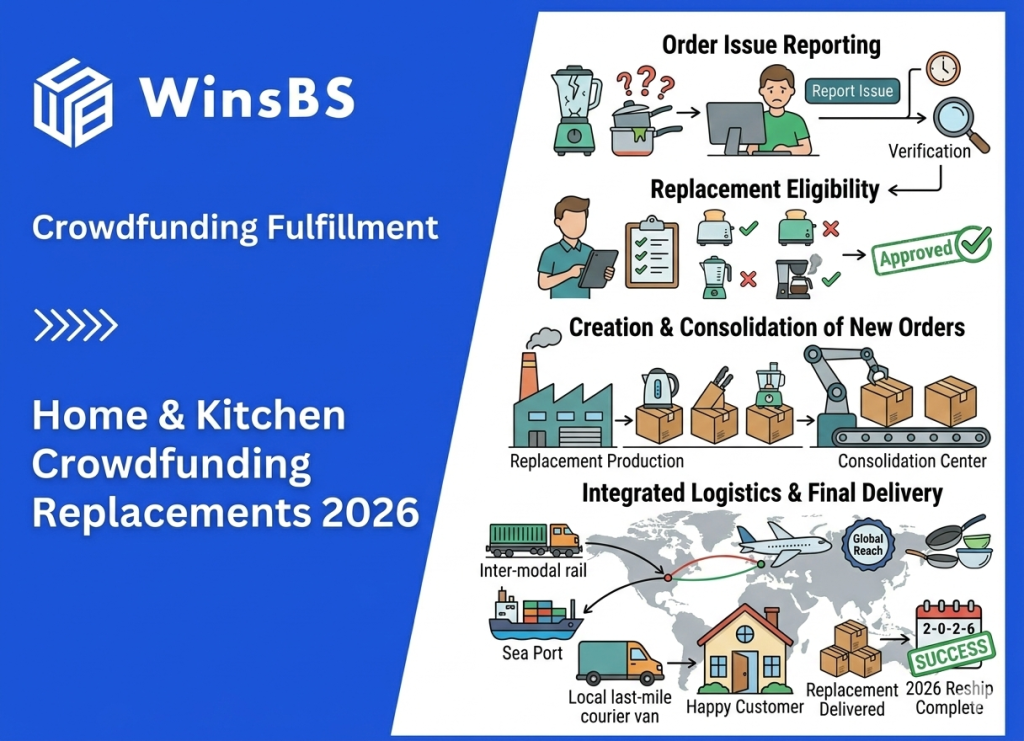
Crowdfunding replacement workflow for home and kitchen products beside WinsBS logo and title, showing damage feedback, eligibility review, production, and global 3PL order fulfillment leading to successful 2026 reshipment.
Crowdfunding Fulfillment, Ecommerce, Order Fulfillment, Shipping & Logistics, Warehousing, Winsbs

Home & Kitchen Crowdfunding Replacements 2026

Home & Kitchen Crowdfunding Replacements in 2026 Why bulky and breakable items turn simple reships into margin erosion WinsBS Fulfillment — Maxwell Anderson Updated February 2026 · Home & Kitchen · Crowdfunding Fulfillment · Reship & Replacement TL;DR: In Home & Kitchen crowdfunding, replacements are rarely small. A broken glass lid, dented pan, or cracked ceramic piece often means shipping a full bulky unit by parcel. What cost $8–$15 per unit in the main wave can become $35–$80 in single reship form. On this page The Main Wave Was Efficient — Until One Unit Broke Why Bulky Items Change the Replacement Cost Structure Breakage Rates Stay Low — Unit Losses Do Not Air Parcel vs Sea Freight: The Structural Cost Gap Why Returns Rarely Make Sense for Large Items Buffer Inventory for Bulky Goods Feels Thinner Than It Looks How Replacement Windows Stretch in Large-Format Campaigns When the Second Cycle Actually Closes Methodology & Sources The Main Wave Was Efficient — Until One Unit Broke The container landed. Pallets were received. Orders moved out in batches. For Home & Kitchen campaigns, the main wave usually feels controlled. Sea freight spreads cost. Cartons are stacked tightly. Unit economics make sense. Then the first message arrives. “The ceramic base cracked in transit.” “The glass lid shattered.” “The corner was crushed.” “It arrived dented.” The issue rate might be under 1%. Sometimes under 0.5%. But Home & Kitchen products have a trait that changes everything: they are often bulky, rigid, and fragile at the same time. A single damaged unit means shipping another full-sized object — not a small fix. You cannot email a replacement corner. You cannot ship half a pan. You cannot bubble-wrap a shattered ceramic base back into shape. The solution is simple from a customer perspective: send a new one. Operationally, that “new one” no longer moves inside a container. It moves alone. And once a bulky, breakable unit moves alone, the cost structure changes. Main wave efficiency hides the true per-unit freight cost. Replacement parcels reveal it. What cost $10 per unit inside a consolidated ocean shipment does not cost $10 when shipped individually by air parcel. That’s where Home & Kitchen replacements begin to feel heavier than their percentage suggests. Why Bulky Items Change the Replacement Cost Structure In many crowdfunding categories, a replacement can be “small.” A missing card pack. A spare cable. A single accessory. Home & Kitchen replacements usually can’t fragment like that. The replacement unit is often the full product — and the shipping price is driven by size, not value. The core cost driver here is dimensional weight. A bulky item can be relatively low in retail value, but expensive to ship because carriers price it like it’s heavy. In the main wave, you hide that cost inside a container: thousands of units share the same ocean lane. In the replacement phase, you lose that advantage. Now each replacement is a single box moving by parcel. One box instead of one carton among hundreds One address instead of a regional batch One carrier label instead of freight allocation One dimensional weight bill instead of container share This is why creators feel the replacement phase as “margin leakage.” Even if replacements are rare, the per-case cost is high enough to be noticeable. A single bulky parcel can cost more to reship than the factory cost of the product itself. In Home & Kitchen, the replacement math is not defect-driven. It’s freight-structure-driven. That structural gap is the reason the second cycle can feel unfair: you already paid for the container. You already shipped the main wave. But replacements don’t live inside that structure. They replay the costliest version of shipping — one unit at a time. Breakage Rates Stay Low — Unit Losses Do Not Home & Kitchen campaigns often report relatively low breakage rates. Strong master cartons. Protective inserts. Foam guards. Double boxing. The main wave is designed to survive ocean transit. But the breakage math is different from other categories. Even a 0.5% breakage rate can translate into high per-unit financial impact. If you shipped 4,000 units, a 0.5% damage rate means 20 replacements. In apparel, that might be manageable. In large-format kitchenware, those 20 units are not small. Each damaged unit typically means: A full-size replacement product Full parcel shipping cost Additional packing material Labor to inspect and re-pack And unlike small consumer goods, damaged Home & Kitchen products often cannot be salvaged. A cracked ceramic base. A shattered glass lid. A bent metal frame. These are not refurbishable at scale. The unit loss is usually total — not partial. That means the true cost of a damaged item includes: Lost inventory value Replacement shipping cost Handling labor Support time The percentage might remain small. But each case carries more weight — literally and financially — than most creators expect when planning only for production margins. In bulky categories, frequency stays low. Per-case impact stays high. Air Parcel vs Sea Freight: The Structural Cost Gap During the main wave, most Home & Kitchen campaigns rely on ocean freight. Containers distribute cost across thousands of units. Transit time is longer, but unit economics are stable. Replacements do not have that luxury. The main wave moves by container. Replacements move by air parcel. That shift changes everything. A container spreads cost by volume. A parcel carrier charges by dimensional weight. A glass pitcher that cost $9–$12 per unit to move inside a container can cost $35–$80 when shipped individually across borders. The product didn’t change. The transport structure did. Ocean freight → low per-unit share Air parcel → high per-unit billable weight Consolidated pallets → distributed addresses Predictable transit → variable carrier pricing For domestic replacements, the cost gap may feel manageable. For international backers, the gap widens significantly. You are effectively shipping a single retail carton across an air network that was never optimized for container-level economies. Replacement freight exposes the true standalone shipping cost of your product. That exposure is
WinsBS logo with blog title "20 Best 3PL Companies Powering U.S. Small Businesses (2025)", showing a U.S. map surrounded by trucks, airplanes, warehouses, and containers, representing 3PL fulfillment and order fulfillment services across America.
Crowdfunding Fulfillment, Ecommerce, Order Fulfillment, Shipping & Logistics, Warehousing, Winsbs

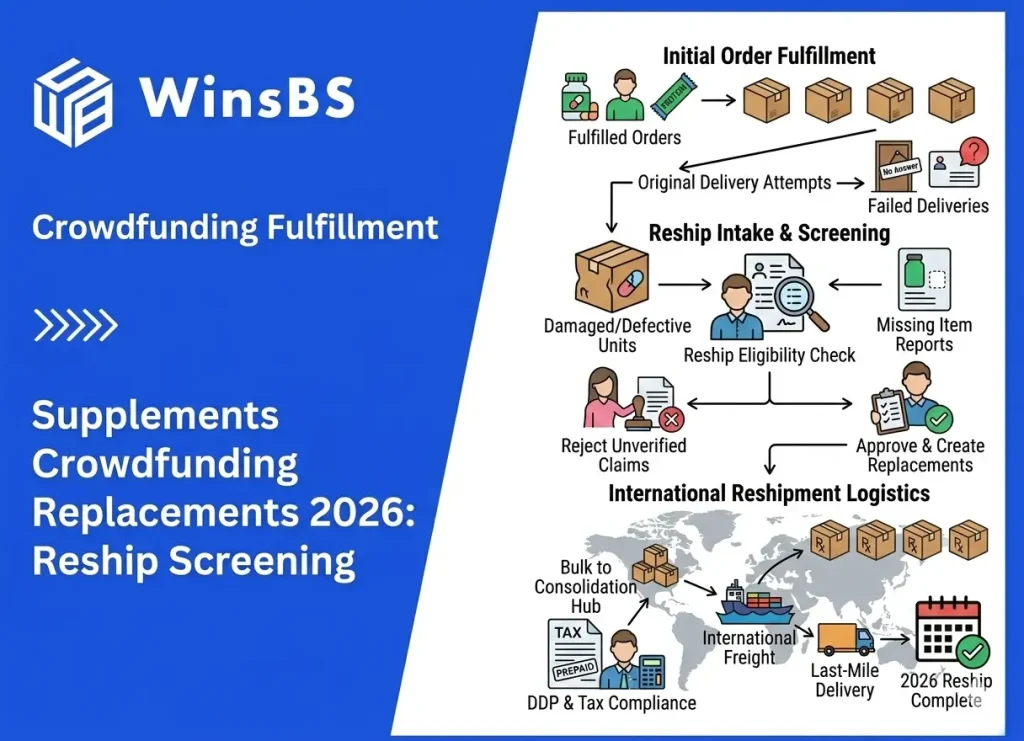
Supplements Crowdfunding Replacements 2026: Reship Screening

Supplements Crowdfunding Replacements in 2026 Why single-bottle reships get screened again — even after the main wave cleared WinsBS Fulfillment — Maxwell Anderson Updated February 2026 · Supplements · Crowdfunding Fulfillment · Reship & Replacement TL;DR: In supplement crowdfunding, a replacement bottle is treated like a new cross-border food shipment. Even if the main wave cleared cleanly, single-bottle reships can be pulled for re-screening and label/batch verification. That’s why “just one replacement” can take longer than the original delivery. On this page You Delivered the Main Wave — Then One Bottle Breaks A Replacement Is Treated as a New Import Event Why Supplements Get Re-Screened More Often Than Other Categories Batch Numbers Become Visible Again DDP Doesn’t Stop Screening Shelf Life Changes the Replacement Math Why One Held Bottle Feels Disproportionate When the Replacement Cycle Actually Ends Methodology & Sources You Delivered the Main Wave — Then One Bottle Breaks The main wave lands. Most backers post Delivered. The comment section quiets down. You finally feel like the campaign can breathe. Then the first support message comes in — small, specific, and hard to ignore. “The seal was broken when it arrived.” “The bottle leaked into the box.” “I only received 1 of the 2 bottles in my tier.” “My package says delivered, but nothing showed up.” None of this means the campaign failed. It’s normal post-delivery variance. But supplements behave differently from many other categories in one key way: the simplest “fix” is still a new cross-border food parcel. If you shipped 3,000 orders, you don’t need a high issue rate for this to become work. Even 1% becomes 30 replacement cases. And unlike apparel or accessories, you can’t always solve it with a small part or a partial reship. Most creators respond the same way at first: you pick a fresh bottle from buffer inventory, print a label, and send it. And this is where the surprise shows up. The warehouse sees a simple replacement. Cross-border systems see a new supplement shipment. Your backer thinks: “They already shipped it once. This should be quick.” You think: “It’s one bottle. It should be easy.” But the replacement is not tied to your main wave in any meaningful automated way. It moves as its own parcel, with its own data, its own label, and its own screening outcome. That’s why supplement replacements can feel out of proportion: one broken bottle turns into a new shipment that can be re-screened. The percentage is small. The operational tail is not. A Replacement Is Treated as a New Import Event When your main wave cleared, it did so as a structured commercial movement. Documentation aligned. Quantities were declared at scale. The shipment moved as a defined batch. A replacement bottle does not inherit that structure. A reshipped supplement is processed as a new cross-border food parcel — not as “part of the original shipment.” From your side, it feels connected to the campaign. From a system perspective, it is simply: A single food-related item Entering through a parcel channel With its own tracking number And its own data submission There is no automatic flag that says: “This cleared before.” There is no memory of your main wave attached to the individual bottle. If the parcel is selected for screening, it goes through that process independently of everything that came before it. That’s the disconnect many creators experience. You think in terms of campaign lifecycle. Cross-border systems evaluate in terms of individual entry events. Main wave logic is campaign-based. Replacement logic is shipment-based. And once a replacement is shipment-based, it re-enters the probability pool for inspection. Most of the time, it passes quickly. But when it doesn’t, the timeline stretches in ways that feel unexpected — especially because the original delivery already succeeded. Why Supplements Get Re-Screened More Often Than Other Categories Not every replacement category behaves the same way. A missing T-shirt. A damaged board game box. A scratched metal component. These usually move through parcel systems with minimal additional scrutiny. Supplements sit in a different bucket. Anything ingestible carries a different risk profile than standard merchandise. That doesn’t mean something is wrong. It means the category itself has higher baseline visibility. In practical terms, that shows up in a few predictable ways: Single-bottle parcels are more likely to be flagged for data review Label details can be examined more closely Declared contents are matched more strictly against category codes Random selection for inspection carries heavier downstream impact During the main wave, large-volume imports absorb this friction. A consolidated shipment distributes risk across thousands of units. A single parcel concentrates it. Volume dilutes attention. Single parcels concentrate it. When a replacement bottle moves through a courier channel, it stands alone in the system. There is no broader campaign context attached. No surrounding volume. No freight structure. It is simply: A food-related product entering cross-border circulation as an individual unit. That structural shift — from consolidated import to isolated parcel — is what makes supplement replacements feel less predictable than the main wave. Comparison: Main Wave vs. Single Reship Logic MAIN WAVE (Bulk Freight) REPLACEMENT (Single Parcel) Consolidated Commercial Entry Distributed Risk (3,000+ Units) Predictable Clearance Wave Individual Import Event Concentrated Screening Visibility Re-screening / Data Audit Risk Note: 2026 compliance audits prioritize individual supplement parcels to ensure lot traceability. The defect rate didn’t increase. The visibility did. Batch Numbers Become Visible Again During the main wave, most backers receive product from the same production lot. Labels match. Batch numbers align. Expiration dates cluster. The shipment moves as one defined production event. Replacements change that visibility. A single-bottle reship isolates the batch — and exposes its details again. If your buffer inventory comes from: A later production run A slightly revised label layout A new expiration window An updated packaging insert That information now travels alone. In a consolidated shipment, small differences can blend into the volume. In a single parcel, they stand on their own. If the parcel is selected for inspection,

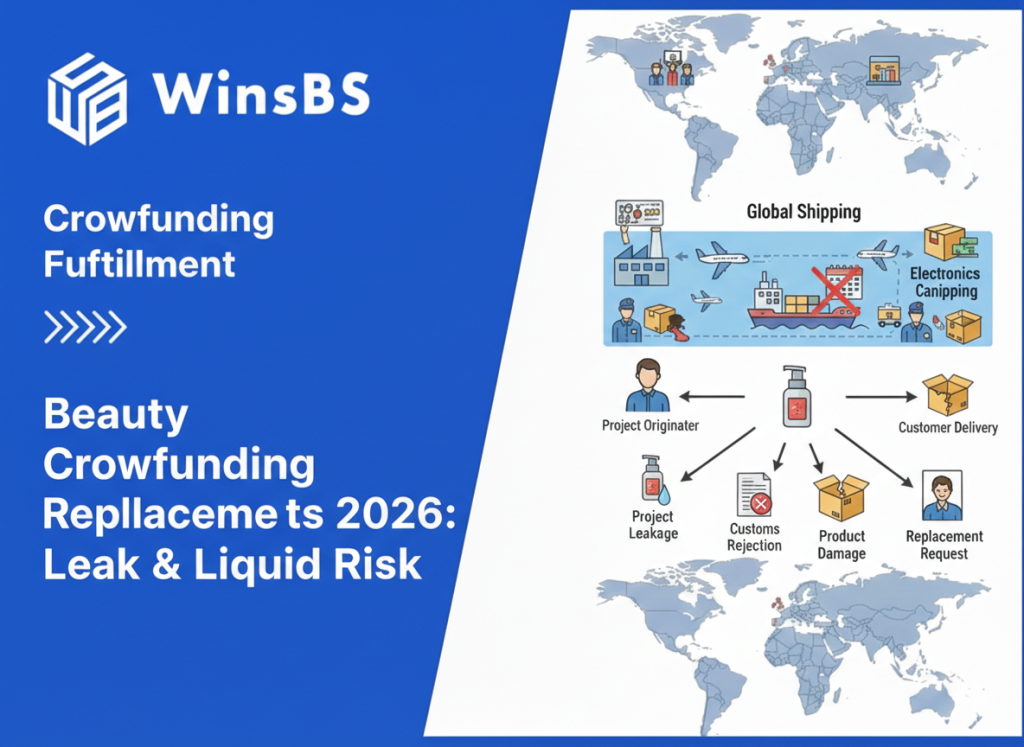
Logistics risk management poster for beauty crowdfunding fulfillment, featuring a cosmetic pump bottle surrounded by leakage, customs rejection, product damage, and replacement request icons, symbolizing cross-border order fulfillment risk in 2026.
Crowdfunding Fulfillment, Ecommerce, Order Fulfillment, Shipping & Logistics, Warehousing, Winsbs

Beauty Crowdfunding Replacements 2026: Leak & Liquid Risk

Beauty & Personal Care Crowdfunding Replacements in 2026 Why leaks, fragile packaging, and liquid rules reshape reship cycles WinsBS Fulfillment — Maxwell Anderson Updated February 2026 · Beauty & Personal Care · Crowdfunding Fulfillment · Reship & Replacement TL;DR: In beauty crowdfunding, replacements are rarely about missing items. They are about leaks, cracked pumps, pressure shifts, and liquid sensitivity. A small failure can spread beyond one unit — and reships follow different rules than the main wave. On this page You Shipped the Skincare — Then Leak Photos Start Appearing The Variable: Liquid Classification & Carrier Sensitivity Partial Bottle vs Full Kit Replacement Decisions Route Differences: Domestic vs Cross-Border Liquid Reships Buffer Risk: When Leakage Rate Exceeds Forecast Cost Reality: Perception Damage vs Unit Cost Structural Closure in Liquid Campaigns Methodology & Sources You Shipped the Skincare — Then Leak Photos Start Appearing The cartons clear. Orders ship. Tracking updates look normal. Backers start posting delivery photos. For a beauty campaign, that first delivery wave feels clean. Bottles look polished. Labels are sharp. Packaging finally exists outside renders and samples. Then the emails begin. “The pump arrived cracked.” “The box smells like serum.” “Oil leaked into the outer carton.” “Everything inside is sticky.” At first, it feels isolated. One damaged unit. Maybe rough handling. Then a second photo appears. Same product. Same packaging. Similar leak pattern. The issue rate may still sit under 1%. On paper, that looks manageable. Liquids don’t fail quietly. They spread. A cracked pump doesn’t just affect the bottle. A loose cap doesn’t just waste 10 milliliters. Leakage seeps into cartons. It softens paper inserts. It stains adjacent products. It amplifies perception. In electronics, one faulty unit is isolated. In beauty, one leak can affect the entire presentation. If you shipped 5,000 units, even a conservative 1% leak rate means 50 replacement cases. But beauty replacements are rarely about “sending one small part.” You are dealing with pressure changes, pump tolerances, cap torque, temperature variation, and liquid viscosity. The main wave moves sealed cartons. The replacement wave deals with compromised packaging. For U.S.-based creators shipping to mixed domestic and international backers, the second phase behaves differently from the first. Domestic reships often move quickly. Cross-border liquid parcels may not. What looked like a finished fulfillment cycle becomes a controlled containment phase — one damaged bottle at a time. The Variable: Liquid Classification & Carrier Sensitivity Beauty campaigns rarely struggle because of SKU complexity. They struggle because liquids behave differently in transit. A moisturizer, facial oil, toner, or serum may look simple. Operationally, each sits inside a carrier sensitivity range. A bottle is not just a product. It is pressure, viscosity, and containment. During the main wave, cartons move in bulk. Packaging is compressed inside larger boxes. Pallet stability reduces movement. Temperature variation is averaged across volume. Scale dampens risk. In the replacement phase, that scale disappears. Now you are shipping single parcels — one bottle, sometimes two — often by air. Air transport introduces pressure change. Smaller parcels experience more internal movement. Cushioning differs from palletized freight. The main wave moves stabilized cartons. The replacement wave exposes individual packaging tolerance. Alcohol content adds another variable. Low-alcohol cosmetic liquids may travel under standard handling. Higher alcohol concentrations shift treatment category. Even when allowed, carriers may apply stricter review. Most creators do not notice this during the first shipment. Everything was prepared at scale. In the replacement window, classification becomes visible one parcel at a time. Transit options narrow. Service levels change. Certain air lanes may be unavailable. Volume hides sensitivity. Single liquid parcels reveal it. That’s why leak-related reships often behave differently from the main wave — even when the product formula hasn’t changed. The difference is not the liquid itself. It is the shipping context. Visual Analysis: Atmospheric Pressure Differential Ground (101.3 kPa) Air Cargo (20.0 kPa) INTERNAL OVERPRESSURE Data Note: Individual reships bypass the volumetric stabilization of palletized freight, exposing seals to vacuum-like conditions during unpressurized cargo transits. Partial Bottle vs Full Kit Replacement Decisions In beauty campaigns, replacements are not always binary. Unlike electronics — where a defect often triggers a full-unit reship — cosmetics allow fragmentation. A single leaking bottle can, in theory, be replaced individually. But campaigns rarely ship single products. They ship bundles. Beauty products are often sold as systems, not stand-alone items. A skincare set may include: Cleanser Toner Serum Moisturizer Bonus travel-size item If only one bottle leaks, you face a structural choice. Replace the single item — or reship the entire kit? Partial replacement protects inventory. Full-kit replacement protects perception. From an inventory standpoint, sending one bottle preserves margin. From a backer standpoint, a sticky outer box can make the whole set feel compromised. There is also consistency risk. Batch variation in fragrance tone, color hue, or label alignment may become visible when mixing old and new components. A replacement bottle from a later batch can look slightly different from the original kit. Liquid products allow fragmentation. Bundled campaigns complicate it. Some creators choose partial reship for cost control. Others default to full-kit replacement to avoid extended dialogue. Either path consumes finished inventory. The difference is speed of depletion. When leak reports cluster, full-kit decisions thin reserve faster than forecast. The issue rate may remain under 2%. The structural impact on buffer can feel higher. Route Differences: Domestic vs Cross-Border Liquid Reships During the main wave, beauty products move in consolidated cartons. Freight is planned. Pallets are stabilized. Documentation is aligned ahead of departure. Replacements behave differently. The main wave ships volume. The replacement wave ships exceptions. For U.S.-based creators, domestic reships are usually straightforward. Ground services handle sealed cosmetic liquids without complexity. Transit time is predictable. Packaging tolerance is rarely tested by altitude change. Cross-border liquid reships introduce additional friction. Alcohol percentage, ingredient labeling, and carrier acceptance policies can narrow service options. Even when allowed, international parcels containing liquids may face: More limited air service lanes Additional packaging scrutiny Longer transit windows Heightened inspection at entry

Global logistics graphic for Electronics Crowdfunding Battery Reships beside WinsBS logo, highlighting hazardous goods handling and international crowdfunding order fulfillment.
Crowdfunding Fulfillment, Ecommerce, Order Fulfillment, Shipping & Logistics, Warehousing, Winsbs

Electronics Crowdfunding Replacements 2026: Battery Reships

Electronics Crowdfunding Replacements in 2026 Why battery devices and partial defects turn reships into full-unit replacements WinsBS Fulfillment — Maxwell Anderson Updated February 2026 · Electronics & Gadgets · Crowdfunding Fulfillment · Reship & Replacement TL;DR: In electronics crowdfunding, replacements rarely stay “small.” A cracked casing, firmware issue, or unstable battery often results in full-unit reship. Once lithium batteries enter the equation, cross-border replacements behave very differently from the main wave. On this page You Shipped the Devices — Then a Few Batteries Start Failing The Variable: Battery Classification and Partial Defects Why Electronics Replacements Default to Full Units Route Differences: Lithium Reships vs Main Wave Freight Buffer Risk: When Spare Units Disappear Faster Than Expected Cost Reality: Testing, Rework, and Compliance Friction The Structural Reality of Hardware Replacement Cycles Methodology & Sources You Shipped the Devices — Then a Few Batteries Start Failing The containers arrive. Devices are picked, packed, and shipped. Tracking updates roll in. Backers post unboxing photos. For a hardware campaign, that moment feels bigger than most. Months of prototyping, tooling, certification, firmware updates — finally out in the real world. Then the first message lands. “My unit won’t power on.” “The battery drains in two hours.” “It overheats while charging.” “It arrived, but something feels off.” At first, it feels isolated. One case. Then two. Then five. The issue rate may still be small — 1% or less. But in electronics, even a small percentage carries weight. In hardware, a defect isn’t just cosmetic. It often raises safety and reliability questions. A cracked plastic casing in a board game is annoying. A lithium battery behaving unpredictably is different. And that difference changes how replacements behave. If you shipped 4,000 units, even a conservative 1% issue rate means 40 backers need resolution. In electronics, the resolution is rarely “send a small missing piece.” There usually isn’t one. You’re dealing with sealed devices, integrated components, and safety considerations. A firmware glitch might be fixable remotely. A battery stability issue usually isn’t. The main wave ships devices. The replacement wave reopens liability. That’s when the second cycle begins — not because volume failed, but because hardware behaves differently once it leaves controlled testing environments. For U.S.-based creators with international backers, this moment carries another layer: lithium batteries change how parcels move. The same route that handled bulk freight smoothly may not behave the same way for individual reships. What looked like a clean finish to fulfillment quietly becomes a new operational phase — one device at a time. The Variable: Battery Classification and Partial Defects Electronics campaigns don’t usually struggle because of SKU count. They struggle because of classification. The moment a device contains a lithium battery, it enters a different shipping category. A device with a battery is not just “a gadget.” It’s regulated cargo. During the main wave, that classification is managed at scale. Freight is prepared correctly. Documentation is aligned. Carriers are pre-selected. Volume smooths complexity. In the replacement phase, volume disappears. Now you are shipping single parcels — often to individual addresses in different countries — each one containing a battery. Carriers treat that differently than a palletized main shipment. Transit options may narrow. Air lanes may be limited. Certain services may no longer be available at small scale. The main wave benefits from freight planning. The replacement wave faces parcel-level rules. Then there’s the defect type itself. In electronics, issues rarely isolate cleanly. A casing crack might expose internal components. A charging issue might indicate battery instability. A firmware glitch might require hardware inspection to confirm. Even if only one component is faulty, the practical resolution is often full-unit replacement. Hardware problems don’t fragment well. They default to whole-device decisions. That default matters. In tabletop, you can sometimes send a single expansion. In electronics, you’re usually sending another complete device — battery included. Which means: Another unit leaves inventory Another battery crosses a border Another compliance-sensitive parcel enters transit The issue percentage may still look small. The structural weight per case is not. Why Electronics Replacements Default to Full Units In theory, a hardware defect sounds specific. “The battery won’t hold charge.” “The screen flickers.” “The button feels loose.” In practice, resolving that defect rarely means mailing one small part. Consumer electronics are integrated systems. When one part fails, the safest fix is often replacing the whole device. Most crowdfunding hardware is not designed for field repair. Devices are sealed. Batteries are internal. Casings are glued or ultrasonically welded. Opening the unit voids warranties and creates new risks. So when a backer reports a problem, you’re usually deciding between: Troubleshooting remotely and hoping firmware solves it Requesting return for inspection (slow and costly) Shipping a full replacement unit immediately Most creators choose the third option. It’s faster. It protects reputation. It avoids prolonged back-and-forth. But operationally, that choice changes the math. A “minor defect” becomes a full-unit inventory decision. If you shipped 3,500 devices and held 5% buffer, that leaves 175 spare units. At a 1% issue rate, 35 units are consumed quickly. If defects cluster early, buffer can thin before you realize it. And unlike tabletop components, you cannot rebalance parts. A spare casing without a battery is not a replacement device. A spare PCB without enclosure is not shippable inventory. Electronics buffer is binary: you either have a complete, compliant unit — or you don’t. The main wave consumes production volume. The replacement wave consumes finished goods. That’s why electronics replacements feel heavier per case. The issue percentage may match other categories. The unit impact rarely does. Bulk freight vs lithium parcel replacement workflow Comparison between main wave freight fulfillment and individual lithium battery replacement parcels, highlighting differences in cost structure, compliance handling, and operational workflow. Main Wave (Freight) Replacement (Parcel) Bulk Pallets / Sea Freight Scale Efficiency Individual Units / Air Parcel Premium Unit Cost UN38.3 Master Manifest Consolidated Compliance Individual Hazmat Labeling Parcel-Level Friction Automated Pick & Pack Linear Workflow Testing + Serial Tracking Multi-Touch Rework Fig 1:

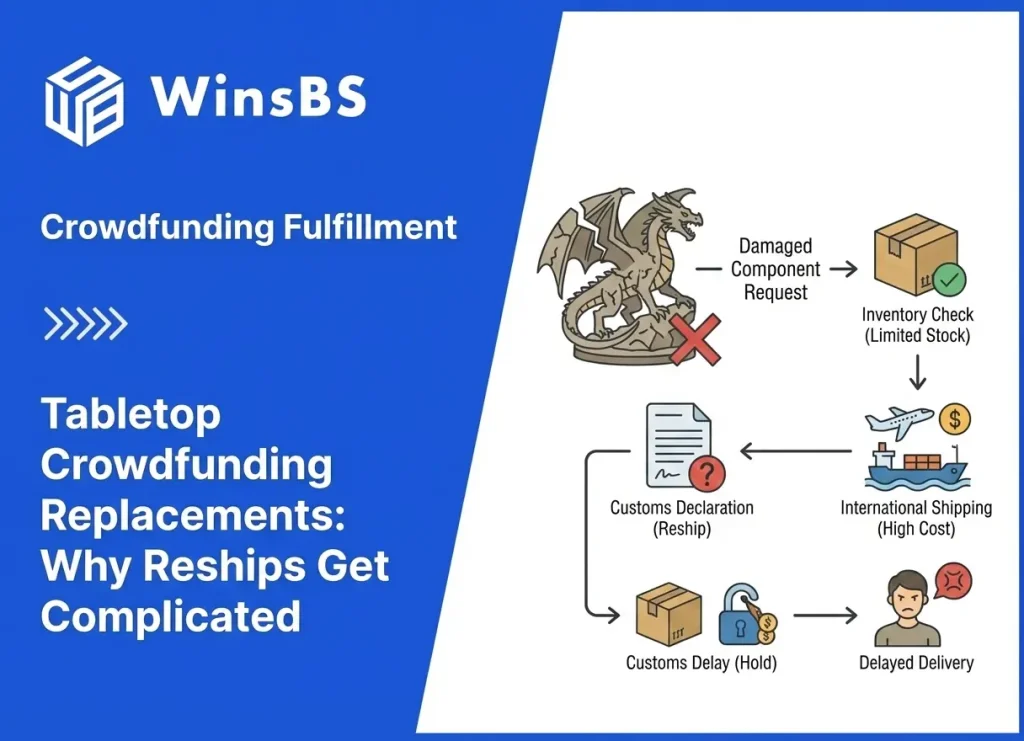
Infographic banner titled "Tabletop Crowdfunding Replacements: Why Reships Get Complicated" showing the complex tabletop crowdfunding fulfillment and order fulfillment reship process, including damaged component request, limited stock check, high international shipping cost, customs declaration, customs delay, and delayed delivery.
Crowdfunding Fulfillment, Ecommerce, Order Fulfillment, Shipping & Logistics, Warehousing, Winsbs

Tabletop Crowdfunding Replacements: Why Reships Get Complicated

Tabletop Crowdfunding Reship Reality in 2026 Why board game campaigns break in the replacement wave: high-SKU tiers, missing parts, and kitting that doesn’t scale after “Delivered” WinsBS Fulfillment — Maxwell Anderson Updated February 2026 · Tabletop & Board Games · Crowdfunding Fulfillment · Reship & Replacement · For the broader context on reships after delivery, see post-delivery replacements (the second fulfillment cycle) . TL;DR: For tabletop campaigns, “replacements” rarely mean one more parcel of the same item. The second fulfillment cycle breaks when a single missing component forces you to rebuild (or fully replace) a multi-item tier. High SKU count + kitting dependencies turn small post-delivery issues into inventory and labor drain — long after the main wave shows Delivered. On this page You Ship 5,000 Games — Then “One Missing Pack” Reopens Fulfillment The Variable: Too Many Parts, Too Many Ways to Be “Incomplete” Why Tabletop Replacements Don’t Behave Like the Main Wave Route Differences: US vs EU/UK/CA/AU When You Reship Components How Buffer Stock Disappears When Parts Aren’t Balanced The Cost Isn’t Postage — It’s Re-kitting, Rework, and Repeat Labor The Structural Reality: You Don’t Run Out of Units — You Run Out of Complete Sets Methodology & Sources You Ship 5,000 Games — Then “One Missing Pack” Reopens Fulfillment The main wave goes out and you finally feel the tension drop. Pallets are cleared. Orders are marked fulfilled. Tracking is moving. A growing share shows Delivered. Backers start posting photos. For a moment, it feels like the campaign is actually closing. Then support starts again — but not in the way most first-time creators expect. “Everything arrived… but my promo pack is missing.” “I didn’t get the metal coins that were in my tier.” “One tray is cracked, and the lid won’t close.” “My box corner is crushed — can you replace it?” “My address changed after the pledge manager — can you resend?” None of these look like “campaign failure.” They’re normal edge cases — the kind that happen in any physical shipment. The surprise is what they turn into operationally. In tabletop, a replacement is rarely a clean “send one more unit.” It’s often a parts problem. A backer doesn’t say “I’m missing SKU #A17.” They say, “My pledge isn’t complete.” And when a tier has five to twelve items inside it, “incomplete” can mean dozens of different combinations. That’s the moment the second cycle starts: not because you want it to, but because the only way to fix a single missing piece is to reopen your kitting logic — again. If you shipped 5,000 pledges, you don’t need dramatic issue rates for this to become real work. Even 1–2% of post-delivery cases means 50–100 replacement decisions: inventory allocation, picking, repacking, label creation, and another shipment out the door. And tabletop replacements don’t stay “small” for long. A missing expansion in a higher tier might not exist as loose stock. The fastest path becomes rebuilding the full tier — or replacing the entire box — just to make the backer whole. The main wave ends when you ship boxes. The replacement wave ends when you can still build complete sets. If you planned inventory to hit the exact pledged quantity, this is where things get tight. Not because you ran out of games — but because you run out of the right parts in the right ratios. Tabletop campaigns rarely fail because boxes didn’t ship. They struggle because complete sets become harder to rebuild. What looks like “just a missing pack” is often the point where kitting complexity reopens your fulfillment operation — long after the main wave showed Delivered. The Variable: Too Many Parts, Too Many Ways to Be “Incomplete” Tabletop campaigns don’t usually break because of volume. They break because of structure. A typical board game campaign is not shipping one product. It’s shipping layers: core box, stretch goals, add-ons, promo packs, upgraded components, collector tiers. By the time fulfillment starts, a single pledge tier may contain 6 to 15 separate physical components — sometimes packed together, sometimes nested inside larger boxes. The more parts a tier contains, the more ways it can be “almost correct.” A missing mini doesn’t look serious. A scratched metal coin doesn’t look catastrophic. A rulebook swapped for the wrong language version feels minor. But each one turns a delivered order into an incomplete pledge. And “incomplete” is where tabletop replacements get complicated. In single-SKU campaigns, a replacement is binary: send another unit or don’t. In tabletop, replacements are combinational. You’re not replacing “a game.” You’re replacing: One expansion from a mid-tier bundle Two missing stretch goal modules A cracked plastic tray inside the main box A language-specific booklet An add-on that was kitted separately The operational challenge is not identifying the problem. It’s whether you still have the right loose inventory to fix it cleanly. During the main wave, kitting is optimized for speed. Units are pre-built. Bundles are standardized. Everything flows forward. In the replacement phase, that logic reverses. Now you’re asking: Do we have standalone expansion units? Do we have leftover promo packs? Are trays separated from main boxes? The main wave rewards bundling. The replacement wave punishes bundling. If inventory was packed tightly into complete sets with no spare parts pulled aside, even a small missing component can force a disproportionate response — such as rebuilding an entire tier or sending a full replacement box. This is where tabletop campaigns feel heavier than they look on paper. Not because issue rates are extreme — but because the structure of the product multiplies the paths to “almost right.” And “almost right” is still a replacement. Why Tabletop Replacements Don’t Behave Like the Main Wave The main wave is designed for efficiency. You forecast volume. You batch pick. You kit full tiers. You print labels in bulk. You move pallets. It’s repetitive, predictable, and optimized for speed. Replacements are the opposite. The main wave is a system. The replacement wave is a series of exceptions.

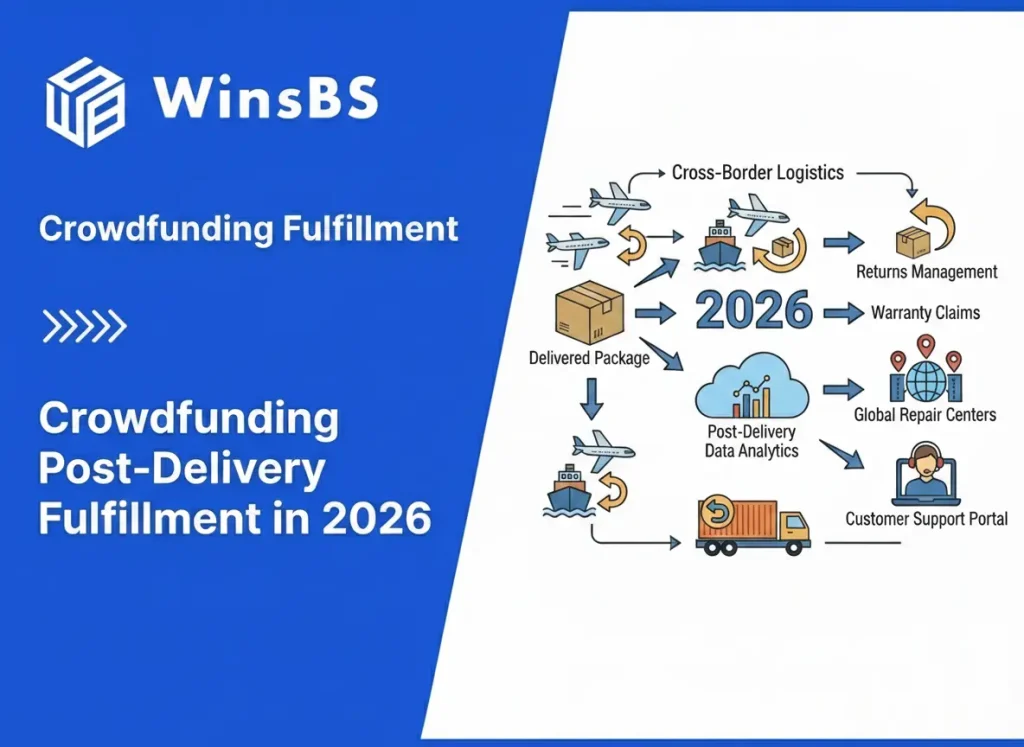
Infographic showing Crowdfunding Post-Delivery Fulfillment in 2026 beside WinsBS logo, illustrating delivered package flows with cross-border logistics, returns management, warranty claims, global repair centers, customer support portal, and post-delivery data analytics, representing advanced crowdfunding order fulfillment services.
Crowdfunding Fulfillment, Ecommerce, Order Fulfillment, Shipping & Logistics, Warehousing, Winsbs

Crowdfunding Post-Delivery Fulfillment in 2026

The Second Fulfillment Cycle in Crowdfunding (2026) Post-delivery replacements, reships, inventory pressure & public visibility — optimized for US creators WinsBS Fulfillment — Maxwell Anderson Updated March 2026 · Crowdfunding Fulfillment · Post-Delivery Support · Reship & Replacement TL;DR: In physical-reward crowdfunding, fulfillment does not end when tracking shows Delivered. Most campaigns enter the Second Fulfillment Cycle — a structured post-delivery phase driven by replacements, reships, inventory buffer depletion, and public visibility pressure. Typical replacement rate: 1–3 %. The real impact depends on category-specific risks (tabletop bundles, electronics defects, beauty leakage, apparel sizing, etc.). This pillar guide + linked deep-dives gives US creators the complete framework. On this page You Finally Exhale — Then Support Starts Again A Reship Is a Decision — And Every Decision Has a Cost Inventory Planning Decides Whether Replacements Feel Manageable — or Chaotic Replacement Costs Rarely Mean “One More Label” — They Accumulate Public Visibility Changes the Pressure of Every Replacement Route Design Multiplier: How Fulfillment Architecture Amplifies or Compresses the Second Cycle Industry-Specific Second Fulfillment Cycle Challenges Controlled Closure: Turning the Second Cycle Into a Defined Phase A Practical Post-Delivery Checklist Before You Call It “Done” FAQ Methodology & Sources The Second Fulfillment Cycle Begins After “Delivered” Structural Definition — The Second Fulfillment Cycle In physical-reward crowdfunding, fulfillment does not end when tracking shows Delivered. Most campaigns enter what we define as the Second Fulfillment Cycle — a structured operational phase that begins after main-wave delivery and ends only when replacement demand stabilizes. Across campaign types, this phase is typically shaped by four recurring forces: Trigger Events: lost parcels, transit damage, incomplete tiers, late address changes Inventory Buffer Pressure: replacement allocation reducing remaining stock Cost Accumulation: shipping, duties, handling, and processing compounding quietly Public Visibility Amplification: comment threads accelerating perception risk Most creators believe fulfillment ends when the main wave ships. In practice, that moment marks a transition — not a conclusion. Pallets leave the warehouse. Orders are marked fulfilled. Tracking updates move steadily toward Delivered. Operationally, the hardest part appears finished. Then support begins again — not with mass refund demands, but with small, specific, and entirely normal edge cases. “Delivered — but nothing was at my door.” “The box arrived crushed.” “My pledge tier is missing one add-on.” “I moved after the survey — can you resend?” None of these represent campaign failure. They represent variance — and variance is structural in crowdfunding fulfillment. Each case usually requires a decision: allocate inventory, confirm the correction, generate a new shipping label, and send a replacement. That decision triggers inventory movement, cost exposure, and often public visibility. Platform-level research summarized in Kickstarter’s fulfillment analysis (with Professor Ethan Mollick’s research) shows that most projects do deliver. However, a measurable minority of backers experience delays, non-receipt, or fulfillment discrepancies. The structural implication is not high failure. It is predictable post-delivery variance. Put that into operational terms. If you shipped 8,000 rewards, even a conservative 1–3% post-delivery variance rate translates into 80–240 replacement cases. Each one requires inventory allocation, processing time, and additional shipping spend. On a 2,000-unit campaign, the same percentage still creates 20–60 reships — enough to materially impact remaining buffer stock if production matched pledge quantity exactly. Main-wave fulfillment ends when you ship. The Second Fulfillment Cycle ends when replacement demand stabilizes and buffer inventory remains intact. In crowdfunding, returns are rarely the defining operational burden. Replacement logistics are. If inventory and budget were planned only for the first wave, the second cycle does not appear as dramatic failure. It appears as scattered cost, fragmented workload, and increasing pressure as public comments surface unresolved cases. Pro Tip for US Creators: Treat the crowdfunding second fulfillment cycle as a budgeted 60–90 day operational phase from day one. This single mindset shift prevents 80% of the “surprise cost” complaints we see from first-time campaigners. 1. A Reship Is a Decision — And Every Decision Has a Cost When a backer writes in, it feels like support work. You read the message. You check the order. You verify the tracking. Then you face the real question: Do we send a replacement? That decision is simple emotionally. Of course you want to fix it. But operationally, it has consequences. Every reship touches three things: inventory, cash flow, and public trust. First, inventory. If you produced exactly what you pledged — no overage — every replacement comes out of the same limited pool. A missing add-on from a mid-tier pledge is not just “one small item.” It may be the last remaining unit in your buffer. Second, cash flow. Even when the product cost is already absorbed, the replacement still requires shipping spend. International parcels especially are not symbolic amounts. Multiply that by dozens of cases and the numbers stop feeling minor. Third, visibility. In ecommerce, a slow replacement can stay inside a private ticket. In crowdfunding, delays are often discussed in comment threads. Other backers read them. Patterns get noticed quickly. This is why replacements feel heavier in crowdfunding than in standard DTC operations. They are not just operational corrections — they are public signals. The most common real-world cases are rarely dramatic: A parcel marked delivered but not received. A corner impact that damages a collector’s box. An accessory missing from a multi-item pledge tier. An address change that came in one week too late. None of these suggest your campaign failed. But each one forces a choice: send now and absorb the cost, delay and investigate, or deny and risk reputation damage. At scale, even modest replacement rates accumulate. On a few thousand orders, a small percentage translates into dozens of real decisions — each touching inventory and budget. The main wave tests your logistics. The replacement phase tests your reserves. This is not where a campaign collapses. It’s where the real ongoing work begins. Pro Tip for US Creators: Treat every crowdfunding reship as a three-part decision (inventory + cash + visibility). Document the first 10 cases in a simple spreadsheet — you’ll

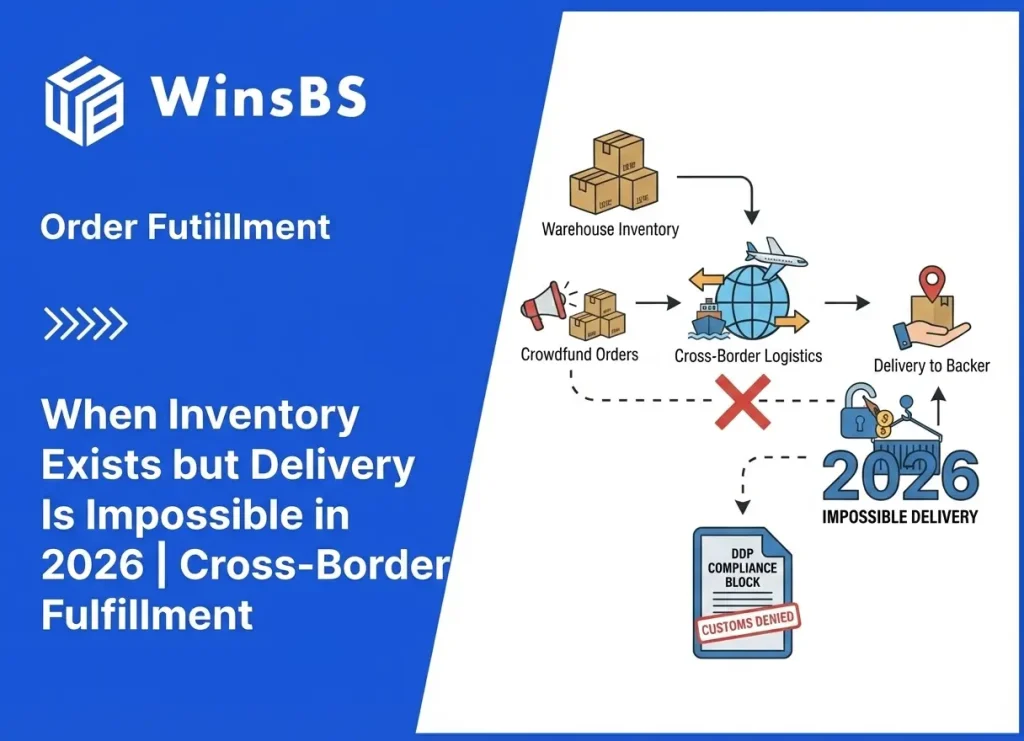
Logistics infographic banner beside WinsBS logo and title, showing warehouse inventory and crowdfunding orders blocked from cross-border logistics by compliance and customs restrictions, symbolizing order fulfillment challenges and cross-border fulfillment barriers in 2026.
Crowdfunding Fulfillment, Ecommerce, Order Fulfillment, Shipping & Logistics, Warehousing, Winsbs

When Inventory Exists but Delivery Is Impossible in 2026 | Cross-Border Fulfillment

When Inventory Exists but Delivery Is Impossible in 2026 Why “In Stock” Doesn’t Always Mean “Deliverable” in Cross-Border Fulfillment WinsBS Fulfillment — Maxwell Anderson Updated February 2026 · Cross-Border Fulfillment · DDP Shipping · Customs Clearance · Inventory Availability TL;DR: In 2026, many ecommerce sellers are facing a new reality: inventory can show in stock inside the warehouse, yet the shipment is blocked at the border. This often appears as a customs hold despite inventory availability or a DDP shipment blocked at border 2026. The reason is structural. Warehouse systems confirm physical availability. Customs clearance and carrier routing systems confirm legal admissibility and route eligibility. Since the Section 321 de minimis ended impact on ecommerce shipments in August 2025, more parcels now move through formal entry review in the United States. In the EU, the upcoming €3 customs duty on low value parcels (effective July 1, 2026) adds another validation layer. In Canada, full enforcement of CARM importer responsibility increases entry-level scrutiny. If you have not reviewed where warehouse control ends, see what fulfillment actually includes in 2026 . On this page 0. The Inventory Is Available. The Shipment Isn’t Moving. 1. Inventory Exists in One System — Delivery Is Decided in Another 2. The Three Status Layers: Physical, Legal, and Route 3. Why the Warehouse Cannot Fix a Customs or DDP Block 4. Same Inventory, Different Market — Different Customs Outcome 5. When Inventory Actually Becomes Deliverable in 2026 6. The Moment “In Stock” Stops Being the Right Question Methodology & Sources 0. The Inventory Is Available. The Shipment Isn’t Moving. You log into your fulfillment dashboard and see available inventory. Units were received, scanned, and stored correctly. Nothing is backordered. Nothing is out of stock. An order is placed. It moves through pick and pack. A shipping label is generated. Tracking activates. From an operational standpoint, the order has been fulfilled under your cross-border fulfillment workflow. Then the tracking status changes. Clearance delay Held at customs Importer information required Entry under review Undeliverable — return to sender At this stage, inventory is still accurate. The warehouse shows no processing error. DDP shipping may have been selected. Duties may have been prepaid. Yet the shipment is not moving. This is the scenario behind many searches such as “in stock but cannot deliver” or “customs hold despite inventory.” Sellers are discovering that inventory availability does not guarantee customs clearance once a parcel enters formal entry review. “In stock” is a warehouse status. “Deliverable” is determined later — at customs entry and route validation. The warehouse confirms possession. Customs authorities and carriers confirm permission. 1. Inventory Exists in One System — Delivery Is Decided in Another Most ecommerce operators assume that once inventory is available inside a fulfillment warehouse, delivery becomes a matter of transportation timing. If the warehouse can pick it and the carrier can scan it, shipment completion feels inevitable. That assumption increasingly breaks down in 2026. A warehouse management system (WMS) tracks physical control: units received, units stored, units allocated, and units shipped. It verifies inventory accuracy and confirms operational execution. Customs clearance systems evaluate something different: declared value, classification, importer identity, and compliance triggers. Carrier systems evaluate route eligibility, service-level compatibility, and automated risk flags. These systems do not share a single definition of “ready.” The warehouse defines ready as physically available. Customs defines ready as legally admissible. Carriers define ready as route-compatible. This structural separation became more visible after the Section 321 de minimis ended impact on ecommerce shipments in August 2025. As more U.S.-bound parcels shifted into formal entry, customs hold rates increased — even when inventory was correctly processed and DDP shipping was selected. If you want a deeper breakdown of where warehouse responsibility ends, review what fulfillment actually includes in 2026 . When sellers search for “why shipment stuck at customs 2026,” they are often encountering this separation between physical inventory status and entry-level validation systems. 2. The Three Status Layers: Physical, Legal, and Route To make “in stock but cannot deliver” situations predictable, separate the shipment into three statuses that operate independently in cross-border fulfillment: the warehouse status, the customs clearance status, and the carrier route status. The first is physical status. This is what your fulfillment warehouse and WMS can prove: units exist, were received, and can be picked, packed, and shipped. This is the layer that shows inventory availability. The second is legal status. This becomes visible at customs entry. Even when DDP shipping is selected, customs clearance can pause if the entry record requires validation of importer identity, classification, valuation, or other admissibility triggers. This is where “customs hold despite in stock” happens. The third is route status. Carriers apply route eligibility and service-level screening. A shipment can be physically shipped and still become undeliverable if the chosen route or service level is not permitted for that shipment profile. Physical availability does not guarantee customs clearance. Customs clearance does not guarantee route eligibility. Inventory vs Deliverability: Physical, Legal, Route Layers (2026) Diagram showing that inventory availability is confirmed by the warehouse, while deliverability depends on customs clearance and carrier route eligibility. PHYSICAL STATUS Fulfillment Warehouse / WMS • Inventory received & counted • “In stock” / available quantity • Pick / pack / label executed • Parcel tendered to carrier handoff LEGAL STATUS Customs Entry / Clearance • Importer identity validation • Classification / valuation review • Admissibility triggers • Holds can occur even under DDP release ROUTE Carrier Validation • Service-level rules • Route eligibility • Automated exceptions • “Undeliverable” Inventory availability lives in the warehouse layer — deliverability is decided by customs clearance and route eligibility. The three layers that create “customs hold despite in stock” outcomes: warehouse inventory availability, customs legal admissibility, and carrier route eligibility. Once you can name these three statuses, most “DDP shipment blocked at border 2026” cases stop looking random. The warehouse can be correct and complete, while customs clearance or carrier routing is still unresolved. 3. Why the Warehouse Cannot

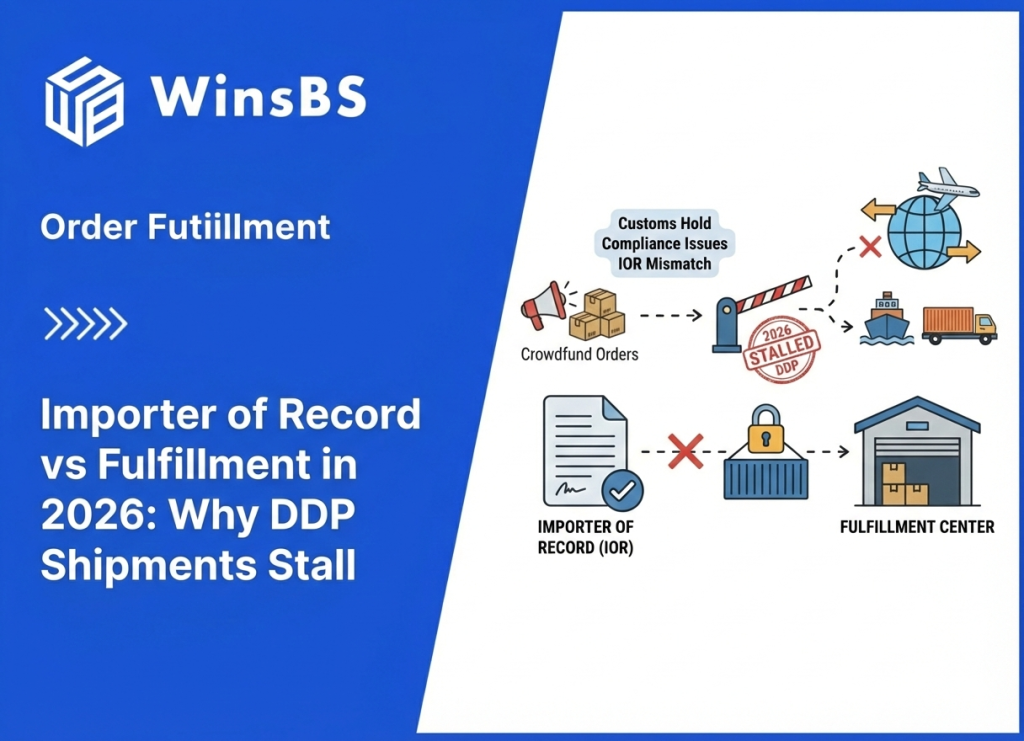
Logistics infographic beside WinsBS logo and title showing crowdfunding orders routed to a customs hold with a stalled DDP shipment stamp, illustrating importer of record mismatch and order fulfillment delays in cross-border 3PL fulfillment.
Crowdfunding Fulfillment, Ecommerce, Order Fulfillment, Shipping & Logistics, Warehousing, Winsbs

Importer of Record vs Fulfillment in 2026: Why DDP Shipments Stall

Importer of Record vs Fulfillment in 2026 Why DDP Shipments Stall at Customs After US De Minimis End, EU €3 Duty & Canada CARM WinsBS Fulfillment — Maxwell Anderson Updated February 2026 · Cross-Border Entry · Customs Clearance · DDP · Importer Liability Positioning note: This article continues the execution boundaries and responsibility splits documented in Order Fulfillment in 2026: What It Includes & Where It Stops , What Fulfillment Companies Are Not Responsible For (2026) , Where DDP Fulfillment Ends , and “Taxes Included” ≠ Import Guarantee (DDP VAT 2026) . It documents a repeatable 2025–2026 shift in cross-border execution: “DDP shipping” can still stall at customs when the entry record cannot validate a legally recognized importing entity. Confirmed system changes that increased importer validation frequency: CBP — E-Commerce FAQs (US, de minimis suspension effective Aug 29, 2025) , European Commission — €3 customs duty on low-value e-commerce packages from July 1, 2026 , and CBSA — CARM (Canada Assessment & Revenue Management) . You Shipped Correctly. Customs Still Asked Who the Importer Is. You did what any cross-border ecommerce seller would reasonably do. You paid the supplier. You moved inventory into a fulfillment warehouse. You confirmed carton markings and declared value. You selected DDP shipping to avoid delivery-time tax surprises. The warehouse executed normally. Inventory was received. Orders were picked and packed. A shipping label was generated. Electronic customs data was transmitted. Tracking went live. For several days, the shipment behaved like a normal international delivery. Then the status changed. Held at customs — pending importer clarification Clearance delay — importer information required Entry under review — declaration validation Nothing in your dashboard showed unpaid tax. Nothing in the warehouse workflow showed error. The carrier confirmed receipt. Yet customs clearance did not proceed. Because the customs system was no longer evaluating fulfillment execution. It was evaluating whether a legally accountable importing entity was recognized inside the entry declaration. Fulfillment moves goods. Customs releases goods only when a recognized importing party stands behind the declaration. If that legal layer was never configured — or cannot be validated at entry — shipment pauses. Fulfillment vs Customs vs Legal Import Layer 2026 Visual representation of fulfillment execution layer versus customs importer validation layer. FULFILLMENT Pick · Pack · Label DDP Shipping Data Transmission CUSTOMS ENTRY Declaration Review Importer Validation Liability Recognition HOLD Importer Not Recognized Structural separation in 2026: warehouse execution and importer validation occur in different system layers. 1. What Fulfillment Actually Completed — And Where It Stops When the shipment stalled, the first instinct was to look backward. Did the warehouse miss something? Was the commercial invoice incomplete? Did DDP not apply correctly? But look at what fulfillment had already completed. Inventory received and logged Order transmitted from ecommerce platform Pick and pack executed Shipping label generated Electronic customs data transmitted Parcel tendered and accepted by carrier From an operational standpoint, fulfillment execution ended successfully. What changed in 2025–2026 is not warehouse performance — it is customs entry behavior. On August 29, 2025, U.S. Customs and Border Protection suspended broad use of Section 321 de minimis treatment for many shipments, increasing the volume of parcels moving through formal entry channels. Formal entry requires a recognized importing party to be declared in the customs record. This shift increased the frequency of situations where warehouse execution completes normally — but clearance pauses at the legal validation layer. Public Case Example (U.S., 2025-2026) Following the issuance of Executive Order 14324, “Suspending Duty-Free De Minimis Treatment for All Countries,” U.S. Customs and Border Protection (CBP) initiated a systemic shift in how low-value ecommerce parcels are processed. By late 2025, trade reports from legal and logistics analysts confirmed that the $800 de minimis threshold—previously the backbone of direct-to-consumer fulfillment—effectively hit a “zero-tolerance” phase. This resulted in significant cargo holds at key entry points like Los Angeles (LAX) and New York (JFK), specifically targeting shipments where the legal “Importer of Record” was not clearly distinguished from the “Fulfillment Provider.” Source: White House — Executive Order on Suspending De Minimis Treatment . The warehouse did not change. The customs validation threshold did. Fulfillment completes physical movement. Customs entry requires validated legal accountability. Once the shipment enters formal review, fulfillment cannot supply that accountability if it was never declared in advance. 2. When Entry Systems Tighten, Legal Identity Becomes Visible The United States is not the only system that increased importer validation. In the European Union, customs reform scheduled for July 1, 2026 introduced a €3 fixed duty for parcels valued under €150 — including shipments where VAT was prepaid at checkout. Even when VAT is handled through IOSS, customs entry still evaluates the declared importing entity separately. Tax linkage and legal responsibility operate as different validation layers. If the declaration cannot validate the responsible importing party, clearance pauses — regardless of prepaid tax. Canada implemented a similar structural tightening through full rollout of the Canada Assessment and Revenue Management (CARM) system. Official reference: CBSA — CARM Registration . Under CARM, businesses acting as importers must register directly with CBSA. Without recognized registration status, entry validation cannot finalize. Public Case Example (EU, 2025–2026) Following increased enforcement of customs controls on low-value e-commerce imports (particularly from China via platforms like Temu and Shein), EU authorities reported widespread non-compliance issues, including inaccurate declarations, safety risks, and valuation mismatches. This led to a surge in parcel holds and clearance delays where importer data or entry records did not align properly. Reuters and the European Commission highlighted how tightened checks and the upcoming customs reforms have impacted direct-to-consumer shipments, with many low-value parcels facing additional scrutiny or holds due to declaration inconsistencies. Key Sources: Reuters — EU to tighten checks on cheap products from sites like Temu and Shein (Feb 2025) — Covers EU-wide customs operations prioritizing safety and compliance risks on e-commerce goods. European Commission — Large-scale EU customs control action shows most third-country e-commerce goods do not follow standards (Jan 2026) — Official report on non-compliance in billions

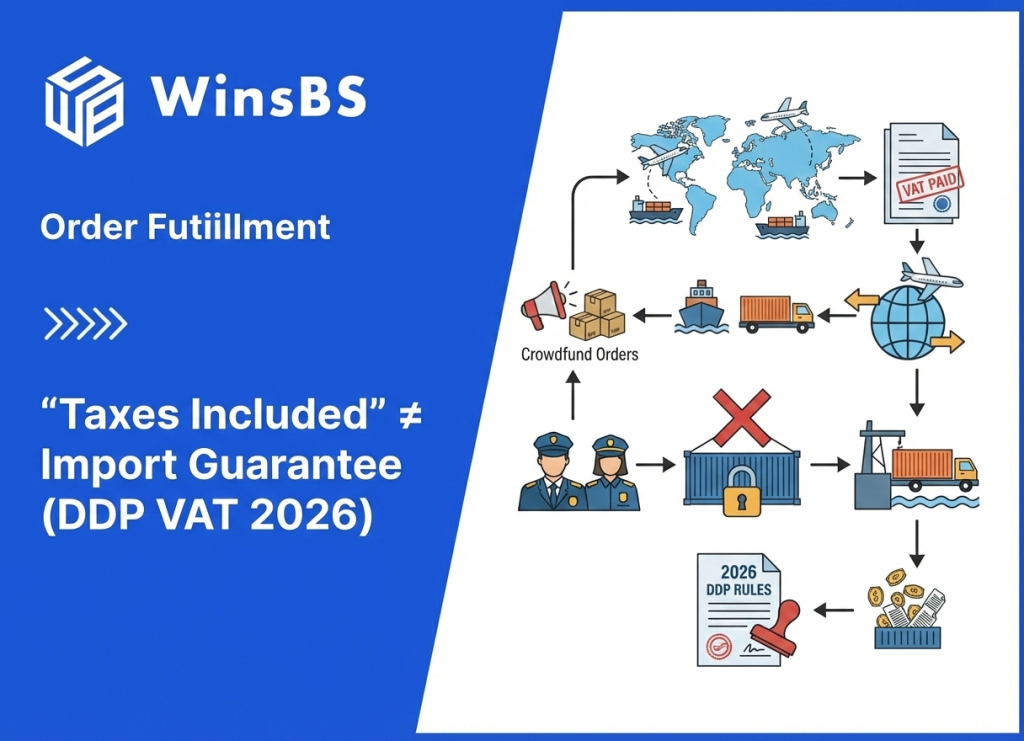
Cross-border logistics infographic beside WinsBS logo and title, showing VAT paid documents, global shipping routes, customs inspection, and a locked container symbolizing DDP order fulfillment risks and import compliance in crowdfunding fulfillment.
Crowdfunding Fulfillment, Ecommerce, Order Fulfillment, Shipping & Logistics, Warehousing, Winsbs

“Taxes Included” ≠ Import Guarantee (DDP VAT 2026)

“Taxes Included” ≠ Import Guarantee (DDP VAT 2026) Why VAT & GST Get Recalculated at EU, UK & Canada Borders WinsBS Fulfillment — Maxwell Anderson Updated February 2026 · Cross-Border DDP · VAT / GST · Customs Validation Positioning note: This article builds on the execution boundaries explained in Order Fulfillment in 2026: What It Includes & Where It Stops , What Fulfillment Companies Are Not Responsible For (2026) , and Where DDP Fulfillment Ends . It documents a repeatable cross-border scenario in 2026: VAT or GST is collected at checkout — yet import tax is requested again at entry in the EU, UK, or Canada. Contents 0. The Parcel Arrived. The Tax Bill Arrived Too. 1. The Order That Looked Fully Settled 2. Where the Recalculation Actually Begins 3. Why the 3PL Cannot Repair This Stage 4. Route Differences: EU, UK, Canada, US 5. 2026 Confirmed Validation Variables 6. When the Buyer Says, “But I Already Paid” 0. The Parcel Arrived. The Tax Bill Arrived Too. The shipment was sent under DDP. At checkout, your buyer saw “taxes included.” The order total already reflected VAT or GST. No additional fee was expected at delivery. The warehouse packed the order. A label was generated. Tracking went live. For several days, everything moved normally. Then one of two things happened. If the parcel was entering the UK, Royal Mail sent a payment request before delivery. If it entered Canada, the courier issued a GST collection notice. If it entered parts of the EU, the parcel paused in customs with VAT under review. The buyer forwarded the message to you. “I thought tax was included.” From your side, it was. The dashboard shows prepaid shipping. The invoice shows tax collected. Nothing is marked unpaid. But the import system is not looking at your checkout page. It is evaluating the parcel as it enters the country. This is the moment where the logic breaks: You paid the tax at sale. The import system is calculating tax at entry. Both are real. They are not the same system. This article starts from that split. 1. The Order That Looked Fully Settled The order was simple. A €120 skincare device shipped from Shenzhen to Germany under a DDP cross-border fulfillment structure. VAT was calculated at checkout. The buyer paid €142.80 in total, including 19% VAT. On your dashboard, the order showed: Product value: €120 VAT collected at checkout: €22.80 Shipping: prepaid (DDP) Status: paid The fulfillment system received that order exactly as shown. The warehouse picked the unit. A DDP shipping label was generated. Electronic customs declaration data was transmitted with: Declared value: €120 HS code attached for EU import classification Sender: your entity Importer: auto-assigned under the shipping structure The parcel left the warehouse. Up to this point, every number matched. The VAT collected at checkout matched the invoice. The invoice matched the shipment record. Nothing was missing from the fulfillment side. Three days later, the parcel reached the EU entry point. Now the EU import system evaluated the parcel independently as an import declaration, not as a checkout transaction. It did not look at the Shopify checkout page. It did not see the buyer-facing “tax included” confirmation. It evaluated: Is there a valid VAT or IOSS linkage inside the entry data? Does the importer registration match the declared responsible party? Is the declared goods value consistent with EU entry thresholds? If any of those elements do not reconcile inside that customs validation system, the parcel is treated as taxable at entry — regardless of what was paid at sale. That is the split. At checkout, VAT was a pricing component. At EU border entry, VAT becomes a compliance validation event. Those two events reference the same amount. They do not share the same verification logic. And that structural separation between checkout tax collection and import tax validation only becomes visible when the parcel reaches the border. 2. Where the Recalculation Actually Begins Three days after dispatch, the parcel reaches the EU entry hub. At that moment, the shipment is no longer treated as an order. It is treated as an import declaration under EU customs validation. The system now checks whether the VAT that was collected at sale is properly linked inside the electronic entry data. For the €120 device shipped from China to Germany, one of four recurring validation triggers typically initiates re-evaluation. 1) VAT or IOSS linkage mismatch If an IOSS number was used for EU VAT-at-sale collection, it must be correctly attached to the customs declaration and match the declared goods value. If the number is missing, expired, misformatted, or not recognized inside the EU import dataset, the system does not assume VAT was paid at checkout. It calculates VAT again at entry. 2) Importer identity inconsistency The checkout invoice lists your company as seller. The EU entry declaration may list a different acting importer depending on the DDP routing structure. If those identities do not reconcile inside the customs validation system, VAT is not considered validated. The parcel pauses for tax assessment. 3) Value structure difference between sale and entry Checkout total: €142.80 (goods + VAT). Declared import value: €120 (goods only). The EU customs system evaluates the declared goods value, not the buyer-facing checkout total. If VAT linkage does not successfully validate against that declared value, VAT is recalculated against €120 at entry. 4) Multi-parcel split creating independent entry records If the shipment was operationally split into two parcels for routing efficiency, each parcel is evaluated independently at EU entry. If one parcel crosses a validation threshold differently, or loses IOSS linkage in data transmission, it may fall outside the prepaid VAT structure. One parcel clears normally. The other enters VAT reassessment. At this stage, the EU import system is not “charging twice.” It is performing its own tax validation cycle based on the customs declaration record. And once that validation cycle begins, the checkout record is no longer relevant to the import decision. In standard cross-border

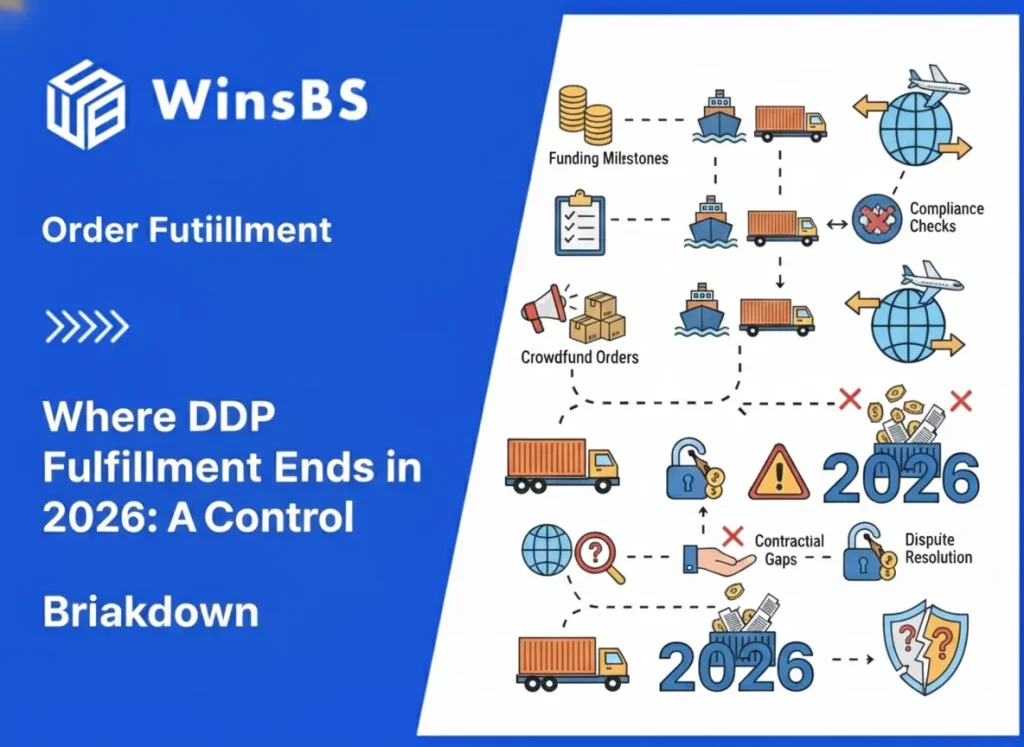
Cross-border logistics and crowdfunding fulfillment infographic beside WinsBS logo and title, showing ships, cargo planes, trucks, and global delivery icons illustrating where DDP fulfillment control ends in 2026 and the order fulfillment process.
Crowdfunding Fulfillment, Ecommerce, Order Fulfillment, Shipping & Logistics, Warehousing, Winsbs

Where DDP Fulfillment Ends in 2026: A Control Breakdown

Where DDP Fulfillment Fails A Stage-by-Stage Breakdown of Where Control Actually Ends (2026) WinsBS Fulfillment — Maxwell Anderson Updated February 2026 Positioning note: This article does not explain what DDP is. It documents a single, repeatable fulfillment moment in 2026: DDP finishes its role — and the shipment continues into a system it does not control. Contents 0. When Everything Looked Done — and Then Nothing Moved 1. What DDP Has Already Finished — Before You Start Looking for Answers 2. When the Flow Stops Responding — Even Though Nothing Is Broken 3. What Happens When You Go Back to the Fulfillment Provider 4. The Stage Where DDP Stops Deciding Anything 5. When DDP Changes the Experience — and When It Doesn’t Change the Outcome 6. Returning to the Moment You Realized Nothing Else Would Move Methodology & Sources — WinsBS Research 0. When Everything Looked Done — and Then Nothing Moved By the time this problem shows up, you have already done the reasonable thing. You didn’t cut corners. You didn’t improvise. You selected DDP, accepted “taxes included,” and paid in full. From your perspective, the risky parts were handled up front. There should be no surprise charges, no doorstep friction, no last-minute decisions left unresolved. And for a while, everything confirms that assumption. Orders are packed. Labels are generated. Tracking numbers appear. The warehouse shows the work as complete. The carrier accepts the shipment. Nothing in the dashboard signals a problem. Then progress stops. Not with an error message. Not with a rejection notice. Just… no movement. At first, this feels like a normal delay. You wait, because waiting still makes sense. Nothing looks broken enough to act on. When waiting turns into checking, the confusion begins. You refresh tracking. You compare it to other shipments. You look for an exception code, a missing scan, any clue that explains the pause. There isn’t one. So you go back one step. You open the fulfillment dashboard again. Everything there looks finished. Orders are closed. Tasks are completed. There is no pending action to click into. This is the moment that feels wrong. If the shipment exists, and shipping has already started, there should still be a way to move it forward. You don’t feel like something failed. You feel like something should still be working — and isn’t. That assumption is what creates the stall. Not because you missed a step, but because the part of the system you are trying to push has already stopped responding. This page starts from that exact moment — the moment where everything looks complete, and yet nothing you do seems to matter anymore. 1. What DDP Has Already Finished — Before You Start Looking for Answers By the time the stall becomes obvious, DDP is no longer doing anything in the background. That sounds counter-intuitive, because from your side, everything that DDP promised seems to have happened. You saw the payment go through. You saw “taxes included” at checkout. You saw shipping proceed without any doorstep charges. Those are not illusions. They are confirmations that DDP has already completed the part of the flow it controls. Money has been collected and allocated. The shipment has been labeled and routed under a prepaid structure. The carrier accepted the handoff on that basis. This is why the dashboards feel calm. There is no unpaid balance, no missing fee, no billing exception waiting to be resolved. From a usage perspective, DDP looks “done” because it is. What it does not do — and never shows you — is stay attached as an active lever. There is no background process where DDP keeps checking whether the shipment is moving. There is no status where prepaid shipping can be re-applied to unlock the next step. Once payment and routing are complete, DDP leaves the flow quietly. What follows still looks like shipping. Tracking updates may appear. The parcel may move between nodes. But those movements no longer respond to how shipping was paid for. This is the first mismatch most creators run into. From your perspective, the condition that should enable progress — payment — has already been satisfied. From the system’s perspective, that condition has already been consumed. This is the same boundary described earlier in Order Fulfillment in 2026: What It Includes (and What It Doesn’t) and What Fulfillment Companies Are Not Responsible For (2026) : execution finishes cleanly, and the shipment continues into a stage that no longer reacts to execution signals. Nothing is wrong with the payment. Nothing is missing from the shipment. The confusion starts because you are still trying to push a lever that has already disengaged. 2. When the Flow Stops Responding — Even Though Nothing Is Broken After DDP has finished its part, the shipment does not stop immediately. That is what makes this stage difficult to recognize. For a while, things still move. Tracking updates may appear. The parcel may pass through one or two nodes. Carrier status changes at least once. From the outside, this looks like normal transit. There is no clear signal telling you that anything has changed. Then the movement slows. Not into an error. Not into a failed state. Just into stillness. At this point, most creators do what they have done successfully before: they try to trigger progress through action. They wait a bit longer. They refresh tracking more frequently. They compare this shipment to others that are still moving. When that does not work, they try intervention. They ask whether something is missing. They ask whether a document needs to be re-uploaded. They ask whether the shipment can be “re-processed” or “pushed.” Nothing changes. Not because the questions are wrong, but because the flow you are now watching does not react to those inputs. This is the first practical sign that the role of the system has shifted. Earlier, progress followed execution. Doing something — packing faster, paying earlier, resubmitting information — produced a visible effect. Here, action no longer