Free 1 Month of Warehousing for New Clients Start with lower storage cost from day one.

FREE QUOTE

Order Fulfillment

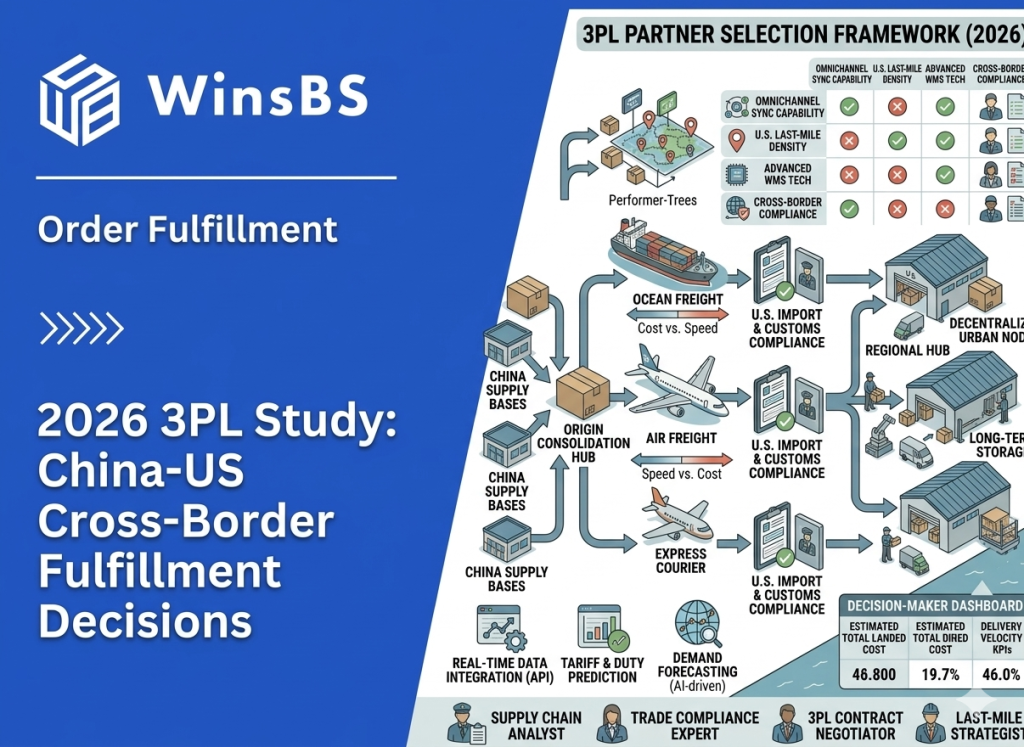
Blue and white infographic beside WinsBS logo and title illustrating cross-border order fulfillment, showing the shift from parcel shipping in China to China-to-US warehousing and faster nationwide eCommerce order fulfillment.
Ecommerce, Order Fulfillment, Shipping & Logistics, Warehousing, Winsbs

When Ecommerce Brands Need Cross-Border Fulfillment: The Strategic Pivot from Parcel Shipping to China-to-US Warehousing (2026)

When Ecommerce Brands Need Cross-Border Fulfillment The Strategic Pivot from Parcel Shipping to Inventory Positioning WinsBS Fulfillment ORDER FULFILLMENT COMPANY · MAXWELL ANDERSON March 2026 Quick Context Many ecommerce brands do not begin with cross-border fulfillment. They begin with direct parcel shipping from China because it is simple, flexible, and workable at small scale. The pivot usually comes later, when delivery visibility weakens, shipping costs become less predictable, and customer experience starts depending on a logistics structure that was never designed for stable international growth. This article explains when that shift happens and why the real decision is no longer about choosing a faster parcel service, but about repositioning inventory closer to the destination market. Table of Contents Why Direct Parcel Shipping Works in the Early Stage Why Shipping Friction Increases as Volume Grows How Cross-Border Logistics Systems Become Complex Where the Parcel Shipping Model Reaches Its Limits Why Inventory Positioning Changes Delivery Stability The Typical China–US Cross-Border Fulfillment Structure When the Operational Pivot Point Has Already Arrived Cross-Border Fulfillment as a Way to Rebuild Delivery Control For readers comparing this article with broader provider-focused research, the logistics logic here sits one level below a company list. The question is not which cross-border fulfillment providers exist, but why ecommerce brands that begin with direct parcel shipping eventually reach a point where inventory positioning, delivery control, and route stability matter more than parcel convenience alone. Why Direct Parcel Shipping Works in the Early Stage For many ecommerce brands manufacturing in China, direct parcel shipping is the most practical way to begin selling internationally. When orders start arriving from overseas customers, sending individual parcels directly from the origin warehouse allows brands to reach global buyers without building additional infrastructure. In its simplest form, the logistics path is straightforward. Products leave a warehouse in China, move through an international parcel carrier, pass through destination-country customs, and are then transferred to a local delivery network for final distribution. This structure is widely used across cross-border ecommerce and is supported by international shipping programs offered by carriers such as USPS international shipping services and other global parcel networks. At a small scale, the model works because it keeps operational requirements minimal. Brands can ship each order as it is placed, avoiding the need to position inventory in another country before demand becomes predictable. There is no overseas warehouse to manage, no inventory forecasting tied to a specific market, and no commitment to a single distribution hub. This flexibility is particularly valuable in the early stages of international growth. Demand may come from several regions at once, and the brand may not yet know which market will develop consistent order volume. Direct parcel shipping allows products to reach customers in multiple countries while the business is still learning where its strongest demand actually exists. Another reason the model works early on is that operational complexity remains manageable. When daily order volume is relatively low, handling each shipment individually does not create significant pressure on logistics coordination, customer service, or carrier performance. Shipping costs are predictable enough, and delivery variability usually remains within acceptable limits for customers who are already expecting international transit times. Industry documentation around international parcel services reflects this reality. Global postal networks and parcel carriers have long developed cross-border ecommerce delivery programs specifically designed for low-to-moderate shipping volumes, a structure widely documented by organizations such as the Universal Postal Union’s ecommerce logistics research. In other words, direct parcel shipping is not an inefficient logistics strategy. In the right conditions, it is the most logical one. It allows brands to test international demand, operate with minimal infrastructure, and keep logistics decisions flexible while the business is still defining its market footprint. The challenge appears later, when the same conditions that once made parcel shipping practical begin to change. As international orders concentrate in specific markets and shipping volumes grow — a trend documented in global cross-border ecommerce research such as Statista’s cross-border ecommerce analysis — the logistics structure that once provided flexibility can gradually become a source of instability. Understanding how that shift happens is the key to recognizing when parcel-based logistics begins reaching its limits. Why Shipping Friction Increases as Volume Grows As international order volume increases, many ecommerce brands begin to notice subtle changes in delivery performance. Shipments that once moved through the logistics chain with relatively predictable timing start showing wider delivery windows, occasional tracking gaps, or unexpected pauses during international transit. In the early stage of cross-border growth, these irregularities are often dismissed as isolated shipping incidents. A parcel may remain in transit for several days without a tracking update, or appear to stall briefly before reappearing in the destination country’s delivery network. Because these situations occur sporadically, they are usually treated as individual carrier issues rather than signs of a structural change. However, when shipping volume continues to rise, the pattern gradually becomes more visible. Customer service teams begin receiving more questions about delivery status, more requests for tracking clarification, and more messages from customers unsure whether their order is still moving through the system. In many cases, the brand itself has limited visibility into the shipment’s exact location during these periods. This shift does not necessarily mean that logistics providers are performing worse. Instead, it reflects the structure of international parcel delivery itself. A direct cross-border shipment typically passes through several independent operational systems before it reaches the final customer. A typical path may begin at a warehouse in China, move into an export carrier network, travel through international transportation routes, pass inspection or processing within destination-country customs, and finally transfer into a domestic delivery network. Each stage is managed by a different organization operating under its own infrastructure and regulatory environment. When parcel volumes remain small, these transitions between systems rarely create noticeable disruption. But as the number of shipments increases, the probability of delays, inspection variations, routing adjustments, or temporary tracking inconsistencies naturally grows. What once appeared to be a simple logistics path begins to

Infographic comparing single-node and multi-node warehouse networks beside WinsBS logo and title, illustrating how multi-warehouse 3PL fulfillment improves eCommerce order fulfillment speed, lowers shipping costs, and enhances customer experience.
Ecommerce, Order Fulfillment, Shipping & Logistics, Warehousing, Winsbs

When Multi-Warehouse Fulfillment Improves Ecommerce Performance

When Does Multi-Warehouse Fulfillment Actually Improve Ecommerce Performance? Why additional warehouse nodes only help when inventory depth, demand spread, and service pressure are ready for them Maxwell Anderson INDEPENDENT 3PL RESEARCH March 2026 Quick Context Many teams start thinking about more warehouses before they have really proved that more warehouse nodes will improve the network. The pressure usually arrives first. One node starts feeling too narrow, regional service differences become easier to notice, and delivery strain becomes harder to absorb from one place. But additional nodes do not automatically fix that. If inventory depth, demand spread, and service pressure are not yet mature enough to support more warehouses cleanly, the business often ends up splitting stock and complexity earlier than it should. So the real question is not whether more warehouses sound useful. It is whether the business has actually reached the stage where added nodes improve fulfillment instead of simply enlarging the structural burden. Table of Contents Quick Answers: Multi-Warehouse Fulfillment in Practice Why Brands Keep Moving Toward More Warehouses Operational Patterns in Multi-Warehouse Fulfillment When More Warehouses Actually Improve Fulfillment When More Warehouses Make the Network Worse Warehouse Count Capability Matrix Execution Capabilities Required for Multi-Warehouse Fulfillment Execution Dataset: Common Multi-Warehouse Signals Trigger Checklist for Warehouse Network Reassessment Operational Risk Signals Once Warehouse Count Is Misread Multi-Warehouse Fulfillment in the Broader U.S. Ecommerce Infrastructure Methodology Editorial Independence This page adds the warehouse-count layer to the broader U.S. ecommerce fulfillment cluster. East Coast fulfillment, West Coast fulfillment, Dallas fulfillment, and fulfillment pricing by network design explain different structural pressures inside the same U.S. ecommerce system. This article asks a different question: when additional warehouse nodes actually belong in that structure, and when they only introduce fragmentation before the business is ready for it. Quick Answers: Multi-Warehouse Fulfillment in Practice Core Problem What does multi-warehouse fulfillment actually solve? Multi-warehouse fulfillment solves a maturity problem before it solves a geography problem. It becomes useful when one node can no longer absorb the real order map cleanly, regional service pressure has become more specific, and the business has enough inventory depth to support more than one placement point without immediately distorting stock. That is why added nodes are not valuable just because they exist. They matter when the business has grown into a network condition that one warehouse no longer handles well enough on its own. Early Instinct Why do brands start asking for more warehouses before proving they really need them? Because the pressure becomes visible before node-readiness becomes real. A single structure starts feeling too narrow, regional service differences become easier to notice, and delivery strain becomes more obvious to the team than inventory readiness, stock depth, or the cost of fragmentation. That is why more warehouses often appear first as an instinctive answer. The problem shows up in service and reach before the business has fully earned the right to solve it with more nodes. Readiness Point When do additional warehouse nodes actually improve fulfillment performance? Added nodes start helping when the business has enough clarity and enough stock to make those nodes serve the demand map better than they fragment inventory. That usually means demand spread is not just broad but structurally clear, service pressure is specific enough to justify multiple placements, and inventory can support cleaner regional coverage without constant distortion. In that stage, additional warehouses stop being symbolic expansion and start becoming real network improvement. Misfit Risk When do more warehouses make the network more expensive or less stable instead? More warehouses make the network worse when they create fragmentation before they create fit. That usually happens when inventory is still too shallow, demand is still too noisy, or service pressure is not yet specific enough to justify the added complexity. In that situation, node count increases faster than network maturity. The result is not a stronger fulfillment model. It is a more expensive one that now has more inventory to balance, more structure to defend, and less room for error. Why Brands Keep Moving Toward More Warehouses Most brands do not arrive at the idea of more warehouses by finishing a clean network model first. They arrive there because they can feel the strain before they can fully explain it. The current node still works, orders are still shipping, and the structure is still defensible on paper. But some parts of the map keep feeling harder than they should. That is usually when “we may need another warehouse” starts sounding obvious. The pressure is real. The readiness is less obvious. That gap is what keeps pushing brands toward more warehouse nodes before they have fully proved that additional nodes will improve the network instead of only splitting it sooner. The Current Node Still Works, but You Can Feel Where It Keeps Coming Up Short This is often the first moment the idea appears. The node is not failing outright, but certain parts of the order map keep asking more from it than it can absorb cleanly. Some regions feel harder to serve. Certain delivery lanes keep carrying more friction. The business can feel where the structure is stretching, even if it has not yet fully modeled what should replace it. You start thinking about another warehouse before the first one has truly stopped working. That is what makes the instinct so understandable. The problem shows up as repeated strain, not as a dramatic collapse. The node is still functioning. It just no longer feels equally natural everywhere. Regional Service Differences Become Impossible Not to Notice What teams usually notice first is not inventory readiness. It is service difference. One side of the country keeps feeling smoother, while another side keeps feeling slower, heavier, or harder to explain. Once that pattern becomes consistent, adding another warehouse starts looking like the most natural way to even things out. Service differences become visible earlier than node-readiness becomes clear. That is why the next warehouse often feels like the obvious answer. The problem is already being felt at

Infographic comparing fulfillment network designs beside WinsBS logo and title, illustrating how 3PL order fulfillment pricing in 2026 changes between consolidated regional hubs and decentralized urban nodes.
Ecommerce, Order Fulfillment, Shipping & Logistics, Warehousing, Winsbs

Why Fulfillment Pricing Changes by Network Design in 2026

Why Ecommerce Fulfillment Pricing Changes by Network Design: East Coast vs West Coast vs Dallas Why similar fulfillment quotes can lead to very different cost structures once the network is actually running Maxwell Anderson INDEPENDENT 3PL RESEARCH March 2026 Quick Context Most brands start with the quote sheet. The real cost usually shows up later, once the network starts shaping parcel behavior, inventory pressure, and service tradeoffs in ways the quote never made fully visible. That is why East Coast, West Coast, and Dallas do not just represent different locations. They create different cost structures. One may push cost deeper into parcel drag, another into inventory imbalance, and another into the hidden price of keeping the wrong node alive for too long. So the real pricing question is not which quote looks cheaper at the start. It is which network design changes where the cost actually lands once fulfillment is running at scale. Table of Contents Quick Answers: Fulfillment Pricing by Network Design Why Pricing Changes Even When Quotes Look Similar Cost Layers That Network Design Actually Changes East Coast vs West Coast vs Dallas: Where Cost Structure Starts to Diverge When Cheaper Fulfillment Becomes More Expensive Network Design Cost Matrix Execution Capabilities Required for Cost Control Execution Dataset: Common Fulfillment Cost Signals Trigger Checklist for Network-Cost Reassessment Operational Risk Signals Once Cost Structure Is Misread Fulfillment Pricing in the Broader U.S. Ecommerce Infrastructure Methodology Editorial Independence This page is the cost-structure synthesis layer for the broader U.S. ecommerce fulfillment cluster. East Coast fulfillment, West Coast fulfillment, and Dallas fulfillment are not just regional options. They create different pricing behavior once parcel movement, inventory placement, service pressure, and node design begin interacting inside the same operating model. Quick Answers: Fulfillment Pricing by Network Design Core Pricing Logic Why can similar fulfillment quotes produce very different real costs? Because the quote only prices one layer of the system. It usually reflects storage, handling, and visible transaction fees. The real divergence starts later, once the network begins shaping parcel behavior, inventory pressure, service tradeoffs, and the cost of keeping the wrong node structure in place. That is why two quotes can look close on paper and still create very different operating outcomes. Providers price transactions first. The network ends up pricing the consequences. Regional Cost Behavior How do East Coast, West Coast, and Dallas change cost behavior differently? They move cost into different parts of the model. East Coast fulfillment can strengthen eastern service alignment while making western balance harder to hold. West Coast fulfillment can improve inbound inventory timing while pushing more cost deeper inland and east. Dallas can preserve one-node balance for longer, but that balance becomes expensive if the business is already ready for a more region-specific structure. So the difference is not just location. It is where each network design causes cost to accumulate once fulfillment is running under real demand pressure. Hidden Cost Layers What cost layers usually stay hidden until the network is running? The biggest hidden layers are usually not missing fees. They are delayed cost behaviors. Parcel drag, inventory imbalance, regional service mismatch, over-concentration, and premature fragmentation often look manageable during quoting because the network has not started exposing them yet. Once orders begin moving through the actual structure, those costs become much easier to feel than to spot on the original rate sheet. Misleading Savings When does a cheaper fulfillment quote become the more expensive operating model? It happens when the quote looks cheap because it is not capturing the layers where the business will really pay later. A lower visible fee can still lead to a more expensive model if the network design creates worse parcel behavior, the wrong inventory shape, or a node structure that keeps service and cost under the wrong kind of pressure. A cheaper quote becomes expensive when the business starts paying in the parts of the network the quote never priced aggressively enough in the first place. Why Pricing Changes Even When Quotes Look Similar Similar fulfillment quotes can look credible at the same time because they are usually pricing the same visible layer of the model. Storage, handling, pick fees, and other transaction-level charges can sit close enough on paper to make two different network structures appear economically similar at the start. That does not mean the underlying cost behavior is similar. It usually means the quote is only capturing the opening layer. The real divergence starts later, once the network begins exposing what the fee sheet could not fully price in advance. This is where parcel movement, inventory placement, service pressure, and node design start pulling cost in different directions. One network may push more pressure into parcel drag. Another may keep transportation cleaner while making inventory balance more expensive to hold together. A third may preserve simplicity for longer, but only by delaying a structure the business is already beginning to need. That is why pricing changes even when the quote does not seem to. The visible fee may stay close, but the network determines where the less visible cost layers begin compounding and how hard they start pushing once the model is live. So the quote is not necessarily wrong. It is just incomplete. The cost does not disappear. It relocates. And where it relocates depends on the network design the business is actually choosing to operate. Cost Layers That Network Design Actually Changes When network design changes, the business is not choosing whether cost exists. It is choosing where cost becomes heavier, which part of the system absorbs the pressure first, and which layer becomes expensive only after the model has been running long enough to expose it. That is why fulfillment pricing cannot be read only through visible fees. Network structure changes multiple cost layers at once, and some of the most expensive ones are not the first ones teams notice. Parcel Movement Cost The first layer most teams feel is parcel movement. Node position changes zone behavior, transit distance,

Isometric DTC fulfillment network with smart fulfillment center, robots, conveyor systems, delivery trucks, cargo plane and container ship beside WinsBS logo and title, symbolizing 3PL order fulfillment and global DTC fulfillment operations in 2026.
Ecommerce, Order Fulfillment, Shipping & Logistics, Warehousing, Winsbs

DTC Fulfillment Companies in 2026: Providers and Logistics Structures

DTC Fulfillment Companies in 2026 Providers Appearing Where DTC Brands Start Balancing Cost, Speed, and Service WinsBS Fulfillment ORDER FULFILLMENT COMPANY · MAXWELL ANDERSON March 2026 Quick Context DTC brands usually focus first on products, marketing, and customer acquisition. As order volume grows, fulfillment starts shaping the customer experience more directly. Shipping cost changes, delivery speed differences, and return handling begin affecting margins and service quality at the same time. Not all DTC fulfillment operates in the same environment. Some brands ship domestically with inventory and customers in the same country. Others rely on cross-border structures where products are manufactured in one market and delivered into another. This article examines providers appearing across both environments and how brands start balancing cost, delivery speed, and service expectations as fulfillment becomes a larger operational decision. For deeper analysis of international shipping structures, see our research on cross-border fulfillment companies . Table of Contents Quick Answers About DTC Fulfillment Domestic vs Cross-Border DTC Fulfillment Providers Appearing in DTC Fulfillment Capability Matrix Cost and Friction Drivers Operational Patterns in DTC Fulfillment Common DTC Fulfillment Structures Execution Dataset Trigger Checklist Risk Signals Global Fulfillment Context Industry Statistics and Methodology Quick Answers About DTC Fulfillment Fulfillment Environment What makes DTC fulfillment different from traditional retail fulfillment? In traditional retail, inventory moves through distribution centers before reaching stores. In DTC operations, orders move directly from warehouse shelves to individual customers. This means shipping speed, parcel costs, and return handling become visible parts of the customer experience rather than background logistics activity. Operational Trigger When do DTC brands usually begin working with fulfillment providers? Many brands begin outsourcing fulfillment when order volumes increase beyond what small internal teams can process consistently. Growth across multiple regions, increasing return volume, and the need for faster delivery windows often push brands toward dedicated fulfillment infrastructure. Fulfillment Structure Why does the domestic vs cross-border distinction matter in DTC fulfillment? Domestic DTC fulfillment usually focuses on warehouse location, shipping zone costs, and last-mile delivery performance. Cross-border DTC operations introduce additional layers such as international shipping lanes, customs processing, and import duties. These structural differences shape how brands design their fulfillment networks. Operational Role What operational problems do DTC fulfillment providers usually solve? Fulfillment providers handle inventory storage, order processing, parcel shipping coordination, and returns management. For growing DTC brands, these systems help stabilize delivery performance while allowing internal teams to focus on product development, marketing, and customer acquisition. Domestic vs Cross-Border DTC Fulfillment Many DTC brands look similar from the outside. Customers place orders through the brand’s website, payments are processed online, and products ship directly to individual buyers. But behind that storefront experience, the fulfillment environment can be very different depending on where products are stored and where customers are located. For some brands, fulfillment happens entirely within one country. For others, the supply chain stretches across international manufacturing bases and consumer markets. These two operating conditions shape how shipping costs behave, how quickly orders can be delivered, and how inventory decisions affect overall margin. Domestic DTC Fulfillment Domestic DTC fulfillment usually means inventory and customers are located within the same national shipping network. In the United States, for example, brands often store inventory in regional warehouses and ship through parcel carriers such as UPS, FedEx, or USPS. The main operational variables tend to revolve around warehouse location, shipping zones, delivery speed expectations, and return handling efficiency. Because international transportation is not involved, domestic fulfillment decisions typically focus on balancing warehouse operating costs with delivery performance. Brands often evaluate how many fulfillment nodes they need, how shipping zones affect parcel rates, and how quickly orders can reach customers in major markets. Cross-Border DTC Fulfillment Other DTC brands operate through cross-border fulfillment structures. Products may be manufactured in countries such as China, Vietnam, or India and sold directly to customers in markets like the United States or Europe. In these cases, fulfillment operations extend beyond domestic parcel delivery and begin to involve international shipping lanes, customs processing, and import tax considerations. Because of these additional layers, cross-border DTC fulfillment introduces different operational signals. Shipping timelines may vary more widely, international transport costs can become a larger share of order economics, and inventory staging decisions often determine how quickly products can reach end customers. A deeper analysis of these structures is explored in our research on cross-border fulfillment companies . Understanding whether a DTC operation behaves primarily as a domestic network or as a cross-border fulfillment system helps explain why certain providers appear more frequently in specific environments. The sections that follow examine how fulfillment providers participate in these operational structures and how brands begin balancing cost, speed, and service across their order flows. Providers Appearing in DTC Fulfillment DTC fulfillment providers do not usually enter the conversation for the same reason. Some appear when brands begin feeling pressure from cross-border inventory movement and U.S. fulfillment positioning. Others become relevant once inventory is already domestic and the challenge shifts toward parcel speed, return handling, or multi-node execution. That is why the same company names do not show up evenly across every DTC operation. In practice, providers tend to appear around specific fulfillment environments, specific cost pressures, and specific service expectations rather than inside one generic category. Cross-Border DTC · inventory transition and U.S. fulfillment positioning WinsBS WinsBS tends to appear when a DTC brand is not operating inside a purely domestic fulfillment structure. Products may be manufactured in Asia, inventory may need to move into the United States, and the brand may be trying to balance international transport costs with a more stable U.S. delivery experience. It usually becomes relevant when fulfillment pressure starts appearing before the parcel even reaches the customer. Inventory staging, U.S. warehouse positioning, and the relationship between cross-border movement and domestic delivery all become part of the decision rather than separate logistics tasks. In that environment, WinsBS is discussed less as a generic warehouse provider and more as part of a DTC execution structure where cross-border supply and U.S.-based

Global logistics infographic beside WinsBS logo and title, showing cross-border order fulfillment networks with warehouses, shipping lanes, cargo ships, aircraft, and trucks representing international 3PL fulfillment services.
Ecommerce, Order Fulfillment, Shipping & Logistics, Warehousing, Winsbs

Cross-Border Fulfillment Companies in 2026: Providers Appearing on the Shipping Lanes Ecommerce Brands Actually Use

Cross-Border Fulfillment Companies in 2026 Providers Appearing on the Shipping Lanes Ecommerce Brands Actually Use WinsBS Fulfillment ORDER FULFILLMENT COMPANY · MAXWELL ANDERSON March 2026 Quick Context Large global retailers operate distributed fulfillment networks across multiple regions. Most ecommerce brands do not. International orders usually begin with inventory in one place and customers appearing in other markets. As orders cross borders, fulfillment complexity often shows up through specific routes — delivery times vary by destination, duties become customer-facing, and shipping costs change depending on where the order travels. This article looks at providers appearing across three common ecommerce shipping lanes: China → United States, U.S. West Coast → Global, and United States → Canada. Table of Contents Quick Answers Providers Appearing in Cross-Border Fulfillment Capability Matrix Cost and Friction Drivers Operational Patterns in Cross-Border Ecommerce Execution Capabilities Execution Dataset Decision Signals Trigger Checklist Risk Signals Global Fulfillment Context Ecosystem Context Methodology Editorial Independence For readers looking at how fulfillment infrastructure changes across ecommerce environments, the operational signals summarized in the 2026 Ecommerce 3PL Signal Index provide broader context across this research cluster. Quick Answers for Teams Shipping Across Borders Cost Exposure Why do some international orders suddenly cost far more than others? For many ecommerce teams, cross-border friction first shows up as a pricing problem. Most international orders may look manageable, and then one shipment suddenly lands at two or three times the expected cost. That jump is often tied less to the product itself and more to where the order is going. Remote-area surcharges, weaker last-mile coverage, extra handoffs, and route-specific carrier pricing can all push cost up fast, even when the destination country looks familiar on paper. This is why cross-border fulfillment often stops feeling simple before volume looks especially large. The problem is not that a brand is shipping internationally. It is that certain addresses inside those markets begin behaving very differently from the rest. Delivery Variance Why can delivery times vary so much within the same country? Many teams expect delivery differences between countries. What catches them off guard is when the real gap appears inside the same market. One order reaches a major city quickly, while another to a more remote area takes much longer and generates a very different customer experience. That usually comes from route structure rather than warehouse delay. Local carrier coverage, distance from main parcel networks, customs routing, and regional handoff quality can all change how the same country performs at the delivery level. In practice, this is one of the clearest signals that cross-border shipping is no longer just a rate question. It has become a fulfillment question, because delivery reliability is now changing by destination, not just by country. Route Friction Which shipping routes tend to create the most operational friction? Most brands do not run into cross-border complexity evenly across all markets. The pressure usually starts on a few recurring routes where order volume, customer expectations, and delivery exceptions begin concentrating in the same places. In ecommerce, that often means specific lanes such as China to the United States, U.S. West Coast inventory serving international orders, or cross-border shipping between the United States and Canada. Each one carries a different mix of cost exposure, transit variance, customs handling, and remote-zone difficulty. What many teams describe as “international shipping complexity” is often this exact pattern: one or two routes begin absorbing a disproportionate amount of operational time, customer support attention, and shipping unpredictability. Decision Point When do brands start needing cross-border fulfillment partners? It usually does not happen when the first international orders appear. Most brands can absorb occasional overseas shipments without changing much. The shift begins when those orders become repeatable enough to create ongoing operational drag. That drag often shows up through higher shipping exceptions, more customer questions about delivery timing or duties, wider cost variation between destinations, and more time spent managing route-specific problems that internal teams were not built to handle every day. At that point, brands are no longer looking for help with “international shipping” in the abstract. They are usually looking for fulfillment partners that can support the specific lanes where the business is starting to feel unstable. Providers Appearing in Cross-Border Fulfillment Cross-border fulfillment providers do not usually enter the picture for the same reason. Some appear closer to manufacturing and export flow. Others become relevant once inventory is already in the United States and international orders start growing from there. Some are discussed because brands need better parcel routing, while others come up when fulfillment itself has to absorb more of the operational pressure. That is why the same company names do not show up evenly across every cross-border situation. In practice, providers tend to appear around specific shipping lanes, specific inventory positions, and specific types of friction. China → United States · trans-pacific movement and U.S. entry Flexport Flexport usually enters the conversation earlier in the supply chain, especially when brands are trying to move inventory from China into the United States in a more structured way. It tends to become relevant when the challenge is no longer just sending parcels internationally, but coordinating freight movement, customs handling, and the transition from overseas production into U.S. fulfillment. On this lane, it appears less as a simple shipping option and more as part of the upstream infrastructure brands consider once volume and inventory value start becoming harder to manage informally. China → United States · parcel injection and export-side routing 4PX 4PX tends to appear in discussions where brands are shipping from China into overseas markets through established cross-border parcel channels rather than building a fully domestic fulfillment setup first. It usually becomes relevant when teams are still operating close to origin and need a provider that sits naturally inside export-side ecommerce flow, especially on trans-Pacific routes where parcel volume starts becoming repeatable. In that environment, the conversation is often less about warehouse sophistication and more about how orders move out of China and into destination markets with enough consistency

Ecommerce, Order Fulfillment, Shipping & Logistics, Warehousing, Winsbs

Dallas Fulfillment Center in 2026: When One-Node Balance Still Works

Dallas Fulfillment Center for Ecommerce Brands in 2026 How one-node balance can work better than coastal specialization before inventory needs to split Maxwell Anderson INDEPENDENT 3PL RESEARCH March 2026 Quick Context Dallas usually enters the conversation when one coastal node is starting to feel too narrow, but inventory still is not deep enough to split cleanly across the country. That is the real value of a central node. Not that it sits in the middle of the map, but that it can keep one-node fulfillment viable for longer while reducing some of the imbalance created by a coast-led structure. The question is not whether Dallas looks balanced. It is whether the business still benefits more from one concentrated node than from a network that is starting to fragment too early. Table of Contents Quick Answers: Dallas Fulfillment in Practice Why Dallas Keeps Appearing in U.S. Network Design Operational Patterns in Dallas Fulfillment When Dallas Fulfillment Actually Fits When Dallas Creates the Wrong Setup Regional Capability Matrix Execution Capabilities Required for Dallas Fulfillment Execution Dataset: Common Dallas Fulfillment Signals Trigger Checklist for Dallas Fulfillment Evaluation Operational Risk Signals Once Dallas Logic Is Overextended Dallas Fulfillment in the Broader U.S. Ecommerce Infrastructure Methodology Editorial Independence Dallas solves a different problem from East Coast or West Coast fulfillment. East Coast logic usually starts with customer density. West Coast logic usually starts with inventory entry. Dallas shows up when neither coast is doing enough on its own, but the business still is not ready to split inventory too early. Quick Answers: Dallas Fulfillment in Practice Core Problem What does a Dallas fulfillment center actually solve? Dallas usually solves a one-node problem before it solves a regional one. It becomes relevant when one coastal node is starting to feel too narrow, but the business still gains more from keeping inventory concentrated than from splitting it across multiple specialized locations. That is why Dallas often matters in a specific stage of growth. It gives one node more room to support a wider domestic order map without forcing the network into fragmentation too early. Network Timing Why do brands move toward Dallas before they split inventory across multiple regions? Because the pressure usually shows up before the business is ready for a clean multi-node structure. Order geography starts widening, one coast no longer feels balanced enough, but inventory depth still is not strong enough to support multiple nodes without creating stock distortion. Dallas enters the conversation at that point because it lets the business stay concentrated a little longer without staying too committed to a single coast. Balance Test Does Dallas improve national fulfillment, or just make one-node fulfillment last longer? Often it does more of the second than the first. Dallas can improve national balance from one node, but that does not mean it automatically solves every regional service problem. What it often does best is extend the life of one-node fulfillment when the business is not yet ready for more regional precision. That distinction matters. Dallas can be the right structure for a stage of the business without being the final structure the network will need later. Misfit Risk When is Dallas the wrong answer, even if one coastal node is no longer enough? Dallas becomes the wrong answer when balance is no longer the real problem. If service pressure has already become too regional, if one side of the country is driving too much of the customer experience, or if the business now needs more precise placement than one central node can give, then Dallas can start delaying a network change that should already be happening. In that situation, Dallas is no longer solving the business. It is only making an older one-node model last longer than it should. Why Dallas Keeps Appearing in U.S. Network Design Dallas usually enters the discussion after a business has already learned what one coastal node cannot do cleanly anymore. The order map gets wider. One side of the country starts feeling too narrow as the main anchor. But the network is still not ready to split inventory with confidence. That is usually when Dallas begins to make sense. The logic is not that Dallas is somehow the perfect answer for the whole country. The logic is that it gives one-node fulfillment more room to keep working once a coast-led structure starts losing balance. In that stage, the business still gains something from concentration. It just can no longer afford to let that concentration sit too heavily on one side of the map. That is what Dallas actually solves. Not full regional precision, and not some permanent national ideal. It solves a narrower but very real problem: how to let one primary node support a broader domestic order map without forcing the business into fragmentation before inventory is ready for it. This is also why Dallas gets overstated so easily. A central position sounds like a complete answer because it sounds neutral and balanced. But balance is not the same thing as full optimization. Dallas can be the right structure for a stage of the network and still be the wrong structure if teams start treating it as a final answer instead of a timed one. So Dallas keeps appearing for a reason. Not because the map says it should, but because the operating reality keeps creating the same pressure: one coast is no longer enough, yet the business still benefits more from one concentrated node than from splitting too early. That pressure is what gives Dallas its place in the conversation. Operational Patterns in Dallas Fulfillment Dallas does not keep appearing in ecommerce fulfillment because people keep rediscovering the map. It keeps appearing because the same tension shows up again and again. One coastal node starts feeling too narrow, national demand begins stretching wider, and the business still is not ready to split inventory across a more fragmented structure. That is what gives Dallas its place. Not geography on its own, but a repeating operating condition:

Isometric logistics hub with port containers, automated conveyors, warehouse zones, and delivery trucks beside WinsBS logo and title, symbolizing West Coast eCommerce fulfillment, inventory timing optimization, and fast order fulfillment services.
Ecommerce, Order Fulfillment, Shipping & Logistics, Warehousing, Winsbs

West Coast Ecommerce Fulfillment in 2026: When Inventory Timing Pays Off

West Coast Ecommerce Fulfillment in 2026 Why port proximity can improve fulfillment timing without automatically improving the whole network Maxwell Anderson INDEPENDENT 3PL RESEARCH March 2026 Quick Context Most brands do not start with a clean national fulfillment map and then choose the West Coast. They back into it because inventory reaches the U.S. from the western side first. That makes West Coast fulfillment feel logical early, sometimes before the business has really decided what kind of domestic network it actually needs. That early advantage is real. Product can become available faster. Launch timing can tighten up. Orders headed to western states can move through a cleaner first leg. But that is exactly where the misread starts. Port proximity helps inventory enter the market faster. It does not automatically make the full network more efficient once national order spread, parcel behavior, and stock balance start carrying more weight. The real question is not whether West Coast fulfillment sounds faster. It is whether faster inventory positioning is creating a payoff that still holds after the rest of the network is taken seriously. Table of Contents Quick Answers: West Coast Fulfillment in Practice Why West Coast Fulfillment Is Still Operationally Important Operational Patterns in West Coast Fulfillment When West Coast Fulfillment Actually Fits When West Coast Fulfillment Creates the Wrong Setup Regional Capability Matrix Execution Capabilities Required for West Coast Fulfillment Execution Dataset: Common West Coast Fulfillment Signals Trigger Checklist for West Coast Fulfillment Evaluation Operational Risk Signals Once West Coast Logic Is Misread West Coast Fulfillment in the Broader U.S. Ecommerce Infrastructure Methodology Editorial Independence This page sits inside the broader U.S. ecommerce fulfillment network design cluster. The West Coast version of the problem is different from East Coast density pressure or Dallas-style balance. It starts earlier, closer to inbound entry, launch timing, and western positioning. For readers comparing that logic against a real operating model, the related West Coast fulfillment page shows how this structure is framed on the main site. Quick Answers: West Coast Fulfillment in Practice Operational Fit What does West Coast ecommerce fulfillment actually solve? West Coast fulfillment usually solves the first part of the inventory problem before it solves the whole delivery problem. Product lands on the western side of the U.S., clears into available stock sooner, and can start moving into domestic orders without waiting for a longer inland repositioning step first. That can matter a great deal during launches, replenishment cycles, or periods when western customer demand is already meaningful. But it still does not answer the bigger network question by itself. A fast starting position is useful. It is not the same thing as an optimized national structure. Entry Logic Why do brands move toward West Coast fulfillment before they redesign the whole U.S. network? Because the West Coast is often where inventory enters the country first. That makes it the most convenient place to begin, especially when teams are trying to shorten the time between inbound arrival and the first domestic order wave. This is why West Coast fulfillment can feel like the obvious answer earlier than it should. The decision often starts as a practical response to where product lands, not as a fully developed view of what the long-term U.S. network should look like. Cost View Does West Coast fulfillment lower cost, or just move cost to a different part of the network? Sometimes it lowers cost in the early part of the flow. Inventory becomes usable faster, western routing can look cleaner, and the first domestic movement may feel more efficient. That is the part many brands notice first. The harder question is what happens next. A structure that looks efficient near the point of entry can still create more pressure deeper in the network once inland shipments, eastern demand, and inventory balance start carrying more weight. In other words, West Coast fulfillment can reduce one cost layer while making another one more visible. Misfit Risk When is West Coast fulfillment the wrong answer, even if inventory enters through the West? It is often the wrong answer when teams keep designing the network around where product lands instead of where demand actually behaves. That usually shows up when national order spread is broader than expected, inland and eastern shipments carry more of the margin pressure, or the business starts treating port convenience as if it were long-term network logic. It can also be the wrong answer when the structure looks clean only because the rest of the network has not been fully measured yet. A good inbound position can still be the wrong operating model once total coverage, parcel behavior, and inventory balance are taken seriously. Why West Coast Fulfillment Is Still Operationally Important West Coast fulfillment keeps showing up for a simple reason: product often reaches the western side of the United States first. That is not a theory or a warehouse preference. It is just how a large share of inbound inventory enters the market. Even in 2025, port-side flow remained strategically relevant, as seen in FreightWaves’ July 2025 reporting on West Coast container momentum. Before a brand has fully mapped its domestic network, the West Coast is already part of the operating reality because that is where inventory becomes physically available first. That changes the timing of everything that comes next. Inventory can move into launch windows sooner. Replenishment can start from a shorter first position. Orders headed into western states can begin from a cleaner routing point. At that stage, West Coast fulfillment is not mainly about making the whole country faster. It is about getting product into a usable domestic position earlier. This is also where the logic starts getting stretched too far. A faster starting position is easy to mistake for a better network. Teams see inventory clear into domestic availability sooner and assume the same structure will continue making sense once national order spread, inland routing, eastern demand, and stock balance start carrying more of the load. That is the part

Fashion logistics illustration with GOH garment racks, demand signal dashboard, trucks, aircraft, and cargo ships beside WinsBS logo and title, symbolizing apparel fulfillment, fashion ecommerce order fulfillment, and global 3PL logistics in 2026.
Ecommerce, Order Fulfillment, Shipping & Logistics, Warehousing, Winsbs

Apparel Fulfillment Companies in 2026: Logistics Signals for Fashion Ecommerce

Apparel Returns Management in 2026 What high-return brands need from a 3PL when returns start eating margin and making stock harder to trust Maxwell Anderson EDITOR-IN-CHIEF | WINSBS RESEARCH April 2026 Maxwell Anderson is Editor-in-Chief at WinsBS Research. His published work focuses on ecommerce fulfillment, cross-border logistics, warehouse execution, and 3PL decision patterns for U.S. brands. In Brief Apparel returns get expensive fast. The label is only the start. The bigger cost shows up after the item gets back to the warehouse and nobody can say, quickly and confidently, whether it can go back on the shelf. Table of Contents Why Returns Get Expensive Fast Where Inventory Starts to Go Wrong Signs Your Returns Process Is Already Slipping Why Standard 3PL Returns Workflows Fall Short Standard vs Apparel-Capable Workflow What Good Returns Management Looks Like Where WinsBS Can Help Why Returns Push Costs Up So Fast Selected References Frequently Asked Questions Apparel returns get expensive fast. The label is only the start. Once the item gets back to the warehouse, someone still has to inspect it, decide whether it is still sellable, fix the packaging, and put the right size and color back into stock. If that part drags, the return keeps costing money long after the package has arrived. That is why returns become such a serious problem for apparel brands. They do not just slow refunds down. They make inventory harder to trust, tie up stock that should already be back on sale, and create more work for support, ops, and planning at the same time. Any warehouse can receive a return. The hard part is getting that unit back into saleable inventory without creating a second mess. Why returns get expensive fast Apparel returns are high by default. The National Retail Federation and Happy Returns estimated that retailers saw returns equal to 16.9% of annual sales in 2024. Fashion ecommerce usually runs worse than the blended average because fit, color, and presentation all affect buying behavior. The commercial pressure is not just on the warehouse side. NRF says 76% of consumers see free returns as an important factor in deciding where to shop, and 67% say a bad return experience would make them less likely to buy again. That leaves apparel brands in a familiar bind: they need to keep the return experience easy for the customer while keeping the reverse workflow tight enough to avoid margin damage. McKinsey’s article Returning to order: Improving returns management for apparel companies put the problem in sharper terms for apparel sellers: its returns survey found a 25% return rate for apparel ecommerce, versus 20% overall, and said poor fit or style drove about 70% of returns. That is why apparel brands get hit twice. The sale is uncertain at the front end, and the resale path is fragile at the back end. The cost stack is bigger than the refund. A returned garment has to be received, opened, checked, graded, sometimes re-bagged, sometimes relabeled, and then restocked correctly. If the item misses the right resale window, the problem gets worse. McKinsey also notes that any lag time in apparel returns can lead to significant markdowns for merchandise being resold. In apparel, the expensive part of a return usually starts after the carrier scan, not before it. “In apparel, the return label is visible. The real cost starts after intake, when the warehouse has to decide whether that unit can still make it back to saleable stock.” Where inventory starts to go wrong Inventory usually starts slipping before the warehouse looks broken. A returned garment is not just one unit coming back. It is a specific style, size, and color that may or may not be ready to sell again. If the system counts it too early, inventory is inflated. If the system blocks it too long, real sellable stock disappears. This is when inventory numbers stop meaning much. Merchandising sees one number. Support sees another. The warehouse knows the item is physically back, but still cannot say whether it should be restocked yet. Once those versions split, the return is no longer just a reverse shipment. It is now a stock-control problem. McKinsey’s returns work is useful here because it explains why the path back to sellable stock gets messy so fast. In its survey, the complexity of the reverse path ranged from 10% in the simplest in-store flow to 42% when items were mailed back, processed centrally, and then restocked in a store or online. That is exactly the kind of operational drag apparel brands underestimate when they think “the item is back, so the problem is solved.” The ownership side is just as weak in many businesses. McKinsey found that 58% of survey respondents saw lack of accountability for returns management inside any single department as a pain point. For apparel brands, that usually shows up as the wrong size restocked to the wrong SKU, support promising inventory the warehouse does not trust, or planning making decisions on stock that is physically present but not truly available. “Returned inventory becomes expensive the moment nobody can say, with confidence, whether the item is blocked, sellable, or simply waiting on a decision.” Signs your returns process is already slipping The first sign is unclear status. Returned items sit in a holding state for too long. Nobody can say whether they are sellable, blocked, damaged, or waiting on review. Once that becomes normal, your process is already too loose. The second sign is disagreement. Customer support thinks the item should be available soon. The warehouse says it still needs inspection. Planning teams use one stock number while operations trust another. If your teams are describing the same returned unit differently, the workflow is not tight enough. Watch for these signals Returned units sit in pending status for days without a clear resale decision. Refunds move faster than item checks and restock decisions. Wrong sizes or colors get restocked after return intake. Seasonal inventory loses selling time while reverse logistics catches

Ecommerce, Order Fulfillment, Shipping & Logistics, Warehousing, Winsbs

East Coast Ecommerce Fulfillment Services in 2026: When They Fit

East Coast Ecommerce Fulfillment Services in 2026: When They Fit Maxwell Anderson Independent 3PL Research March 2026 TLDR East Coast ecommerce fulfillment is usually not a “faster shipping” story in the abstract. It becomes operationally important when eastern order density, parcel zone behavior, and delivery promise consistency begin shaping fulfillment outcomes more than a single national warehouse can support cleanly. This guide explains why East Coast fulfillment is being re-evaluated in 2026, what business conditions actually justify it, and where brands often misread regional coverage pressure as a generic warehousing problem. Contents Quick Answers About East Coast Ecommerce Fulfillment Why East Coast Fulfillment Is Being Re-evaluated Operational Patterns in East Coast Fulfillment When East Coast Fulfillment Actually Fits When East Coast Fulfillment Does Not Solve the Problem Regional Capability Matrix Execution Capabilities Required for East Coast Fulfillment East Coast Fulfillment Signal Dataset Trigger Signals for East Coast Fulfillment Evaluation Operational Risk Signals East Coast Fulfillment Within the U.S. 3PL Landscape Observation Sources and Signal Methodology This article is part of the broader U.S. ecommerce fulfillment network design cluster. East Coast fulfillment is analyzed here as one regional execution logic within that system, alongside West Coast positioning, Dallas-based central-node balance, and the cost behavior created by different network structures. Quick Answers About East Coast Ecommerce Fulfillment Quick Answer What is East Coast ecommerce fulfillment? East Coast ecommerce fulfillment refers to inventory storage and order execution positioned to serve customers across the eastern United States through a warehouse or fulfillment network located on the East Coast. In operational terms, it matters when eastern order density, delivery promise expectations, and parcel zone behavior begin making a national single-node setup less efficient for brands serving U.S. customers at scale. Quick Answer Who usually needs East Coast ecommerce fulfillment services? Brands usually begin evaluating East Coast ecommerce fulfillment services when a meaningful share of their customer demand is concentrated across eastern or southeastern markets. This often becomes more relevant when shipping performance, delivery consistency, or parcel cost to eastern customers starts creating operational pressure that a single national warehouse cannot absorb cleanly. Quick Answer Is East Coast fulfillment always cheaper? No. East Coast fulfillment is not automatically cheaper in the abstract, because total fulfillment cost depends on order geography, inventory structure, and how shipments move across the rest of the U.S. network. What East Coast placement often changes is not the existence of cost, but which cost pressures become dominant, especially for eastern parcel efficiency, delivery consistency, and regional service economics. Quick Answer When does East Coast fulfillment outperform a central U.S. setup? East Coast fulfillment usually outperforms a central U.S. setup when eastern customer concentration is strong enough that regional service levels and parcel behavior matter more than broad national balance. In those cases, an East Coast node may support more consistent eastern delivery performance, while a central-node model may remain better when national order spread is broader and inventory concentration still matters more than coastal proximity. Why East Coast Fulfillment Is Being Re-evaluated East Coast ecommerce fulfillment has become more important again because many brands are no longer evaluating U.S. fulfillment purely as a question of warehouse availability. As consumer shipping expectations in the United States continue shifting toward more predictable delivery outcomes, fulfillment performance begins reflecting customer geography, delivery expectation patterns, and parcel cost behavior more directly. For many ecommerce operators, the problem does not begin with a dramatic warehouse failure. It usually appears more quietly. Eastern customers begin receiving slower delivery estimates than expected. Shipping costs into eastern markets drift upward even when core ecommerce fulfillment services still look commercially acceptable on paper. Service promises start being shaped by where inventory happens to sit rather than by where customer demand is actually concentrated. This is one reason East Coast fulfillment is being re-evaluated in 2026. Brands that once treated U.S. fulfillment as a simple one-node problem are increasingly finding that regional demand concentration changes how fulfillment behaves. Once that happens, East Coast placement starts looking less like an optional warehouse location and more like a response to how the eastern side of the order map is affecting service and cost outcomes. Observation: East Coast fulfillment usually becomes relevant when eastern order concentration begins affecting service quality more than a single national warehouse can support consistently. Explanation: Customer geography in the U.S. is not operationally neutral. Eastern demand density can create delivery and cost behavior that differs from what a one-node national model suggests on paper. Implication: East Coast warehouse placement is often re-evaluated not because brands suddenly want another location, but because eastern fulfillment performance is becoming a structural issue rather than a temporary shipping fluctuation. Another reason this topic matters is that many brands still describe East Coast fulfillment in language that is too generic. They may talk about “faster shipping” or “better regional coverage,” but those phrases often hide the real operational question. As Forrester’s research on elevated fulfillment expectations has suggested in adjacent commerce and operations discussions, the real issue is whether eastern order density, parcel zone behavior, and delivery promise consistency are now important enough to justify changing the network structure behind fulfillment. That distinction matters because East Coast fulfillment is not automatically the right answer whenever shipping feels slow. In some cases the issue is still forecasting, replenishment timing, or a mismatch between service promises and actual order geography. But once eastern performance pressure keeps appearing in the same region, the conversation usually shifts. The problem is no longer simply fulfillment execution. It becomes fulfillment design. Operational Patterns in East Coast Fulfillment Once East Coast fulfillment becomes a real consideration, the underlying reason is usually visible in recurring operating patterns rather than in a single cost report or isolated shipping complaint. The same signals tend to appear repeatedly when eastern demand begins shaping fulfillment performance more strongly than a national one-node setup can absorb. These patterns matter because they reveal whether East Coast fulfillment is emerging as a genuine network response or whether teams are

Automated subscription box packing line with conveyor belt, robotic arms, warehouse staff, and global shipping icons beside WinsBS logo and title, symbolizing subscription fulfillment, order fulfillment services, and global 3PL logistics in 2026.
Ecommerce, Order Fulfillment, Shipping & Logistics, Warehousing, Winsbs

Subscription Fulfillment Companies in 2026: Providers Used for Subscription Box Logistics

Subscription Fulfillment Companies in 2026 Providers Used for Subscription Box Logistics and Recurring Shipping Maxwell Anderson Independent 3PL Research March 2026 TLDR Subscription fulfillment operates on recurring shipping cycles rather than continuous ecommerce order flow. Brands managing subscription boxes often encounter operational complexity once assembly workflows, SKU rotation, and monthly shipping waves begin to scale. This guide explains which fulfillment providers appear most often in subscription logistics discussions, how recurring shipment cycles affect warehouse operations, and what operational signals indicate when subscription brands begin moving toward specialized 3PL fulfillment. Contents Quick Answers About Subscription Fulfillment Subscription Fulfillment Providers Frequently Used by Brands Subscription Fulfillment Capability Matrix Operational Patterns in Subscription Fulfillment Execution Capabilities Required for Subscription Fulfillment Subscription Fulfillment Execution Signals Dataset When Subscription Brands Need Specialized Fulfillment Operational Risk Signals in Subscription Logistics Subscription Fulfillment Within the 3PL Landscape Observation Sources and Signal Methodology This article is part of the 2026 Ecommerce 3PL Signal Index which tracks operational signals across fulfillment providers used by ecommerce brands. Subscription fulfillment appears frequently in logistics discussions because recurring shipping cycles introduce different operational pressures than standard ecommerce order flows. Quick Answers About Subscription Fulfillment Quick Answer What is subscription fulfillment? Subscription fulfillment refers to the logistics process of preparing and shipping recurring customer orders on a fixed cycle. Unlike standard ecommerce fulfillment, subscription operations usually involve recurring batch releases, box assembly, and shipping coordination tied to billing schedules. Quick Answer How is subscription fulfillment different from ecommerce fulfillment? Subscription fulfillment differs from standard ecommerce fulfillment because orders are generated in recurring cycles rather than placed one by one throughout the day. This creates monthly or weekly shipping waves, recurring assembly work, and inventory staging requirements that are less common in continuous ecommerce order flow. Quick Answer What operational challenges appear in subscription box logistics? Common challenges include recurring box assembly, SKU rotation between cycles, inventory forecasting, compressed shipping windows, and growing support requests after each release. These issues usually become more visible as subscriber volume rises and each cycle requires more coordinated warehouse work. Quick Answer When do subscription brands start using 3PL fulfillment? Many subscription brands move to third-party fulfillment when in-house packing starts taking multiple days each cycle or when assembly, shipping, and inventory coordination begin to consume too much operational time. This shift often happens once recurring volume, box complexity, or subscriber geography grows beyond what a small internal team can handle consistently. Subscription Fulfillment Providers Frequently Used by Brands Subscription brands usually evaluate fulfillment providers differently from standard ecommerce sellers. Once recurring shipping cycles begin to scale, the operational question shifts from simple order shipping to managing batch releases, box assembly, and recurring warehouse workflows tied to subscription billing schedules. The providers below appear frequently in subscription fulfillment discussions because they are associated with recurring shipping operations, box kitting workflows, and logistics infrastructure that supports subscription-based distribution models. Recurring Ecommerce Operations ShipBob Typical Subscription Fit: DTC subscription brands scaling recurring shipments through an ecommerce-focused warehouse network. Operational Signals: Recurring order handling, batch shipping workflows, and platform integrations used by subscription-based businesses. Subscription Box Operations ShipMonk Typical Subscription Fit: Subscription box brands dealing with multi-SKU assembly, rotating products, and recurring cycle shipments. Operational Signals: Box kitting workflows, recurring shipping support, and infrastructure suited for assembly-heavy subscription programs. Warehouse Technology Infrastructure ShipHero Typical Subscription Fit: Brands with recurring order cycles that require stronger warehouse systems and inventory visibility. Operational Signals: Warehouse management systems, order processing control, and operational infrastructure supporting recurring fulfillment. Structured Product Handling Red Stag Fulfillment Typical Subscription Fit: Subscription programs shipping higher-value or operationally sensitive products. Operational Signals: Order accuracy emphasis, careful handling workflows, and fulfillment operations focused on reliability. Flexible Growth Stage Fulfillment Fulfillrite Typical Subscription Fit: Earlier-stage subscription brands transitioning away from in-house packing operations. Operational Signals: Recurring shipment support and flexible batch fulfillment workflows. Distributed Fulfillment Network Quiet Platforms Typical Subscription Fit: Growing brands needing distributed fulfillment capacity across recurring shipping cycles. Operational Signals: Network-based fulfillment infrastructure and scalable recurring order processing. Enterprise Logistics Infrastructure Whiplash Typical Subscription Fit: Large subscription brands requiring enterprise-scale infrastructure and integrations. Operational Signals: Omnichannel logistics, warehouse orchestration, and recurring shipment execution capacity. Mid-Market Subscription Logistics Shipfusion Typical Subscription Fit: Mid-sized subscription brands shipping recurring boxes across North America. Operational Signals: Recurring order processing, kitting workflows, and batch shipping coordination. Global Shipping Infrastructure Easyship Typical Subscription Fit: Subscription brands prioritizing cross-border shipping and international subscriber delivery. Operational Signals: International shipping coordination, duty handling infrastructure, and global carrier integrations. Cross-Border Fulfillment WinsBS Typical Subscription Fit: Brands managing recurring shipments with stronger international or cross-border logistics requirements. Operational Signals: Global shipping coordination and fulfillment workflows supporting recurring cross-border distribution. At a glance, many subscription fulfillment providers appear similar. Operational differences usually become clearer once recurring shipping cycles, box assembly complexity, and subscriber geography begin shaping warehouse operations. Subscription Fulfillment Capability Matrix Subscription fulfillment providers often appear similar at a surface level. The operational differences usually emerge once recurring shipping cycles, box assembly workflows, and international subscriber distribution begin shaping warehouse operations. The matrix below compares common capabilities observed in subscription fulfillment environments rather than marketing claims. Provider Subscription Cycle Handling Box Kitting SKU Rotation Batch Shipping International Shipping ShipBob Strong Moderate Moderate Strong Moderate ShipMonk Strong Strong Strong Strong Moderate ShipHero Strong Moderate Moderate Strong Moderate Red Stag Fulfillment Moderate Moderate Limited Moderate Moderate Fulfillrite Moderate Moderate Moderate Moderate Moderate Quiet Platforms Strong Moderate Moderate Strong Moderate Whiplash Strong Strong Moderate Strong Strong Shipfusion Strong Moderate Moderate Strong Moderate Easyship Moderate Limited Limited Moderate Strong WinsBS Moderate Moderate Moderate Moderate Strong The capability comparison above is intended as a workflow snapshot rather than a ranking. Subscription brands typically evaluate providers based on how recurring cycles, assembly complexity, and shipping coordination affect operational reliability over time. Operational Patterns in Subscription Fulfillment Subscription fulfillment usually operates differently from standard ecommerce logistics because orders are not generated continuously throughout the day. Instead, shipments are often released in recurring cycles tied to billing schedules,