

Online Support
Typically replies within 5 minutes
Hello! How can we assist you today?

Ecommerce

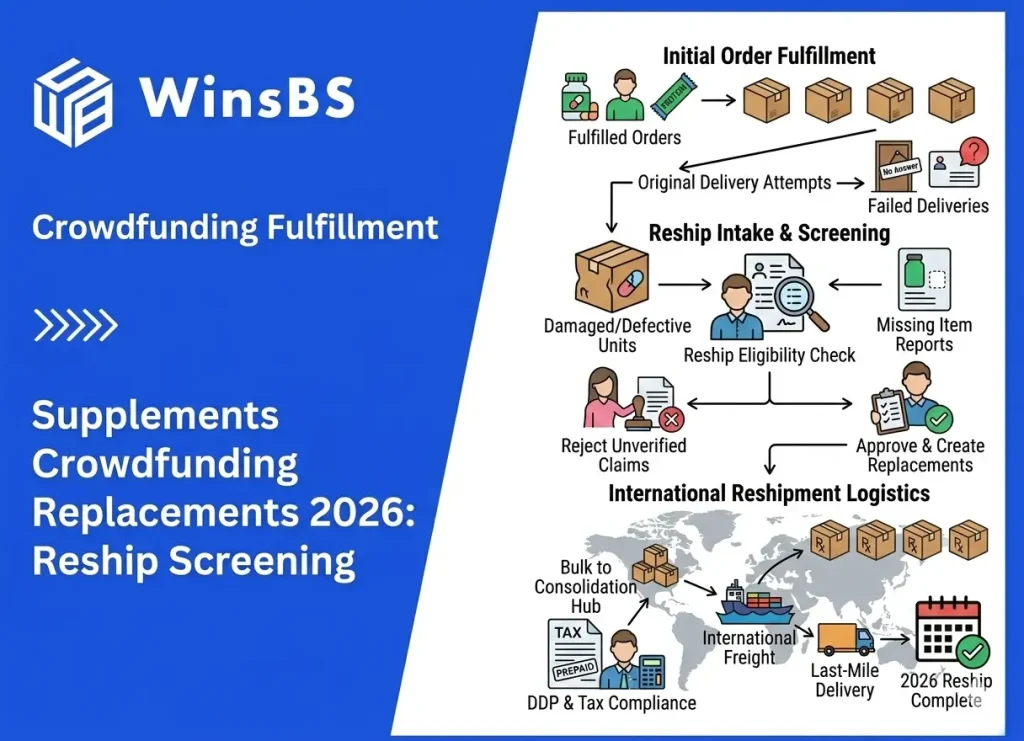
WinsBS crowdfunding logistics risk infographic showing food supplement DDP fulfillment flow, highlighting order fulfillment risks, customs issues, shipment delays, and financial loss in crowdfunding campaigns.
Ecommerce, Order Fulfillment, Shipping & Logistics

Food Supplements DDP Risk in Crowdfunding: Why “Taxes Included” Fails

Food Supplements DDP Risk in Crowdfunding Fulfillment Why “Taxes Included” Fails When Ingredients and Claims Aren’t Fixed WinsBS Fulfillment – Maxwell Anderson Updated January 2026 Table of Contents Key judgment: why DDP fails before shipping 1. Why food supplements are most often misjudged in crowdfunding 2. The three intuitive assumptions that fail under regulatory review 3. How regulatory systems actually define food supplements 4. Why DDP becomes structurally unstable for supplements 5. Country differences are not “strictness,” but entry gates 6. Why responsibility becomes non-transferable once problems appear 7. When DDP can work — and why these conditions are rare 8. Why crowdfunding timelines conflict with regulatory timelines 9. What this means before you commit to DDP Key judgment Food supplements are repeatedly misjudged in crowdfunding because they feel like “normal consumer goods.” Regulatory systems do not treat ingestible products that way. Once ingestion and health-related claims are involved, the category shifts into a compliance-first domain where admissibility determines outcomes long before duty payment matters. DDP (“taxes included”) can prepay duties and taxes, but it cannot make an inadmissible product admissible. When a campaign commits to DDP while ingredients, dosage, or label claims are still moving, DDP becomes structurally unstable: it locks responsibility at the exact moment the product identity is least stable. The failure often appears later as a “shipping problem,” but it begins earlier as a product-definition problem. A small post-campaign change that looks minor to backers can materially change how a supplement is treated at the border or in-market. 1. Why Food Supplements Are Most Often Misjudged in Crowdfunding Food supplements feel familiar. Creators have used similar products, seen them sold on major marketplaces, and watched countless brands ship them cross-border. Compared with categories that obviously “look regulated,” supplements can feel routine. That familiarity creates confidence. The problem is not that creators ignore rules. The problem is that they use the wrong mental model. Retail normality is not regulatory normality. A product being common in commerce is not evidence that it is stable under regulatory definitions. In the United States, the “dietary supplement” category is clearly defined by statute, placing direct responsibility on companies to assess safety and finalize labeling before marketing — a core principle the FDA continues to highlight in its ongoing guidance. Explore the FDA’s current overview of dietary supplements and regulatory responsibilities for firms. In the EU, the framework splits responsibilities: one directive sets the basic rules for food supplements as a product category, while a separate regulation strictly governs nutrition and health claims. This division alone disrupts many crowdfunding assumptions, since category approval and allowable claims don’t always align. See Directive 2002/46/EC on food supplements and Regulation (EC) No 1924/2006 on nutrition and health claims. Crowdfunding amplifies this mismatch because it commits to delivery terms while the product is still evolving. In established trade, supplements that ship reliably do so under stable formulas, stable labels, and stable claims. In crowdfunding, those elements often remain negotiable after funding. 2. The Three Intuitive Assumptions That Fail Under Regulatory Review Most supplement crowdfunding failures begin with three intuitions that feel reasonable in consumer commerce but fail under regulatory review. The first intuition is: “It’s just vitamins, herbs, protein, or probiotics — it’s not dangerous.” Regulatory control is not limited to “dangerous goods.” Ingestible products are controlled because they can be misleading, adulterated, misbranded, or positioned as medicines through claims. The question is not whether the product feels safe. The question is whether its identity and labeling fall cleanly inside the lawful category you are using to ship it — precisely the framework explained in the FDA’s detailed questions and answers on dietary supplements under DSHEA. FDA Questions and Answers on Dietary Supplements (DSHEA framework). The second intuition is: “Similar products sell on Amazon, so ours will be fine.” Marketplace presence is not proof of regulatory stability. Many products exist in commerce under inconsistent labeling quality, inconsistent claim discipline, and inconsistent ingredient documentation. Crowdfunding turns “inconsistency” into “failure” because you commit to thousands of cross-border deliveries under one promise. The third intuition is: “DDP solves it because taxes are prepaid and someone else handles the import.” DDP can change who pays and who arranges clearance, but it does not change what the product is. If the product’s admissibility is questioned, payment does not resolve the hold. DDP is a payment structure, not an admissibility guarantee — as the U.S. Department of Commerce clearly outlines in its practical guide to Incoterms. U.S. Department of Commerce — Know Your Incoterms (DDP overview). These assumptions appear “true” in mature supply chains because mature brands typically freeze formula and claims before scaling cross-border delivery. Crowdfunding reverses that sequence. 3. How Regulatory Systems Actually Define Food Supplements Supplements are not evaluated as “a product type people buy.” They are evaluated as a defined ingestible item with a defined composition and a defined label-claim posture. In practice, systems define supplements through the interaction of ingredients, dosage, intended-use framing, and claims language. In the U.S., “dietary supplement” is defined in statute. That definition does not magically make every ingestible “a supplement.” It describes the category boundaries that your product must actually fit — laid out in the legal text at 21 U.S.C. § 321 — Definitions (including dietary supplement definition). Manufacturing and handling expectations for supplements also sit inside formal compliance frameworks, including current good manufacturing practice requirements specific to supplements. This matters operationally because once a campaign scales, any mismatch in traceability, lot identity, or label control becomes a systemic exposure rather than a one-off mistake. The FDA’s small-entity compliance guide walks through these requirements in clear, practical detail. 21 CFR Part 111 — cGMP for dietary supplements and FDA Small Entity Compliance Guide for 21 CFR Part 111. Note that even as recently as mid-2025, the FDA released new educational videos and fact sheets to help companies better navigate the New Dietary Ingredient (NDI) notification process, underscoring how pre-market safety evaluations remain a key focus for certain ingredients. FDA’s latest

Infographic showing DDP for electronics crowdfunding in 2026 beside WinsBS logo and title, illustrating cross-border order fulfillment, taxes, tariffs, and global logistics routes for successful or failed campaigns.
Ecommerce, Order Fulfillment, Shipping & Logistics

DDP for Electronics Crowdfunding (2026): Best & Hardest Countries

DDP for Kickstarter & Indiegogo Electronics 2026: Best & Hardest Countries Guide Tariffs After De Minimis Removal, Battery/Wireless Compliance, Costs & Execution Tips WinsBS Fulfillment – Maxwell Anderson Updated January 20, 2026 Table of Contents TL;DR Why DDP Remains the Default Choice 2025–2026 Changes: De Minimis Gone & Tariff Reality DDP by Country: Easiest vs Hardest in 2026 Why DDP Is Predictable in Some Countries — and Structurally Hard in Others Why Regulatory Responsibility Does Not Transfer Under DDP What Actually Breaks When DDP Fails in Crowdfunding How to Execute DDP Successfully for Electronics Battery, Wireless & Extension Risks When to Avoid DDP (Red Flags & Alternatives) Self-Check: Is DDP Right for Your Campaign? FAQ: Common DDP Questions 2026 TL;DR For most $50–200 consumer electronics campaigns on Kickstarter or Indiegogo in 2026, DDP (Delivered Duty Paid) is still the smartest play to keep backers happy—no surprise fees, fewer chargebacks, better reviews. The big shift? US de minimis ended August 29, 2025—every commercial shipment now hits formal entry + duties (typically 15–30% for electronics). EU kicks in a €3 flat customs fee per item from July 1, 2026 on low-value parcels. Easiest markets: Canada, Singapore, Australia, UK, US (with solid prep). Hardest: India, Brazil, much of LATAM and select Middle East (high tariffs, delays—often better to skip DDP here). The key is locking in battery/wireless specs early and budgeting realistically. Partner with a 3PL that handles IOR, CE/RED, UN38.3—makes all the difference. Why DDP Remains the Default Choice for Electronics Crowdfunding in 2026 Let’s be real: backers on Kickstarter and Indiegogo don’t want to deal with unexpected duty or tax bills when their gadget finally arrives. Those surprise charges often lead to refunds, chargebacks, public complaints in the comments, and lasting damage to your campaign’s rating. That’s exactly why DDP—where you pre-pay duties, taxes, and clearance—continues to be the go-to recommendation from fulfillment partners like LaunchBoom, Fulfillrite, and eFulfillment Service. It delivers the cleanest backer experience, especially for products in the $50–200 range. Yes, costs have gone up significantly since late 2025. But for most campaigns, the math still works: absorbing 15–30% extra in landed costs upfront is usually cheaper than the fallout from unhappy backers. 2025–2026 Changes: De Minimis Gone & Tariff Reality The landscape shifted hard in 2025. The US fully suspended the de minimis exemption ($800 duty-free threshold) on August 29, 2025, via Executive Order. Now every commercial shipment—regardless of value—requires formal entry, broker involvement, and full duties/taxes. For consumer electronics (HS codes in the 85xx chapter), you’re typically looking at 0–5% base duties plus Section 301 add-ons, pushing effective rates to 15–30% in many cases. Broker fees alone can add $20–50 per parcel. Over in the EU, a new €3 flat customs duty per item kicks in July 1, 2026 for parcels valued under €150, on top of VAT (19–27%) and any product-specific duties. The UK remains relatively stable post-Brexit, but VAT enforcement is tight. Campaigns that pretend it’s still 2024 pricing get burned on margins. The ones that model these realities into their pledge tiers and shipping costs? They fulfill smoothly and keep backers smiling. DDP by Country: Easiest vs Hardest in 2026 (Consumer Electronics) Not all markets are created equal when it comes to DDP execution. Here’s a quick-reference table based on current enforcement patterns and real-world data from 3PLs handling electronics campaigns. Country/Region DDP Ease Level 2026 Key Changes Typical Added Cost Tips for Success Biggest Risks United States Medium-Hard De minimis gone Aug 2025; formal entry always 15–30% duty + $20–50 broker/parcel Bulk to US warehouse; accurate HTS code; pre-pay via 3PL Margin erosion from high tariffs Canada Easy-Medium Low threshold; predictable valuation Low duties (often 0–5%) Clear valuation and documentation Minimal European Union (Core Markets) Medium €3 flat fee Jul 2026 + CE/RED/Batteries Reg strict VAT 19–27% + €3 + 0–5% duty IOSS for VAT; early conformity (CE/RED); UN38.3 for batteries Conformity review reopening if wireless changes United Kingdom Easy-Medium Post-Brexit VAT enforcement Similar to EU Use UK VAT scheme for high volume Declarant vs consignee mismatch Australia Medium GST on low value; scope validation 10% GST + duties Pre-pay GST; early product scope check Reassessment delays Japan Medium-Hard Registered importer required Low-moderate duties Use 3PL as IOR; pre-register Importer mismatch blocks release Singapore Easy Efficient customs, low barriers Minimal duties Standard docs; fast clearance Minimal India / Brazil / LATAM / Select Middle East Hard High tariffs + strict inspections + local rules 20–50%+ + delays Avoid DDP; consider local partner or DAP Long holds, rejections, extra fees Pro tip: If your backers are concentrated in the top easy-medium markets (US, Canada, EU core, UK, Australia), DDP scales well. Spreading thin across hard regions? That’s when risk compounds quickly. Why DDP Is Predictable in Some Countries — and Structurally Hard in Others Here’s the thing that trips up a lot of teams: DDP difficulty isn’t about carrier reliability or warehouse speed—it’s about how each country’s customs and regulatory systems sequence their checks. In the US, since the de minimis suspension in August 2025, everything goes formal entry. But the focus stays on classification accuracy, valuation, and entry docs first. Get those right, and prepaid duties under DDP usually clear without drama—even if the bill is higher than before. That’s why so many campaigns describe US DDP as “expensive but predictable.” The rules are clear: importers must exercise reasonable care under 19 U.S.C. §1484. That said, flip to the European Union and the sequence changes. For wireless products, conformity under the Radio Equipment Directive (2014/53/EU) comes before duties are even considered valid. Battery-powered gear falls under the Batteries Regulation (EU) 2023/1542, with similar upfront checks. Prepaying duties doesn’t override those requirements—so if scope or docs get questioned, the shipment sits. This isn’t inconsistency; it’s different enforcement logic. The same gadget might sail through US customs under DDP but stall in the EU until conformity is confirmed. Understanding this upfront lets you plan smarter—early pre-checks in conformity-heavy markets, tighter valuation in tariff-first

Infographic showing crowdfunding fulfillment risks for consumer electronics under DDP in 2026, with WinsBS branding, a DDP tax trap, logistics flow from creators to backers, and outcomes including cost overruns, reputational damage, and campaign failure.
Ecommerce, Order Fulfillment, Shipping & Logistics

Consumer Electronics DDP Risk in Crowdfunding Fulfillment (2026)

Consumer Electronics DDP Risk in Crowdfunding Fulfillment Why “Prepaid Duties” Fails When Product Definition Isn’t Fixed WinsBS Fulfillment – Maxwell Anderson Updated January 2026 Table of Contents TL;DR 1. Why Consumer Electronics Are Most Often Misjudged in Crowdfunding 2. The Three Intuitive Assumptions That Fail Under Regulatory Review 3. How Customs and Regulatory Systems Actually Define Electronic Products 4. Why DDP Becomes Structurally Unstable for Consumer Electronics 5. Country Differences Are Not Policy Variations, but Classification Entry Points 6. Why Responsibility Becomes Non-Transferable Once Problems Appear 7. When DDP Can Work — and Why These Conditions Are Rare 8. Why Crowdfunding Timelines Conflict With Regulatory Timelines 9. What This Means Before You Commit to DDP TL;DR Consumer electronics are misjudged in crowdfunding because they feel familiar, but customs and regulatory systems do not evaluate products by retail category. They evaluate devices by technical and regulatory attributes that can shift with small specification changes. DDP covers duties and taxes, but it does not retroactively validate an incorrect or outdated classification. When product definition is unstable at the time of commitment, DDP becomes structurally unstable. In U.S. law, the importer of record is legally responsible for filing with reasonable care, including declared value, classification, and duty rate. The responsibility concentrates; it does not transfer when a problem appears. In the EU and UK, the same consumer-facing device can trigger different regulatory paths based on technical scope and legal responsibility, which is why “it worked in Country A” does not guarantee it will work elsewhere. 1. Why Consumer Electronics Are Most Often Misjudged in Crowdfunding Consumer electronics feel familiar. Most creators have owned similar products, backed comparable campaigns, or shipped related items before. Compared to categories like food, cosmetics, or medical devices, electronics appear mature, standardized, and globally routine. That familiarity creates confidence. The problem is not that this confidence is irrational. The problem is that commercial product categories are not the way customs systems evaluate goods. In international trade enforcement, products are classified according to technical and regulatory attributes, not retail labels or consumer perception. What creators call “consumer electronics” has no standalone legal meaning in customs law. Product evaluation follows formal customs classification and entry responsibilities that are independent of how an item is marketed or sold. This disconnect between commercial language and regulatory definition is why consumer electronics are repeatedly misjudged at the crowdfunding stage. The failure does not begin at shipping. It begins at definition. 2. The Three Intuitive Assumptions That Fail Under Regulatory Review Most consumer-electronics campaigns do not fail because creators ignore the rules. They fail because decisions are made using intuitions that operate outside the regulatory responsibility framework. The first intuition is: “This product isn’t dangerous.” Regulatory control, however, is not limited to hazardous goods. Electronic products containing batteries or circuits remain subject to formal oversight regardless of perceived danger. International transport and border systems treat lithium-powered devices as regulated articles even when they are consumer-safe. (49 CFR § 173.185 — Lithium cells and batteries) The second intuition is: “Similar products ship successfully every day.” This is true only after product specifications and regulatory classifications have been finalized. In routine trade, electronics are shipped under stable definitions. In crowdfunding, commitments are made before specifications are frozen, reversing the normal compliance sequence. The third intuition is: “DDP solves the problem by paying upfront.” Delivered Duty Paid terms cover customs duties and taxes, but they do not override regulatory admissibility requirements. If a product fails classification or compliance review, payment cannot resolve the hold. These assumptions are common because they work in mature supply chains. They break down when responsibility is assessed before product identity is fixed. 3. How Customs and Regulatory Systems Actually Define Electronic Products Customs systems do not treat consumer electronics as a single category. They evaluate devices through multiple regulatory scopes, each triggered by specific technical attributes rather than end-user function. Electronic products are assessed based on factors such as battery composition, radio or wireless functionality, and applicable safety frameworks. A device marketed under the same name can be routed into a different regulatory pathway if any of these attributes change. This approach is codified in the EU’s regulatory treatment of electronic equipment, where compliance obligations depend on technical scope rather than consumer labeling. (Directive 2014/53/EU; Regulation (EU) 2023/1542) Once a product is declared, legal responsibility for classification accuracy rests with the importer of record, not the logistics provider or payment intermediary. Misclassification is treated as a liability issue, not a billing issue. (19 U.S.C. § 1484(a)(1) — importer responsibility using reasonable care) For crowdfunding campaigns, this creates a structural mismatch. Product specifications frequently evolve after campaigns close. From a regulatory perspective, those changes do not refine the product—they redefine it. At that point, the risk is no longer logistical. It is legal, and it cannot be corrected retroactively. 4. Why DDP Becomes Structurally Unstable for Consumer Electronics Delivered Duty Paid works only when the product being declared is already stable. DDP assumes that the description, classification, and regulatory scope used at the time of declaration will remain valid through clearance. For consumer electronics in crowdfunding, that assumption is rarely true. Customs declarations rely on the accuracy and completeness of declared product information. When specifications change—battery type, wireless capability, internal components—the original declaration no longer reflects the actual product entering the country. At that point, DDP does not “fail” operationally; it fails because it was applied to a product definition that no longer exists. (19 U.S.C. § 1484 — filing documentation, classification, and duty rate using reasonable care) This is why additional payment often cannot resolve a hold. DDP covers duties and taxes, but it does not retroactively validate an incorrect or outdated classification. When a product’s regulatory identity changes after commitment, the issue is not cost—it is admissibility. (19 CFR Part 141 — entry of merchandise requirements) For electronics, where minor specification changes can trigger different regulatory treatment, DDP becomes structurally unstable in crowdfunding timelines. The model presumes certainty at the exact

WinsBS logistics infographic showing the 2026 Kickstarter DDP trap, with VAT and tax risks, customs issues, and budget overruns caused by “taxes included” crowdfunding fulfillment promises.
Ecommerce, Order Fulfillment, Shipping & Logistics

2026 Kickstarter DDP Trap: Why “Taxes Included” Breaks Campaigns

2026 Kickstarter DDP Trap: It Saves Backers from Surprise Fees — But Can Still Bankrupt Your Campaign Why many crowdfunding campaigns fail not during shipping, but when a promise quietly stops working WinsBS Fulfillment – Maxwell Anderson Updated January 2026 Crowdfunding shipping failures in 2026 are rarely caused by bad logistics. They usually begin earlier — when a creator makes a promise on a campaign page that no longer survives real customs enforcement. “Worldwide shipping,” “taxes included,” and “DDP” are not delivery options. They are commitments about responsibility, cost, and legal exposure. Once those commitments collide with reality, execution can only reveal the problem. Contents Why backers get angry before shipping even starts Why execution is blamed for problems it didn’t create The promises that quietly lock failure in place Why DDP protects backers and endangers creators Why research, AI, and tariff tables fail Why product type matters more than destination What to check before the promise is locked WHY BACKERS GET ANGRY BEFORE SHIPPING EVEN STARTS Backers do not become angry the moment a package is delayed. At first, they wait. Most people who support crowdfunding understand uncertainty. They expect production delays. They accept that international shipping is imperfect. Anger begins later — when the delivery window promised on the campaign page has already passed, and the next message they receive is not an update, but a payment request. In earlier crowdfunding cycles, many international parcels moved through customs quietly. Low-value shipments often cleared without formal duty collection or brokerage review. This created an environment where smooth delivery felt normal, even when the underlying risk was never examined. On August 29, 2025, that environment ended. The United States suspended de minimis entry for commercial shipments. Packages that once passed unnoticed now face routine duty assessment, brokerage fees, and compliance checks. This shift explains why platforms like Kickstarter introduced tariff visibility tools. Costs that were once invisible now appear after funding — often after trust has already been spent. For backers, the breaking point is not the delay itself. It is the realization that something promised earlier is no longer true. When a campaign implies “no extra fees” and the backer is later asked to pay at the door, the shipment does more than arrive late. It arrives carrying proof that the original promise has failed. WHY EXECUTION IS BLAMED FOR PROBLEMS IT DIDN’T CREATE When fulfillment starts to fall apart, attention moves downstream. Warehouses, carriers, customs brokers, and fulfillment partners become the obvious targets. In most cases, execution is not malfunctioning. It is behaving exactly as instructed. The real failure occurs earlier, when a promise made during the campaign no longer aligns with legal and customs reality. After funding, a creator can change carriers or warehouses. What cannot be easily changed is who pays duties, which countries were promised service, and whether the campaign committed to absorbing all import costs. Once these promises are funded, execution loses flexibility. It cannot renegotiate responsibility. It can only expose the mismatch. This is why many campaigns feel like they “suddenly collapsed” during shipping. The collapse was already locked in. Shipping simply became the moment it surfaced. THE PROMISES THAT QUIETLY LOCK FAILURE IN PLACE Crowdfunding shipping rarely fails because of one bad decision. It fails because several reasonable promises are made at the same time. Promising worldwide shipping assumes that the product can be legally imported into every listed destination under consistent rules. Saying “taxes included” transfers duty responsibility away from the backer. That choice feels generous, but it also fixes who absorbs classification disputes, clearance delays, and unexpected fees. Delivery timelines assume predictable clearance. Customs delays, however, are legal reviews — not logistics errors. Crowdfunding products evolve after launch. Materials change. Batteries are added. Accessories and bundles expand through stretch goals. Each change can alter how customs defines the product, even though the campaign page — and its promises — remain frozen. Returns, reshipments, and abandoned parcels are not edge cases. Under current enforcement conditions, they are common outcomes when promises fail. Once these commitments are published and funded, they stop being assumptions. They become constraints. WHY DDP PROTECTS BACKERS AND ENDANGERS CREATORS Duty-paid delivery is widely recommended in crowdfunding because it removes friction at the door. Backers receive rewards without surprise fees or paperwork. What changes under duty-paid delivery is not the shipping route, but who customs treats as responsible when something does not line up. In a duty-paid setup, the seller becomes the party customs turns to when classification is questioned, documentation is incomplete, or duties cannot be prepaid under local clearance rules. These are not logistical events. They are legal and administrative processes. Once triggered, they introduce storage fees, brokerage intervention, return risk, and timeline uncertainty that no warehouse can override. The common assumption is that duty-paid delivery is simply “more expensive shipping.” In reality, it is a transfer of legal exposure. The backer is shielded. The creator absorbs whatever friction emerges. In crowdfunding, this exposure is amplified. Products are often still evolving when the promise is made. Responsibility structures are rarely tested before funding. Whether duty-paid delivery works depends less on intent and more on whether the product’s final form, regulatory treatment, and responsible entity align under real clearance conditions. WHY RESEARCH, AI, AND TARIFF TABLES FAIL As risk increases, creators often respond by researching harder. They look up HS codes, consult tariff tables, or rely on AI summaries. The limitation is not missing information. It is instability. Customs outcomes depend on inputs that must remain fixed. Crowdfunding products rarely do. A small change in materials or components can alter how customs defines a product. After the suspension of de minimis entry, those differences matter far more than before. This is why tools that work well for mature, stable SKUs often fail in crowdfunding. The problem is not calculation. It is that the assumptions no longer hold. WHY PRODUCT TYPE MATTERS MORE THAN DESTINATION Country-by-country rules change frequently. Product characteristics change far less. Whether a promise

WinsBS infographic analyzing crowdfunding fulfillment issues, showing that many apparent 3PL problems stem from upstream product design, factory packaging, SKU data, and logistics decisions rather than 3PL order fulfillment itself.
Crowdfunding Fulfillment, Ecommerce, Order Fulfillment

Crowdfunding 3PL Problems That Aren’t Actually 3PL Problems

Crowdfunding 3PL Problems That Aren’t Actually 3PL Problems WinsBS Research – Maxwell Anderson When crowdfunding fulfillment issues repeat across multiple 3PLs over time, execution is no longer the primary variable. In these cases, fulfillment failures are driven by constraints created before execution begins—through commitments, assumptions, and fixed decisions. When a Crowdfunding 3PL Really Is the Problem When the Same Problems Persist After Replacing the 3PL When Execution Has No Remaining Degrees of Freedom When Crowdfunding Fulfillment Is Treated as a Standardized 3PL Task When Decision Responsibility Is Pushed Down to Execution Crowdfunding teams almost always encounter fulfillment issues at some point. Delays, cost overruns, missed delivery windows, communication breakdowns — these are familiar problems, especially once orders move from planning into execution. The most common reaction is also the most understandable one: the 3PL must be the problem. And sometimes, that assessment is correct. Poor execution exists. Some providers fail to meet basic operational standards, and replacing a 3PL can resolve very real fulfillment issues. But there is a point where that explanation stops holding up. When fulfillment problems continue to surface after working with multiple 3PLs — often across different regions, contracts, and teams — the pattern begins to suggest something else. What initially looks like execution failure starts to resemble a structural issue that predates fulfillment itself. This article is not an argument against 3PLs. It is an attempt to clarify when recurring crowdfunding fulfillment problems no longer belong to the execution layer, even though execution still matters. When a Crowdfunding 3PL Really Is the Problem Not all fulfillment failures are structural. Some are plainly operational. Missed pickups, inventory inaccuracies, unresponsive support, or repeated procedural errors are execution problems. In these cases, changing providers can and often does improve outcomes. The symptoms change, timelines stabilize, and basic reliability returns. Recognizing these situations matters. Without acknowledging real execution failure, any deeper analysis loses credibility. But this explanation has limits. Execution problems tend to change when execution changes. When they do not, something else is at play. Why Execution Failures Are Usually Provider-Specific Execution failures are typically linked to localized process controls, labor training, and system integration within a specific fulfillment operation. Official platform documentation from Amazon Seller Central and Shopify Fulfillment Services distinguishes execution errors from upstream planning constraints. When the Same Problems Persist After Replacing the 3PL Replacing one 3PL does not automatically rule out execution failure. Replacing two may still leave room for doubt. It is only when similar fulfillment problems repeat across multiple providers, over time, and despite changes in teams, contracts, or locations, that execution stops being the primary variable. At that point, the differences between providers matter less than the consistency of the outcome. Delays may appear under different names. Cost overruns may arise from different line items. Communication styles may vary. But the underlying result remains unchanged. When that happens, the issue is no longer about how fulfillment is performed. It is about what fulfillment is being asked to carry. Why Repeated Failures Across Providers Signal Structural Constraints In operations management, failure patterns that persist after supplier replacement are treated as system-level signals rather than execution anomalies. Research and practitioner analysis published by McKinsey & Company — Operations Insights consistently show that when outcomes remain unchanged after changing vendors, the binding constraints are usually upstream decisions such as pricing commitments, delivery promises, or planning assumptions that remain fixed. Crowdfunding fulfillment amplifies this dynamic because many of these commitments are locked before demand uncertainty is resolved, making execution changes insufficient to alter final outcomes. When Execution Has No Remaining Degrees of Freedom Early in a crowdfunding project, execution can still influence outcomes. Teams can adjust timelines, rework packaging, or absorb minor changes. Over time, however, those options narrow. Once pricing, delivery promises, SKU structures, and regulatory assumptions are fixed, execution stops being a lever and becomes a constraint. At that stage, even solid execution cannot meaningfully alter results. Execution has not failed — its influence has simply been exhausted. How Early Commitments Eliminate Execution Flexibility Operations and project management research consistently shows that once commitments become externally visible, the range of outcomes execution can influence contracts rapidly. Analysis published by MIT Sloan Management Review explain that pricing promises, delivery timelines, and compliance representations, once communicated to customers or backers, cannot be reversed without reputational, legal, or contractual consequences. As a result, execution teams are forced to operate within increasingly narrow constraints, regardless of execution quality, turning execution from a decision lever into a bounded response function. When Crowdfunding Fulfillment Is Treated as a Standardized 3PL Task Standardized fulfillment models are not inherently flawed. They perform exceptionally well when inputs are stable. Problems begin when crowdfunding fulfillment is expected to behave like a static 3PL workflow. Volumes shift, destinations change, SKUs evolve, and assumptions are revised. Treating this environment as static introduces friction over time. Why Systems Designed for Consistency Struggle With Volatility Fulfillment systems designed for repeatability assume predictable volumes, stable SKU structures, and limited destination variance. Industry research from Gartner — Supply Chain Management and operational analyses summarized by McKinsey & Company — Operations Insights show that performance degradation under variable demand conditions occurs even when execution quality remains high. In crowdfunding environments, where demand signals, SKU definitions, and destination mixes continue to change after launch, systems optimized for consistency are repeatedly forced outside their design envelope, creating friction that is often misattributed to execution failure. When Decision Responsibility Is Pushed Down to Execution Fulfillment failures are visible. Decision failures accumulate quietly. Over time, unresolved assumptions move downstream. Execution becomes the final layer absorbing their impact. Fulfillment breaks not because it failed, but because it inherited decisions it never made. Why Unresolved Decisions Surface as Fulfillment Failures Research in supply chain governance and execution accountability shows that when upstream decisions remain unresolved, operational layers are forced to compensate without authority to change inputs. Studies and practitioner analyses published by MIT Sloan Management Review and execution accountability frameworks referenced by Harvard Business Review

WinsBS infographic with blue-and-white split layout explaining why crowdfunding fulfillment fails despite good decisions, illustrating 3PL order fulfillment risks across production, cross-border logistics, and external disruptions.
Crowdfunding Fulfillment, Ecommerce, Order Fulfillment

Why Crowdfunding Fulfillment Keeps Failing — Even After Good Decisions

Why Crowdfunding Fulfillment Keeps Failing Even When You Did Everything “Right” WinsBS Research – Maxwell Anderson THE MOMENT THINGS START TO FEEL OFF Most creators can point to a very specific moment. The campaign has ended. Funding cleared. Manufacturing is underway or already finished. You’re finally past the stressful part. You have a fulfillment partner lined up. Rates are quoted. Warehousing is confirmed. There’s a shipping plan on paper that looks complete. At this point, nothing feels wrong. The first warning signs don’t appear immediately. They show up later—sometimes weeks later—when timelines begin to slip, costs drift upward, or fulfillment updates start sounding vague. Backers ask questions. You ask your partner for explanations. Everyone is “working on it.” It feels like execution is breaking down. WHAT IT LOOKS LIKE WHEN IT STARTS GOING WRONG From the outside, the problems look operational: Delayed waves of shipments Labels reissued or reworked Costs increasing in ways no one predicted Support tickets piling up faster than answers arrive At this stage, most teams focus on fixing what’s visible. You renegotiate carrier options. You adjust packaging. You re-sequence fulfillment waves. All reasonable moves. And yet, the problems don’t actually resolve. They just change shape. THE PART EVERYONE MISSES AT THE TIME What almost no one realizes in that moment is this: Crowdfunding fulfillment usually fails before any of these problems appear. The failure doesn’t begin with shipping delays or warehouse bottlenecks. It begins earlier—when a set of decisions quietly becomes irreversible. Those decisions often happen right after funding closes, or even before: Locking a fulfillment partner Selecting a primary warehouse location Finalizing SKU structures and bundle assumptions Accepting a pricing model based on projected averages At the time, these choices feel safe. You have survey data. You have past campaigns to reference. You have quotes that look accurate. There is no obvious reason not to move forward. WHY THE DECISION MADE SENSE WHEN YOU MADE IT This is the part that matters, and it’s where most postmortems go wrong. The problem is not that creators made careless decisions. In most cases, the decisions were rational given the information available at the time. Final order volume was still an estimate. Geographic distribution was based on surveys, not actual pledges. Add-on behavior hadn’t stabilized yet. Final weights and dimensions were still theoretical. Waiting felt risky. Delaying felt inefficient. Momentum mattered. So the structure was locked in early—because nothing appeared to be unstable enough to justify waiting. From inside the moment, it looked like progress. THE TURN: THE PROBLEM DIDN’T START WHERE YOU’RE FIXING IT Here is the critical shift most teams never make: The fulfillment problems did not start when execution began. They started when real-world variables finally replaced assumptions—after the structure was already fixed. When actual backer geography deviated from surveys. When SKU mix shifted due to add-ons and upgrades. When dimensional weight increased slightly—but enough to break pricing tiers. When return behavior appeared for the first time. None of these changes were dramatic on their own. But the structure they were now forced into had no flexibility left. HOW A “GOOD” DECISION TURNS INTO AN UNFIXABLE STRUCTURE Once inventory is received, systems integrated, and workflows activated, the fulfillment setup hardens. Switching partners is no longer a clean choice. It triggers inventory relocation costs, double handling and reprocessing, data mismatches between systems, and paused or delayed fulfillment waves. These aren’t execution failures. They are the cost of trying to reverse a structure that was never designed for late-stage uncertainty. At that point, every adjustment is reactive. Every fix introduces new friction elsewhere. The system is no longer adapting to reality. Reality is being forced through a system that can’t bend. THE QUESTION THAT ACTUALLY MATTERS This is not a story about picking the wrong warehouse or the wrong carrier. The real question is simpler—and more uncomfortable: At what point did irreversible decisions get made before the variables were real? If the risk entered during execution, optimization can still help. If the risk entered at the decision layer, no amount of operational effort can fully remove it. That distinction determines whether a project can be stabilized—or whether it’s already locked into damage control. And until that moment is identified clearly, every fulfillment fix is just treating symptoms.

WinsBS branded infographic with title "Why Crowdfunding Fulfillment Keeps Failing After Correct Decisions", showing a flowchart of external risks such as international shipping delays, customs issues, and fulfillment bottlenecks impacting crowdfunding order fulfillment.
Crowdfunding Fulfillment, Ecommerce, Order Fulfillment

Why Crowdfunding Fulfillment Keeps Failing After Correct Decisions

Why Some Crowdfunding Fulfillment Problems Are Not Execution Problems WinsBS Research – Maxwell Anderson Persistent Execution Failure Is Not an Execution Problem An execution problem has one defining property: it can be stabilized through repetition, optimization, or replacement. When execution issues persist after processes are adjusted, partners are replaced, and timelines are reworked, the problem no longer fits the definition of an execution failure. Persistence is not a symptom of poor execution. It is evidence of unstable inputs. At that point, execution is no longer failing. It is correctly responding to conditions that cannot converge. In real crowdfunding fulfillment environments, this pattern appears when teams cycle through multiple fulfillment partners, adjust internal workflows, or re-baseline timelines, yet continue to encounter the same categories of delay, cost variance, or exception handling. The repetition of failure across different execution setups indicates that the instability precedes execution itself. Fulfillment Is Where Problems Appear, Not Where They Originate Fulfillment is the first layer where decisions become irreversible. Inventory moves. Fees are charged. Delays become visible. Because of this, fulfillment is often mistaken as the source of failure. This is a category error. The place where a problem becomes visible is not the place where it was created. Fulfillment does not generate instability. It exposes it. This exposure occurs because fulfillment is the first system that must operate on committed assumptions. Carrier billing systems, inventory allocation rules, and compliance enforcement mechanisms do not interpret intent. They execute against declared data. When upstream assumptions are unstable, fulfillment becomes the surface where mismatch is enforced. Unresolved Product Definition Makes Stable Fulfillment Impossible A product can exist, be manufacturable, and still be undefined. Definition is not about whether something can be produced. It is about whether its boundaries are fixed. When SKU composition, bundle logic, packaging, weight, or dimensional profiles continue to change, the product has not converged. A fulfillment system cannot execute an object whose boundaries are still moving. In this state, fulfillment plans are repeatedly invalidated, not because execution is incorrect, but because the target keeps changing. In crowdfunding contexts, this instability often persists beyond campaign close, as add-ons, late pledges, and post-campaign configuration changes continue to alter the physical definition of what must be fulfilled. Fulfillment systems do not adapt to moving definitions; they repeatedly enforce the most recent snapshot, turning ongoing definition drift into operational exception. Compliance Interpretability Is a Decision Failure, Not an Execution Risk Execution systems operate on fixed paths. They require deterministic inputs. Compliance that depends on interpretation, destination-specific context, or conditional classification does not meet this requirement. Interpretation space is not a form of execution risk. It is a signal that the decision process is incomplete. When multiple compliance outcomes remain possible, execution has no authority to choose between them. Delays, holds, and cost variance in this situation are not operational mistakes. They are the consequence of unresolved decision paths. Regulatory systems, carrier compliance checks, and customs authorities do not resolve ambiguity. They enforce outcomes once declarations are submitted. If compliance logic has not been finalized at the decision layer, execution systems simply surface that ambiguity as holds, penalties, or forced reclassification. Execution Optimization Cannot Reverse Definition-Level Errors When pressure increases, teams often attempt to solve the problem through execution. They replace fulfillment partners. They renegotiate costs. They adjust timelines. These actions change how fast consequences appear. They do not change what those consequences are. Execution optimization affects exposure speed, not problem nature. Once a problem exists at the definition or risk layer, no amount of execution efficiency can neutralize it. At this stage, optimization does not remove risk. It accelerates the rate at which the system enforces outcomes. External systems continue to bill, route, and penalize based on committed assumptions, regardless of how efficiently execution is performed. When Execution Keeps Failing, the Problem Must Be Reframed Continuing to discuss persistent failures using fulfillment or execution language leads to systematic misdiagnosis. The relevant question is no longer how to execute better. It is whether the conditions required for execution have actually been satisfied. When execution continues to fail, the problem has already moved out of the execution layer. At that point, further optimization only deepens the misunderstanding. Reframing the problem at the decision layer is the only way to prevent execution systems from repeatedly enforcing unresolved risk. Where This Article Fits — Crowdfunding Fulfillment Decision Framework This article is part of a broader Crowdfunding Fulfillment Decision Framework. It isolates one foundational variable: why persistent fulfillment failure is often a decision-layer problem rather than an execution-layer issue . It is written as a decision-layer reference. It does not provide fulfillment tactics, execution workflows, or optimization guidance. The full framework examines how decision timing, structural variability, compliance determinism, and execution responsibility interact across crowdfunding fulfillment environments. Crowdfunding Fulfillment Decision Framework (Hub)

WinsBS infographic showing when to choose a crowdfunding fulfillment partner, with timeline icons, products, warehouse, and transport symbols, illustrating timing risks in 3PL order fulfillment for crowdfunding campaigns.
Crowdfunding Fulfillment, Ecommerce, Order Fulfillment

When to Choose a Crowdfunding Fulfillment Partner: Timing Risks

When to Choose a Crowdfunding Fulfillment Partner Timing Risks Before Commitment Locks In Crowdfunding Fulfillment · Decision Timing Analysis “When should I choose a crowdfunding fulfillment partner?” is one of the most common — and most misunderstood — questions creators ask. Across Kickstarter and Indiegogo campaigns, many teams follow similar patterns: they research fulfillment options months before launch, collect quotes during the campaign, and attempt to finalize a partner shortly after funding closes. The existence of this pattern is not the problem. The problem is that timing is often treated as a calendar decision, rather than a commitment decision. In crowdfunding, choosing a partner is rarely what creates risk. Locking an irreversible fulfillment structure too early is. Why Timing Matters More Than Partner Quality In crowdfunding fulfillment, execution quality cannot compensate for a timing mistake. A highly capable fulfillment partner committed at the wrong moment produces the same downstream constraints as a poorly matched one. Once the fulfillment structure is locked, all remaining uncertainty — demand variability, destination dispersion, SKU divergence, and exception exposure — is forced through that structure. Correct partner selection does not undo structural misalignment caused by premature commitment. Fulfillment breakdowns are rarely caused by warehouse performance alone. They originate from commitments made before key variables are known, stabilized, or validated. Evaluation Is Reversible, Commitment Is Not During a crowdfunding campaign, creators often assume they are still in an evaluation phase. Evaluation includes system compatibility checks, scenario modeling, quote comparison, and data validation. These actions are reversible by design. They allow structural assumptions to be tested without fixing execution paths. Commitment begins when reversal becomes operationally impractical: when agreements are signed, inventory is received, systems are integrated, or fulfillment capacity is reserved against a fixed structure. At that point, changing direction no longer resets the system. It compounds cost, delay, and operational exposure. What Must Be Stable Before Commitment Fulfillment commitment assumes that certain variables are no longer in flux. SKU structure must be coherent. Bundles, variants, and component mappings define pick logic and inventory allocation. Destination mix must be directionally stable. Geographic dispersion determines routing, customs exposure, tax treatment, and carrier selection. Weight and packaging assumptions determine rate cards, surcharge exposure, and carrier class eligibility. Exception handling assumptions — including address changes, failed deliveries, replacements, and partial shipments — define downstream operational liability. Signals That Commitment Is Premature Premature commitment is not defined by inexperience. It is defined by unresolved variability being locked into an irreversible structure. When SKU composition continues to change, commitment multiplies rework rather than simplifying execution. When destination ratios are still shifting, locked routing assumptions amplify customs and carrier risk. Uncertainty itself is not the failure condition. Crowdfunding is inherently uncertain. Risk emerges only when uncertainty is frozen into execution. When Delay Becomes Riskier Than Commitment Delay is not universally safer. Regulatory deadlines can impose immovable fulfillment windows. Manufacturing locks can fix cartonization, palletization, and delivery schedules. Fulfillment capacity constraints during peak seasons can invert the risk equation. In these conditions, delay compounds risk rather than containing it. Where This Analysis Fits — Crowdfunding Fulfillment Decision Framework This analysis is part of a broader Crowdfunding Fulfillment Decision Framework. It isolates one structural variable: why fulfillment cost risk persists even when quotes are accurate. It is intentionally written as a cost-variance validation. It does not explain how to calculate shipping, negotiate carrier rates, optimize packaging, or reduce fulfillment spend. It validates a timing principle: cost becomes uncontrollable when commitments are made before cost-driving variables stabilize, even if the quote was accurate at the moment it was issued. The framework as a whole examines how decision timing, structural variability, and execution responsibility interact across crowdfunding fulfillment environments. Crowdfunding Fulfillment Decision Framework (Hub) Related framework pages validate additional dimensions such as decision timing, demand convergence, SKU and weight variance, and exception exposure, without collapsing the framework into an execution guide.

WinsBS infographic titled "Why Accurate Quotes Fail: Crowdfunding Fulfillment Cost Variance", featuring pricing documents, cost comparison, complex SKU packaging, fluctuating cost charts, and shipping by sea and truck, illustrating crowdfunding order fulfillment cost variance.
Crowdfunding Fulfillment, Ecommerce, Order Fulfillment

Why Accurate Quotes Fail: Crowdfunding Fulfillment Cost Variance

Crowdfunding Fulfillment Cost Variance Why Accurate Quotes Do Not Eliminate Cost Risk Crowdfunding Fulfillment Risk Analysis · WinsBS Research In crowdfunding fulfillment, cost risk persists even when quotes are accurate. This risk does not come from sloppy estimation or weak negotiation. It exists because many of the variables that ultimately determine fulfillment cost are not finalized at the moment pricing decisions are made. When those variables materialize later, fulfillment commitments are already locked and cost can no longer be corrected through execution quality. This is a timing failure, not a pricing failure. The quote can be correct when issued, and the budget can still break later, because the commitment was made before the variables that control cost had finished forming. This analysis establishes a narrow but decisive boundary: pricing accuracy does not equal cost control in crowdfunding fulfillment. Accurate Quotes Do Not Make Costs Controllable A fulfillment quote can be precise and still fail to control a crowdfunding budget. Accuracy only describes whether assumptions were applied correctly at the time of pricing. It does not guarantee that those assumptions will still match reality once fulfillment execution begins. Kickstarter explicitly warns creators to “expect the unexpected” when charging shipping , noting that rates fluctuate, final product dimensions may change, and item weight is often unknown until production is complete. This is not a disclaimer about poor planning. It is an acknowledgment that pricing operates before critical variables stabilize. The implication is structural. A quote can be correct at issuance and still fail to control final cost because the conditions it is based on have not yet fully formed. Cost Variance Emerges After Decisions Are Locked The most consequential cost drivers in crowdfunding fulfillment appear only after commitment. They are not fully observable during quoting and cannot be neutralized through early precision. Once fulfillment commitments are locked, cost variance becomes an enforced outcome rather than a negotiable estimate. This is why cost overruns often feel “sudden” to teams: they do not appear while decisions are being made, they appear when external measurement and billing systems begin applying the real conditions. One of the most common sources is SKU size and weight variance. Carriers do not bill against intended specifications. They bill against measured package attributes once parcels enter their network. UPS applies dimensional weight as the billable basis whenever it exceeds actual weight and issues automatic shipping charge corrections when declared dimensions or weight differ from what is measured . This adjustment is mechanical rather than discretionary. FedEx follows the identical rule, charging shipments based on actual or dimensional weight, whichever is greater. FedEx’s dimensional weight policy confirms that billable cost is determined after measurement, not at the quoting stage. Once shipments are processed, cost stops being an estimate. It becomes an enforced outcome defined by external systems, regardless of how accurate the original quote may have been. Destination Mix Finalizes Only After Commitment Final destination mix is a post-commitment variable. Crowdfunding projects rarely know their true geographic distribution when fulfillment quotes are issued. Domestic versus international ratios, near-zone versus far-zone shipments, and customs exposure typically stabilize only after surveys close and address data is locked. Kickstarter notes that worldwide shipping makes customs duties and VAT particularly difficult to anticipate , precisely because these costs depend on where rewards actually ship, not where teams expect them to ship at pricing time. Once destination mix finalizes after commitment, fulfillment cost outcomes are no longer governed by quote accuracy. They are governed by geography. This is another timing exposure. A quote can be “accurate” against a provisional destination mix, and still fail against the final distribution, because destination reality is locked later than pricing decisions. Exceptions and Returns Function as Cost Amplifiers Exceptions and returns are not edge cases in fulfillment economics. They behave like distributions: predictable in existence, unpredictable in scale and timing. Industry data illustrates the magnitude. The National Retail Federation projects that in 2025, retail returns will total approximately $849.9 billion, with online sales experiencing an average return rate of about 19.3%. The 2025 Retail Returns Landscape shows that these costs are systemic rather than exceptional. Once outbound shipping begins, crowdfunding fulfillment mirrors e-commerce: parcel-level delivery, address issues, damage events, and reshipments. These costs surface only after execution starts, when earlier decisions can no longer be reversed. Exceptions are where cost variance becomes visible. They are not primarily failures of effort. They are the point where assumptions collide with real-world distribution and error rates, and where “average” planning stops describing the outcome. Average Cost Models Conceal Tail Risk Average cost figures create false confidence under variability. In crowdfunding fulfillment, a small number of outlier events often dominate total cost impact. Harvard Business Review describes this as the “flaw of averages” : plans built on mean outcomes routinely fail when variability dominates real operational systems. McKinsey reinforces the same conclusion, emphasizing that rare but severe disruptions are real possibilities that must be accounted for, not statistical curiosities. Their analysis on risk and resilience in global value chains explains why tail events overwhelm average-based planning. Cost variance is rarely distributed evenly. It is often dominated by tail exposure that emerges only after execution begins, which is why a budget can look “safe” on average and still fail under real operational variance. Certain Costs Become Irversible Once Triggered Some fulfillment costs cannot be adjusted once activated. They become structural outcomes enforced by external systems. UPS explains that incorrect weight or dimension declarations trigger automatic billing corrections after shipment processing, with no discretionary reversal. Compliance follows the same logic. European Commission guidance shows that incorrect OSS or IOSS VAT declarations can result in penalties ranging from 90% to 180% of unpaid tax. EU VAT penalty examples illustrate that once rules are triggered, cost becomes mandatory. At this stage, cost is no longer something to be optimized. It is something to be absorbed. Irreversibility is the point where timing becomes visible. Once a cost has been triggered by carrier measurement, destination reality, or compliance enforcement,

WinsBS infographic on Gamefound crowdfunding fulfillment, illustrating SKU variation and weight variance risks with board game boxes, scales, warehouse sorting, and cross-border shipping for order fulfillment.
Crowdfunding Fulfillment, Ecommerce, Order Fulfillment

Gamefound Fulfillment Risk: SKU & Weight Variance Explained

Gamefound Fulfillment: SKU & Weight Variance Risk Why unstable reward structures turn fulfillment models into structural failures Crowdfunding Fulfillment Risk Analysis · WinsBS Research Many Gamefound teams approach fulfillment planning as a downstream optimization problem. Once the campaign ends, attention shifts to carrier quotes, warehouse selection, and last-mile rates, with the assumption that execution efficiency will determine whether fulfillment succeeds or fails. What often goes unnoticed is that the most consequential constraints have already been set by the time teams start discussing carrier quotes and warehouse options. Fulfillment models are frequently locked while the physical reality of what must be shipped is still changing. This instability rarely announces itself early. Instead, it accumulates quietly and only becomes visible when costs spike, warehouse systems strain, or timelines slip. Where fulfillment risk actually begins In Gamefound campaigns, fulfillment risk does not originate with shipping distance, carrier selection, or warehouse performance. It begins earlier, with how rewards are structured and how those structures evolve after the campaign closes. In Gamefound campaigns, fulfillment risk originates from SKU structure rather than shipping distance, warehouse location, or carrier selection. Once pledges are finalized, teams quickly realize they are no longer shipping a single, stable product. Orders are composed of a base game combined with expansions, unlocked stretch-goal content, and optional add-ons selected independently by backers. Each order represents a different physical configuration. This is not an edge case. It is the normal operating condition of Gamefound fulfillment. Multiple SKUs per backer are not an exception in Gamefound campaigns but a structural default, making SKU composition inherently unstable before fulfillment execution. Professional fulfillment providers have repeatedly documented how this structure drives complexity. According to eFulfillment Service , unvetted stretch goals, excessive add-ons, and multi-SKU reward tiers are primary drivers of kitting errors, labor overruns, and late-stage cost escalation. The risk does not come from the number of SKUs alone. SKU quantity does not scale linearly with fulfillment complexity; SKU combinations created by tiers, add-ons, and stretch goals increase fulfillment variance exponentially. When fulfillment decisions are committed while this structure is still fluid, risk becomes embedded. Costs may appear controlled on spreadsheets, but they are anchored to assumptions that no longer reflect the eventual composition of real orders. This premature lock-in — committing to fulfillment models while key variables such as SKU composition are still fluid — is exactly the variance-driven failure pattern described in the Crowdfunding Fulfillment Decision Framework (2026) . How bundle expansion breaks weight assumptions Once SKU structure starts drifting, the impact does not stop at picking and packing logic. The next assumption to fail is almost always weight. Early in planning, teams often treat weight as a relatively stable input: estimate a box, estimate a unit weight, and scale from there. This approach only works if the bundle itself is already fixed. In practice, bundle composition continues to evolve well after early estimates are made. As add-ons are selected and stretch goals expand the contents of a pledge, packaging changes. Inserts, protection materials, and box dimensions shift to accommodate new configurations. Weight variance in Gamefound fulfillment is rarely a measurement error; it is a structural consequence of evolving bundle composition. Board games are particularly exposed to this dynamic because shipping costs are driven less by scale weight than by volume. As explained by PledgeBox , carriers charge by actual weight or dimensional weight, whichever is greater. When bundles grow, dimensional profiles change even if product weight does not. Add-ons and stretch goals structurally decouple package dimensions from base product weight, rendering early dimensional assumptions invalid by design. This variability is not hypothetical. LaunchBoom’s 2026 guidance on reward tier design makes this explicit: add-on selection and tier uptake cannot be reliably predicted before the campaign and pledge manager close . As a result, final bundle composition remains irreducibly variable until execution begins. Dimensional weight pricing causes parcels to be rated based on volumetric space rather than mass, making bundle composition drift a pricing variable rather than an estimation issue. When the pricing basis itself shifts, early weight models fail not because teams miscalculated, but because the underlying assumptions no longer apply. Why cost escalation appears late—and all at once One of the most damaging aspects of SKU and weight variance is timing. Early pricing models are typically built before real data exists on add-on uptake, final bundle composition, or geographic distribution of orders. Early fulfillment pricing models assume fixed SKU composition, weight, and dimensional profiles before actual bundle uptake is known. When those assumptions collide with finalized pledge data, costs rarely adjust smoothly. They jump. In examples documented by eFulfillment Service , unchecked SKU explosion and kitting instability directly created risks of $3,000–$4,500 labor overruns — risks that only became manageable after proactive intervention. When SKU composition and bundle structure evolve after assumptions are locked, fulfillment costs do not adjust incrementally; they escalate structurally. Repricing, zone-based rate shifts, and secondary handling requirements tend to surface together, not as isolated line items. Where fulfillment systems reach their limits Cost increases are only one visible symptom of structural mismatch. The same instability places stress on fulfillment systems themselves. Fulfillment systems are designed around stable SKU definitions, repeatable pick logic, and predictable inventory slotting. When every order represents a different combination of components, systems are forced to resolve constant exceptions. SKU variance breaks pick logic by replacing SKU-level handling with component-level decision paths that multiply exception states. Slotting assumptions fail for the same reason, increasing manual intervention and labor overhead even when execution teams perform competently. System failure under SKU variance reflects assumption mismatch rather than system quality or execution capability. The structural boundary: what can be known, and what must remain open SKU complexity and weight variance do not make analysis impossible. They simply define a clear boundary: some elements can be evaluated early, while others must remain flexible until the end. Reward structure can be mapped. SKU boundaries can be observed. Bundle composition patterns can be monitored as pledges accumulate. These activities increase clarity without