Crowdfunding Fulfillment Decision Framework (2026)
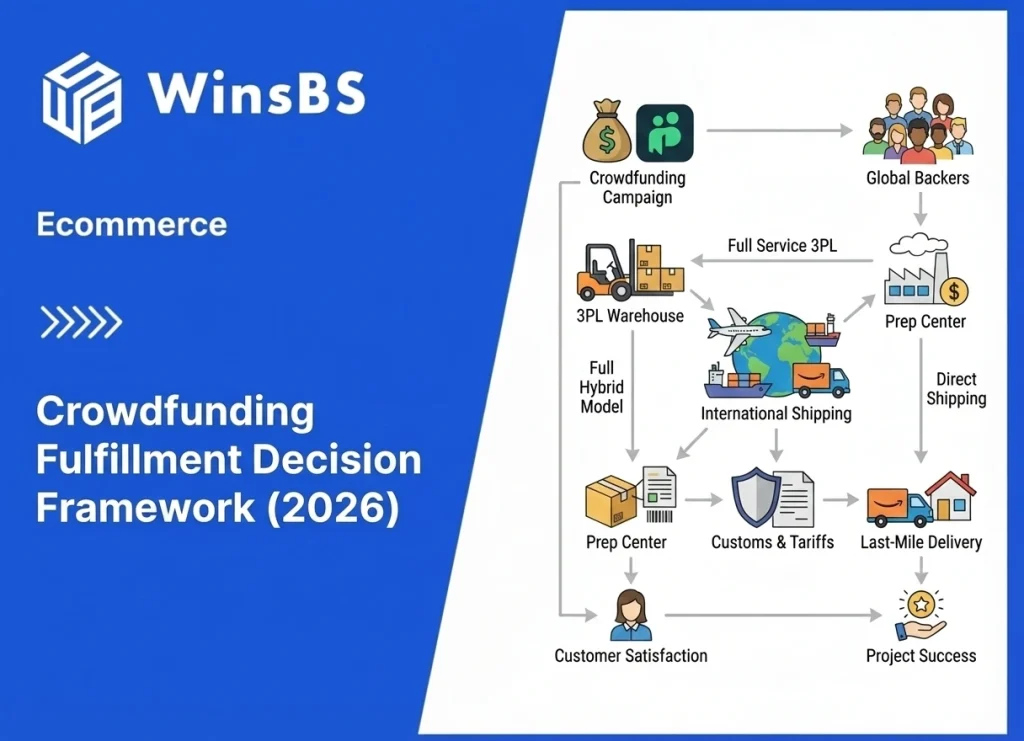
Crowdfunding Fulfillment Decision Framework What Actually Breaks Crowdfunding Fulfillment — Before Execution Begins WinsBS Research – Maxwell Anderson TL;DR Most crowdfunding fulfillment failures do not start in warehouses. They start when irreversible decisions are made before volume, geography, and SKU structure are known. This framework helps you identify where that break is introduced—not how to fix it. WHAT ACTUALLY BREAKS CROWDFUNDING FULFILLMENT Crowdfunding fulfillment failure is not execution failure. It is decision failure that locks irreversible constraints before key variables are known. Most projects discover problems only when shipments delay, costs spike, or backer complaints rise. These visible issues are symptoms of earlier commitments made without finalized data on order volume, geographic distribution, SKU variants, or bundle uptake. Execution adjustments can mitigate operational errors. They cannot unlock structural constraints embedded months earlier. The root break occurs at the decision layer, not in warehouses or carrier networks. → Validate crowdfunding fulfillment decision standards against actual project variables: Crowdfunding Fulfillment Decisions: Beyond the 3PL WHY 3PL DECISIONS ARE IRREVERSIBLE IN CROWDFUNDING Selecting a 3PL is not an optimization exercise. It defines the fixed boundary for volume handling, geographic coverage, system integration, and returns processing. Once inventory is received, labels generated, or APIs connected, switching providers triggers inventory relocation fees, double-handling charges, data reconciliation gaps, and multi-week fulfillment pauses. These are not vendor performance failures— they are direct penalties of post-commitment change. Irreversibility is structural and platform-amplified. Kickstarter’s fixed funding deadline creates a hard fulfillment window that Indiegogo’s flexible or InDemand models do not. Projects that ignore this difference routinely face constraints they cannot renegotiate. → Examine platform-driven constraints: Kickstarter Fulfillment Timing Risks Indiegogo Ongoing Demand Risks Gamefound SKU & Weight Variance Risks WHY AVERAGE COST MODELS FAIL IN CROWDFUNDING Average per-unit cost accuracy does not guarantee financial safety. Safety is determined by exposure to variance across volume tiers, international shipping mix, dimensional weight fluctuations, and return rates. Pricing models built on averages alone escalate unpredictably under real-world deviations. Rigid tier structures, zone-skipping penalties, or carrier surcharges turn attractive quotes into structural losses. Risk originates in the unmodeled gap between expected case and worst tolerable outcome. → Analyze variance-driven cost exposure: Cost Variance Risks in Crowdfunding WHEN TIMING OVERRIDES VENDOR SELECTION Choosing a capable 3PL too early produces the same outcome as choosing an incapable one. Commitment timing dominates long-term fit more than comparative vendor capability. Evaluation, quoting, and scenario testing remain fully reversible throughout the campaign. Commitment—defined as signed MSA, inventory receipt, or live system integration— locks the structure irreversibly. Key variables that dictate required capabilities only crystallize after the funding period ends. Committing before these variables are fixed transfers uncertainty from the project into the fulfillment chain. → Determine safe commitment timing: When to Commit to a Crowdfunding 3PL WHERE THIS FRAMEWORK APPLIES This framework applies when material uncertainty exists in final volume, geographic distribution, or SKU configuration at the moment of fulfillment commitment. When these variables are fully known and fixed upfront, irreversibility drops dramatically and execution quality becomes the primary outcome driver. Projects involving regulated goods, extreme dimensional constraints, or specialized handling requirements exit the standard 3PL constraint profile. Content Attribution & Editorial Disclosure — WinsBS Research Prepared by: WinsBS Research Team. This article is intentionally written as a decision-layer framework, not an execution guide, vendor comparison, or operational checklist. Its purpose is to help readers determine where their crowdfunding fulfillment risk actually originates— before any warehouse, carrier, or software decision is made. By the end of this page, readers should be able to identify whether their project’s failure risk is being introduced upstream at the decision level, rather than downstream during fulfillment execution. This page does not attempt to resolve those risks. Each decision boundary introduced here requires separate validation. Editorial independence. WinsBS Research operates independently from WinsBS commercial operations. This framework is published to support structural analysis and does not include sponsored conclusions or paid placements. Information verified as of January 2026. Disclaimer: This content is provided for informational purposes only and does not constitute legal, tax, or operational advice.