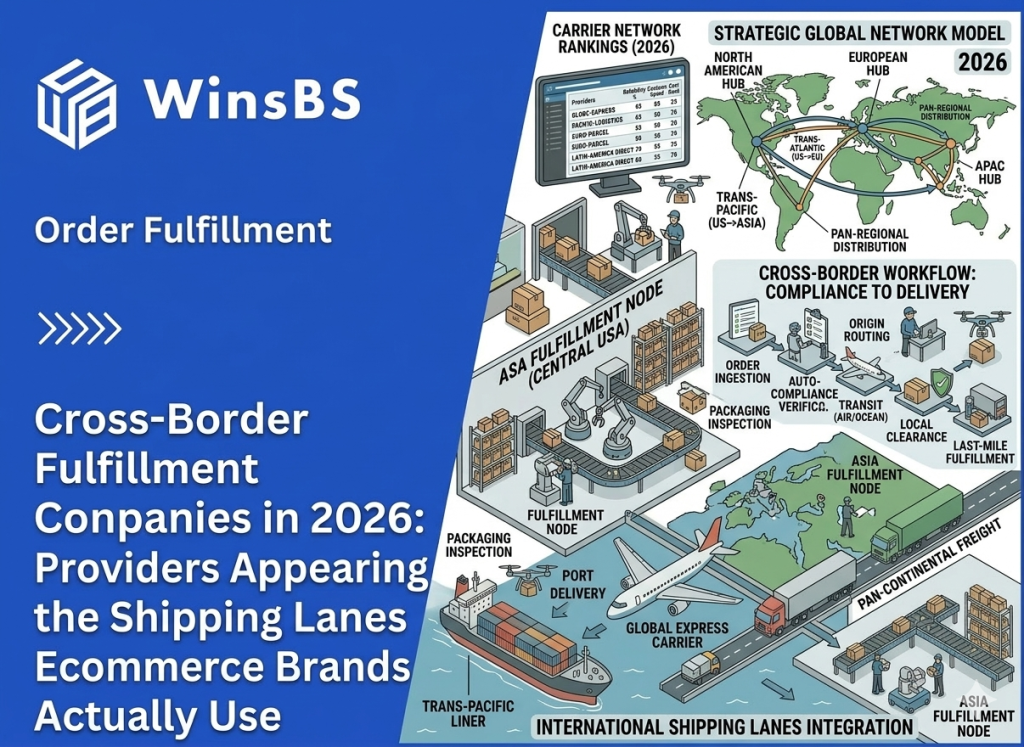
Cross-Border Fulfillment Companies in 2026: Providers Appearing on the Shipping Lanes Ecommerce Brands Actually Use
Cross-Border Fulfillment Companies in 2026 Providers Appearing on the Shipping Lanes Ecommerce Brands Actually Use WinsBS Fulfillment ORDER FULFILLMENT COMPANY · MAXWELL ANDERSON March 2026 Quick Context Large global retailers operate distributed fulfillment networks across multiple regions. Most ecommerce brands do not. International orders usually begin with inventory in one place and customers appearing in other markets. As orders cross borders, fulfillment complexity often shows up through specific routes — delivery times vary by destination, duties become customer-facing, and shipping costs change depending on where the order travels. This article looks at providers appearing across three common ecommerce shipping lanes: China → United States, U.S. West Coast → Global, and United States → Canada. Table of Contents Quick Answers Providers Appearing in Cross-Border Fulfillment Capability Matrix Cost and Friction Drivers Operational Patterns in Cross-Border Ecommerce Execution Capabilities Execution Dataset Decision Signals Trigger Checklist Risk Signals Global Fulfillment Context Ecosystem Context Methodology Editorial Independence For readers looking at how fulfillment infrastructure changes across ecommerce environments, the operational signals summarized in the 2026 Ecommerce 3PL Signal Index provide broader context across this research cluster. Quick Answers for Teams Shipping Across Borders Cost Exposure Why do some international orders suddenly cost far more than others? For many ecommerce teams, cross-border friction first shows up as a pricing problem. Most international orders may look manageable, and then one shipment suddenly lands at two or three times the expected cost. That jump is often tied less to the product itself and more to where the order is going. Remote-area surcharges, weaker last-mile coverage, extra handoffs, and route-specific carrier pricing can all push cost up fast, even when the destination country looks familiar on paper. This is why cross-border fulfillment often stops feeling simple before volume looks especially large. The problem is not that a brand is shipping internationally. It is that certain addresses inside those markets begin behaving very differently from the rest. Delivery Variance Why can delivery times vary so much within the same country? Many teams expect delivery differences between countries. What catches them off guard is when the real gap appears inside the same market. One order reaches a major city quickly, while another to a more remote area takes much longer and generates a very different customer experience. That usually comes from route structure rather than warehouse delay. Local carrier coverage, distance from main parcel networks, customs routing, and regional handoff quality can all change how the same country performs at the delivery level. In practice, this is one of the clearest signals that cross-border shipping is no longer just a rate question. It has become a fulfillment question, because delivery reliability is now changing by destination, not just by country. Route Friction Which shipping routes tend to create the most operational friction? Most brands do not run into cross-border complexity evenly across all markets. The pressure usually starts on a few recurring routes where order volume, customer expectations, and delivery exceptions begin concentrating in the same places. In ecommerce, that often means specific lanes such as China to the United States, U.S. West Coast inventory serving international orders, or cross-border shipping between the United States and Canada. Each one carries a different mix of cost exposure, transit variance, customs handling, and remote-zone difficulty. What many teams describe as “international shipping complexity” is often this exact pattern: one or two routes begin absorbing a disproportionate amount of operational time, customer support attention, and shipping unpredictability. Decision Point When do brands start needing cross-border fulfillment partners? It usually does not happen when the first international orders appear. Most brands can absorb occasional overseas shipments without changing much. The shift begins when those orders become repeatable enough to create ongoing operational drag. That drag often shows up through higher shipping exceptions, more customer questions about delivery timing or duties, wider cost variation between destinations, and more time spent managing route-specific problems that internal teams were not built to handle every day. At that point, brands are no longer looking for help with “international shipping” in the abstract. They are usually looking for fulfillment partners that can support the specific lanes where the business is starting to feel unstable. Providers Appearing in Cross-Border Fulfillment Cross-border fulfillment providers do not usually enter the picture for the same reason. Some appear closer to manufacturing and export flow. Others become relevant once inventory is already in the United States and international orders start growing from there. Some are discussed because brands need better parcel routing, while others come up when fulfillment itself has to absorb more of the operational pressure. That is why the same company names do not show up evenly across every cross-border situation. In practice, providers tend to appear around specific shipping lanes, specific inventory positions, and specific types of friction. China → United States · trans-pacific movement and U.S. entry Flexport Flexport usually enters the conversation earlier in the supply chain, especially when brands are trying to move inventory from China into the United States in a more structured way. It tends to become relevant when the challenge is no longer just sending parcels internationally, but coordinating freight movement, customs handling, and the transition from overseas production into U.S. fulfillment. On this lane, it appears less as a simple shipping option and more as part of the upstream infrastructure brands consider once volume and inventory value start becoming harder to manage informally. China → United States · parcel injection and export-side routing 4PX 4PX tends to appear in discussions where brands are shipping from China into overseas markets through established cross-border parcel channels rather than building a fully domestic fulfillment setup first. It usually becomes relevant when teams are still operating close to origin and need a provider that sits naturally inside export-side ecommerce flow, especially on trans-Pacific routes where parcel volume starts becoming repeatable. In that environment, the conversation is often less about warehouse sophistication and more about how orders move out of China and into destination markets with enough consistency