


Online Support
Typically replies within 5 minutes
Hello! How can we assist you today?

2026

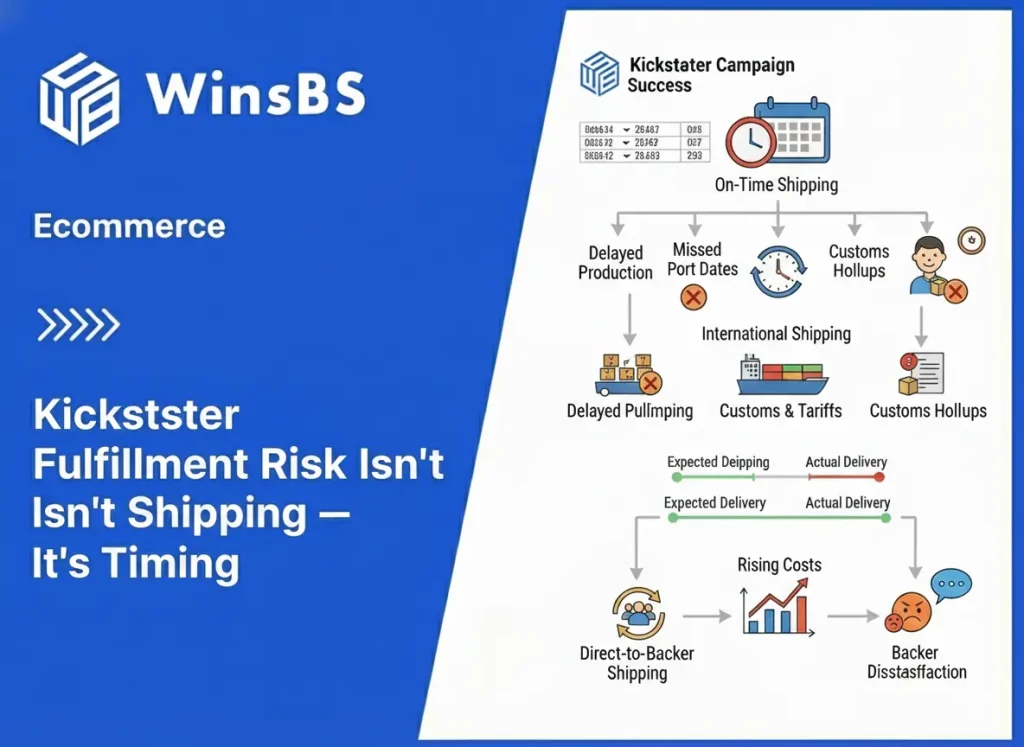
Vector illustration beside WinsBS logo and title "Kickstarter Fulfillment Risk Isn’t Shipping — It’s Timing", showing clocks and calendars for timing control, global logistics network, 3PL warehouses, and order fulfillment delivery flow.
Crowdfunding Fulfillment, Ecommerce, Order Fulfillment

Kickstarter Fulfillment Risk Isn’t Shipping — It’s Timing

Kickstarter Fulfillment Risk Is a Timing Problem Where fulfillment decisions become irreversible too early Research & Analysis by WinsBS Research – Maxwell Anderson This analysis focuses on decision timing in Kickstarter fulfillment. It does not explain Kickstarter mechanics, pledge managers, or shipping workflows. Most Kickstarter fulfillment failures do not begin in warehouses. They begin when fulfillment decisions are locked before the underlying data has stabilized. These decisions often feel reasonable at the moment they are made, but become costly later because they are committed too early. On Kickstarter, fulfillment risk is amplified by timing. Decisions finalized at the end of a campaign frequently precede meaningful changes in demand, destination distribution, and address data. Timing errors amplify execution errors. A small mismatch becomes a large operational problem when it is forced through a plan that was finalized too early. Why Timing Is the Primary Fulfillment Risk on Kickstarter Fulfillment problems on Kickstarter rarely originate during shipping. They originate when decisions become difficult to reverse while post-campaign variability is still present. Funding close is often treated as the moment when fulfillment assumptions should be finalized. In practice, this moment frequently occurs while pledge volume, SKU mix, and destination distribution are still shifting. Kickstarter’s own documentation implicitly acknowledges that timing matters. In its official fulfillment handbook, the platform states that creators can wait to send surveys and collect shipping addresses until closer to shipping: “Send your backer reward surveys and begin collecting shipping addresses—you can wait to do this until you’re closer to shipping rewards.” This is not a procedural suggestion. It is a platform-level acknowledgment that early commitment increases mismatch risk. The broader decision-timing logic validated here is introduced in the Crowdfunding Fulfillment Decision Framework . Funding Close ≠ Demand Stabilization A successful funding close does not stabilize demand on Kickstarter. Treating it as a stabilization point is a structural misinterpretation. After funding close, demand can continue to grow through late pledges. Add-ons can shift SKU composition, survey responses can alter destination distribution, and address information can change as backers relocate. Kickstarter explicitly supports post-campaign pledging through its Late Pledges feature: “How long you wish to accept Late Pledges for is entirely up to you.” The same documentation makes clear that late pledges must end when surveys or fulfillment begin: “When you’re ready to send your surveys or begin fulfillment for a specific reward, you will need to end Late Pledges for that reward.” Data continues to change after funding close, but fulfillment decisions are often frozen as if it does not. Survey Lock and BackerKit Are Freeze Points Surveys and pledge managers function as freeze points, not administrative conveniences. When a survey is launched or a pledge manager is closed, multiple fulfillment dimensions begin to harden at once: SKU finalization, packaging assumptions, and destination mix assumptions. Kickstarter enforces this freeze through platform sequencing. Its survey documentation states: “The survey can only be sent once.” Variability does not stop after this moment. It simply stops being absorbed by the system and reappears as exceptions. Why Early Fulfillment Commitment Backfires Early fulfillment commitment backfires because it converts normal change into repeated rework. When commitments are made before late pledges conclude and before survey data stabilizes, later changes express themselves as rerouting, inventory repositioning, and exception-handling overhead. Fulfillment operators consistently describe this pattern. Fulfillrite notes that surveys sent too early lead to outdated address data and costly rerouting: “Kickstarter surveys can only be sent one time… if you send it too early and collect address information, people may forget to update it when they change addresses.” Early commitment does not reduce uncertainty. It amplifies it through repetition. What Can Be Evaluated Early Versus What Must Wait Evaluation and commitment are different categories of decisions. Cost structures, risk exposure, and operational constraints can be evaluated while data is still fluid. Commitment occurs when assumptions are treated as final and execution is aligned to them. Timing errors amplify execution errors. A small execution issue becomes a major customer-facing problem when it is forced through a plan that was locked against outdated assumptions. The boundary between evaluation and commitment determines when partner selection and scope finalization should occur. That boundary is examined in detail in When to Choose a Crowdfunding Fulfillment Partner . Where This Article Fits — Crowdfunding Fulfillment Decision Framework This article is part of a broader Crowdfunding Fulfillment Decision Framework. It isolates one variable: how decision timing amplifies fulfillment risk in Kickstarter campaigns. It is intentionally written as a decision-layer reference. It does not provide vendor rankings, step-by-step workflows, or operational checklists. The full framework explains how timing, ownership, and execution responsibility interact across crowdfunding fulfillment decisions. Crowdfunding Fulfillment Decision Framework (Hub)
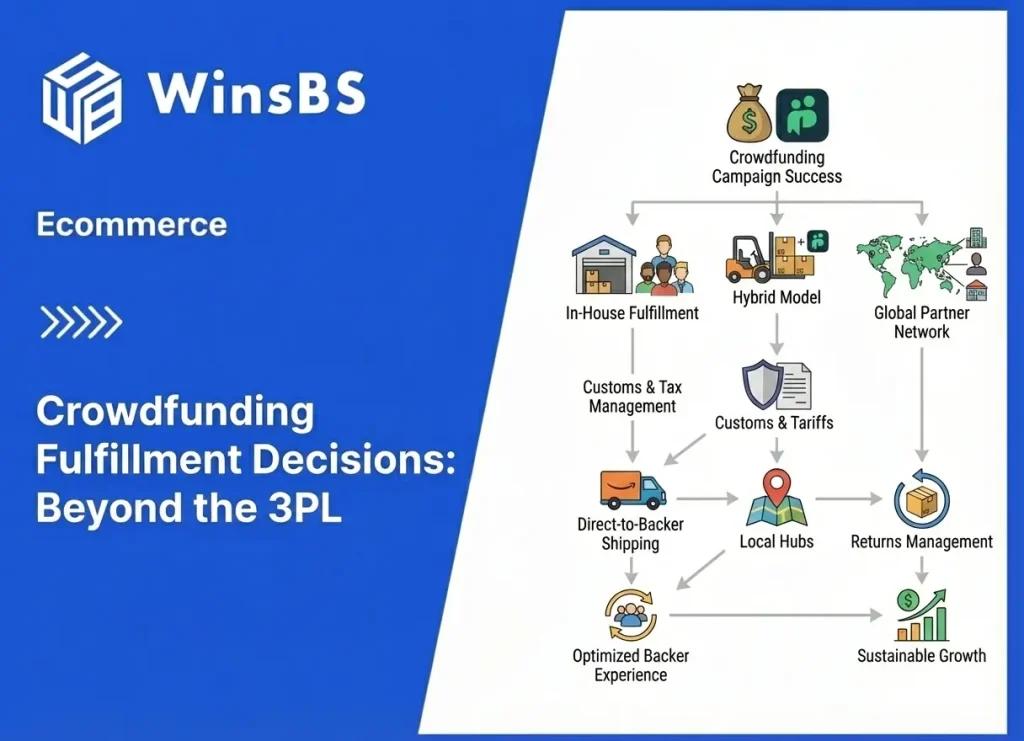
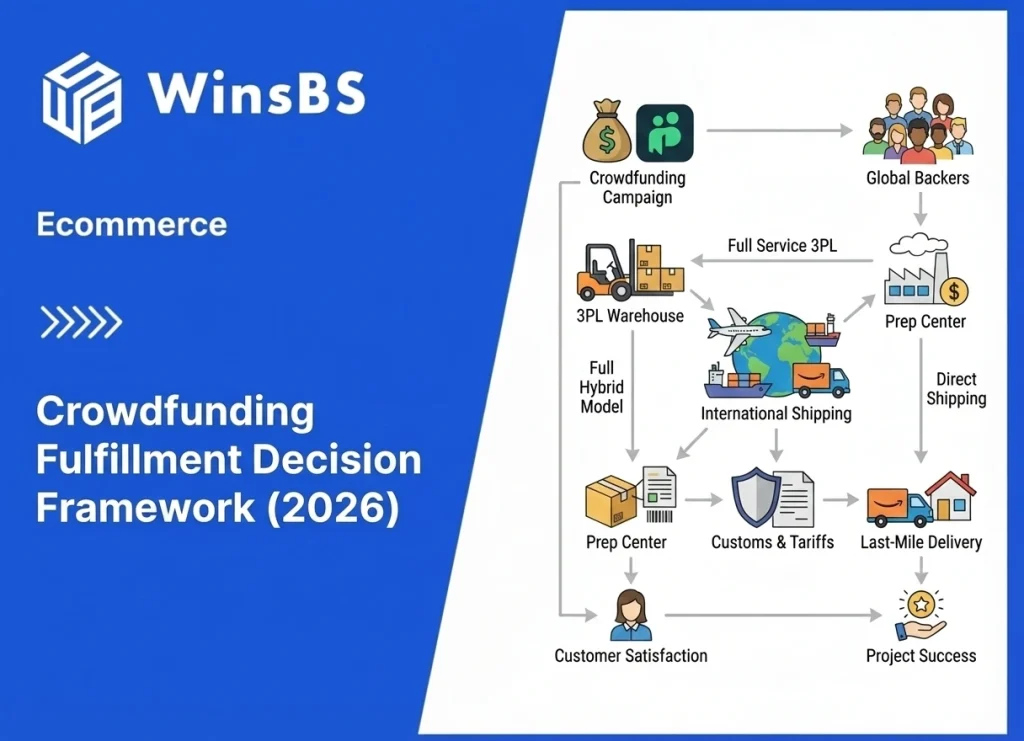
Illustration beside WinsBS logo and title showing global crowdfunding fulfillment beyond traditional 3PL, with logistics network, backers, custom packaging, tax handling, and last-mile delivery icons.
Crowdfunding Fulfillment, Ecommerce, Order Fulfillment

Crowdfunding Fulfillment Decisions: Beyond the 3PL

Beyond the 3PL A Closed-Loop Framework for Crowdfunding Fulfillment Decisions WinsBS Research – Maxwell Anderson Research focus: crowdfunding fulfillment execution, order-level risk, and post-campaign decision frameworks. For most crowdfunding creators, the shipping phase is not an operational afterthought. It is the moment where execution risk finally materializes. Standard e-commerce fulfillment models are built around stability: predictable order flow, fixed SKUs, and low exception rates. Crowdfunding operates under the opposite assumptions. Choosing a fulfillment partner in a crowdfunding context is therefore not a procurement decision. It is a commitment to who will own the irreversible execution variables of a campaign once change is no longer cheap. The Variables That Break Standard Fulfillment Models In traditional e-commerce fulfillment, variability is incremental. Volume grows gradually, SKUs stabilize, and exceptions remain manageable. Crowdfunding fulfillment behaves differently. Variability is concentrated late, synchronized across thousands of orders, and tightly coupled to physical execution. This difference reshapes fulfillment risk at a structural level. Address and reward changes are not edge cases. They are a direct consequence of how crowdfunding platforms and pledge management systems are designed. Backers are intentionally allowed to modify shipping details and reward selections after a campaign ends. While this improves backer experience, it means critical order data remains fluid precisely as fulfillment execution approaches. “Backers will only be able to make changes to their shipping address if the creator hasn’t yet locked addresses.” — Kickstarter Help Center, Fulfillment Handbook “Backers can update their shipping information during the survey process before fulfillment begins.” — BackerKit, Official Blog & Guides Without execution-layer controls to intercept and reconcile these changes, errors compound rapidly. Returns, reshipments, and manual recovery begin to replace controlled fulfillment workflows. Destination mix drift introduces a second layer of instability. Crowdfunding campaigns often discover late in the process that international demand differs materially from early assumptions. This shift is rarely driven by planning errors. It emerges as campaigns gain visibility, unlock stretch goals, or attract backers from regions that were not dominant during the initial funding phase. What makes destination mix drift risky is timing. The distribution of countries often becomes clear only after packaging, routing, and cost assumptions have already been set. Once inventory has already been inbounded, these changes can no longer be resolved through pricing adjustments or carrier swaps. They become execution constraints that must be absorbed by the fulfillment system. Role Boundaries: Where Fulfillment Responsibility Actually Ends Most crowdfunding fulfillment failures originate from role confusion, not from individual service breakdowns. Carriers are responsible for transportation performance. Their obligation begins when a parcel is tendered and ends with delivery or a carrier-defined exception. They do not manage order logic or recovery outcomes. Freight forwarders coordinate line-haul movement and documentation. Their unit of work is freight, not the individual backer order. They do not own SKU discrepancies or reshipment decisions. 4PL orchestrators aggregate vendors and resources. In stable environments this can be effective. In crowdfunding, additional abstraction layers often fragment responsibility precisely when exception density peaks. Order fulfillment execution is defined differently. It is the ability to absorb volatility at the order level and close the loop when something goes wrong. Crowdfunding does not fail because transportation or coordination is weak. It fails when those functions are mistaken for execution ownership. Once role boundaries are understood, a pattern becomes clear. Many providers are not misrepresenting themselves; they are operating exactly within the limits of their role. This is where the idea of being “crowdfunding-friendly” begins to break down under real execution pressure. What “Crowdfunding-Friendly” Actually Means The label “crowdfunding-friendly” is not inherently misleading. Its validity depends entirely on context. Most general-purpose fulfillment systems are optimized for stable SKUs, predictable cadence, and low exception density. Crowdfunding introduces the opposite environment. Compatibility is therefore not a logo or a partnership badge. It is the ability to absorb volatility without breaking execution logic or deflecting responsibility downstream. A crowdfunding-capable execution partner must handle late-stage data changes, complex reward logic, destination shifts, and exception recovery within a single closed loop. WinsBS is built for crowdfunding execution. This statement defines scope and responsibility, not comparative positioning. The Lock-In Effect: Decisions That Cannot Be Reversed Crowdfunding fulfillment carries a distinct risk profile. The most costly failures occur after execution has already begun. System integrations, packaging specifications, and routing decisions are often finalized before the full shape of demand is visible. Once physical execution starts, flexibility collapses rapidly. System integration lock, packaging specification lock, and routing and tax path lock are not planning errors. They are structural properties of physical fulfillment. “The Import One-Stop Shop (IOSS) scheme must be set up before the goods are shipped.” — European Commission, Import One-Stop Shop (IOSS) Evaluating Information Quality In crowdfunding fulfillment, expertise is revealed by information quality, not by promises. Vague assurances of scalability and flexibility often avoid discussing how exceptions are handled once they dominate the workload. Strong signals appear as clearly stated boundaries, early discussion of compliance and tax paths, and explicit ownership of recovery workflows. Crowdfunding success does not depend on avoiding problems. It depends on whether problems have a clearly defined owner once execution begins. Where This Article Fits — Crowdfunding Fulfillment Decision Framework This article is part of a broader Crowdfunding Fulfillment Decision Framework. It focuses on one question: who actually owns execution outcomes when crowdfunding volatility begins to surface. It is intentionally written as a decision-layer reference. It does not provide vendor rankings, step-by-step selection workflows, or a scoring checklist. If you want the full framework overview and the decision layers this article connects to, start here: Crowdfunding Fulfillment Decision Framework (Hub) Related pages in this framework each validate a specific variable introduced here—such as post-campaign changes, destination mix shifts, and exception recovery— without collapsing the framework into an execution checklist.

Crowdfunding fulfillment framework illustration beside WinsBS logo and title, showing backers, product packaging, 3PL warehousing, international logistics, and final order fulfillment delivery.
Crowdfunding Fulfillment, Ecommerce, Order Fulfillment

Crowdfunding Fulfillment Decision Framework (2026)

Crowdfunding Fulfillment Decision Framework What Actually Breaks Crowdfunding Fulfillment — Before Execution Begins WinsBS Research – Maxwell Anderson TL;DR Most crowdfunding fulfillment failures do not start in warehouses. They start when irreversible decisions are made before volume, geography, and SKU structure are known. This framework helps you identify where that break is introduced—not how to fix it. WHAT ACTUALLY BREAKS CROWDFUNDING FULFILLMENT Crowdfunding fulfillment failure is not execution failure. It is decision failure that locks irreversible constraints before key variables are known. Most projects discover problems only when shipments delay, costs spike, or backer complaints rise. These visible issues are symptoms of earlier commitments made without finalized data on order volume, geographic distribution, SKU variants, or bundle uptake. Execution adjustments can mitigate operational errors. They cannot unlock structural constraints embedded months earlier. The root break occurs at the decision layer, not in warehouses or carrier networks. → Validate crowdfunding fulfillment decision standards against actual project variables: Crowdfunding Fulfillment Decisions: Beyond the 3PL WHY 3PL DECISIONS ARE IRREVERSIBLE IN CROWDFUNDING Selecting a 3PL is not an optimization exercise. It defines the fixed boundary for volume handling, geographic coverage, system integration, and returns processing. Once inventory is received, labels generated, or APIs connected, switching providers triggers inventory relocation fees, double-handling charges, data reconciliation gaps, and multi-week fulfillment pauses. These are not vendor performance failures— they are direct penalties of post-commitment change. Irreversibility is structural and platform-amplified. Kickstarter’s fixed funding deadline creates a hard fulfillment window that Indiegogo’s flexible or InDemand models do not. Projects that ignore this difference routinely face constraints they cannot renegotiate. → Examine platform-driven constraints: Kickstarter Fulfillment Timing Risks Indiegogo Ongoing Demand Risks Gamefound SKU & Weight Variance Risks WHY AVERAGE COST MODELS FAIL IN CROWDFUNDING Average per-unit cost accuracy does not guarantee financial safety. Safety is determined by exposure to variance across volume tiers, international shipping mix, dimensional weight fluctuations, and return rates. Pricing models built on averages alone escalate unpredictably under real-world deviations. Rigid tier structures, zone-skipping penalties, or carrier surcharges turn attractive quotes into structural losses. Risk originates in the unmodeled gap between expected case and worst tolerable outcome. → Analyze variance-driven cost exposure: Cost Variance Risks in Crowdfunding WHEN TIMING OVERRIDES VENDOR SELECTION Choosing a capable 3PL too early produces the same outcome as choosing an incapable one. Commitment timing dominates long-term fit more than comparative vendor capability. Evaluation, quoting, and scenario testing remain fully reversible throughout the campaign. Commitment—defined as signed MSA, inventory receipt, or live system integration— locks the structure irreversibly. Key variables that dictate required capabilities only crystallize after the funding period ends. Committing before these variables are fixed transfers uncertainty from the project into the fulfillment chain. → Determine safe commitment timing: When to Commit to a Crowdfunding 3PL WHERE THIS FRAMEWORK APPLIES This framework applies when material uncertainty exists in final volume, geographic distribution, or SKU configuration at the moment of fulfillment commitment. When these variables are fully known and fixed upfront, irreversibility drops dramatically and execution quality becomes the primary outcome driver. Projects involving regulated goods, extreme dimensional constraints, or specialized handling requirements exit the standard 3PL constraint profile. Content Attribution & Editorial Disclosure — WinsBS Research Prepared by: WinsBS Research Team. This article is intentionally written as a decision-layer framework, not an execution guide, vendor comparison, or operational checklist. Its purpose is to help readers determine where their crowdfunding fulfillment risk actually originates— before any warehouse, carrier, or software decision is made. By the end of this page, readers should be able to identify whether their project’s failure risk is being introduced upstream at the decision level, rather than downstream during fulfillment execution. This page does not attempt to resolve those risks. Each decision boundary introduced here requires separate validation. Editorial independence. WinsBS Research operates independently from WinsBS commercial operations. This framework is published to support structural analysis and does not include sponsored conclusions or paid placements. Information verified as of January 2026. Disclaimer: This content is provided for informational purposes only and does not constitute legal, tax, or operational advice.