Free 1 Month of Warehousing for New Clients Start with lower storage cost from day one.

FREE QUOTE

May 2026

Crowdfunding Fulfillment, Ecommerce, Order Fulfillment, Shipping & Logistics, Warehousing, Winsbs

Import Duties From China to the USA: Who Pays Customs Fees Before Cargo Ships?

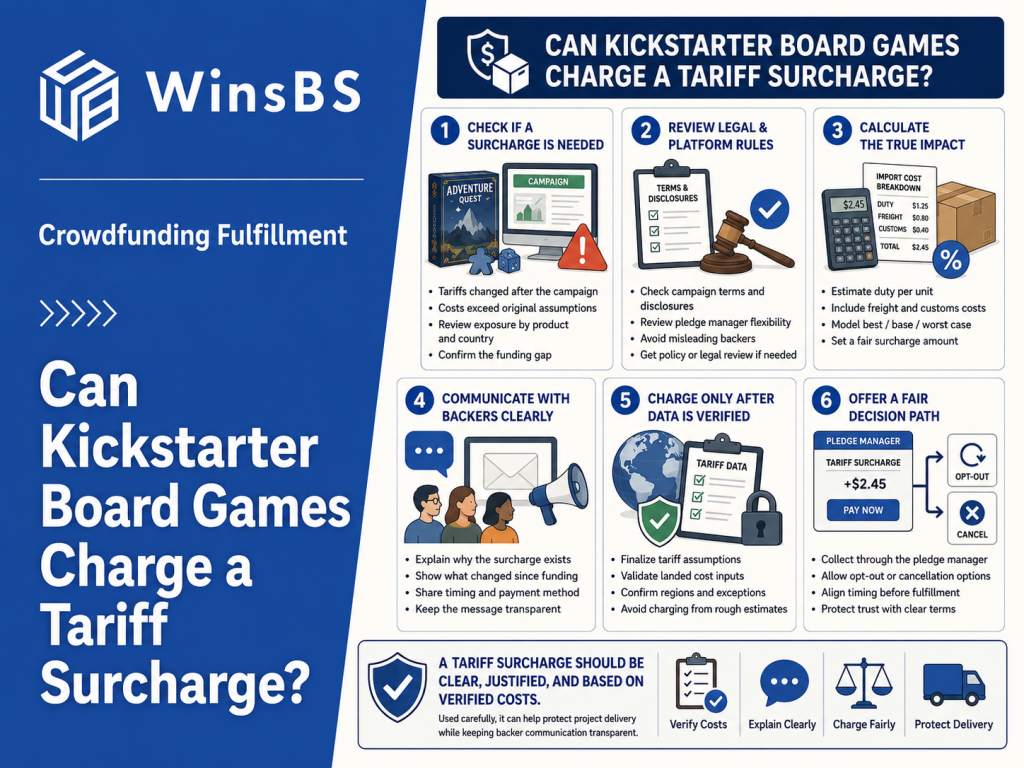
WinsBS / Import costs from China to the U.S. Import Duties From China to the USA: Who Pays Customs Fees, and When Should That Be Clear? For China-to-U.S. shipments, the first question is not whether a warehouse can receive the cargo. It is who will clear the goods into the U.S. and who gets the bill if customs stops the shipment. When that part is still fuzzy, the problem stops looking like paperwork. It turns into extra duty, exam fees, daily demurrage, launch delays, and angry customer messages asking where the inventory went. Where the U.S. import problem starts The warehouse usually sees the cargo after customs release. It is not where this problem begins. China pickup and export docs The invoice, packing list, and product details have to be right before the cargo moves. Ocean booking and filing Carrier filings and pre-arrival data have to match the real shipment. IOR, broker, and bond Someone on the U.S. side has to be named to clear the goods and work with the broker. HTS, value, origin, and duty bill The product code, declared value, and origin decide how much the import bill will be. Arrival, exam, and release risk If customs or the port stops the cargo here, the bill can snowball before the warehouse ever sees it. Release, drayage, and warehouse receipt Only after release can the cargo move to the warehouse the way the original plan expected. If these answers are still loose, the first damage shows up as extra bills and delay long before the warehouse can help. The cheapest time to fix this is before the cargo leaves China. If a quote says DDP but nobody can explain who clears customs and who pays surprise port bills, the risky part of the shipment is still open. Quick Answer Before cargo leaves China, someone has to own the U.S. customs job and someone has to own the bills if that job goes wrong. If that is still fuzzy at departure, the bill can jump fast: a single exam event can add roughly $500 to $2,000+, and demurrage can climb to about $150 to $400+ per container, per day, once free time expires. That means naming the Importer of Record, the broker, the bond or filing authority, the HTS code, the declared value, the country of origin, and who pays duty, Section 301, MPF, HMF, exam bills, demurrage, storage, and drayage if they show up. A DDP quote may sound reassuring, but it still does not prove the customs side is ready. The warehouse usually gets the cargo after release. It is not the automatic backup payer when the customs side was never settled. Start With Customs, Not The Warehouse If the first serious question in your shipment plan is still “Can the warehouse receive this?”, you are looking too late in the process. The real question is who will clear the goods into the U.S. and who will answer when customs asks for more money or more documents. The warehouse cannot solve that part for you. If the importer, broker, or paperwork is wrong, the cargo can still stop at the port even when the warehouse is fully ready to receive it. That is why WinsBS starts from the China side. We check the invoice, material list, HTS assumptions, and labels at the factory floor in China, because it is far cheaper to catch a mistake there than after the ship arrives and the port clock starts running. The warehouse enters the story later, after release. It does not magically become the importer or the duty payer just because it is waiting for the truck. Where This Problem Usually Hits In A China-To-U.S. Ocean Shipment On a real ocean shipment, the import-cost problem shows up in the middle of the U.S. release process, not at the very end. China pickup and export documentation Ocean booking and carrier filing Pre-arrival filing and ISF readiness U.S. arrival, entry, and entry-summary work Duty, MPF, HMF, and additional-duty calculation Exam, hold, demurrage, detention, or storage if triggered Release, drayage, and inland transfer Warehouse receipt after cargo is cleared If duty, broker, and port costs are still unclear here, the warehouse cannot clean that up later. By then the shipment is already in the expensive part of the route. Debunking The Search Terms: Import Duties vs. Import Tax vs. Customs Fees People search these three phrases as if they mean the same thing. On a real U.S. shipment, they do not. Search phrase What the term usually points to Where the bill usually lands Import duties Usually customs duty under the HTS classification, and sometimes additional duties such as Section 301. Usually on the U.S. import side, often through the Importer of Record, unless the seller is clearly absorbing that bill under a DDP structure. Import tax Many U.S. buyers use this loosely when they mean duty or other government entry charges. It is search language, not a precise U.S. import term like VAT. The bill still has to sit with either the U.S. importer or the seller under the agreed trade term. A warehouse does not become the payer just because it receives the goods. Customs fees This is the most misleading phrase because it may refer to MPF or HMF, broker fees, exam costs, demurrage, detention, storage, or other extra charges, even though those are not all the same kind of bill. The payer depends on the exact charge. Government fees, broker service fees, carrier or terminal charges, and warehouse charges need to be separated before anyone says a quote “includes customs fees.” In plain English: the Importer of Record is the name tied to the customs entry. The broker files it. The forwarder moves the freight and may re-bill charges. The warehouse usually sees the cargo only after customs release. One caution: the final payer still depends on the country rules, the contract, and the names actually used on the shipment. When Someone Says “Customs Fees,” Ask Which Bill
Crowdfunding Fulfillment, Ecommerce, Order Fulfillment, Shipping & Logistics, Warehousing, Winsbs

Kickstarter Fulfillment Companies for Board Games Made in China

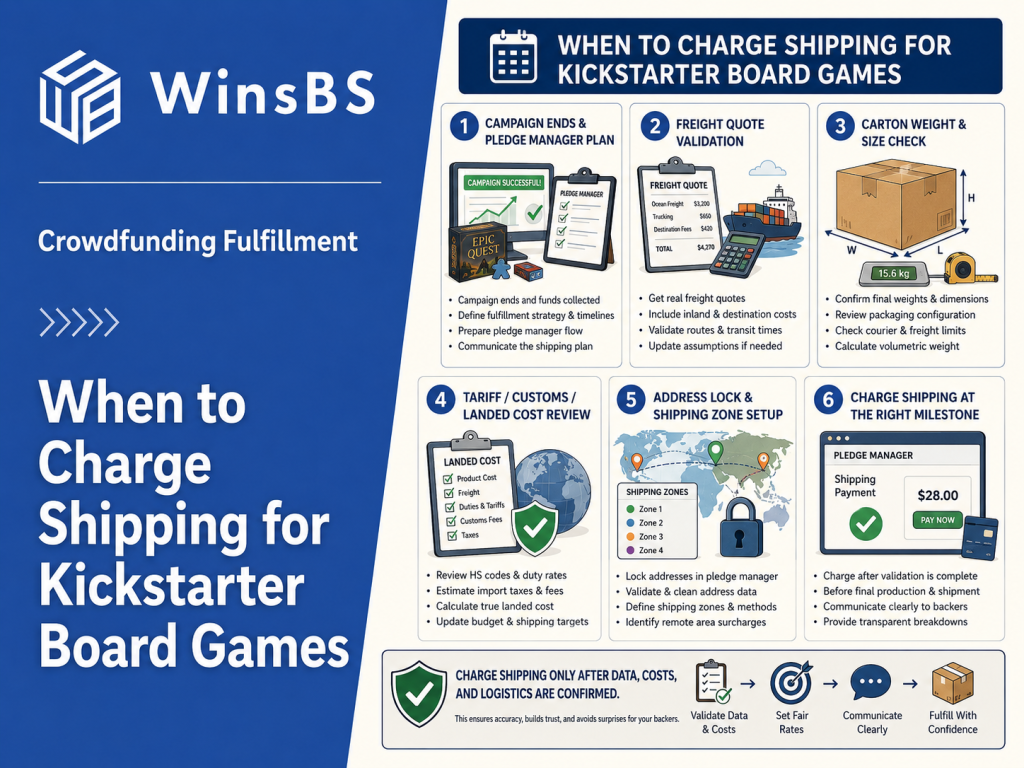
China-to-U.S. tabletop crowdfunding fulfillment / Choosing a fulfillment company Kickstarter Fulfillment Companies for Board Games Made in China: What to Compare Before You Ask for Quotes If you are collecting warehouse quotes before your carton count, shipping plan, import costs, and backer charges are settled, you are probably asking the wrong company to fix the wrong problem. Start Here “Fulfillment company” sounds like one decision. For a board game made in China, it usually is not. Factory in China Production is almost done, but the final carton count or labels may still be moving. Freight plan A quote may already exist even though the shipment details behind it are not final. Import costs DDP, tariff, tax, and who pays what may still be unclear. Warehouse intake A U.S. warehouse may already be asking for labels, intake pre-alerts, or receiving files. Backer orders Reward tiers, add-ons, and pick rules may still not match the physical shipment. Damages and returns If damaged games come back or replacement parts are needed, somebody still has to grade, strip, restock, or reship them. Pledge manager Helps with orders, add-ons, addresses, and shipping charges. Does not make the freight plan or warehouse files accurate by itself. Freight forwarder Helps move the shipment from China to the U.S. Does not turn reward tiers into warehouse pick lists. U.S. warehouse Ships clean inventory well once it arrives ready to receive. It is not the best place to discover what the factory packed wrong. WinsBS Fits when the hard part is still the handoff from the factory in China to the warehouse in the U.S. That is usually the stage where the wrong quote looks cheap and the right files do not exist yet. Maxwell Anderson Built from recurring WinsBS reviews of freight quotes, carton files, pledge-manager exports, receiving instructions, reward-to-SKU rules, kitting plans, replacement exposure, and warehouse requests for board games made in China. Quick Answer Before comparing Kickstarter fulfillment companies, first decide which part of the job is still unresolved: pledge-manager cleanup, China-to-U.S. freight, import-cost responsibility, U.S. warehouse receiving, reward-to-SKU execution, or damage and return handling. If carton files, route, receiving rules, shipping charges, or replacement plans are still changing, a warehouse quote alone is not a fulfillment plan. The missing work usually appears later as receiving labor, relabeling, under-collected shipping, wrong picks, replacement requests, damaged-game handling, or backer support pressure. A workable tabletop fulfillment plan has to connect your China carton files, U.S. warehouse receiving rules, and domestic damage and return handling into one system before freight moves. Jump To Start with the part that sounds most like your project right now. Why this search gets messy What has to happen before a backer gets a box What each provider actually helps with Which situation are you in When a U.S. warehouse is enough What to send before comparing quotes Where WinsBS fits FAQ Related decisions What to send WinsBS Why This Search Gets Messy So Fast The campaign is over. The game is being made in China. Production is almost done. Someone on the team says, “we need a fulfillment company,” because that sounds like the next obvious step. At the same time, a freight quote may already be in the inbox, the carton file may still be changing, BackerKit or Gamefound may still be moving, shipping fees may not be locked, DDP or tariff responsibility may still be fuzzy, and the U.S. warehouse may already be asking for labels or receiving instructions. That is why this search becomes frustrating so quickly. The team thinks it is shopping for one service, but it is really looking at several different jobs that happen at different points in the chain. A freight quote is not a fulfillment plan. A warehouse can ship clean inventory well. It should not be guessing what the factory packed. The wrong company often gets hired before the real problem has even been named. What Has to Happen Before a Backer Gets a Box A backer only sees the last step. The team has to manage everything before it. Factory packout in China Final carton file Freight booking and route Import costs and customs responsibility Warehouse receiving in the U.S. Reward-to-SKU and kitting rules Outbound parcels Reverse logistics, damage resolution, and returns If your warehouse quote does not say how damaged games, backer returns, or stripped replacement parts are handled after arrival, you do not have a full fulfillment plan yet. You only have a quote for the clean version of the job. That full chain is why a broad search for “fulfillment company” often lands on the wrong comparison. If you need the full picture before you compare providers, start with the China-to-U.S. fulfillment model for tabletop crowdfunding. Why Warehouse Quotes Often Come Too Early A warehouse quote feels concrete. It has rates. It sounds like progress. That is exactly why teams grab it too early. The problem is that the shipment may still be changing upstream. The route may not be locked yet. The carton file may not be final yet. Shipping fees may not match the real order profile yet. The warehouse may already be asking for files that do not exist in a clean form yet. Once that happens, the warehouse is no longer just receiving and shipping. It becomes the place where old mistakes show up as recounting, relabeling, manual checks, hold decisions, and extra labor. When a pallet of heavy deluxe boxes reaches the dock with split corners or shifted trays, a standard warehouse quote usually does not cover the re-boxing, grading, and replacement work that follows. Before treating a warehouse quote as the real answer, check whether the route is actually ready to lock, whether the pre-freight checklist is complete, and whether the timeline still has unresolved handoffs before U.S. receipt. What Each Provider Actually Helps With Provider type Good for Does not solve Ask before quote Red flag Pledge manager Orders, add-ons, addresses, and shipping charge collection. Carton truth, freight planning, warehouse receiving files,

Crowdfunding Fulfillment, Ecommerce, Order Fulfillment, Shipping & Logistics, Warehousing, Winsbs

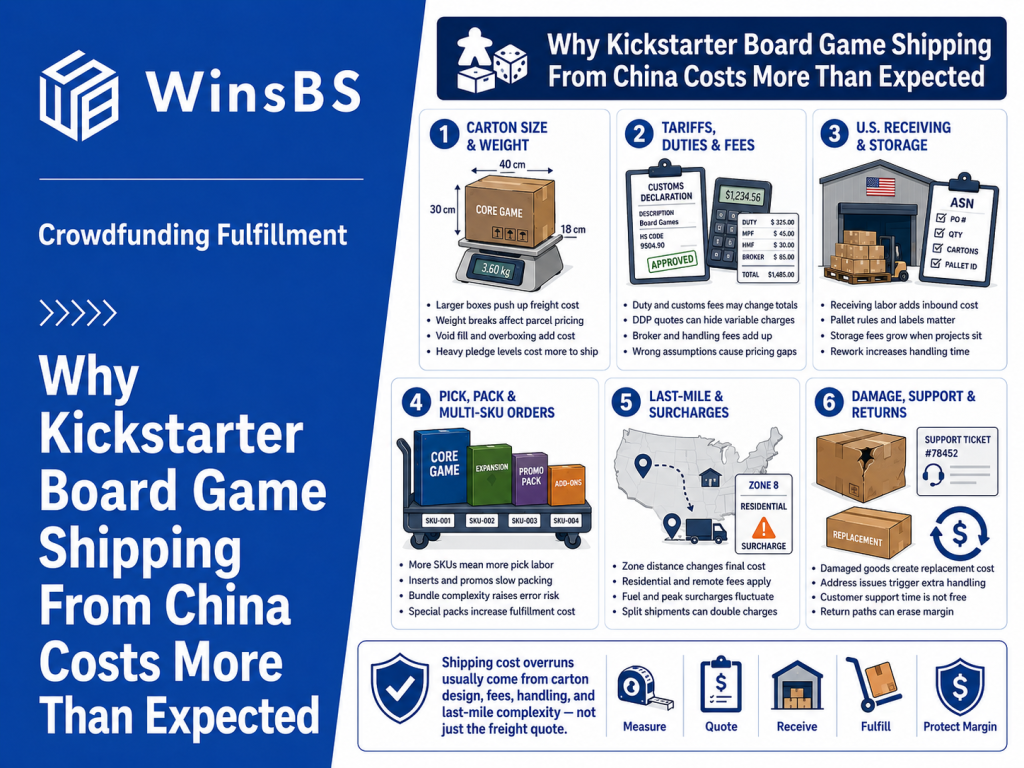
Why Kickstarter Board Game Shipping From China Costs More Than Expected

China-to-U.S. tabletop crowdfunding fulfillment / Kickstarter board game shipping cost gaps Why Kickstarter Board Game Shipping From China Costs More Than Creators Expect Costs usually start climbing before freight gets expensive, when the campaign price, shipping fee, carton file, DDP or tax plan, warehouse plan, and backer promise were built from different drafts of the same shipment. Cost Chain The first painful invoice is usually not the first mistake. It is the first moment the mistake becomes visible. Factory Packout Carton size, count, protection, and sealed-unit logic are still moving while the team wants one final answer. Freight Quote The forwarder prices one carton file, one route, one timing assumption, and one import story. Shipping Fee Promise BackerKit or Gamefound may already be charging from weight and duty or tax assumptions that are still moving. U.S. Receiving The warehouse only sees the cartons that actually landed, the intake file it was given, and the labor it now has to bill. Pick, Kit, Replace Wrong reward logic, late kitting, and missing spare reserve turn old planning drift into new U.S. labor and backer complaints. What usually moved first: a fixable China-side choice. What gets billed later: U.S. receiving, relabeling, rework, kitting labor, replacement handling, returns, or support time. Maxwell Anderson The argument here comes from the same thing WinsBS keeps seeing in China-made board game campaigns: freight gets quoted from one carton draft, shipping fees get set from another, and the warehouse later receives cartons built from a third set of decisions. Quick Answer Most Kickstarter board game shipping problems do not start when freight gets expensive. They start earlier, when the campaign price, BackerKit shipping fee, factory carton data, DDP or tariff plan, freight quote, U.S. warehouse plan, and backer promise were built from different drafts of the same shipment. A freight quote is not a fulfillment plan. It is only one price for one carton file, one route, and one timing assumption. Shipping fee shock is usually created before shipping begins, when the quote, the backer charge, and the warehouse prep stop describing the same cartons. WinsBS is most useful before the next handoff turns that mismatch into freight rework, U.S. receiving labor, kitting cost, replacement spend, or backer trust damage. If This Is What You Are Dealing With, Start Here Use the first symptom you can already see. The goal is to stop the next mismatch from turning into a new U.S. warehouse charge or a backer hold. What you are seeing Check first Pause if Send WinsBS The freight quote from China to the U.S. jumped. Compare the quote date to the current factory carton file, pallet dimensions, and final add-on mix. The quote used older box dimensions or packout assumptions than the real cargo now headed to export. The latest freight quote plus the carton drafts it was built from. Backers are pushing back on shipping fees. Compare the BackerKit or Gamefound table to current item weights, add-ons, and zone mix. The fee table opened before retail packaging, stretch goals, or regional routing stopped changing. The shipping table export plus the current weight and volume parameters. DDP or tax no longer feels safe. Check who is paying duty, tariff, tax, and import-related adjustments for the cargo that is actually shipping. Importer responsibility, country mix, or return exposure changed after the financial model was locked. The DDP or tax assumption file plus the latest forwarder routing notes. The U.S. warehouse added receiving charges. Compare the warehouse intake file, box labels, SKU map, and WRO instructions to the physical pallets that landed. The dock instructions do not accurately mirror the physical pallets or bin-ready SKU configurations. The intake file, packing labels, and the current reward-to-SKU architecture map. Replacement spend is rising. Check spare component reserve, damage patterns, and the rule defining what each shipped reward contains. Spare stock was never separated before the main wave or support teams are guessing what should have shipped. The replacement plan, current stock split data, and recent support ticket examples. Review My Shipping Cost Gap * Zero sales calls. We take your current Excel packaging draft and forwarder quote, returning a 3-point structural alignment audit within 48 hours. Check This First Why Cost Shock Starts Early The Simple Model The Real Cost Chain Where Cost Gaps Open Bill Shock Moments Before Another Quote Where WinsBS Fits Related Decision Guides What To Send WinsBS Why Cost Shock Starts Early The problem usually begins in an ordinary week near the end of production. The factory wants the final carton and packout answer, the forwarder has already quoted from one carton draft, and BackerKit or Gamefound may already have a live shipping fee table. At the same time, a DDP or tariff assumption may already be sitting inside that number, while the U.S. warehouse is asking for the intake file, carton labels, and the rule set it will use when the truck reaches the dock. That would still be manageable if the rest of the project were already stable. In reality, reward tiers may still not have become physical warehouse pick lines, kitting may still be treated as something to solve later, replacement reserve may still be mixed into saleable stock, and the backer promise may already be public. The team feels as if it is wrapping up one shipment, when it is really still carrying several different working drafts of the same cargo at once. Nothing looks broken at first, which is exactly why the drift gets missed. The first hard invoice arrives later: freight is higher than expected, the warehouse bills for extra receiving work, the pick rules do not match the rewards sold, and replacement requests begin. The cost feels sudden only because that is the first point where the mismatch can no longer stay hidden inside a spreadsheet. Core judgment: Most teams do not get surprised by one expensive service. They get surprised because several providers were pricing different cartons, different fee rules, and different intake assumptions while the campaign

Crowdfunding Fulfillment, Ecommerce, Order Fulfillment, Shipping & Logistics, Warehousing, Winsbs

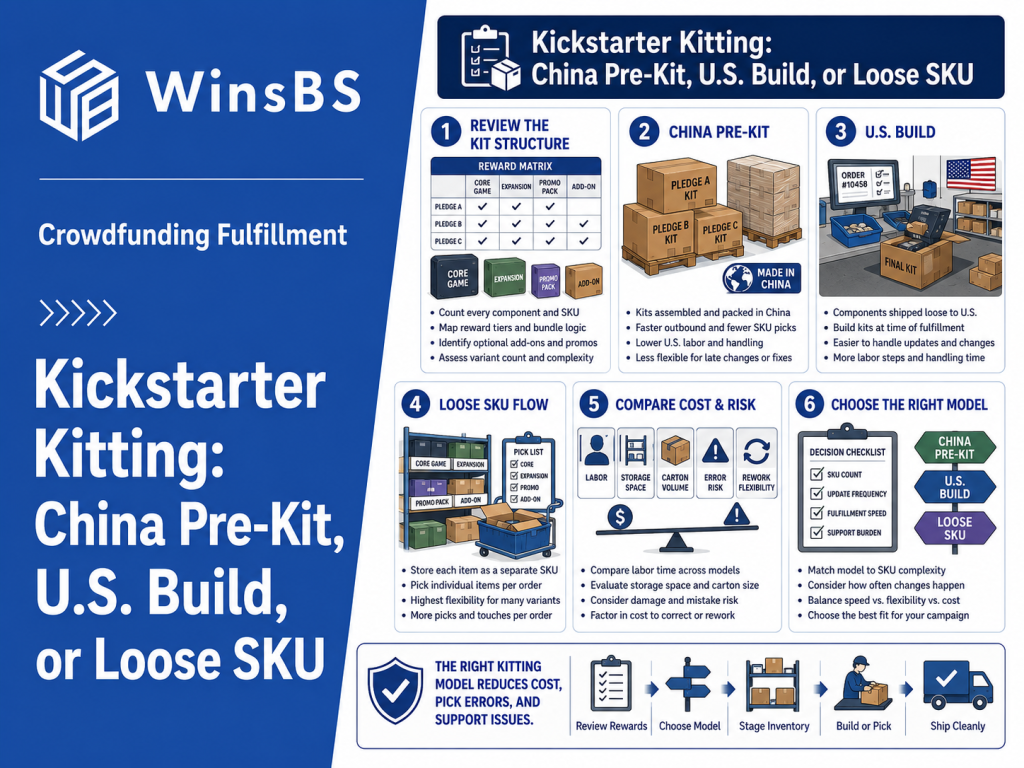
Kickstarter Kitting: China Pre-Kit, U.S. Build, or Loose SKU

China-to-U.S. tabletop crowdfunding fulfillment / Board game kitting fulfillment for Kickstarter Board Game Kitting Fulfillment for Kickstarter: Pre-Kit in China, Kit at the U.S. Warehouse, or Pick Loose SKUs? Choose where a board game campaign should become a real kit before a cheap-looking freight plan turns a fixable China-side problem into expensive U.S. warehouse work. Execution Map The cost usually moves one handoff later than the wrong decision. Factory Packout Decide what physically belongs together before cartons are treated as final. Freight Booking Quote and booking depend on carton count, cube, pallet structure, and timing. U.S. Receiving The dock only sees cartons, labels, intake files, and labor requirements. Backer Outcome Missed add-ons, replacements, and returns appear after the physical mismatch is already old. Lock too early: a problem that was still cheap to correct near the factory can return later as U.S. relabeling, re-kitting, replacement handling, or return work. Maxwell Anderson Published: May 14, 2026. Based on WinsBS review patterns across China-origin board game packing lists, kit BOMs, carton files, freight plans, U.S. receiving scans, warehouse bin locations, pick rules, and spare inventory for later replacement tickets. Quick Answer Lock the kitting choice only when factory packout, freight assumptions, receiving files, and the backer promise are still describing the same shipment. If one cheap consolidated freight quote is the main reason to lock early, the team is usually moving risk, not removing it. The loss appears later as U.S. warehouse labor, replacement handling, return work, or delayed label release. The safer process is the one that keeps mistakes visible and fixable at the cheapest controllable point in the chain, usually before the goods leave China. Only after that should the team decide whether a repeated stable unit belongs in a China pre-kit, whether the U.S. warehouse is truly prepared to build kits, or whether add-ons and spare parts still need to stay loose. A kit SKU belongs only to a real finished unit. Real Pressure Execution Path Freight And Receiving Decision Table Pre-Kit vs Warehouse Kit vs Loose Pick Receiving Warehouse Test-Kit Checklist Send Files For Review The Real Pressure: The Factory Wants A Packing Answer Before The Export Is Stable The problem usually starts in a very ordinary week. Production is nearly done. The factory wants a final answer on sealed Deluxe kits versus loose components. The freight forwarder wants to know whether the carton count and cube are stable enough to keep the booking. The U.S. warehouse wants to know whether it will receive finished kit SKUs or component SKUs. Meanwhile, late backers are still adding sleeves, mats, coins, and extra minis in BackerKit or Gamefound. Smaller publishers and crowdfunding teams often make the next choice for a simple reason: one consolidated shipment quote looks cheaper. So the team keeps pushing toward one easy packout answer, even if some component questions, spare-part planning, or return handling should still be solved before departure. Nothing feels broken yet. The campaign still looks close to launch. Then one answer gets locked too early. The factory seals kits from yesterday’s add-on mix. The freight plan still reflects the old carton shape. The receiving file still assumes one finished Deluxe SKU. Two or three weeks later the shipment reaches the dock, and the mismatch becomes relabeling, re-kitting, delayed label release, or missed items in the first outbound wave. Core judgment: Do not choose kitting by convenience. Choose it by what must remain easy to identify, pick, count, replace, and test. What looks like one small packing decision at that point usually keeps moving through the rest of the shipment. It changes handoffs first, then costs, then support work after delivery. Work that could have been handled near the factory at China-side cost now lands in U.S. labor instead. What Has To Stay Consistent From Factory Packout To U.S. Receiving Everything here belongs to one event chain: campaign close, production finish, freight booking, U.S. receiving, then delivery. Teams usually discover the kitting choice was wrong only after the physical shipment no longer matches the promise made upstream. The cost arrives one handoff later, then one invoice later, then one support queue later. Kitting should be read inside that same chain. If the model changes after one handoff is already treated as final, the next handoff absorbs the mistake. Booking assumptions drift. Then the receiving file drifts. Then the warehouse labor plan drifts. By the time the backer opens the wrong box, the real mistake is already old. Kickstarter, Gamefound, and BackerKit campaigns often finalize shipping and post-campaign order data later than the live campaign because order mix, add-ons, and landed-cost assumptions can still move. The kitting choice has to respect that same timing. The first quote rarely shows what late correction costs after arrival. Shenzhen factory packout China consolidation Yantian export booking Ocean shipment Los Angeles receiving warehouse ASN / WRO intake Bin setup or kit build Kickstarter outbound wave A China pre-kit changes the factory packing list, carton labels, master-carton cube, and what the receiving warehouse expects to scan. A U.S. warehouse kit changes bin setup, labor scheduling, and the days between receiving and label release. A loose SKU model keeps components easier to count, but it adds more pick lines during the main wave. The hidden money question is where unresolved work gets paid for: near the factory before departure, or later inside a U.S. warehouse at U.S. labor rates. How Kitting Changes Freight And Receiving The break usually shows up in one of three places first: the freight booking no longer matches the carton file, the receiving warehouse expects a different intake pattern than the one arriving at the dock, or the warehouse has to bill for work the original plan assumed would never happen. Freight was booked from the old carton shape The project was quoted from loose-component cartons, then the factory changed to sealed kits. That can change carton count, pallet count, and cube after the routing was already treated as final. The dock sees a different shipment

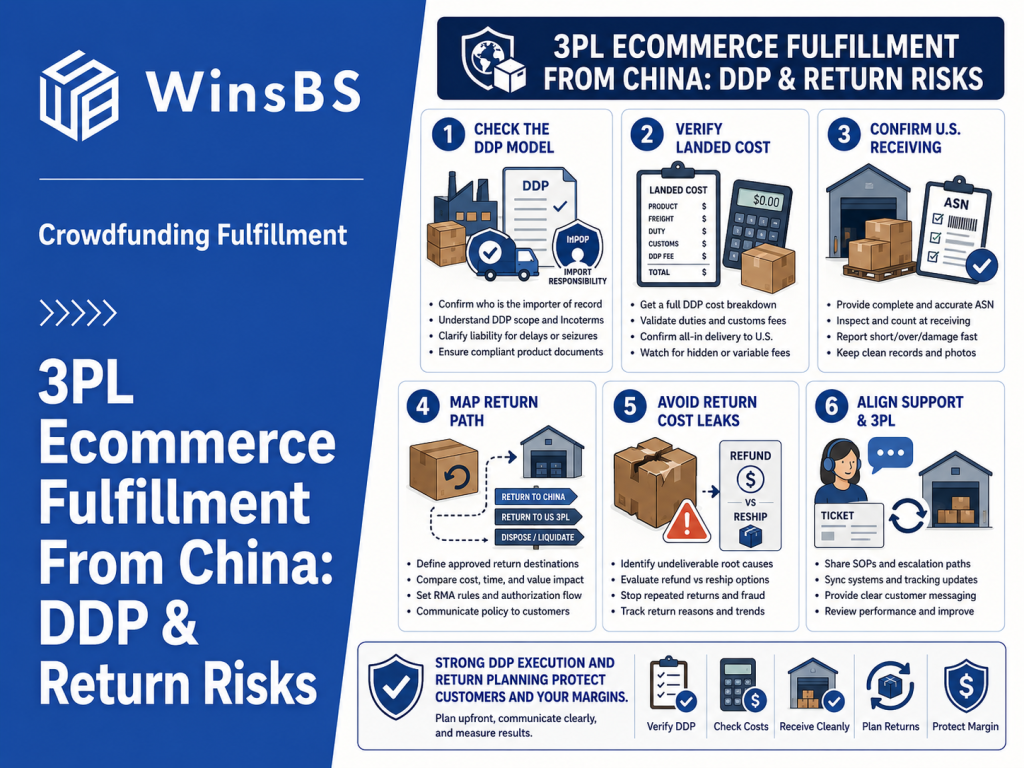
3PL ecommerce fulfillment infographic showing China DDP logistics, landed cost checks, U.S. receiving, returns planning, and margin risk controls.
Crowdfunding Fulfillment, Ecommerce, Order Fulfillment, Shipping & Logistics, Warehousing, Winsbs

3PL Ecommerce Fulfillment From China: DDP & Return Risks

WinsBS / 3PL ecommerce fulfillment from China 3PL Ecommerce Fulfillment From China: DDP, Carrier, U.S. Receiving, and Return Risks Before You Ship For ecommerce brands and importers selling China-sourced finished goods, assembled products, or critical components, the April 2026 freight and 3PL reports point to one practical risk. The lowest quote can become the most expensive route when DDP ownership, carrier exceptions, U.S. receiving, and returns are not priced before release. Maxwell Anderson Published: May 12, 2026. Last updated: May 12, 2026. Purpose: help sellers check the quote before goods leave China: what is being shipped, who pays import costs, where delivery can fail, whether the U.S. warehouse can receive it, and what returns will cost. Before Goods Leave China A cheap quote is not final until these answers are clear 01 What is shipping? Product, carton, SKU data 02 Who pays import costs? Duty, broker, exceptions 03 What if delivery fails? Remote area, address error 04 Can the U.S. warehouse receive it? Labels, SKU, appointment 05 Where do returns go? U.S., Hong Kong, China, disposalWinsBS checks the questions that can turn a low freight or 3PL quote into extra charges after the goods have already moved. Quick Answer Before China-sourced finished goods, assembled products, or critical components for ecommerce orders are released, a 3PL quote is not complete unless it answers five questions. What is shipping? Who pays import costs? What happens if delivery fails? Can the U.S. warehouse receive it? Where do returns go? If a supplier is ready to ship and the quote looks acceptable, WinsBS checks the parts that usually destroy margin after release. That means duties, exceptions, failed DHL/UPS/FedEx or special-line deliveries, warehouse files, and return recovery. The April 2026 reports do not make a vendor choice for you. They show why real China-to-U.S. fulfillment cost depends on the product, declared value, shipping method, warehouse intake rules, and return address. Core judgment: WinsBS protects margin by finding the point where a cheap quote can turn into an extra charge, delay, refused delivery, manual warehouse task, or unrecoverable return. Where A China-To-U.S. Fulfillment Quote Can Break The risk is not one shipment line from China to the customer. The risk is that one part of the plan is unclear, and the seller pays for it later. Factory pickup or China consolidation Export carrier or ocean lane U.S. entry, port, or local transfer Warehouse intake Platform orders and pick-pack rules Customer delivery Return, exchange, disposal, or resale path If the warehouse only discovers the problem after the goods arrive, the quote was not ready. What To Check Start with the April 2026 reports, then check the parts of your own quote that can create extra charges: product type, DDP, failed delivery, U.S. warehouse intake, U.S. local delivery, SKU files, and returns. China-To-U.S. Path Why April Reports Matter Where Extra Charges Appear Product And Shipping Risk DDP Risk Failed Delivery And Returns U.S. Warehouse And Local Delivery Complete Quote Check Which Provider May Miss The Issue When To Ask WinsBS Send Files For Review Related Reading Why April 2026 Reports Matter For Ecommerce Fulfillment The useful reading is not “logistics is getting more expensive.” Sellers already know that. The useful question is simpler: which part of my quote will become more expensive after I say yes? C.H. Robinson’s April 2026 freight market update raised its 2026 U.S. dry van linehaul cost-per-mile forecast to +17% year over year and temperature-controlled to +16%. If your shipment needs U.S. truck delivery, LTL, warehouse appointments, or local transfer after arrival, that forecast matters to your margin. If you sell a high-value electronic item by DHL, UPS, or FedEx, the risky cost may not be the base shipping price. It may be signature service, insurance, failed delivery, address correction, duty dispute, or where the parcel goes if the buyer refuses it. If you move bulky inventory by ocean into a U.S. 3PL, the risky cost may appear later. Drayage, LTL, warehouse appointment delays, pallet handling, remote delivery ZIP codes, and split inventory can erase the savings from a low ocean rate. If you use DDP for regulated or sensitive products, “tax included” is not enough. The quote still needs to say who pays duty, who talks to the broker, who handles customs questions, and who pays when the shipment must return. The April 2026 reports are useful because they show where the market is getting tighter. Armstrong & Associates reports that 94% of Domestic Fortune 500 companies use at least one 3PL and estimates U.S. 3PL revenue at $323.4 billion in 2025. That proves 3PL use is normal, but it does not prove your quote is complete. UNCTAD’s April 2026 update describes global trade growth alongside rising fragility. For a seller, that means cross-border plans need clearer responsibility before goods move. What is shipping? Who pays import costs? What if delivery fails? Can the warehouse receive it? Where do returns go? Where Extra Charges Can Appear After You Accept The Quote The reports matter only when they point to a charge your quote has not explained. Each row names the source, the charge to check, and what WinsBS confirms before the goods move. What the report says What may be billed later What WinsBS confirms first C.H. Robinson Freight Market Update, April 2026Truckload and LTL cost pressure is rising. DrayageLTL into 3PLReceiving appointmentSplit inventoryRemote area surchargeWarehouse distance We check cartons, pallets, warehouse location, customer ZIP patterns, remote-area risk, and LTL cost before the warehouse choice is treated as final. C.H. Robinson Freight Market Update, April 2026Ocean networks may look balanced while routing and fuel pressure still affect consistency. Schedule driftDetentionStorageDelayed receivingLate platform promises We check whether late sailing, port delay, or a changed arrival date will break warehouse receiving or customer delivery promises. Armstrong & Associates 3PL/Customer Relationships, 20263PL relationships are becoming deeper and more execution-dependent. SKU file cleanupException laborReturn handlingInspectionChina-to-U.S. file mismatch We check whether the quote covers the work needed to receive, store, pick, pack, and return your actual product.

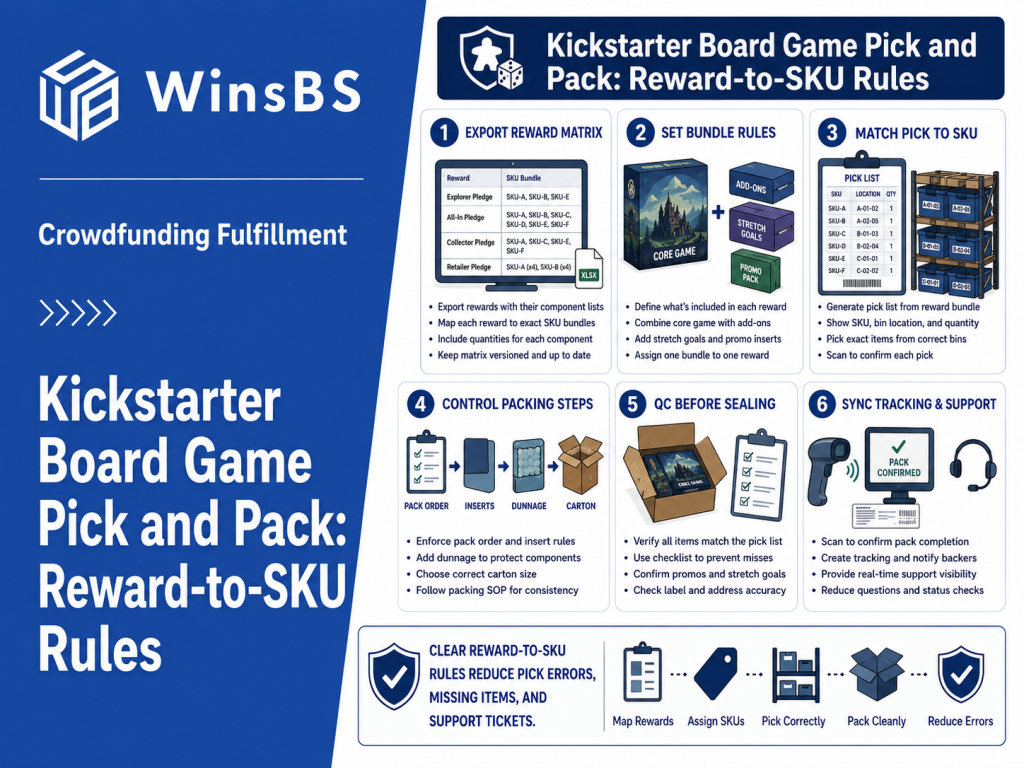
Kickstarter board game pick and pack infographic showing reward-to-SKU rules for crowdfunding fulfillment.
Crowdfunding Fulfillment, Ecommerce, Order Fulfillment, Shipping & Logistics, Warehousing, Winsbs

Kickstarter Board Game Pick and Pack: Reward-to-SKU Rules

China-to-U.S. tabletop crowdfunding fulfillment / Kickstarter board game pick-and-pack readiness Kickstarter Board Game Pick-and-Pack Readiness: When BackerKit Exports, Add-ons, and Warehouse Pick Rules Do Not Match A WinsBS decision guide for creators who need pick and pack fulfillment, board game kitting, pledge-manager exports, add-on lists, SKU maps, carton files, warehouse bins, and pick rules to match before outbound fulfillment starts. Maxwell Anderson Last reviewed: May 2026. Based on WinsBS reviews of China-origin board game fulfillment files, pledge-manager exports, add-on complexity, U.S. warehouse handoffs, and post-release wrong-shipment patterns. Quick Answer For a complex Kickstarter board game, build fulfillment from warehouse-pickable SKUs, not reward names. Use SPU or pledge names to define product families and bundle logic, then convert every BackerKit, Gamefound, or Kickstarter Pledge Manager order into SKU pick lines before labels are released. A final export is not a final pick rule. The export becomes usable only after each pledge, paid add-on, stretch goal, kit, and replacement reserve has a clear relationship to physical SKUs, carton sources, warehouse bins, and test-picked orders. Use this page to build the model: reward language to SPU logic, SPU logic to SKU lines, SKU lines to bins, and bins to a pick rule the warehouse can execute without chat context. Downloadable Asset Reward-to-SKU Pick Rule Worksheet Use the two-page PDF when your team needs to turn BackerKit or Gamefound reward language into SKU pick lines before label release. Reward-to-SKU matrix for base, deluxe, all-in, and duplicate add-on patterns. Add-on quantity, stretch goal, reserve stock, and kit SKU checks. Eight sample orders to test-pick before the main wave ships. This PDF is an operational worksheet, not platform UI support, warehouse pricing advice, legal advice, tax advice, customs advice, or consumer-rights advice. Download The PDF Worksheet Use This Page Start with the section that matches your current pressure: converting pledge language to SKUs, building the reward-to-SKU matrix, handling duplicate add-ons, or testing the warehouse rule before label release. Real Pressure Example Campaign SPU / SKU / Bundle / Kit Reward-To-SKU Matrix Add-on Quantity Rules Stretch Goals Warehouse Test Pick Wrong Order Examples Where WinsBS Fits Send Files For Review The Real Pressure Before Orders Start Shipping The hard moment is not when the warehouse says it can pick and pack. The hard moment is when a creator has to answer what a real backer should receive: base game, miniatures box, dungeon tile pack, boss expansion, neoprene mat, metal coins, sleeves, promo cards, stretch goal box, one extra mini set, or a replacement component. Reward names are written for backers. SKU names are written for inventory. Carton files are written for receiving. Pick rules are written for warehouse labor. If those layers are mixed together, the first shipping wave becomes the test, and backers discover the model failure through missing add-ons or duplicate expansions. Core judgment: Use SPU for product grouping and pledge logic; use SKU for warehouse picking. Example Campaign: Dungeon Game With Minis, Tiles, Mat, Expansion, Promo Cards, And Stretch Goals Use a concrete campaign before building the warehouse rule. Imagine a dungeon board game with these physical pieces: Core Game, Dungeon Tiles Pack, Miniatures Box, Hero Upgrade Pack, Boss Expansion, Neoprene Mat, Metal Coins, Sleeves, Kickstarter Exclusive Promo Cards, Stretch Goal Box, and Late Add-on Extra Mini Set. Base pledge includes the Core Game. Deluxe pledge includes Core Game, Miniatures Box, and Dungeon Tiles Pack. All-in pledge includes Deluxe plus Boss Expansion, Mat, Coins, Sleeves, Promo Cards, and Stretch Goal Box. A backer can still buy extra add-ons. One base backer may buy a mat. One deluxe backer may buy an extra Miniatures Box. One all-in backer may buy a second Boss Expansion. The warehouse should not be asked to pick `Deluxe Adventurer Pledge`. It should pick physical lines such as `SKU-CORE-001 x1`, `SKU-MINI-001 x1`, and `SKU-TILE-001 x1`, unless a real pre-assembled kit SKU exists. Backer reward language SPU / pledge logic Bundle rule SKU pick lines Carton source Warehouse bin Test pick Shipment label Backer order The Rule: SPU Explains The Product. SKU Drives The Warehouse. A complex board game campaign needs layers. Do not collapse all of them into the pledge-manager export. On small screens, each row becomes a card so the layer, example, and warehouse use stay readable. Layer Example Used For Should Warehouse Pick From This? Reward name Deluxe Adventurer Pledge Backer-facing campaign promise and pledge selection. No. Translate it before release. SPU / product family Dungeon Game System Commercial grouping, pledge logic, reporting, and product-family planning. Usually no. It is normally not a bin-level physical unit. SKU / physical unit SKU-MINI-001 Miniatures Box Warehouse bins, carton files, pick rules, inventory count, and support tickets. Yes. This is the normal pick line. Bundle rule Deluxe = Core + Minis + Tiles Converting pledge language into multiple SKU pick lines. No, unless it has been converted into SKU lines. Kit SKU KIT-DELUXE-001 A pre-assembled set physically created and binned by the warehouse. Yes, but only if the kit actually exists as pickable inventory. Release rule: the warehouse should pick SKU lines or real kit SKUs, not campaign language. A paid add-on must become a separate pick line unless it was intentionally pre-kitted. A stretch goal must be assigned either to every eligible order or to a specific pledge / SKU rule. Reward-To-SKU Matrix: What The Warehouse Must Actually Pick Build this matrix before label release. It is the translation sheet between BackerKit or Gamefound reward language and the warehouse-facing pick rule. On small screens, each row becomes a card so you can check the pledge pattern that matches your current issue. Backer Selection What Backer Sees Paid Add-on Handling Warehouse Pick Lines Base Pledge Core Game None SKU-CORE-001 x1 Deluxe Pledge Core + Minis + Dungeon Tiles Do not duplicate included minis or tiles unless export shows extra quantity. SKU-CORE-001 x1; SKU-MINI-001 x1; SKU-TILE-001 x1 All-In Pledge Deluxe + Boss Expansion + Mat + Coins + Sleeves + Promo + Stretch Goal Box Add extra copies only when paid add-on

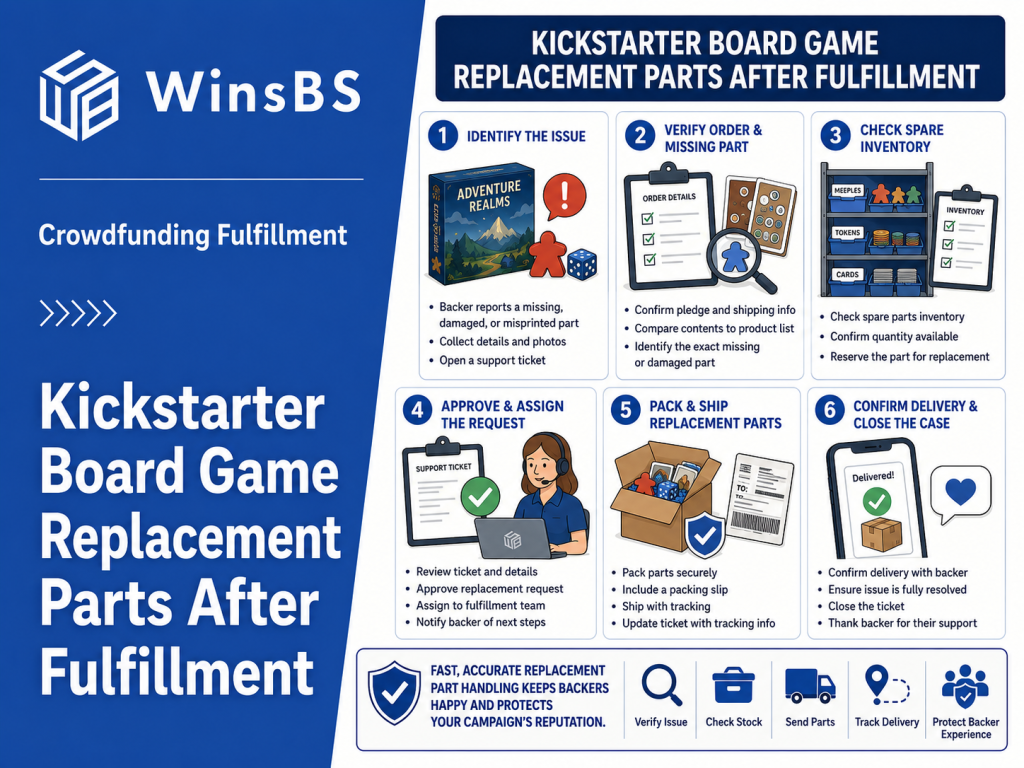
Kickstarter board game replacement parts fulfillment workflow infographic
Crowdfunding Fulfillment, Ecommerce, Order Fulfillment, Shipping & Logistics, Warehousing, Winsbs

Kickstarter Board Game Replacement Parts After Fulfillment

China-to-U.S. tabletop crowdfunding fulfillment / Kickstarter board game replacement parts and returns Kickstarter Board Game Replacement Parts After Fulfillment: What Breaks When Backers Start Reporting Issues? Missing miniatures, crushed boxes, wrong add-ons, non-delivery claims, returns, and refund pressure after China-to-U.S. crowdfunding fulfillment. Maxwell Anderson Based on WinsBS reviews of China-origin board game fulfillment files, U.S. receiving issues, spare inventory separation problems, and backer-facing exception patterns. Replacement handling breaks when spare cartons, component names, warehouse bins, support tickets, and approval rules do not describe the same decision. Quick Answer Most Kickstarter board game replacement problems are not solved at the support inbox. They are solved by knowing where the spare parts are, whether the U.S. warehouse can identify and pick them, whether the issue is worth a part resend or full-game resend, and whether the backer should receive a replacement, refund, or no-return resolution. The hard question is not only “how do we reply?” It is: are the parts in China or the U.S., are they named and binned, what proof is required, and what can support promise without draining the spare pool? WinsBS is most useful when the issue crosses China-origin preparation and U.S. warehouse execution, not when it is only a support-script problem. Use This Page If tickets are already arriving, start with the triage table. If cargo just reached the U.S., check the spare-parts bottlenecks. If cargo has not left China, use the experienced-campaign checklist before the factory handoff. Real Pressure Why China-to-U.S. Makes It Harder Ticket Triage Table Exception Log Template Experienced Campaigns New Creator Mistakes Returns Reality Where WinsBS Fits Send Files For Review The Real Pressure After Backers Start Receiving Games The first batch of backers receives games. Fifty support emails come in. One backer says a miniature is missing. Another says the retail box corner is crushed. Another received the base game but not the neoprene mat. Someone says tracking shows delivered but nothing arrived. Public comments start asking whether the campaign will replace everything. At the same time, the factory says the extras already shipped with the main cargo. The U.S. warehouse says the cartons are marked “extras” but not set up as pickable SKUs. Support asks whether it can resend parts immediately. The campaign owner wants to protect backer trust without turning every $3 component problem into a $60 full-game replacement plus domestic shipping. This is the moment replacement handling becomes a China-to-U.S. execution problem. Support cannot answer consistently if the spare parts location, component name, warehouse bin, proof rule, and resend authority are all unclear. The Replacement Chain Has To Survive Real Exceptions China factory Component list Spare parts count Spare carton label Packing list Freight lane U.S. receiving scan Replacement bin Warehouse rule Support ticket Proof review Resend or refund decision Backer resolution This chain breaks when a spare part exists physically but is not named, counted, labeled, received, binned, or authorized for resend. A warehouse can only ship what it can identify. Why China-to-U.S. Fulfillment Makes Replacement Parts Harder 1. Spare parts may not be in the U.S. If miniatures, cards, token sheets, or component packs are still at the China factory, one-off replacement parcels to U.S. backers are slow, hard to track, and usually expensive compared with domestic part resends. The creator needs to decide whether to wait for a spare shipment, use a U.S. parts pool, send a full game, or offer another resolution. 2. Factory extras may not be warehouse-ready inventory. An “extras” carton is not the same as a replacement bin. Someone has to open it, identify parts, photograph them if needed, create pickable names or SKUs, count quantities, assign bin locations, and decide who pays the warehouse labor. 3. A small missing part can force a full-game resend. The painful cost is not the missing miniature. It is what happens when the warehouse cannot pick that miniature and support approves a full-game resend instead. That burns sellable stock, replacement stock, parcel cost, and support time. 4. Return-to-China is usually not a practical default. For board game backers, returning a damaged or disputed game to China is usually too slow and too costly to be the default answer. Even a return to a U.S. warehouse may not be worth restocking if the game is opened, incomplete, damaged, or expensive to inspect. 5. Pledge-manager data still matters after fulfillment. Wrong add-ons and missing stretch goals often start with order data, not warehouse labor. Check the pledge-manager export, add-on list, pick rule, and shipment log before calling the issue a warehouse mistake. Common Surprise Points After Fulfillment Starts These are recurring failure patterns WinsBS sees when spare parts, receiving files, and support promises were not aligned before delivery. Most campaigns do not get one clean replacement problem. They get several small surprises at the same time, and each one changes what support can honestly promise. The factory has moved on. It may be busy with the next project and unwilling or slow to sort loose parts, repack extras, or confirm old component names. Spare parts in China need their own handling. A small parts shipment still needs packing, labels, export paperwork, tracking, and a clear U.S. receiving plan. Parts may not match perfectly. Color batches, old-version components, revised cards, or promo variations can make a “simple” part resend more sensitive than it looks. Extras cartons create warehouse labor. The U.S. warehouse may charge to open cartons, count parts, photograph components, create bin locations, and make them pickable. Replacement addresses may be stale. A backer may have changed address after the original shipment, but support may still approve a replacement from old data. Replacement stock can disappear into other channels. Shopify sales, late pledges, or leftover sales can consume units that should have been protected for damaged contents or missing parts. Backers compare outcomes publicly. If two support agents answer the same issue differently, screenshots can force the campaign to upgrade the policy for everyone. Returned games may not be recoverable. A returned opened game can arrive

Kickstarter board game tariff surcharge infographic by WinsBS for crowdfunding fulfillment guidance.
Crowdfunding Fulfillment, Ecommerce, Order Fulfillment, Shipping & Logistics, Warehousing, Winsbs

Can Kickstarter Board Games Charge a Tariff Surcharge?

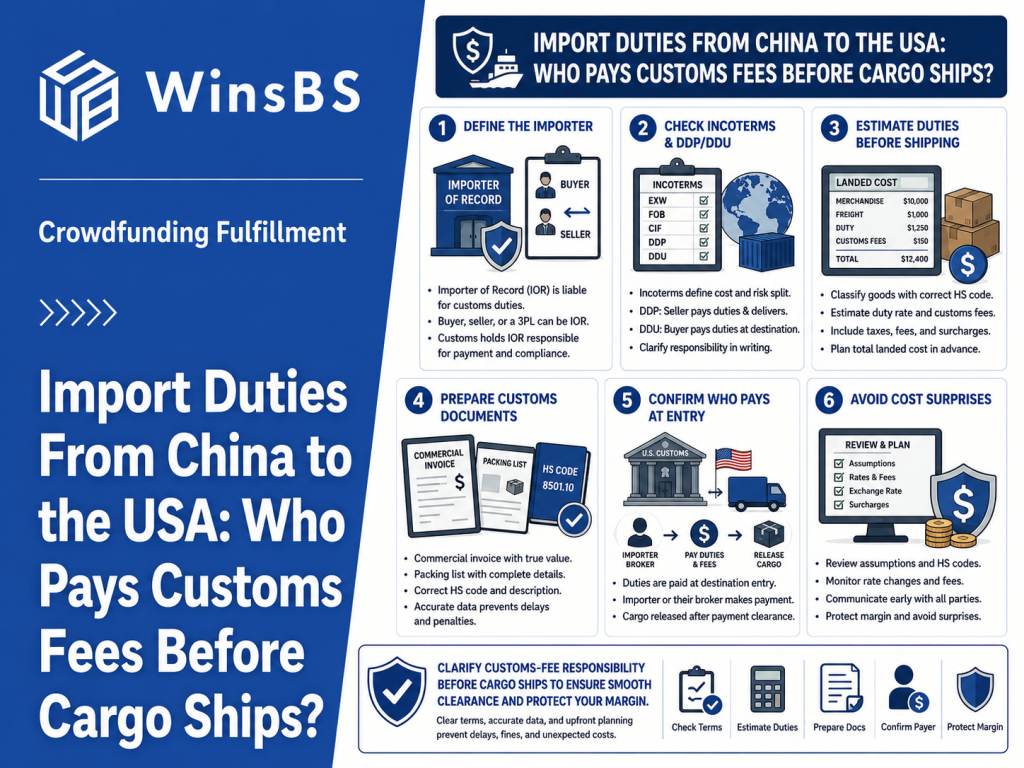
China-to-U.S. tabletop crowdfunding fulfillment / Kickstarter tariff surcharges for board games Kickstarter Tariff Surcharges for Board Games: Can You Charge Backers Extra? When a board game creator can ask backers to pay a tariff surcharge, import-cost fee, or extra shipping charge, and when the charge should stay paused. Maxwell Anderson Last reviewed: May 2026. Reviewed from recurring WinsBS China-to-U.S. crowdfunding handoff failures. Quick Answer Sometimes you can collect a tariff surcharge, but you should not make it live until the charge, import files, platform setup, and backer update all say the same thing. If you are asking whether you can charge Kickstarter backers extra for tariffs, the safer question is whether your tariff or duty reason, surcharge amount, DDP or importer assumption, tax setting, pledge-manager collection method, and backer update are ready to show backers without a later correction. Platform rules change. This page separates platform capability from surcharge readiness; confirm the current Kickstarter, BackerKit, or Gamefound setup before publishing a charge. Can You, Should You, And When Should You Stop? Can you? Platform tools may allow a surcharge, but eligibility and setup limits still matter. Kickstarter says its tariff surcharge currently applies only to backers with a U.S. shipping address. Should you? Only if the duty reason, amount, import owner, tax setting, platform label, and backer update all describe the same cost change. When should you stop? If freight, carton weight, or shipping zones changed instead, reopen the shipping table. If DDP or importer responsibility is unresolved, pause the surcharge. If inventory already cleared, this is mostly a backer communication and cost-recovery decision. This is the pressure point: the campaign already funded, backers already paid for the game, shipping expectations may be public, freight may be quoted or booked, and a tariff or duty assumption changed after the campaign team built its cost plan. The support team expects backlash, the pledge manager is waiting for numbers, and the creator does not want to absorb the full import-cost change alone. Why Tariff Surcharges Fail: The China-to-U.S. Data Gap China board game factory -> final carton file -> commercial invoice -> HTS classification assumption -> duty estimate -> DDP or importer decision -> freight lane -> U.S. import event -> receiving hub -> pledge-manager surcharge setup -> backer update -> backer charge. A tariff surcharge does not exist in isolation. It depends on the same commercial invoice, packing list, duty estimate, DDP assumption, importer assumption, tax setting, freight lane, and backer-facing promise the fulfillment plan depends on. A tariff surcharge is never just a finance line; it is a final test of your China-to-U.S. supply chain alignment. BackerKit or Gamefound can collect a surcharge, but the platform cannot make an unclear import-cost decision trustworthy. A Board Game Example Here is where creators usually get into trouble: the factory’s final carton file grows from 800 cartons to 940 cartons after stretch goals and inserts are finalized, carton weight is higher than the shipping table used, and the DDP quote also changed. Do not label that whole gap as a tariff surcharge. Part of the problem may be carton weight, part may be freight or receiving hub math, and only part may be duty or tariff exposure. The public mistake happens when checkout becomes the first explanation. If the charge is really a shipping-table adjustment, call it that and use the shipping readiness review. If the charge is a tariff or duty correction, make the commercial invoice, duty estimate, importer decision, platform label, backer update, and support answer match before collecting. Contents Quick Answer Surcharge Readiness Decision Table What Must Be Decided Common Misreads What To Do Next Where WinsBS Fits Send Your Setup For Review Surcharge Readiness Check It is tempting to use the platform’s collection tool quickly when margin is under pressure. That instinct is understandable. Still, if the importer, DDP, or tax assumption is still moving, the surcharge should not go live. The expensive part is not only the tariff. It is the trust hit when backers think the campaign changed the rules after payment. The import-cost reason is not stable Tariff or duty reason is not clear. The campaign cannot yet explain what changed from the original cost assumption. Commercial invoice, duty estimate, or classification assumption is still moving. The surcharge amount may be built on an unfinished file set. The campaign cannot explain why backers are being asked to pay more now. That is a backer-facing readiness failure, not only a finance delay. The collection setup is not stable Surcharge amount is still rough. Do not publish a charge that may need another correction after the next duty estimate. DDP assumption is not final. The campaign still cannot say whether import cost is being absorbed into landed cost or collected from backers. Importer assumption is not final. The campaign still cannot say who owns the import responsibility behind the charge. Tax setting is not final. Checkout, import-cost fee, and tax treatment may not describe the same payment event. BackerKit or Gamefound collection method is not final. The platform field should not go live before the import-cost decision is clear. The backer-facing explanation is not stable The shipping table was built before the import-cost change was understood. Reopen the table or surcharge setup before asking backers to pay more. Backer update is not written yet. The payment request should not arrive before the explanation. Support script is not ready. Backers will ask why the charge exists, who pays it, and why it was not included earlier. What Has To Match Before Collecting Use this compact review before a tariff surcharge, import-cost fee, or extra shipping charge goes live. The question is not only whether a platform can collect the money. The question is whether the charge, files, and backer update describe the same cost change. If You Only Have 10 Minutes If the amount is rough, do not publish. If DDP or importer responsibility is unresolved, pause. If the gap is freight, carton weight, or zones, reopen the

Infographic showing when to charge shipping for Kickstarter board games, with a blue left panel featuring the WinsBS logo and title, and a white right panel with six illustrated steps on campaign planning, freight quotes, carton checks, customs review, address setup, and shipping milestones.
Crowdfunding Fulfillment, Ecommerce, Order Fulfillment, Shipping & Logistics, Warehousing, Winsbs

When to Charge Shipping for Kickstarter Board Games | WinsBS

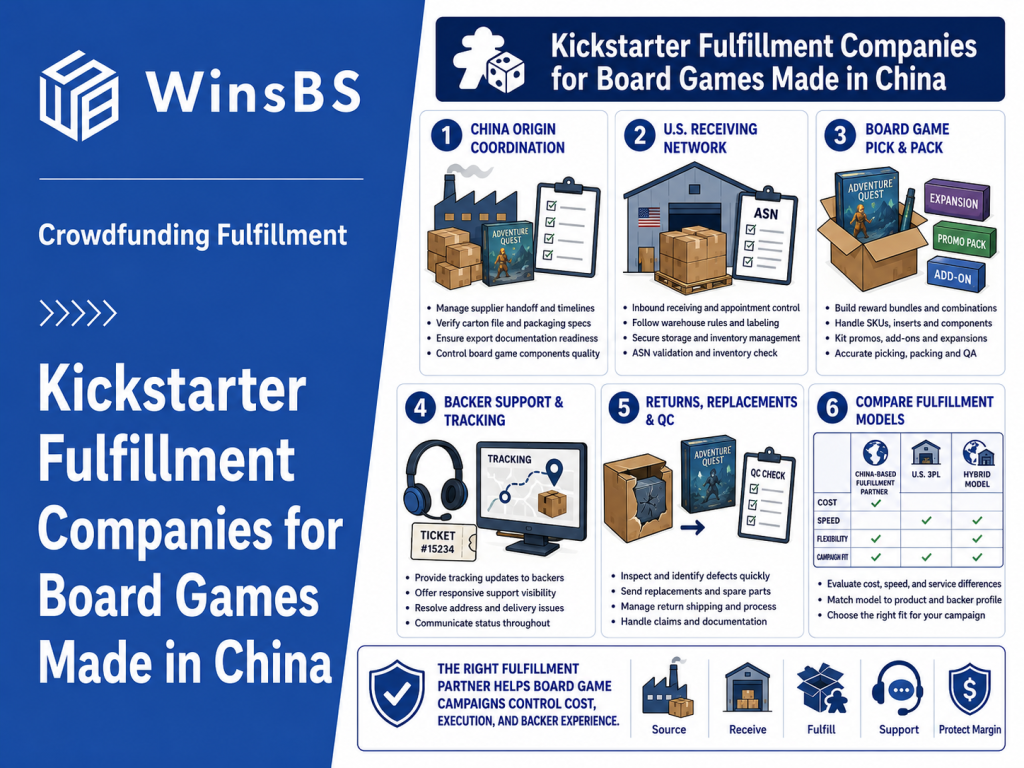
China-to-U.S. tabletop crowdfunding fulfillment / Pledge manager shipping fees for Kickstarter board games: when to charge backers Pledge Manager Shipping Fees for Kickstarter Board Games: When to Charge Backers What must be final before you charge backers in BackerKit, Gamefound, or Kickstarter Pledge Manager. Maxwell Anderson Reviewed from WinsBS China-to-U.S. crowdfunding fulfillment operations. Quick Answer Charge shipping only when your pledge manager table, final carton file, receiving hub, import-cost assumption, and backer message still describe the same shipment. If final weights, carton count, shipping zones, address-lock timing, tax setting, or DDP or importer assumptions are still moving, do not charge backers yet. Definition: In plain terms, the fee is ready only when the shipping table, final carton file, receiving hub, import-cost assumption, and backer update still describe the same China-to-U.S. shipment. This is the pressure point: production feels done, freight may already be quoted or booked, the shipping table is half-built, final weights may still be old, zones may still be rough, the receiving hub may not be final, address lock is being discussed, and backers are waiting for an update. That is exactly when teams confuse “the platform can accept numbers” with “the shipping fee is actually ready to charge.” China-to-U.S. Execution Path Before The Backer Charge China board game factory -> supplier pickup -> China consolidation -> final carton weight and count -> China port -> ocean lane -> U.S. port -> inland move -> receiving hub -> BackerKit or Gamefound shipping table -> address lock -> backer charge. Shipping fees do not exist in isolation. They depend on the same physical shipment assumptions the freight plan and warehouse plan depend on. Charging shipping is not the same thing as being ready to charge shipping. A shipping table is only final when the physical shipment and the backer promise still describe the same load. If the cartons are still moving, the shipping fee should not be treated as locked. Contents Quick Answer 5-Question Gate Before You Charge Where The Fee Breaks What Must Be Final Before Charging Backers Common Misreads What To Do Next Commercial Risk Where WinsBS Fits FAQ Methodology Send Your Shipping Table For Review Answer These 5 Questions Before You Charge Backers Have final carton weights been measured after final pack-out? Is the receiving hub final? Does the pledge manager table use the latest item and packaging weights? Is the DDP, importer, or tax handling final? Has address-lock timing already been set and communicated? If any two answers are no, do not charge shipping yet. If the receiving hub, import-cost assumption, or final carton weights are not final, pause even if the other answers look stable. Downloadable Asset Download The 2-Page Shipping Fee Readiness Checklist Use the short PDF version when your BackerKit or Gamefound shipping table is half-built and you need a fast stop/go review before charging backers. The 5-question gate in one page-friendly format The fastest stop signals before a shipping charge goes live A compact file list to send for a China-to-U.S. review The PDF is a fast screen, not a replacement for checking the live shipping table against the latest carton file, receiving hub plan, and import-cost assumption. Download The PDF Checklist Before You Charge: Stop If These Inputs Are Still Moving Shipment data still moving Carton weight changed after the latest sample, final pack-out, or last shipping-table build. Carton count is still moving because add-ons, case packs, or final production quantities are still shifting. The shipment is still physically changing while the fee table is being treated as final. Platform table still unstable The BackerKit or Gamefound shipping table uses old weights or old item-level assumptions. Shipping zones are still rough and the live table would be built from placeholders. Freight was booked before final weight and hub were stable and the team is treating that booking as proof the fee table is ready. Import, address, or hub assumptions still unresolved The receiving hub is not final or changed after freight planning began. The tax setting is not final for the same backer-facing shipment you are about to charge for. The DDP or importer assumption is not final and the team still cannot say where import cost belongs. Address-lock timing is not set and the shipping charge logic is running ahead of address readiness. Where The Fee Breaks When The Shipment Changes A pledge manager can collect a fee. It cannot make unstable shipment assumptions safe. Use this table to decide whether the number you are about to charge still belongs to the same shipment that will leave China, arrive at the receiving hub, and be released to backers. What you are about to charge for What must already be final Where it breaks What backers feel next What to fix before charging Final carton weight Measured box weight, packaging-material weight, and the item weights feeding the shipping table BackerKit whole-order weight rules or Gamefound shipping logic are built from old numbers Undercharge, re-opened shipping request, or a later correction message Remeasure the current pack-out and rebuild the shipping table from the final weight inputs Carton count and box count Final carton file, case-pack logic, and the load shape behind the freight plan Freight, warehouse, and fee table stop describing the same load Delay, re-stated charge logic, or a backer update that walks back an earlier promise Freeze carton count and confirm the shipping table still belongs to that exact load Shipping zones Region mapping, service assumptions, and the lane / hub plan behind the zones Zone tables are rough while the live checkout acts as if they are final Wrong regional charge or a later request for more money Finalize the zone map from the actual receiving and release plan Receiving hub choice Which U.S. hub receives the inbound and which parcel logic follows it The freight booking points one way and the shipping table assumes another hub Longer lead time, changed delivery expectation, or a table reopen Reconfirm the receiving hub and rerun the table if the