
Board Game Fulfillment Checklist Before Freight Leaves China
This is the WinsBS pre-departure checklist for China-made board games: not a generic shipping list, but an evidence-backed review of the SKU file, packing list, commercial invoice, carton labels, ASN or WRO, warehouse receiving guide, DDP or importer assumption, and BackerKit or Gamefound shipping table before freight leaves China.
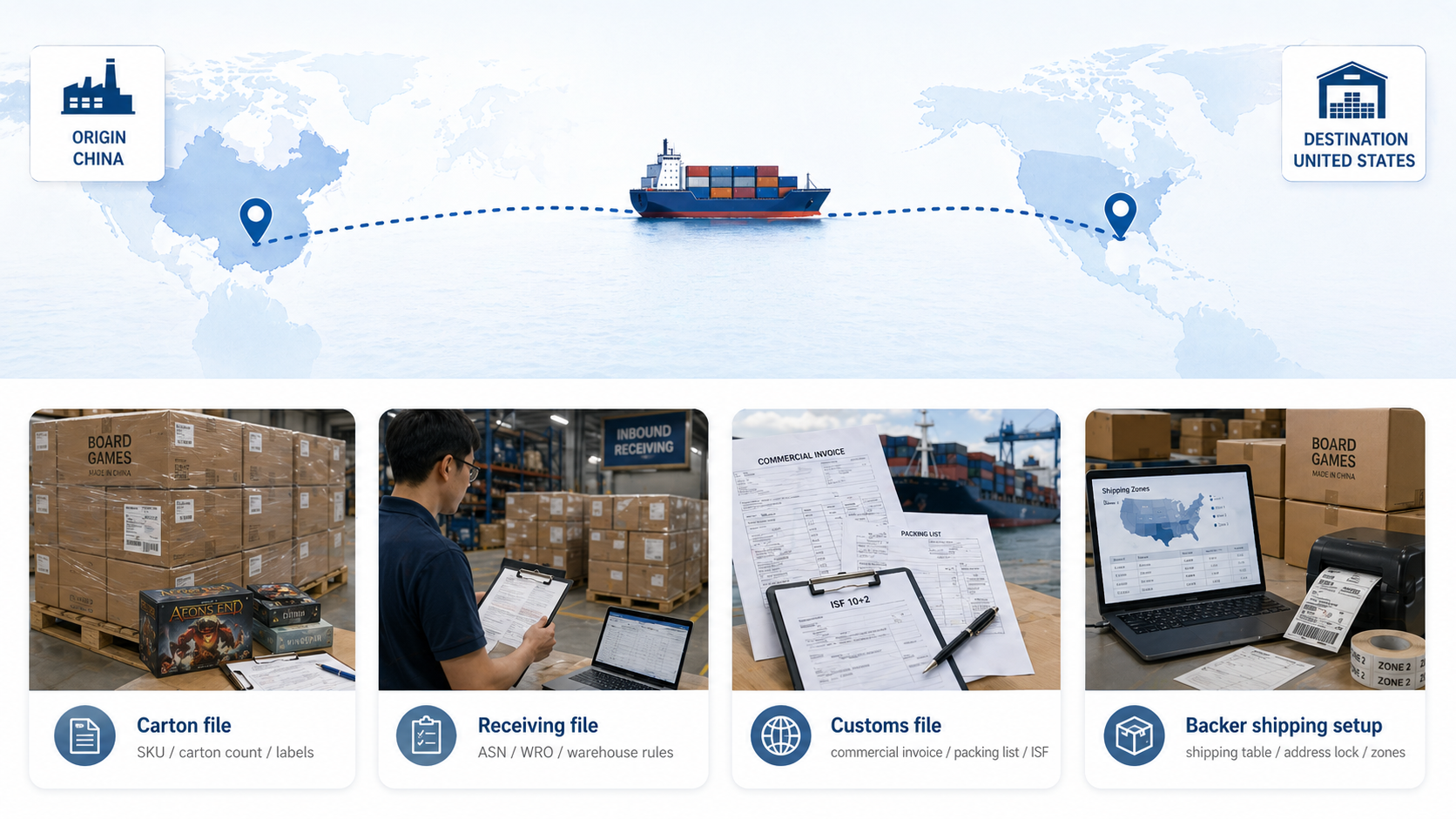
A board game shipment is not ready to leave China just because production is finished. It is ready only when the SKU file, packing list, commercial invoice, carton labels, ASN or WRO, receiving warehouse rules, packaging spec, and BackerKit or Gamefound shipping table still describe the same shipment.
The WinsBS checklist turns those later enforcement points into a pre-departure review built from the rules that freight forwarders, customs brokers, receiving warehouses, packaging tests, and pledge managers will enforce later.
Before freight leaves China, lock the final carton file, ASN or WRO, commercial invoice, packing list, importer or DDP assumption, and backer shipping table. WinsBS groups those checks into a usable review, with packaging and correction planning added because board games often fail at those handoffs too. If the files do not match before departure, the mismatch usually returns later as a customs question, a receiving exception, a relabeling job, a shipping-fee gap, or a backer delay.
The China-to-U.S. Handoff Chain This Checklist Is Trying To Protect
A board game shipment does not become stable because cartons exist or because a booking can be made. It becomes stable when the SKU file, packing list, labels, customs documents, warehouse inbound file, and backer shipping table keep matching through each handoff from factory release to backer promise.
One common path: China board game factory -> supplier pickup -> China consolidation -> packing list and carton freeze -> export filing -> ocean booking -> customs / ISF -> U.S. receiving dock -> pledge-manager or backer promise.
The final SKU file, case pack, and packaging spec have to match the load actually being packed. If they drift here, the packing list and shipping table both become stale later.
The factory city, pickup owner, and actual carton count have to stay visible. If consolidation changes carton count, carton size, SKU mix, or pallet shape but the packing list, freight quote, ASN or WRO, and warehouse label file do not change, the freight quote and warehouse inbound plan stop describing the same load.
The carton dimensions, gross and net weight, CBM, commercial invoice, and packing list have to line up before export filing and booking. If those numbers drift, the commercial invoice, packing list, ISF timing, and booking file stop matching the cargo before the U.S. warehouse ever sees it.
The receiving warehouse, ASN or WRO, labels, shipping table, address-lock status, and shipping message have to match what arrives at the receiving dock and what backers were told. If not, the same mismatch returns as manual receiving, shipping undercharge, or support pressure.
The WinsBS Pre-Departure Checklist for Board Game Freight
This checklist is not asking whether freight can move in theory. It is asking whether the SKU file, carton labels, warehouse rules, customs documents, packaging assumptions, and backer promise still describe the same shipment in practice.
For Kickstarter and tabletop creators, use this as the China-to-U.S. board game freight checklist before factory pickup, China consolidation, or ocean freight booking.
Use this checklist as a stop/go review
- If carton count, carton dimensions, or gross or net weight changed after the freight quote, do not treat the quote as final.
- If the receiving warehouse has not confirmed the carton label format, ASN or WRO fields, or appointment rules, do not release the cargo yet.
- If the packing list and commercial invoice do not mirror the same load, fix the file set before departure.
- If the BackerKit, Gamefound, or pledge-manager shipping table was built on old carton weights, old zones, or an old receiving hub, reopen the shipping promise before freight moves.
If pickup is scheduled this week, check carton count, carton dimensions and weight, receiving labels, commercial invoice and packing-list match, and the backer shipping table first.
Use this table when the factory says goods are ready, but your carton file, warehouse file, or backer promise is still moving.
| WinsBS checklist item | Evidence source | File or data to verify | Where it breaks | What happens if wrong |
|---|---|---|---|---|
| Final SKU file, case pack, and carton count must match the load now ready to move. | Amazon documents box content, carton labels, inbound defects, and manual processing; Flexport requires carton count and packing-list accuracy; Stord expects item-master dimensions, weights, and pack definitions to match receiving data. | Final SKU file, case-pack file, packing list, carton count, freight quote, ASN or WRO. | China consolidation, freight booking, receiving dock, warehouse putaway. | Break result: The inbound file and the real cartons stop describing the same load at receiving. Loss type: Manual receiving, mismatch investigation, delayed putaway, and possible inbound defect handling. Fix before departure: Reconcile the SKU file, case pack, and carton count, then reissue the packing list and inbound file. |
| Carton dimensions, gross weight, net weight, and CBM must be locked before freight moves. | Flexport uses quantity, weight, dimensions, and carton count in the packing-list and customs file set; CBP and eCFR require package-level detail that matches the load; pledge-manager shipping logic depends on final measured weights and load shape. | Measured carton dimensions, gross and net weight, CBM sheet, packing list, commercial invoice, freight quote, shipping table. | Freight quote, customs paperwork, inland costing, pledge-manager charge logic. | Break result: The freight, customs, and shipping-cost model start using different measurements for the same load. Loss type: Requoted freight, customs discrepancy, DIM-weight surprise, and shipping undercharge. Fix before departure: Remeasure the cartons, update the packing list, and rerun shipping assumptions from the new measurements. |
| Carton labels and pallet labels must match the warehouse's scannable receiving rules. | Amazon documents carton labels, box content, inbound defects, and manual processing; ShipBob and Stord require scannable receiving labels tied to the declared inbound file rather than warehouse-side guessing. | Carton label PDF, pallet label proof, SKU label standard, warehouse receiving guide. | Receiving dock, case-level scan, on-hold receiving queue. | Break result: The receiving dock cannot trust the cartons it is unloading. Loss type: On-hold receiving, relabeling labor, inbound defect fees, and delayed order release. Fix before departure: Reprint the labels to warehouse spec and verify the carton-to-file mapping before pickup. |
| ASN, WRO, dock appointment logic, and receiving instructions must already describe the shipment being released. | ShipBob and Stord use WRO or ASN data, labels, and receiving instructions to prepare inbound handling; ShipMonk exposes expected SKU and quantity mismatch through receiving exceptions rather than silent corrections. | ASN or WRO, dock appointment notes if available, target receiving warehouse, warehouse guide, manifest or packing list. | Receiving appointment, unload, quantity check, putaway. | Break result: The warehouse receives the shipment as an exception instead of a planned inbound. Loss type: Partial, short, or over exceptions, manual receiving, delayed intake, and extra labor. Fix before departure: Confirm the final warehouse, update the inbound file, and align labels and carton counts to that receiving plan. |
| HS classification notes, importer of record or DDP assumption, commercial invoice values, packing-list carton count, and ISF timing must still match the same load. | Flexport treats the commercial invoice and packing list as base customs documents; eCFR and CBP require package-level detail, timely ISF filing, and importer responsibility for entry accuracy. | Commercial invoice, packing list, HS classification notes, IOR assumption, ISF timing status, DDP or customs assumption. | Export filing, customs entry, ISF filing, U.S. port clearance. | Break result: The customs file stops mirroring the physical shipment before entry is made. Loss type: Customs questions, exam exposure, demurrage or storage, and delayed release. Fix before departure: Correct the invoice and packing list, confirm the importer of record or DDP assumption, and make sure the filing schedule still works for the actual load. |
| Wood pallets, crates, or dunnage must have usable ISPM 15 proof if wood packaging is part of the load. | APHIS requires ISPM 15 proof for pallets, crates, boxes, and dunnage entering the U.S., and that evidence has to exist before port review begins. | Pallet spec, WPM stamp photos, supplier confirmation, palletization plan. | U.S. port inspection, customs hold, receiving delay. | Break result: The wood-packaging assumption fails at inspection instead of passing quietly into receiving. Loss type: Rejected or delayed receiving, repalletization, import disruption, and storage pressure. Fix before departure: Confirm the pallet material and stamp evidence, or change the palletization plan before cargo leaves China. |
| Master carton strength, corner protection, insert fit, void control, pallet or floor-load plan, and any transit-test result must match the actual transport route. | ISTA and FedEx connect transit testing to damage-producing conditions; Panda supports board-game packaging context, and Stonemaier is used as customer-promise context for why damage prevention matters before departure. | Packaging spec, master-carton strength, corner-protection method, insert fit, void-control note, pallet or floor-load plan, transit-test result if available. | Ocean movement, parcel handoff, backer unboxing, replacement support. | Break result: The packaging standard fails under transport stress instead of protecting the game through delivery. Loss type: Damaged boxes, replacement shipments, reshipping cost, support ticket load, and margin loss. Fix before departure: Reopen the packaging spec, strengthen the vulnerable points, and confirm the revised carton file before release. |
| The BackerKit or Gamefound shipping table, address-lock timing, tax or duties setting, receiving hub, and backer shipping update must follow final carton weight and zone logic. | Kickstarter, BackerKit, and Gamefound tie pledge-manager shipping logic to final weights, zones, taxes, address lock, and the actual post-campaign shipment plan. | BackerKit or Gamefound shipping table, address-lock status, tax or duties setting, receiving hub, backer shipping update, final item or box-weight inputs. | Backer charge logic, label generation, support communication, final-mile release. | Break result: The backer-facing charge and timing model stops matching the shipment that is actually moving. Loss type: Shipping undercharge, tax mismatch, late address corrections, and backer trust loss. Fix before departure: Rerun the shipping table from final weight and zone logic, then update the promise to match the load actually moving. |
| A replacement reserve and exception owner must exist before the load leaves China. | This layer is built from the warehouse, customs, packaging, and pledge-manager evidence above. WinsBS adds it so someone owns the correction if carton count, labels, customs timing, packaging damage, or the backer promise changes. | Replacement or damage reserve note, exception owner list, corrective path for count drift, label failure, customs timing drift, or damage. | Receiving exception handling, support response, replacement execution. | Break result: Exceptions are discovered downstream without a named correction owner or response path. Loss type: Slower exception handling, more warehouse cleanup labor, support delay, and replacement confusion. Fix before departure: Assign the owner, define the correction path, and decide which exceptions still require a China-side stop before release. |
If you only use one part of this page, use the table above before you approve pickup. See what to send WinsBS for a pre-departure review.
What The Final Carton File Must Prove
This section is about whether the final SKU file, case pack, carton count, carton dimensions, gross and net weight, and labels still describe the same load before pickup. Amazon FBA, Flexport, and Stord all work from that assumption later. The receiving dock will scan what arrives; it will not rebuild your SKU map, case pack, and carton count from scratch.
What your carton file must prove
The final SKU file, packing list, measured carton sheet, and label file should still map cleanly to the cartons now ready to move.
Where the mismatch shows up first
It usually breaks at China consolidation, freight quoting, or first receiving scan. The same mismatch then returns as a customs discrepancy, receiving exception, or shipping-table drift.
Do not let the ship solve a spreadsheet problem. If the final carton data changed after the freight quote was built, the right move is to update the SKU file, packing list, measured carton sheet, and label file before freight leaves China.
What The Warehouse File Must Match
This part of the checklist means the inbound file, labels, and warehouse instructions already describe what the dock team will actually see. ShipBob, Stord, and ShipMonk all treat receiving as a check against the ASN or WRO, expected SKU count, carton labels, and warehouse instructions, not an invitation for the warehouse to improvise.
What the warehouse needs before arrival
ASN or WRO detail, warehouse receiving guide, scannable carton labels, and a target receiving warehouse that has not drifted since the booking logic was created.
What breaks when the warehouse file drifts
The receiving dock learns the shipment through partial, short, over, or on-hold exceptions. That turns clean intake into manual receiving, relabeling labor, and delayed putaway.
A dock team cannot scan a file that was never made true. A U.S. warehouse can receive a clean shipment faster, but it cannot cheaply reverse a weak China-origin inbound file after the cargo has already moved.
What The Customs File Must Still Match
This part of the checklist means the commercial invoice, packing list, HS notes, importer or DDP assumption, ISF timing, and wood-packaging compliance still describe the same shipment before departure. Customs problems do not begin at the warehouse. They begin when the commercial invoice, packing list, HS notes, importer or DDP assumption, or ISF timing no longer matches the cartons being loaded.
What the customs file needs before departure
A commercial invoice and packing list that match each other, a stable importer or DDP assumption, usable ISF timing, and ISPM 15 proof if wood pallets or dunnage are involved.
Where customs drift gets exposed
The load hits customs questions, exam exposure, filing delay, or wood-packaging trouble at the port. None of those are cheap fixes after departure.
DDP pays for a certain customs path. It does not remove the need for the invoice, packing list, importer assumption, and timing window to still describe the same cargo.
What The Packaging Standard Must Survive
Packaging readiness matters more for board games than for many other categories because carton crush, weak corner protection, and loose internal organization often turn into whole-box replacements rather than minor cosmetic complaints. ISTA, FedEx, Panda, and Stonemaier all point toward the same execution reality: damage risk is usually cheaper to control before departure than after delivery.
What the packaging standard must cover
Outer-carton strength, corner protection, internal organization, void control, and whether the packaging spec still matches the actual transport plan.
What happens when packaging review is skipped
The damage problem reappears later as dented game boxes, replacement shipments, support tickets, and lower margin. The warehouse can report those outcomes, but it cannot erase the upstream packaging decision.
For board games, packaging review is not a side conversation after the booking. It is part of whether the shipment should leave China at all.
What Your Backer Promise Must Not Outrun
This part of the checklist means the BackerKit or Gamefound shipping table, address-lock timing, tax or duties setting, and backer update all follow final carton weight, receiving hub, and zone logic. Kickstarter, BackerKit, and Gamefound all push shipping precision later for a reason: they expect final weights, zones, and address data to settle closer to real fulfillment.
What the backer promise depends on
Final weight assumptions, target receiving hub, current address-lock timing, and a shipping message written from the load that is actually moving.
What breaks when the promise gets ahead of the load
Shipping undercharge, tax mismatch, late address cleanup, and backer trust loss. The promise stops describing the shipment before the warehouse even receives it.
A backer shipping promise should follow the final carton file, receiving hub, and zone logic. It should not get ahead of them.
Who Owns The Fix?
The exception plan asks a blunt question: if carton count changes tomorrow, labels fail scan, ISPM 15 proof is missing, the packing list no longer matches, or the backer shipping table is wrong, who owns the fix and where will it happen? This layer is not directly mandated by one external source. It is the WinsBS operating layer built from the carton file, warehouse file, customs file, packaging review, and backer-promise evidence above so someone owns the correction before the load leaves China.
Do not let freight leave China yet if two or more of these are true
- Mixed SKUs still exist in unmarked cartons.
- Case-level barcode or carton label rules are still unresolved.
- The packing list and the actual cartons no longer match.
- The cargo was quoted or booked before case pack and the final carton file were frozen.
- Wood packaging is being used, but ISPM 15 proof is still missing.
- Backer shipping charges or windows were promised before final weight, final zones, or final hub allocation stabilized.
Who owns each fix
The owner for count drift, label failure, customs timing changes, packaging damage, and shipping-promise drift. If that owner does not exist before departure, the issue is not truly controlled yet.
What still has to be fixed before release
Any mismatch that changes the packing list, label file, carton count, commercial invoice, or shipping table should be corrected before the load leaves China instead of being pushed into warehouse cleanup later.
How The Same Checklist Changes By Project State
The same checklist does not mean the same decision. What you check hardest depends on what is still moving.
Mostly U.S. Backers, One Main Wave
The biggest control points are the carton file, the inbound warehouse file, and the backer promise. Keep the focus on a clean inbound file and a shipping message that still matches the warehouse plan.
Next action: Confirm the final warehouse, shipping table, and carton file before release.
Add-Ons Or Pledge-Manager Cleanup Are Still Moving
The risk shifts toward the backer promise and the final carton file. If add-ons or substitutions are still changing, a usable freight quote is still not a stable shipment.
Next action: Freeze the SKU and shipping assumptions before cargo leaves China.
Freight Was Quoted Or Booked, But The Plan Changed
The main danger is false certainty. A booking can remain technically valid while the warehouse, import, or carton assumptions underneath it have already drifted.
Next action: Reopen the pre-departure review and check whether the booking still describes the real load.
Inventory Is Already Stable In The U.S.
This page becomes lower fit once the cross-border release decision is already over and inventory is cleanly in place.
Next action: Shift the work to domestic warehouse execution instead of pretending the China-side gate still exists.
What Happens When This Checklist Is Skipped
When a pre-departure review is skipped, the problem usually does not stay where it started. It moves downstream into a more expensive node.
Carton Count Changes After The Freight Quote
Mismatched files: packing list, freight quote, ASN or WRO.
Break node: booking, customs paperwork, receiving dock.
Consequence: requote pressure, manual receiving, mismatch investigation, and delayed putaway.
Carton Labels Do Not Match Warehouse Receiving Rules
Mismatched files: carton label PDF, SKU file, warehouse receiving guide.
Break node: receiving dock and first scan.
Consequence: on-hold receiving, relabeling labor, inbound defect fees, and delayed order release.
Final Box Weight Exceeds The Pledge-Manager Estimate
Mismatched files: measured weight sheet, shipping table, backer shipping promise.
Break node: shipping-charge logic and label generation.
Consequence: DIM-weight surprise, shipping undercharge, support tickets, and backer trust loss.
Wood Pallets Or Dunnage Lack ISPM 15 Proof
Mismatched files: pallet spec, pallet photos, customs or palletization assumption.
Break node: U.S. port inspection.
Consequence: customs disruption, rejected or delayed receiving, repalletization, or storage pressure.
ASN Or WRO Says One SKU Mix, But The Cartons Contain Another
Mismatched files: ASN or WRO, SKU file, carton labels, packing list.
Break node: receiving dock, quantity check, putaway.
Consequence: Partial, short, or over receiving exceptions, on-hold receiving, manual receiving, and relabeling work.
Commercial Invoice And Packing List Do Not Mirror Each Other
Mismatched files: commercial invoice, packing list, HS notes, booking file.
Break node: export filing, ISF timing review, customs entry.
Consequence: customs questions, document correction pressure, exam exposure, and delayed clearance.
Packaging Spec Ignores Corner Protection Or Transport Stress
Mismatched files: packaging spec, transit-risk assumption, replacement reserve plan.
Break node: final-mile parcel handling and backer unboxing.
Consequence: damaged boxes, replacement shipments, support load, and lost margin.
Common Misreads Before Departure
The Warehouse Can Fix It Later
The warehouse can report a mismatch, hold inventory, or charge labor against it. That is not the same thing as fixing the decision cheaply. When teams say the warehouse will fix it later, they are usually moving a China-side correction into a more expensive U.S. node.
The Booking Proves The Load Is Stable
A booking only proves someone can reserve movement for one assumed load shape. If carton count, dimensions, weights, warehouse choice, or the commercial invoice, packing list, ISF timing, or importer assumption changed afterward, the booking may already be describing the wrong shipment.
Customs Paperwork Can Catch Up After Departure
Commercial invoice, packing list, importer or DDP assumption, ISF timing, and wood-packaging proof all depend on the same shipment still being described in the customs file. Once the load moves, document drift turns into customs questions, exam exposure, or delay.
The Backer Promise Can Stay Ahead Of Final Carton Data
When the shipping message is based on older weight, zone, or timing assumptions than the real load, support pressure begins before the warehouse even receives inventory. The promise should follow the final carton file and receiving file, not guess ahead of them.
Packaging Review Can Wait Because Freight Is Already Moving
For board games, packaging weakness often returns as whole-box replacement work rather than a minor adjustment. Once the packaging spec and carton file are locked into the load, the correction window becomes far more expensive.
When WinsBS Fits, And When It Does Not
WinsBS is strongest while the cargo is still in China and the SKU file, packing list, labels, commercial invoice, ASN or WRO, and shipping table can still be corrected before the receiving warehouse inherits the mismatch.
Why this review is not the same as choosing a freight provider or warehouse
- A freight forwarder can move the cargo, but may not own warehouse-promise alignment before release.
- A U.S. warehouse can receive clean inventory, but it cannot cheaply fix weak China-origin files after departure.
- WinsBS fits when the carton files, import documents, receiving rules, and backer promise still need one China-to-U.S. execution review before the load moves.
The shipment is still waiting on release, or the SKU file, packing list, labels, commercial invoice, ASN or WRO, and shipping table still need one review before the load moves.
The inventory is already imported, received cleanly, and stable in the U.S., and the real need is domestic warehouse execution rather than the factory pickup or China release decision.
Signs the shipment can actually leave China
- The final SKU and carton file is frozen for the load now moving.
- The receiving warehouse, labels, and inbound file still match that load.
- The commercial invoice, packing list, importer or DDP assumption, and wood-packaging plan still match that load.
- The packaging standard still matches the actual transport plan.
- The shipping table, address-lock timing, and backer promise were written from the current plan, not an older one.
- The exception owner already knows what must still be fixed in China before departure.
FAQ
What should be final before board game freight leaves China?
The final SKU file, carton count, dimensions, weight, ASN or WRO, receiving warehouse rules, commercial invoice, packing list, packaging standard, shipping table, and backer promise should still describe the same shipment before cargo moves.
Can freight be booked before final carton counts are locked?
Capacity can sometimes be priced or booked early, but that does not mean the shipment is ready to release. If final carton data is still moving, the booking may already be describing the wrong load.
Do I need the receiving warehouse and its rules before departure?
Yes. The carton label format, ASN or WRO fields, appointment rules, inbound file, and what arrives at the receiving dock all depend on the target receiving warehouse being known before departure.
What if the commercial invoice, packing list, and booked lane describe slightly different loads?
Treat that as a stop sign, not a paperwork detail. The documents and booking logic need to be reconciled before departure, or the mismatch usually returns later as a customs or receiving problem.
Are packaging tests and corner protection really part of the checklist?
Yes. For board games, packaging weakness often becomes damaged boxes, replacement shipments, and support load. Packaging review is part of release readiness, not a separate conversation after the cargo moves.
When should DDP, tariff, or customs review be finished?
Before freight leaves China, the commercial invoice, packing list, importer or DDP assumption, and ISF timing should still fit the same shipment being released. If those are still moving after the cargo plan feels fixed, the shipment is not fully aligned yet.
What if backers already saw a shipping window based on old assumptions?
Reopen the review. An old backer promise is not a reason to push freight out faster. It is a sign that the promise and the shipment file set are no longer aligned.
When is WinsBS lower fit for this checklist?
WinsBS is lower fit when the inventory is already imported, received, and stable in the U.S., and the real problem is standard domestic warehouse execution rather than the China-side release gate.
Is this checklist for Kickstarter board games shipping from China?
Yes. It is built for Kickstarter, Gamefound, BackerKit, and similar tabletop campaigns that still need to align the carton file, warehouse file, commercial invoice and packing list, packaging standard, backer promise, and correction plan before factory pickup, China consolidation, or ocean freight booking.
Is this checklist only for Amazon FBA?
No. Amazon FBA is useful because its public inbound rules are strict and specific, but the same pre-departure logic also appears in 3PL receiving, freight documentation, customs filing, packaging testing, and pledge-manager shipping setup.
Methodology
This page organizes the linked public rules and operating guidance below into one pre-departure review for China-made board games. The goal is not to create a private WinsBS preference list. The goal is to show which outside systems will enforce the same files and assumptions later.
The evidence hierarchy stays conservative. Government, platform, and first-party warehouse or freight documents anchor hard claims. Secondary industry sources shape packaging context and failure patterns. Public copy favors consequence types such as inbound defect fees, labor, customs exams, delay, replacement shipments, and backer trust loss instead of brittle exact dollar claims.
This checklist is an operational readiness review, not legal, tax, customs brokerage, or tariff classification advice. Confirm classification, duties, importer responsibility, and filing obligations with a licensed broker or qualified advisor.
Primary source links used for this checklist:
- Amazon Seller Central inbound help for box content, carton labels, and inbound handling rules.
- ShipBob warehouse receiving guide, Stord warehouse terms, and ShipMonk receiving discrepancy workflow for WRO or ASN logic, expected SKU and quantity, labels, appointments, on-hold receiving, and receiving exceptions.
- Flexport commercial invoice and packing list guidance for commercial invoice and packing-list fields, 19 CFR 141.86 for invoice detail and package-level content requirements, and CBP Importer Security Filing guidance plus 19 CFR 149.2 for ISF timing and importer-side filing responsibility.
- APHIS wood packaging material rules for ISPM 15 proof covering pallets, crates, boxes, and dunnage.
- ISTA test procedures, FedEx Packaging Lab, Panda Component Guidebook, and Stonemaier damaged or missing component help for transit testing, board-game packaging context, and customer-facing replacement expectations.
- Kickstarter pledge-manager shipping guidance, Kickstarter Pledge Manager overview, BackerKit shipping options, BackerKit address locking, and Gamefound shipping setup overview for final weights, zones, taxes, address lock, and pledge-manager shipping logic.
What To Send For A WinsBS Pre-Departure Review
Send WinsBS the carton files, receiving files, import documents, packaging spec, and backer shipping setup before freight leaves China, not after the U.S. warehouse starts discovering mismatches. The review question is simple: do the carton files, receiving files, import documents, packaging spec, backer promise, and correction plan still describe the same shipment, or is the load about to move on conflicting assumptions?
Send These Files And Data Points
- Final SKU file
- Packing list
- Commercial invoice
- Carton count, dimensions, gross and net weight, and CBM
- Carton label PDF and pallet label proof if applicable
- Factory city
- China consolidation status
- Packaging spec
- Receiving labels, warehouse guide, and ASN or WRO details if available
- Freight quote or booked lane
- DDP, tariff, or customs assumption
- Target receiving warehouse
- Pledge-manager shipping table, address-lock status, and backer shipping promise
- Replacement or damage reserve
What WinsBS Will Review
WinsBS will review whether the shipment can leave China yet, whether the carton files, receiving files, import documents, packaging spec, backer promise, and correction plan still describe the same load, which fields still cannot be locked, and which problems must be corrected before the cargo moves.
The output should be a stop/go view: what can be released, what must be corrected in China, and which promises should not be treated as final yet.
Send Your Shipment File For Review
Use the WinsBS inquiry page to send the carton files, receiving files, import documents, packaging spec, and backer shipping setup for review.
If Freight Is Already Quoted Or Booked
Send the booked lane with the latest carton file, warehouse file, commercial invoice, packing list, importer or DDP assumption, and shipping promise. A booking is useful context, but it is not proof that the current load is still aligned.
If The Warehouse Or Promise Changed Late
Send the updated warehouse instructions, shipping table, address-lock status, and message already given to backers. WinsBS will check whether the late change reopened the departure decision.